

TL;DR:
- The therapeutic alliance is the most reliable predictor of therapy success.
- Compatibility and having a good working relationship matter more than credentials or technique.
- Actively evaluating progress and communication improves therapy outcomes significantly.
Choosing a therapist can feel overwhelming. There are directories with hundreds of names, confusing credentials, and no clear way to know who will actually help you. Many people pick someone at random, feel the sessions aren't working, and quietly give up. That cycle is common, but it doesn't have to be yours. Research shows that alliance predicts outcomes more reliably than any single therapist credential or technique, which means the process you use to find and evaluate a therapist genuinely matters. This guide walks you through that process, step by step.
Table of Contents
- Understanding what really matters in therapy
- Preparing for your search: requirements and preferences
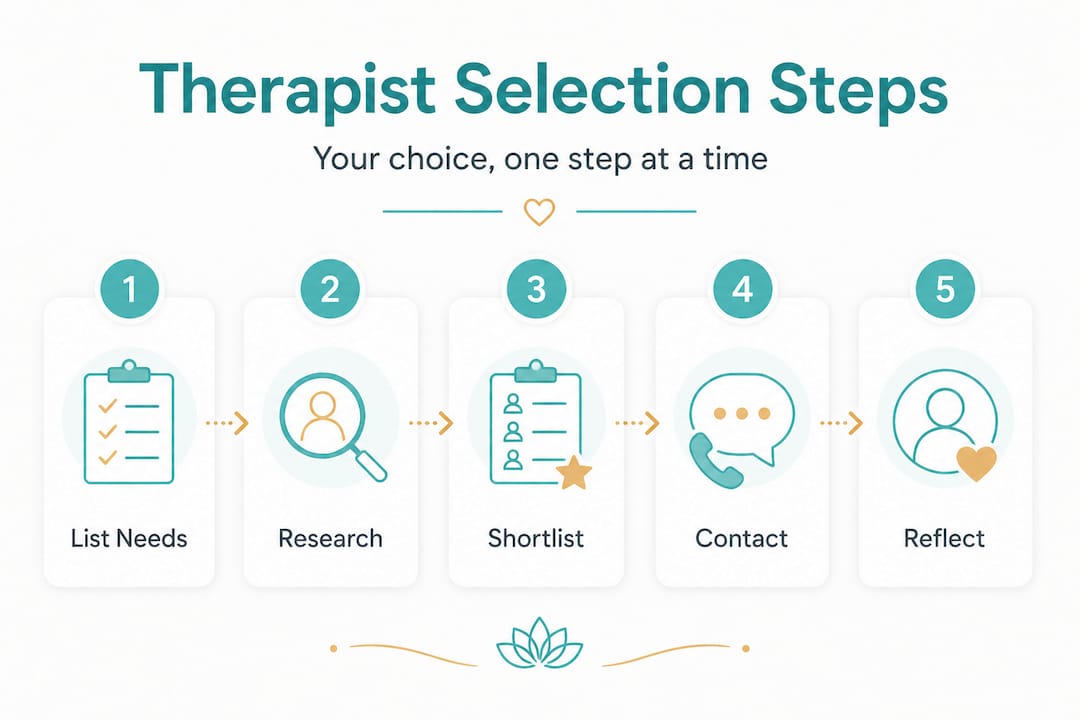
- Step-by-step workflow for choosing a therapist
- Troubleshooting and common mistakes when choosing a therapist
- What to expect: evaluating your progress and outcomes
- Why the perfect fit matters more than therapist credentials
- Find your therapist match with expert guidance
- Frequently asked questions
Key Takeaways
| Point | Details |
|---|---|
| Focus on fit | The strength of your connection with your therapist is the best predictor of success, not their techniques or credentials. |
| Use evidence-based tools | Tools that match you by outcomes and needs can boost your chances of finding a suitable therapist. |
| Clarify your requirements | Know your preferences and constraints before you start your search so you can rule out unsuitable options quickly. |
| Monitor your progress | Regularly check that you’re making measurable progress; if not, discuss changes or consider switching therapists. |
Understanding what really matters in therapy
Most people start their search by looking at qualifications. They check whether a therapist is accredited, how many years they've been practising, or whether they offer a specific type of therapy like CBT or psychodynamic work. These things aren't irrelevant, but they're not the strongest predictors of whether therapy will help you.
The research points clearly to one factor above others: the therapeutic alliance. This is the working relationship between you and your therapist. It includes trust, agreement on goals, and a sense of collaboration. A large meta-analysis of 295 studies involving over 30,000 patients found a correlation of r=0.278 between alliance and therapy outcomes. That finding held across different therapy types, different ways of measuring outcomes, and both online and face-to-face settings.
"The therapeutic alliance accounts for approximately 8% of outcome variance across modalities and settings, making it one of the most consistent predictors of therapy success identified in the literature."
What this means practically is that a therapist who makes you feel understood, respected, and engaged is likely to help you more than one with an impressive CV but a poor relational style. Experts also note that fit matters more than technique, and that common factors shared across all good therapy relationships outweigh the specific brand of therapy being used.
| Superficial criteria | True predictors of success |
|---|---|
| Years of experience | Quality of the therapeutic alliance |
| Specific therapy brand (e.g. CBT) | Shared goals and open communication |
| Academic qualifications | Therapist responsiveness and warmth |
| Clinic location or prestige | Your sense of being heard and respected |
| Online reviews | Progress tracking and regular feedback |
Pro Tip: When you first contact a therapist, ask how they measure progress and how they adjust their approach if things aren't working. A good therapist will welcome these questions. This tells you far more than their list of qualifications.
There is also growing evidence supporting data-driven matching as a way to improve your chances of finding the right fit from the start, rather than relying on trial and error.
Preparing for your search: requirements and preferences
Before you start browsing directories or asking for recommendations, it helps to get clear on what you actually need. This preparation stage saves time and reduces the chance of ending up with someone who isn't suited to your situation.
Start with your practical requirements. These are the non-negotiable factors that will determine whether a therapist is even an option for you.
- Location: Do you need someone local, or are you open to online sessions?
- Availability: What days and times can you reliably attend?
- Cost and insurance: What is your budget, and does the therapist accept your insurance or offer sliding-scale fees?
- Language: Do you need sessions in a language other than English?
- Format: Do you prefer in-person, video, or phone sessions?
Once you've established your requirements, think about your personal preferences. These aren't dealbreakers, but they can meaningfully affect how comfortable you feel.
- Gender or gender identity of the therapist
- Cultural background or lived experience relevant to your own
- Specialism in a particular area such as trauma, anxiety, relationships, or grief
- Communication style, for example, more structured or more conversational
- Whether you want homework or exercises between sessions
| Category | Examples | Priority level |
|---|---|---|
| Requirements | Location, cost, insurance, language | Must-have |
| Strong preferences | Gender, specialism, cultural background | Important |
| Soft preferences | Communication style, session format | Nice to have |
Research supports the value of using tools for matching therapists based on outcome data. One study found that evidence-based matching using a therapist's historical success with patients who have similar concerns significantly improved outcomes, particularly for people with more severe difficulties and for those from minority backgrounds. This is a meaningful finding. It suggests that matching based on real outcome data, rather than a therapist's self-described specialisms, produces better results.
Taking 20 minutes to write down your requirements and preferences before you search will make every subsequent step faster and clearer.

Step-by-step workflow for choosing a therapist
With your requirements and preferences in hand, you're ready to begin the actual search. Here is a practical, ordered workflow that reflects both the research and the realities of finding therapy.
-
Define your primary concern. Write one or two sentences describing what you most want help with. This will guide your search and help you evaluate whether a therapist's experience is relevant.
-
Search using the right tools. Directories are a starting point, but they vary widely in quality. Where possible, use platforms that incorporate outcome data or structured matching, rather than simply listing therapists by postcode. Research notes that data-driven approaches tend to outperform unstructured directory searches, particularly when alliance and outcome tracking are built into the process.
-
Create a shortlist of three to five therapists. Apply your requirements first to filter out anyone who doesn't meet your practical needs. Then use your preferences to narrow the list further.
-
Contact each therapist. Many offer a brief introductory call at no charge. Use this to ask about their approach, how they track progress, and how they handle situations where a client isn't improving. A short, clear message works best. Introduce yourself briefly, mention your primary concern, and ask whether they have availability for an initial consultation.
-
Attend the first session with an open but evaluative mindset. Notice how you feel during and after the session. Do you feel heard? Does the therapist ask about your goals? Are they clear about what the work will involve?
-
Review the fit after the first or second session. Don't assume the first person you try is the right one. Research on the process for finding a therapist consistently shows that early alliance is one of the strongest predictors of whether therapy will be helpful. If something feels off, it is worth exploring other options.
-
Commit to regular feedback. Once you've found someone you feel comfortable with, make a habit of reflecting on your progress. Good therapy should produce measurable change over time.
Pro Tip: When sending an initial email or leaving a voicemail, keep it to three or four sentences. State your concern, ask about availability, and mention one or two of your practical requirements. Therapists receive many enquiries, and a clear, focused message is more likely to get a prompt response.
Troubleshooting and common mistakes when choosing a therapist
Even with a clear plan, it's easy to fall into patterns that make finding the right therapist harder than it needs to be. Recognising these mistakes early can save you significant time and frustration.
Common mistakes to avoid:
- Prioritising credentials over connection. A long list of qualifications doesn't guarantee a good working relationship. Credentials confirm training, not fit.
- Ignoring early discomfort. If you feel unheard or judged in the first couple of sessions, that's important information. It's not always a sign to give up on therapy; it may be a sign to try a different therapist.
- Not asking about progress tracking. Effective therapists regularly check in on whether their approach is working. If a therapist never asks how you feel things are going, that's worth noting.
- Settling too quickly. Many people stay with a therapist who isn't helping because switching feels awkward or disloyal. It isn't. Finding the right fit is part of the process.
- Overlooking the importance of reliability in online therapy. If you're considering digital sessions, consistency and responsiveness matter enormously.
Research on digital therapy found that provider reliability and engagement are strongly linked to positive client support ratings, with an R² of 0.72. Early alliance changes before formal treatment even begins predict outcomes, and telepsychiatry alliance scores carry an odds ratio of 1.05 to 1.08 for achieving 50% symptom improvement.
This data reinforces that the quality of client support expectations in digital therapy is not a secondary concern. Whether you're meeting in person or online, the relational quality of your sessions shapes what you get from them.
What to expect: evaluating your progress and outcomes
Starting therapy is one thing. Knowing whether it's working is another. Many people continue attending sessions without a clear sense of whether anything is changing. That uncertainty can erode motivation and trust in the process.
Here are positive signs that your therapy is on the right track:
- Your therapist regularly checks in on how you feel the sessions are going
- You have agreed on clear goals and revisit them over time
- You notice gradual but measurable changes in how you think, feel, or behave
- You feel comfortable raising concerns or disagreements with your therapist
- Sessions feel purposeful rather than repetitive or directionless
The evidence is clear that alliance causally predicts weekly therapy outcomes, and that therapist traits are far weaker predictors than the quality of the relational dynamic between you. This means that if progress has stalled, the relationship itself is the first place to look.
If you're not making progress after six to eight sessions, consider having an honest conversation with your therapist about it. Ask whether your goals need to be revisited, whether a different approach might help, or whether a referral to someone else would be appropriate. A good therapist will respond to this openly. If they don't, that itself is useful information.
Why the perfect fit matters more than therapist credentials
There's a persistent belief that finding the "best" therapist means finding the most qualified one. It's understandable. Credentials feel concrete and reassuring in a way that "good fit" doesn't. But the evidence doesn't support this belief.
Research consistently shows that therapist personality is not strongly predictive of effectiveness, and that common relational factors shared across all good therapy relationships matter far more than the specific technique or therapeutic brand being used. A therapist with a modest CV who listens well, tracks your progress, and adjusts their approach when needed will very likely help you more than a highly credentialled one who doesn't.
What this means for you is practical. Don't spend your energy comparing qualifications. Spend it on evaluating how you feel in the room, whether your goals are being taken seriously, and whether you're making genuine progress. These are the things that predict outcomes.
It also means being proactive. Ask questions early. Raise concerns when something doesn't feel right. Revisit your goals regularly. People who take an active role in their therapy tend to get more from it, because they're helping to build and maintain the very alliance that drives outcomes.
Being proactive isn't about being difficult. It's about being a participant in your own care rather than a passive recipient of it.
Find your therapist match with expert guidance
Knowing what to look for is a strong start. But putting it all into practice, especially when you're already feeling overwhelmed, is a different challenge.

GuideMe is designed to make this process easier. It combines human expertise with AI-powered matching to help you understand your mental health needs and find your therapist match based on evidence-backed principles, not just proximity or availability. GuideMe creates an in-depth therapy plan tailored to you and connects you with therapists who are genuinely suited to your situation. The platform supports you from the very first step, so you spend less time searching and more time making progress. If you're ready to find the right therapist with confidence, GuideMe is where to start.
Frequently asked questions
How important is the therapeutic alliance in choosing a therapist?
The therapeutic alliance is one of the most important factors in therapy success. A meta-analysis of 295 studies found a consistent correlation between alliance quality and positive outcomes across all therapy types and settings.
What is evidence-based matching in therapy selection?
Evidence-based matching uses a therapist's actual outcome data with patients who have similar concerns to guide the pairing process. Research shows this approach significantly improves results, particularly for people with more severe difficulties or from minority backgrounds.
Are therapist personality and style strong predictors of effectiveness?
No. Studies show that therapist personality is not a strong predictor of therapy outcomes. The quality of the working relationship matters far more than a therapist's individual traits or preferred technique.
How can I tell if my therapist is the right fit?
Look for regular progress check-ins, open communication, and measurable change in how you think or feel. Research confirms that alliance predicts weekly outcomes, so a lack of progress after several sessions is worth discussing directly with your therapist.
Does online therapy affect the importance of choosing carefully?
Yes, and arguably more so. Provider reliability and engagement are strongly linked to positive outcomes in digital therapy, and early alliance formation before treatment formally begins has been shown to predict how well things go.