

TL;DR:
- Choosing the right therapy approach depends on personal goals, comfort, and evidence strength.
- CBT is highly structured and effective for anxiety and depression, typically lasting 6-20 sessions.
- Deep issues may benefit from psychodynamic or humanistic therapies, emphasizing insight and self-exploration.
Choosing a counselling approach can feel overwhelming. There are dozens of therapy styles available, each with its own methods, strengths, and evidence base. Yet the approach you choose has a direct impact on whether therapy feels useful or frustrating. Understanding your options means you can have more informed conversations with potential therapists, advocate clearly for what you need, and move towards care that genuinely fits your life. This article breaks down the most widely used, evidence-based counselling approaches so you can make a confident, informed decision about your mental health journey.
Table of Contents
- How to evaluate counselling approaches
- Cognitive behavioural therapy (CBT): Changing thoughts and behaviours%3A-changing-thoughts-and-behaviours)
- Psychodynamic therapy: Understanding patterns and the unconscious
- Person-centred and humanistic therapies: Focusing on self-growth
- Gestalt and dialectical behaviour therapy: Newer approaches at a glance
- How to choose: Matching counselling styles to your needs
- Why 'best' depends on you: What most guides miss about therapy choices
- Take the next step towards the right support
- Frequently asked questions
Key Takeaways
| Point | Details |
|---|---|
| Personal fit matters | The most effective therapy is the one that feels right and addresses your needs. |
| Evidence-based options | CBT, psychodynamic, and humanistic therapies all have strong research support for different situations. |
| Try and adapt | It’s normal to try different approaches or switch therapists until you find the best match. |
| Ask questions | Don’t hesitate to discuss different therapy methods with providers before starting. |
How to evaluate counselling approaches
Now that we understand why making an informed choice matters, let's explore how to approach your decision.
Not all counselling approaches suit every person or every problem. When comparing options, four key criteria are worth considering: the strength of empirical evidence behind the approach, your personal comfort with its methods, your therapist's training and expertise, and your specific therapy goals. These factors interact. An approach with strong research behind it may still feel wrong if the methods do not resonate with you personally.
Different problems also respond better to different styles. Anxiety and depression tend to respond well to structured, skills-focused approaches. Trauma often needs careful, paced processing. Self-esteem difficulties may benefit from deeper relational work. Knowing what you want to address helps narrow your options significantly.
Research on psychotherapy effectiveness consistently highlights that the quality of the therapeutic relationship is as important as the technique itself. Matching to client preferences is a key factor in therapy success. This means choosing the right model for your personality and goals matters as much as picking a well-researched method.
Before your first session, ask yourself:
- What specific issues do I want to address?
- Do I prefer structured sessions with clear exercises, or open-ended exploration?
- Am I looking for short-term relief or longer-term self-understanding?
- How do I feel about discussing my past versus focusing on the present?
- Am I comfortable with homework and goal-setting between sessions?
Pro Tip: Two often-overlooked factors in therapy success are your readiness to engage and your therapist's flexibility. A therapist who adapts to your pace and communication style can make any evidence-based approach far more effective.
Cognitive behavioural therapy (CBT): Changing thoughts and behaviours
With clear criteria in mind, let's look at one of the most recommended approaches: CBT.
Cognitive behavioural therapy is a structured, time-limited approach that focuses on the relationship between thoughts, feelings, and behaviours. It operates on a simple but powerful premise: how you think affects how you feel, and how you feel affects what you do. By identifying and challenging unhelpful thought patterns, CBT helps people change behaviour and reduce distress.
CBT is effective for a wide range of difficulties, including anxiety, depression, PTSD, OCD, and phobias. CBT evidence shows strong empirical support with large effect sizes across controlled trials. Effect sizes typically range from g=0.73 to g=1.18, which is considered robust in psychological research. Controlled trial comparisons confirm its standing as one of the most rigorously tested therapy forms available.
Common CBT methods include:
- Cognitive restructuring: Identifying and reframing negative thought patterns
- Behavioural activation: Gradually re-engaging with meaningful activities to lift mood
- Exposure therapy: Safely confronting feared situations to reduce avoidance
- Goal-setting: Establishing clear, measurable targets for progress
- Homework tasks: Practising skills between sessions to reinforce learning
Pros: CBT is time-efficient, often lasting 6 to 20 sessions. It is highly structured, which suits people who prefer clear direction. Its evidence base is extensive.
Cons: The structured format can feel rigid for some people. It focuses more on current patterns than deeper emotional history, which may not address root causes for everyone. How therapists use CBT varies, so it is worth discussing your therapist's specific approach before committing.
Psychodynamic therapy: Understanding patterns and the unconscious
While CBT offers structured change, some issues need deeper exploration. Enter psychodynamic therapy.
Psychodynamic therapy draws on the idea that many of our current difficulties are rooted in unconscious patterns and unresolved past experiences. Rather than focusing on symptoms alone, it explores what lies beneath them. This makes it particularly well-suited for people dealing with personality difficulties, persistent relationship problems, or a desire for deeper self-understanding.
Therapists use methods such as free association (speaking freely without self-censorship), exploring recurring relationship dynamics, and sometimes working with dreams or fantasies to uncover unconscious themes. The therapeutic relationship itself becomes a tool for understanding patterns.
Psychodynamic research shows effect sizes comparable to CBT in several meta-analyses, with some studies reporting g=0.97 on symptom measures. Importantly, benefits often continue to grow after therapy ends, a phenomenon sometimes called the "sleeper effect."
"Psychodynamic treatments show large pre-post effect sizes and compare favourably to other established therapies, with effects that persist and even grow following treatment." APA Monitor on Psychodynamic Therapy
Key strengths of psychodynamic therapy:
- Addresses root causes rather than surface symptoms
- Builds lasting insight into recurring emotional and relational patterns
- Particularly valuable for complex or longstanding difficulties
- Encourages psychodynamic therapy overview of how past experiences shape present behaviour
It tends to be longer-term than CBT, but for many people, that depth of work produces more durable change.
Person-centred and humanistic therapies: Focusing on self-growth
Not every approach focuses on symptoms. Some empower change through deep acceptance. Enter humanistic therapies.
Person-centred therapy, developed by Carl Rogers, is built on three core conditions: empathy, unconditional positive regard, and congruence. Rather than directing clients towards specific outcomes, the therapist creates a safe space in which clients can explore their own values, feelings, and potential. The client leads; the therapist follows.

This approach is particularly effective for building self-esteem, managing mild to moderate anxiety or depression, and supporting people through major life transitions. Person-centred therapy's core conditions are considered essential for therapeutic change and have influenced virtually every modern therapy model.
Humanistic approaches have a moderate but growing evidence base, and their greatest documented strength is in fostering a strong therapeutic alliance, which itself predicts positive outcomes across all therapy types.
Who benefits most from person-centred therapy:
- People who feel unheard or misunderstood in daily life
- Those exploring identity, purpose, or personal values
- Individuals who prefer a collaborative, non-prescriptive approach
- People who want to strengthen self-trust rather than follow a set programme
Pro Tip: If you find highly structured methods stifling, person-centred therapy may offer the freedom you need. It can also be combined effectively with CBT techniques, giving you both structure and support as needed. Look for a therapist who offers humanistic therapy explained alongside practical skills if you want the best of both worlds.
Gestalt and dialectical behaviour therapy: Newer approaches at a glance
Some therapies target unique challenges. Let's consider two powerful contemporary styles.
Gestalt and DBT are two distinct but influential approaches worth knowing. Gestalt therapy centres on present-moment awareness and uses experiential exercises, most famously the "empty chair" technique, where clients speak to an imagined person or part of themselves to process unresolved feelings. It is particularly powerful for self-exploration and emotional integration.
Dialectical behaviour therapy (DBT) was originally developed for borderline personality disorder and is now widely used for emotional regulation difficulties, self-harm, and suicidality. It combines CBT with mindfulness and acceptance strategies, and it teaches four core skill sets: mindfulness, distress tolerance, emotional regulation, and interpersonal effectiveness. Humanistic context research supports awareness-based methods as a foundation for several of these newer styles.
| Feature | Gestalt therapy | Dialectical behaviour therapy (DBT) |
|---|---|---|
| Core focus | Present-moment awareness | Emotional regulation and skills |
| Main techniques | Empty-chair dialogue, body awareness | Mindfulness, distress tolerance, interpersonal skills |
| Best for | Self-exploration, unresolved feelings | Borderline personality, self-harm, crisis management |
| Format | Usually individual, open-ended | Structured, often includes group skills training |
| Evidence base | Moderate, growing | Strong, especially for emotion dysregulation |
Both approaches offer something distinct. DBT is highly structured and skills-focused, making it ideal for people in significant distress. Gestalt is more exploratory and experiential, suiting those who want to understand themselves more deeply.
How to choose: Matching counselling styles to your needs
Having explored each approach, here is how to fit them to your real-world context.
Meta-analysis findings confirm that no single therapy outperforms all others across every situation. What matters most is matching the approach to your individual preferences and goals. Therapy effectiveness research shows consistent results when the right fit is achieved.
| Approach | Best for | Typical length | Key strength |
|---|---|---|---|
| CBT | Anxiety, depression, PTSD | 6 to 20 sessions | Structured, evidence-backed |
| Psychodynamic | Personality issues, deep patterns | Months to years | Lasting insight |
| Person-centred | Self-esteem, life transitions | Variable | Empathy, autonomy |
| DBT | Emotional dysregulation, self-harm | 6 to 12 months | Skills-based, crisis support |
| Gestalt | Self-awareness, unresolved emotions | Variable | Experiential depth |
Steps to take before getting started with therapy:
- Write down what you most want to change or understand about yourself
- Consider whether you prefer structure or flexibility in sessions
- Research two or three approaches that align with your goals
- Ask potential therapists about their training and the methods they use
- Commit to an initial period of sessions before deciding whether the fit is right
Remember, the therapeutic relationship is consistently the strongest predictor of success. The approach matters, but so does the person delivering it.
Why 'best' depends on you: What most guides miss about therapy choices
Beyond research and lists, here is a deeper perspective for your journey.
Most articles about therapy approaches present research rankings as though there is a clear winner. There is not. What the evidence actually shows is that common factors, the quality of the relationship, the client's belief in the process, and the collaborative setting of goals, account for a significant portion of therapy outcomes across all approaches.
Clinics and content that promote one approach as universally superior are often influenced by training allegiances, not client outcomes. The uncomfortable truth is that personalising therapy to fit your values, communication style, and specific needs will always outperform picking a method based on popularity alone.
Ask questions. If a therapist seems unwilling to discuss their approach or adapt to your feedback, that itself tells you something important. Good therapy is collaborative. The right approach is the one in which you feel safe, understood, and genuinely engaged in the process.
Take the next step towards the right support
Knowing your options is just the start. Finding the right fit is where real progress begins.
Navigating the many counselling approaches on your own can still feel daunting, even with good information. Guide Me Therapy resources are designed to take that pressure off. GuideMe combines human expertise with AI-powered matching to help you understand your needs, explore your options, and connect with a therapist who genuinely suits you. You do not have to guess.
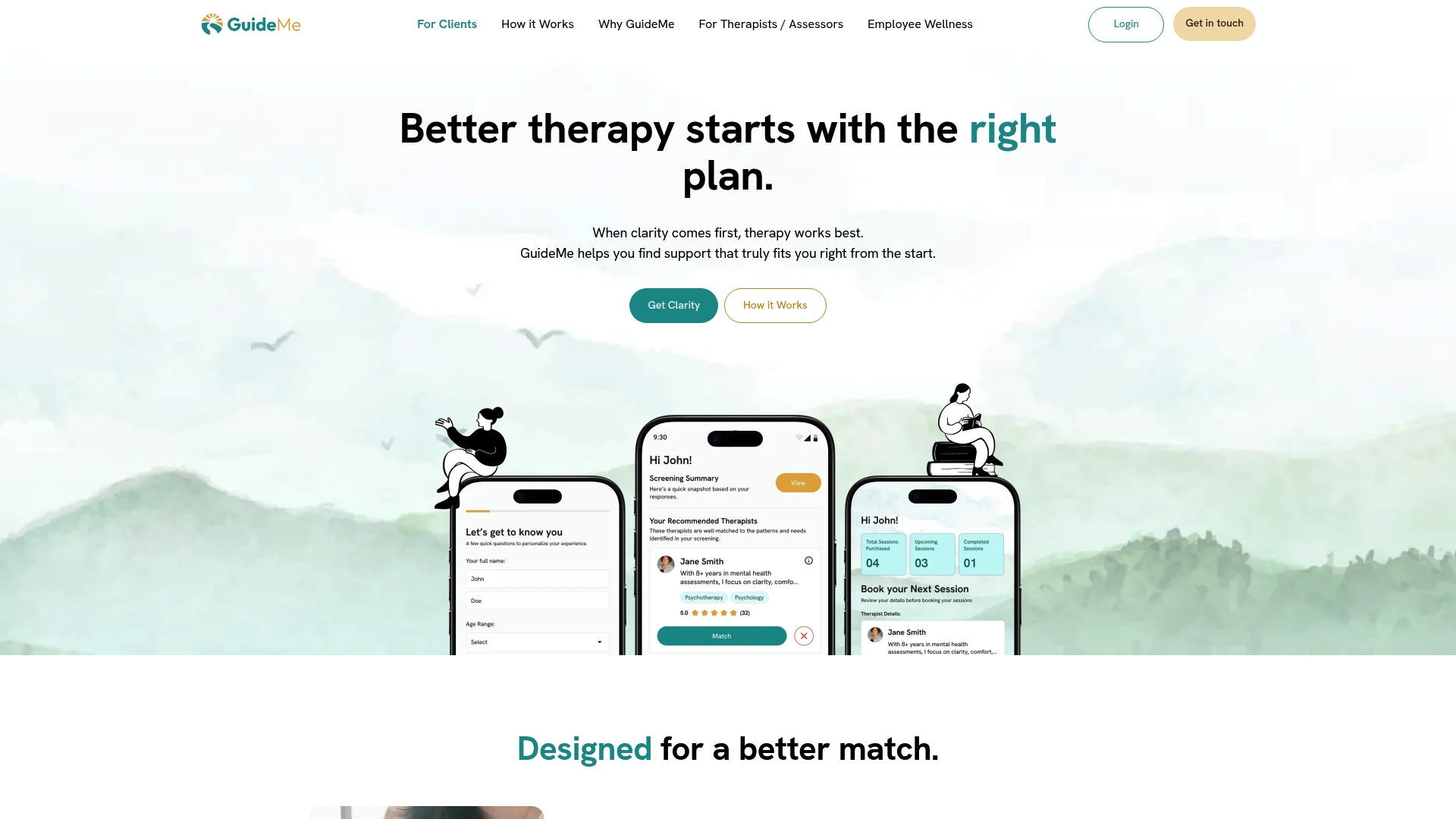
Whether you are drawn to structured CBT, reflective psychodynamic work, or the empathetic space of person-centred therapy, GuideMe helps you move from uncertainty to clarity. Start with an in-depth therapy plan tailored to your situation, and take the first step towards care that truly fits.
Frequently asked questions
Which counselling approach is the most effective?
CBT holds the broadest evidence base across common disorders, but effectiveness ultimately depends on personal fit, the presenting issue, and the quality of the therapeutic relationship. No single approach works best for everyone.
Can I switch counselling approaches if one does not help?
Yes, switching is entirely normal and often beneficial. Many therapists adapt their methods based on client progress and feedback, and some blend several approaches to find what works best for you.
How long does therapy typically take for each approach?
Session length varies widely by approach and individual goals. CBT usually runs 6 to 20 sessions, while psychodynamic and humanistic therapies can continue for months or even years depending on what you are working through.
What if I'm not comfortable with my therapist's style?
Discomfort with your therapist's style is worth addressing directly. Client preferences are central to therapy success, so raise your concerns openly or consider seeking a therapist whose approach feels like a better match.