

TL;DR:
- Financial therapy combines mental health practices with financial planning to address emotional barriers.
- Evidence shows financial therapy reduces stress and improves financial decision-making through psychological techniques.
- Collaboration between financial professionals and certified financial therapists enhances client outcomes by addressing root emotional issues.
Money management is rarely just about numbers. For many professionals in financial services, the gap between knowing what to do and actually doing it comes down to psychology, not spreadsheets. Beliefs formed in childhood, emotional responses to risk, and unresolved financial trauma all shape the decisions clients make every day. Therapists who specialise in financial behaviour are helping to close that gap. This guide explains what financial therapy is, how these professionals work, and why their role is becoming increasingly important across the financial services sector.
Table of Contents
- What is financial therapy and why does it matter?
- Key methodologies and tools used by financial therapists
- Common financial challenges addressed by therapists
- How therapists collaborate within the financial services industry
- Evidence and impact: what the research reveals
- Our perspective: why real change starts with the mind, not the plan
- Experience the benefits of expert-led financial therapy
- Frequently asked questions
Key Takeaways
| Point | Details |
|---|---|
| Therapists address root causes | Financial therapists help resolve underlying emotional and behavioural barriers to money management. |
| Blend of skills matters | Effective financial therapists combine psychological expertise with financial knowledge and ethical standards. |
| Proven impact | Empirical research confirms therapy can significantly reduce stress and improve financial well-being. |
| Collaboration is key | Therapists and financial advisers achieve better results when they address both emotional and strategic needs together. |
What is financial therapy and why does it matter?
Financial therapy is a relatively young but rapidly growing field. It sits at the intersection of mental health practice and financial planning, addressing the emotional and psychological factors that drive financial behaviour. As what financial therapy involves becomes clearer to professionals, demand for these services is rising across the industry.
Financial therapists integrate therapeutic techniques with financial knowledge to address emotional, psychological, and behavioural barriers to effective money management. This means they are trained to work with both the practical and emotional dimensions of a client's financial life, something a traditional adviser is rarely equipped to do.
To practise as a Certified Financial Therapist (CFT), professionals must meet specific standards. Certification requires a bachelor's degree, 500 hours of experience including 250 direct client hours, formal training, a qualifying examination, and adherence to the Financial Therapy Association's ethics code.
The therapists' role in finance is distinct from that of a traditional adviser. Here is a summary of those key differences:
| Feature | Financial therapist | Traditional financial adviser |
|---|---|---|
| Primary focus | Emotions, beliefs, behaviour | Strategies, products, goals |
| Core training | Therapy and financial planning | Finance and investment |
| Certification body | Financial Therapy Association | FCA regulated bodies |
| Client sessions | Therapeutic conversations | Financial reviews and planning |
| Outcomes targeted | Emotional well-being, behaviour change | Wealth growth, financial security |
"The psychological relationship a person has with money is often more influential than their income or assets. Financial therapy addresses what traditional advice cannot."
Key reasons financial therapy is gaining recognition include:
- Growing awareness of mental health's role in financial outcomes
- Rising rates of financial anxiety among working professionals
- Integration of psychology into financial planning qualifications
- Increased demand from clients seeking holistic support
Key methodologies and tools used by financial therapists
With an understanding of what financial therapy is, the next step is to explore how these professionals actually work with clients and what makes their methods distinct.
Key methodologies include self-reflection, cognitive behavioural therapy (CBT), emotionally focused therapy (EFT), Gottman method, systems theory, financial genograms, values clarification, and evidence-based interventions. Each of these tools serves a specific purpose in helping clients understand and change their financial behaviour.
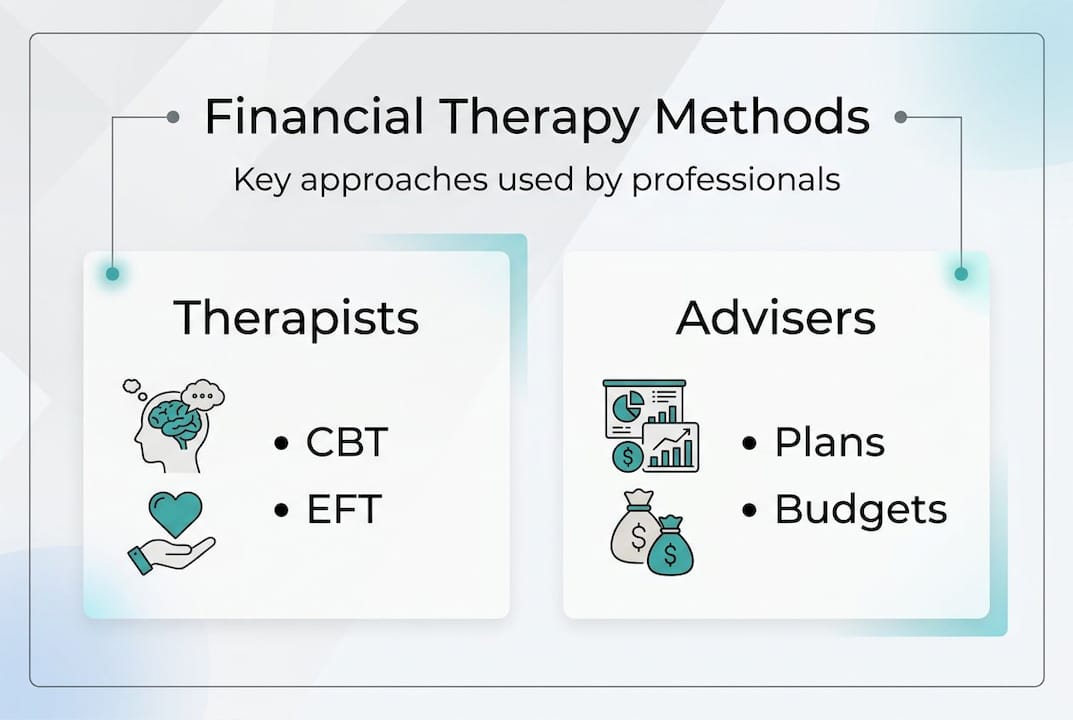
CBT, for example, helps clients identify and challenge unhelpful thought patterns around money. EFT focuses on emotional responses and attachment, which is particularly useful when working with couples. Financial genograms map out generational money patterns, revealing how family history shapes current financial decisions. These are not tools you will find in a standard financial planning session.
The link between money and mental health is well established, and financial therapists are trained to navigate both sides of that relationship. The Financial Therapy Association outlines core competencies that practitioners must develop, covering money and relationships, therapeutic skills, and research literacy.
Here is how a financial therapist typically approaches a new client:
- Conduct an initial assessment of the client's financial history and emotional relationship with money
- Identify specific behavioural patterns, triggers, or beliefs that are causing difficulties
- Select appropriate therapeutic interventions based on the client's needs
- Work through structured sessions combining financial education with emotional processing
- Measure progress using both financial and psychological indicators
This process of managing emotional barriers is what separates financial therapy from conventional advice.
Pro Tip: Not all practitioners labelled 'financial therapist' are properly certified. Always verify credentials and ask directly about their training, qualifications, and therapeutic approach before committing to sessions.
| Method | Financial therapist | Traditional adviser |
|---|---|---|
| CBT | Yes, regularly used | Rarely applied |
| Financial genograms | Core tool | Not used |
| Values clarification | Standard practice | Occasionally referenced |
| Investment analysis | Limited | Primary focus |
| Couples sessions | Common | Uncommon |
Common financial challenges addressed by therapists
Now that methodologies are clear, it is helpful to see which challenges are most commonly addressed through financial therapy and why it delivers results.
Financial therapists help with money anxiety, overspending, generational trauma, couples conflicts, financial infidelity, and poor decision-making due to emotions. These are issues that traditional financial advice rarely resolves, because the root cause is psychological rather than practical.

The evidence for financial therapy's effectiveness is growing. RCTs demonstrate increases in financial capability (b=0.89) and decreases in financial stress (b=0.48), providing robust empirical support for the field. These are not marginal improvements. They represent meaningful, measurable changes in how people manage their financial lives.
For financial services professionals, understanding the relationship between money and stress is increasingly important. Clients who are emotionally overwhelmed cannot engage effectively with financial planning, no matter how sound the strategy.
The most common issues financial therapists address include:
- Money anxiety: Persistent worry about finances that interferes with daily functioning
- Overspending and compulsive buying: Emotional spending used to manage difficult feelings
- Money scripts: Deep-seated beliefs about money inherited from family or past experience
- Financial trauma: Past events such as bankruptcy or poverty that continue to affect decisions
- Couples and family conflict: Disagreements about money that damage relationships
- Financial infidelity: Hiding spending, debt, or financial decisions from a partner
- Overcoming money anxiety: Building healthier, more sustainable relationships with financial decisions
Pro Tip: Working on the root emotional causes of financial difficulties leads to sustainable change. Surface-level fixes, such as budgeting tools alone, rarely hold when underlying beliefs remain unaddressed.
How therapists collaborate within the financial services industry
With clear evidence of impact on individuals, it is vital to understand how therapists actually fit within the larger financial services landscape.
Financial therapists focus on emotions and beliefs rather than strategies and goals, complementing behavioural finance but working at a deeper psychological level. Importantly, financial therapy is not currently regulated in the same way as therapy or financial advice, which makes choosing a certified practitioner essential.
Psychology is now core to the CFP curriculum, reflecting a broader shift in how the financial planning profession understands client behaviour. Referral and collaboration are becoming standard practice rather than exceptions.
For financial services professionals, here are the steps to effective collaboration with a financial therapist:
- Recognise when a client's difficulties are emotional rather than purely financial
- Identify a certified financial therapist with relevant experience
- Establish a referral relationship with clear communication boundaries
- Share relevant financial context with the therapist, with client consent
- Review client progress jointly to ensure holistic support
Understanding therapist versus adviser roles is essential for knowing when to refer and when to collaborate. The key distinctions to keep in mind include:
- Financial advice is FCA regulated; financial therapy is not currently regulated in the same way
- Therapists cannot provide regulated investment advice
- Advisers are not trained to address psychological or emotional barriers
- Collaborative approaches produce better outcomes than either profession working in isolation
- Certification from the Financial Therapy Association is the most reliable quality marker
Evidence and impact: what the research reveals
To round out the evidence base, let us review what current research actually shows about the value and limitations of therapy within finance.
Financial therapy improves financial well-being and reduces stress, with randomised controlled trials demonstrating increases in financial capability (b=0.89) and decreases in financial stress (b=0.48). These findings come from rigorous study designs, not anecdotal reports.
The well-being research also highlights that financial therapy integrates well with behavioural finance, offering a more psychologically grounded approach to understanding client decisions. As the evidence base grows, so does the profession's credibility.
However, empirical benchmarks are limited but growing, and the unregulated nature of the field does carry risks. Without proper certification, clients may encounter practitioners who lack the training to deliver safe, effective support.
| Study type | Key finding | Significance |
|---|---|---|
| Randomised controlled trials | Financial capability b=0.89 | Strong positive effect |
| RCT stress outcomes | Financial stress b=0.48 | Meaningful reduction |
| Behavioural finance integration | Psychological depth added | Complements existing models |
| International data | Growing adoption globally | Expanding evidence base |
The financial therapy evidence now supports its inclusion as a standard component of holistic financial planning. Psychological competence is no longer optional for professionals who want to serve clients effectively.
"The field is still maturing, but the research direction is clear: addressing psychological factors improves financial outcomes in ways that financial advice alone cannot achieve."
Our perspective: why real change starts with the mind, not the plan
Stepping back from the research, experience consistently shows that the subtleties of financial difficulty are rarely resolved by numbers alone. A well-constructed financial plan means very little if the person following it carries unresolved beliefs about money, fear of success, or deep-seated shame around debt.
In financial services, there is still a tendency to treat client resistance as a knowledge problem. If the client just understood the numbers better, the thinking goes, they would make better decisions. But working with a therapist reveals something different. The barriers are almost always emotional first and practical second.
What makes financial therapy genuinely valuable is not just the tools it uses, but the questions it asks. Why does this client keep making the same choices despite knowing the consequences? What does money represent to them emotionally? These are not questions a financial model can answer.
The conventional focus on products and strategy often misses the real barriers to financial well-being. Collaboration between finance and therapy is not a luxury. It is increasingly the standard that clients deserve and that the profession needs to adopt.
Experience the benefits of expert-led financial therapy
If you work in financial services and recognise that some clients need more than a revised financial plan, the next step is finding the right therapeutic support. GuideMe is a therapy navigation platform that helps you understand your mental health needs and get matched with the right therapist from the start.

Whether you are a professional looking to refer clients or someone ready to address your own relationship with money, GuideMe makes the process straightforward and supportive. Using both human expertise and AI-powered matching, GuideMe ensures that explore financial therapy is accessible, informed, and tailored to your specific needs. Take the first step towards lasting financial well-being today.
Frequently asked questions
How is a financial therapist different from a financial adviser?
A financial therapist focuses on your emotions, beliefs, and psychological relationship with money, while an adviser emphasises strategies and financial products. The two roles complement each other but serve distinct purposes.
What qualifications should a financial therapist have?
Look for therapists with Certified Financial Therapist credentials, which require a bachelor's degree, 500 hours of experience, and adherence to the Financial Therapy Association's ethics standards.
Can financial therapy help reduce money-related stress?
Yes. Research demonstrates significant reductions in financial stress and meaningful improvements in financial well-being and capability through financial therapy interventions.
When should a financial services professional refer clients to a therapist?
Refer when you notice deep emotional issues, persistent anxiety, financial trauma, or repeated patterns that financial advice alone has not resolved.