

TL;DR:
- Employee mental health significantly impacts organizational productivity and resilience.
- Acceptance and Commitment Therapy (ACT) builds skills like mindfulness and emotional flexibility.
- Implementing therapy proactively fosters a healthier culture and improves business outcomes.
Many business leaders pour their energy into strategy, technology, and market positioning. Yet the factor that most reliably separates high-performing organisations from struggling ones is often overlooked: the mental health of their people. ACT interventions reduce distress and burnout in high-stress workplaces, which means therapy is not a wellness perk but a performance lever. This guide walks you through the evidence, the mechanisms, and the practical steps to make therapy a genuine asset in your organisation, whether you lead a startup, an SME, or a large enterprise.
Table of Contents
- The evolving understanding of therapy in business
- Key mechanisms: How therapy transforms teams and leaders
- Comparing therapy approaches for different business settings
- Implementing therapy in your organisation: Practical strategies
- Why therapy works in business: What most leaders miss
- How to take the next step with therapy in your business
- Frequently asked questions
Key Takeaways
| Point | Details |
|---|---|
| Therapy drives performance | Evidence-based therapy such as ACT reduces burnout and measurably boosts business outcomes. |
| Right approach matters | Tailoring interventions to your organisation—whether ACT, recovery support, or co-founder therapy—maximises team benefit. |
| Embed, don't bolt-on | Sustained success comes from integrating therapy principles into daily leadership and culture. |
| Start small, measure impact | Pilot programmes and tracking key metrics will help your business scale mental health benefits confidently. |
The evolving understanding of therapy in business
For most of the twentieth century, therapy was seen as something people sought privately when things went badly wrong. In corporate settings, admitting to mental health struggles was often perceived as weakness. Many leaders quietly managed stress, anxiety, and burnout on their own, and organisations treated emotional wellbeing as entirely separate from productivity.
That mindset has shifted considerably. The change was not overnight. It came through a combination of rising burnout rates, greater public dialogue about mental health, and a growing body of research demonstrating that psychological wellbeing is directly tied to business outcomes. Organisations began to recognise that unaddressed mental health issues cost them in absenteeism, turnover, and lost performance.
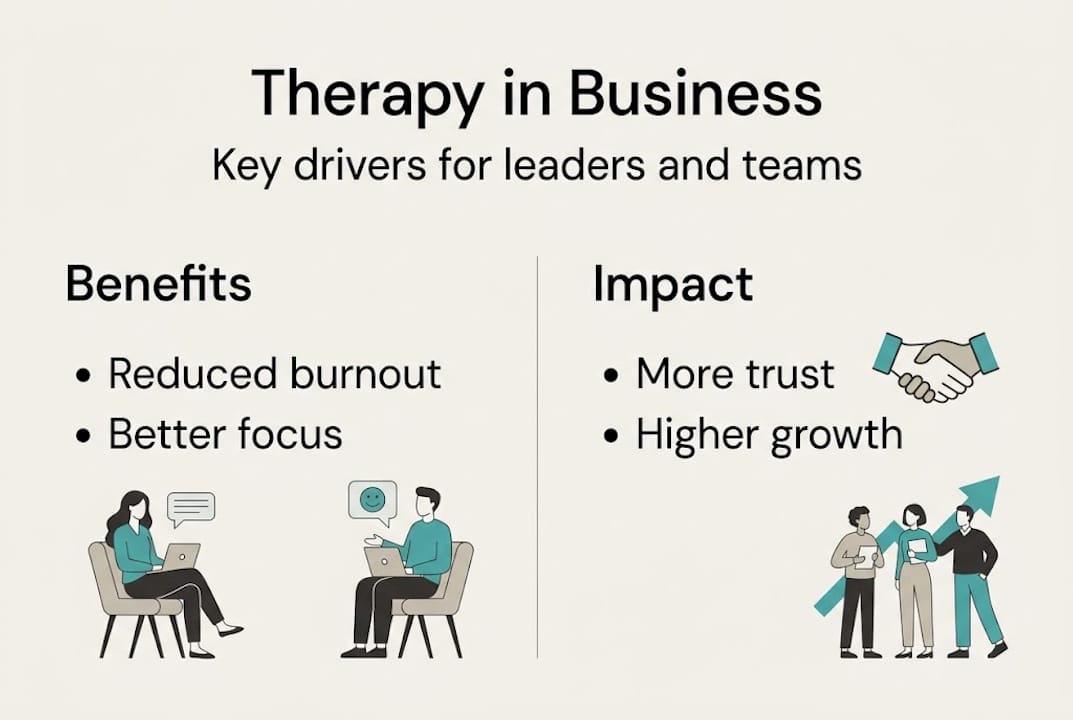
Today, forward-thinking leaders view therapy for staff wellbeing as a proactive investment rather than a reactive response. The distinction matters enormously. Reactive support, offered only in crisis, tends to be more expensive and less effective. Proactive programmes, embedded into the culture, build resilience before problems escalate.
Recent research has confirmed this shift with hard evidence. Studies on Acceptance and Commitment Therapy (ACT) in workplace settings show that ACT programmes improve psychological flexibility, mindfulness, and measurable work outcomes. These are not soft metrics. They translate directly into reduced sick days, higher engagement scores, and stronger team cohesion.
The evidence is compelling enough that therapy is now considered a core driver of organisational resilience by many HR professionals and occupational psychologists. Key reasons for this shift include:
- Burnout costs UK businesses an estimated £28 billion per year in lost productivity
- High turnover linked to poor mental health is significantly more expensive than prevention
- Employees who feel psychologically supported perform better and stay longer
- Leadership effectiveness is directly tied to emotional regulation and self-awareness
"48% of ACT programme participants showed reliable improvements in distress; effect sizes in line with meta-analyses."
This finding is significant. Nearly half of participants in structured ACT programmes showed measurable recovery from psychological distress. For HR professionals designing workplace wellbeing strategies, that kind of evidence changes the conversation entirely.
Key mechanisms: How therapy transforms teams and leaders
Understanding why therapy works in business settings helps leaders make smarter decisions about which interventions to invest in. ACT is particularly well-suited to organisational contexts because it does not focus on eliminating difficult thoughts and feelings. Instead, it builds the capacity to act effectively even when those feelings are present.
ACT interventions foster psychological flexibility, mindfulness, and values-based behaviour. Each of these has a specific and practical effect on teams:
- Psychological flexibility allows employees to adapt to change, tolerate uncertainty, and maintain focus under pressure. In fast-moving businesses, this is invaluable.
- Mindfulness reduces reactive decision-making. Leaders who practise mindfulness are more measured in high-stakes situations and less likely to make costly impulsive choices.
- Values-based behaviour creates alignment between individual purpose and organisational goals. When people feel their work is meaningful, discretionary effort increases naturally.
- Reduced avoidance means teams address conflict, poor performance, and difficult conversations earlier rather than letting problems fester.
- Improved communication follows from greater emotional awareness, which reduces misunderstandings and interpersonal friction across departments.
These mechanisms do not operate in isolation. When ACT principles are introduced consistently, they create a cultural shift. Teams become more honest, more adaptable, and more capable of aligning actions with values in healthcare teams and across other high-pressure sectors.

Pro Tip: Layer ACT with tailored, confidential support for your leadership team. Senior leaders often face unique pressures that group programmes do not fully address. Providing access to a dedicated therapist for leadership coaching and support can accelerate cultural change from the top down.
It is also worth noting that these mechanisms work across different levels of an organisation. A junior team member benefits from mindfulness tools just as much as a chief executive dealing with strategic pressure. The scalability of ACT makes it one of the most practical approaches available to HR professionals working with limited budgets.
Comparing therapy approaches for different business settings
Not every organisation needs the same solution, and choosing the wrong intervention can mean wasted resources and minimal impact. Here is a straightforward comparison of the main options available to leaders today.
| Approach | Strengths | Limitations | Best suited for |
|---|---|---|---|
| ACT (group or individual) | Strong evidence base, scalable, builds lasting skills | Requires trained facilitators | Teams in high-stress sectors |
| Traditional counselling | Personalised, flexible | Less structured, harder to scale | Individual crisis support |
| Stress management workshops | Low cost, broad reach | Surface-level, limited lasting effect | Awareness raising |
| Peer support programmes | Builds community, low cost | Inconsistent quality, no clinical depth | Supplementary support |
| Co-founder therapy | Prevents relational breakdown | Specialist and niche | Early-stage startups |
For entrepreneurs and SME founders, the picture is particularly important to understand. Daily recovery experiences, specifically control and relaxation, improve well-being and reduce burnout. This means the standard corporate wellness package is often poorly designed for founders, who need personalised recovery strategies rather than generic workshops.
Recovery experiences that matter most for entrepreneurs include:
- Control: Choosing when and how to rest, rather than being forced into downtime
- Relaxation: Activities that genuinely lower arousal, not just passive distraction
- Detachment: Mentally disconnecting from work during off hours
- Mastery: Engaging in activities outside work that build confidence and competence
For those exploring the range of options available, reading about therapy approaches for burnout can provide additional context and help leaders make more informed decisions.
Larger organisations, by contrast, benefit most from structured, evidence-based programmes delivered at scale, with consistent training for facilitators and clear measurement frameworks in place from the outset.
Implementing therapy in your organisation: Practical strategies
Knowing which approach to choose is only part of the challenge. Implementation is where most organisations either succeed or lose momentum. The following steps provide a clear path forward.
- Assess current need. Survey your teams to understand existing stress levels, burnout indicators, and attitudes towards mental health support. Use anonymised data to identify the departments or roles most at risk.
- Define your objectives. Are you focused on reducing absenteeism, improving engagement, or supporting a specific group such as senior leaders or new parents? Clear goals shape everything that follows.
- Select your intervention. Match the approach to your context using the comparison table above. For most organisations, a combination of group ACT sessions and individual access to a therapist produces the strongest outcomes.
- Pilot before scaling. Introduce the programme with one or two teams first. Gather anonymised feedback, measure the impact on key metrics, and refine the approach before rolling it out organisation-wide.
- Embed and sustain. Therapy initiatives fail when they are treated as one-off events. Build them into your ongoing people strategy, with regular check-ins, refreshed content, and visible leadership endorsement.
Pro Tip: Use a pilot group of 15 to 30 people and run the programme for at least eight weeks before measuring outcomes. Short pilots produce unreliable data.
Tracking the right metrics ensures that your investment can be justified to stakeholders. Consider monitoring the following:
| Metric | Why it matters | How to measure |
|---|---|---|
| Employee stress levels | Indicates overall psychological safety | Validated survey tools (e.g. PHQ-9, GAD-7) |
| Engagement scores | Links wellbeing to motivation | Quarterly pulse surveys |
| Absenteeism rates | Direct cost indicator | HR attendance records |
| Burnout prevalence | Early warning of deeper issues | Maslach Burnout Inventory |
| Retention rates | Long-term return on investment | Staff turnover data |
It is also worth noting that co-founder therapy prevents a significant proportion of startup failures rooted in relational issues. For early-stage businesses, this is often the most high-impact intervention available, and one that is routinely overlooked in favour of business coaching or financial advice.
Why therapy works in business: What most leaders miss
After examining the evidence and the practical steps, it is worth addressing what genuinely distinguishes organisations that achieve lasting results from those that do not. Most leaders approach therapy as a problem-solving tool, something to deploy when things go wrong. That framing limits its impact from the start.
Therapy is most powerful when it is treated as a cultural infrastructure. It creates the conditions for candour, flexibility, and resilience to become normal rather than exceptional. Conventional stress management programmes miss this because they address symptoms without touching the relational dynamics that sustain them.
When leadership teams engage with organisational therapy insights and model therapeutic principles openly, something changes across the whole business. People take more creative risks. Difficult conversations happen earlier. Trust deepens across teams.
Sustainable change does not come from offering a support line and calling it a wellbeing strategy. It comes from leaders who are willing to do their own work first and create space for others to do the same.
How to take the next step with therapy in your business
Understanding the evidence is one thing. Knowing where to start in your own organisation is another, and that is where having the right guidance matters.
GuideMe is built to help organisations and individuals find the right therapeutic support from the beginning, not after several failed attempts. Through business therapy solutions, GuideMe combines human expertise with intelligent matching to connect your people with therapists who genuinely fit their needs. Whether you are looking to support an individual leader or design a programme for an entire team, GuideMe can help you build a strategy that is practical, evidence-based, and sustainable. Reach out today to explore what the right support looks like for your business.
Frequently asked questions
What type of therapy works best for business teams?
Acceptance and Commitment Therapy (ACT) has the strongest evidence base for improving team well-being, with ACT reducing distress and burnout particularly in high-stress workplaces.
How do entrepreneurs benefit from therapy compared to large firms?
Entrepreneurs benefit most from personalised recovery strategies; control and relaxation are the daily experiences most strongly linked to reduced burnout and improved well-being for founders.
Can therapy really improve measurable business outcomes?
Yes. Research shows that 48% of participants in ACT programmes experienced significant and reliable declines in psychological distress, with direct benefits for organisational performance.
What is the best way to introduce therapy in a company?
Begin with a pilot programme for a select team, gather anonymised feedback over at least eight weeks, and scale up with visible leadership endorsement and clear measurement in place.