

TL;DR:
- Therapy is increasingly used by professionals as a strategic tool to enhance emotional resilience, communication, and career growth. It addresses common workplace challenges like imposter syndrome, burnout, and leadership difficulties, leading to improved performance and well-being. Combining therapy with coaching allows high-achievers to unlock their full potential and sustain long-term success.
Therapy is not just for people going through a crisis. Many professionals quietly use it as a strategic tool to perform better, communicate more clearly, and build the kind of resilience that fuels long-term career success. Therapy addresses imposter syndrome, stress, burnout, and leadership challenges through emotional regulation and self-awareness. If you are ambitious and want to grow, therapy may be the most practical investment you have not yet considered.
Table of Contents
Key Takeaways
| Point | Details |
|---|---|
| Therapy supports career skills | Modern therapy builds self-awareness, emotional regulation, and resilience central to professional success. |
| Evidence for workplace impact | Studies show therapy interventions reduce stress, boost work functioning, and increase productivity. |
| Therapy and coaching are distinct | Therapy addresses emotional barriers while coaching drives goal attainment; both benefit career development. |
| Organisations see measurable gains | Corporate therapy reduces turnover and absenteeism while enhancing team dynamics and emotional intelligence. |
| Long-term planning matters | Sustaining career growth with therapy requires ongoing strategies and integration into work life. |
Understanding therapy’s changing role in professional life
To understand why therapy matters for your career, it helps to examine its expanded role in the modern workplace. For a long time, seeking therapy was seen as a response to serious mental illness or personal breakdown. That perception is shifting, and quickly.
Today, professionals at all levels use therapy to address complex career challenges. These are not necessarily clinical problems. They are the everyday pressures that quietly erode performance, confidence, and motivation over time.
“Therapy is no longer just about treating what is broken. It is about building what is needed to go further.”
Common challenges that therapy helps professionals address include:
-
Imposter syndrome: Persistent self-doubt despite clear evidence of competence
-
Career-related anxiety: Worry about performance reviews, promotions, or public speaking
-
Leadership difficulties: Struggling to manage teams, give feedback, or handle conflict
-
Burnout: Exhaustion from chronic workplace stress that diminishes engagement and output
-
Communication barriers: Difficulty asserting boundaries or expressing ideas under pressure
Emotional resilience and self-awareness are no longer just soft skills. They are foundational psychological skills that employers and leaders actively look for. Research increasingly supports the idea that professionals who invest in these areas outperform those who rely purely on technical knowledge.
The stigma around therapy is fading. Many high-performers now talk openly about working with a therapist as a sign of self-investment. It signals commitment to growth, not weakness. Some organisations even offer therapy as part of their employee wellbeing programmes, recognising its role in recovery-focused approaches to sustained performance.
Key ways therapy drives career advancement
Having set the context, we can now explore exactly how therapy converts into measurable workplace gains.
Work-focused therapy interventions have strong evidence behind them. A major review found that work-focused interventions for employees experiencing depression, anxiety, or distress improve work functioning with a standardised mean difference of 0.41 and mental health outcomes with an SMD of 0.18 post-intervention. These are clinically meaningful figures that translate directly into reduced absenteeism and higher productivity.
Digital approaches are also proving effective. A study on a digital cognitive behavioural therapy (CBT) programme found it reduces perceived stress with an effect size of 0.36, lowers burnout by 0.31, and improves occupational functioning by 0.31. CBT, which helps people identify and change unhelpful thought patterns, is particularly effective for professionals who struggle with perfectionism, fear of failure, or overthinking in high-stakes situations.
Here is a look at how these therapy benefits map to professional outcomes:
| Therapy intervention | Workplace benefit | Evidence strength |
|---|---|---|
| Cognitive behavioural therapy | Reduced stress, improved decision-making | Strong |
| Emotion regulation training | Better conflict management, leadership | Moderate to strong |
| Mindfulness-based therapy | Reduced burnout, improved focus | Moderate |
| Work-focused counselling | Reduced absenteeism, improved functioning | Strong |
| Digital CBT programmes | Accessible stress and burnout reduction | Growing |
Therapy also strengthens personal effectiveness in ways that directly affect career progression. Here is a typical path from therapy sessions to workplace improvement:
-
Identify root patterns: A therapist helps you recognise recurring thought patterns or behaviours that hold you back, such as avoidance of difficult conversations.
-
Build self-awareness: You develop a clearer understanding of your emotional triggers and how they influence your professional decisions.
-
Practise new responses: Through guided exercises, you practise healthier responses to stress, criticism, and uncertainty.
-
Apply in real situations: You bring these skills into meetings, performance reviews, and leadership moments.
-
Review and refine: Regular sessions help you track progress and adjust your approach as challenges evolve.
Pro Tip: Keep a brief journal after each therapy session and note one specific insight you can apply at work that week. Over several months, you will build a practical record of your professional development that you can reflect on and share in performance conversations.
Connecting therapy learnings to therapy for career growth means treating each session as a practical investment with real professional returns. It is not passive. It requires your active engagement.
When you are rebooting your professional mindset, therapy provides the structured support to do so with intention rather than trial and error.

Therapy, coaching, and other support: How do they differ?
With therapy’s effectiveness established, it is vital to distinguish it from related professional support options like coaching or mentoring.
Many professionals feel confused about whether they need therapy, coaching, or both. The distinction matters, because choosing the wrong type of support can slow your progress rather than accelerate it.
Therapy and coaching differ in fundamental ways. Therapy focuses on healing emotional barriers, including past experiences like anxiety, trauma, or deeply ingrained self-limiting beliefs, that are actively preventing you from moving forward. Coaching is future-focused and goal-oriented, helping you map out strategies and actions to reach specific targets.
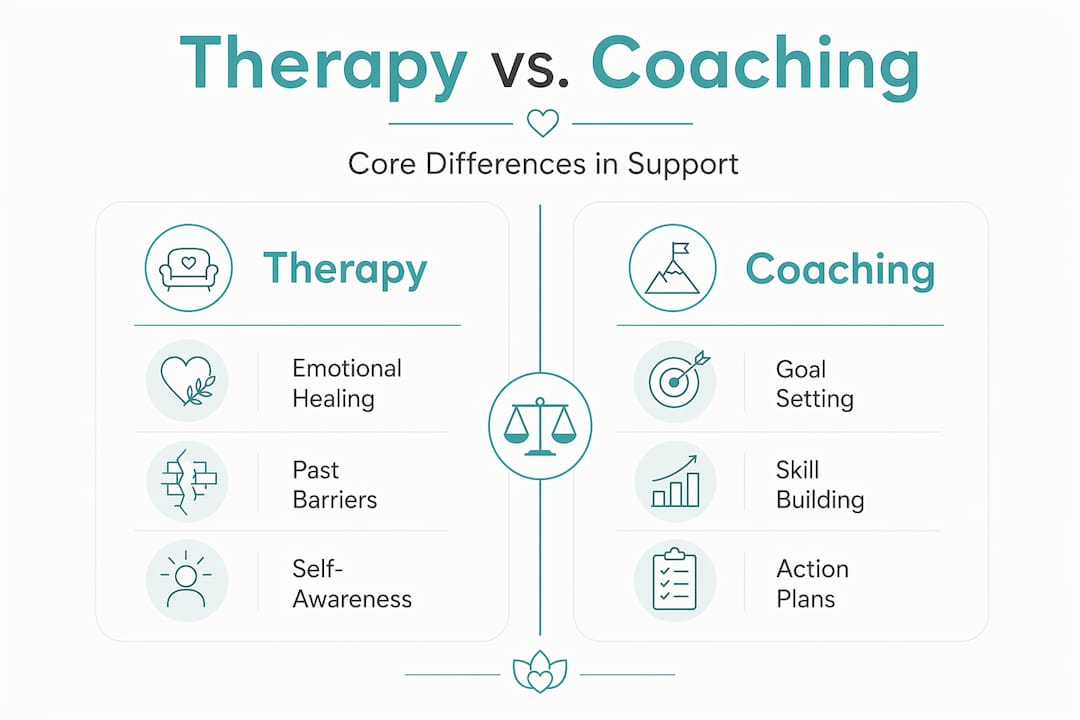
| Feature | Therapy | Coaching |
|---|---|---|
| Primary focus | Emotional and psychological barriers | Goals, skills, and performance |
| Time orientation | Past and present | Present and future |
| Regulation | Regulated profession with ethical frameworks | Largely unregulated |
| Best for | Anxiety, burnout, trauma, self-doubt | Career planning, leadership skills |
| Typical outcomes | Resilience, clarity, emotional health | Accountability, strategy, momentum |
Neither option replaces the other. They serve different purposes, and many professionals benefit from using both at different stages of their career.
Coaching works well once you have the psychological foundation in place. If you are trying to build leadership presence or set ambitious targets, a coach can help you plan and stay accountable. But if hidden anxiety, low self-worth, or unresolved stress are quietly derailing your efforts, coaching strategies alone will not hold.
This is a common pattern among high-achievers. On the outside, they appear successful and confident. Internally, they may be managing significant anxiety, fear of failure, or self-doubt that they mask with long hours and relentless achievement.
Pro Tip: If you notice that coaching advice makes sense intellectually but you still cannot follow through consistently, this is often a signal that emotional barriers need therapeutic attention first. Therapy and coaching can complement each other powerfully when you use them in the right sequence.
Key questions to help you decide where to start:
-
Are you held back by anxiety, self-doubt, or emotional exhaustion? Start with therapy.
-
Do you have a clear direction but need accountability and strategy? Coaching may be the right fit.
-
Are you managing a major career transition alongside emotional difficulty? Consider both.
Therapy in workplace culture: Organisational benefits
Having examined individual and professional support, let us expand our view to the organisational impact of therapy.
The benefits of therapy are not limited to the individual professional. When organisations invest in therapy and mental health support for their teams, the returns are measurable and significant.
Corporate therapy reduces turnover, lowers absenteeism, boosts productivity, strengthens emotional intelligence, and improves team dynamics. These are not abstract benefits. They show up in recruitment costs, project delivery times, and manager effectiveness ratings.
Key organisational metrics improved by therapy programmes:
-
Staff retention: Employees who feel supported are significantly less likely to leave, reducing costly recruitment cycles
-
Reduced absenteeism: Mental health is one of the leading causes of workplace absence; therapy programmes directly address this
-
Productivity gains: Employees with better emotional regulation and lower stress levels work more consistently and efficiently
-
Team cohesion: Emotionally intelligent teams communicate better, manage conflict more constructively, and collaborate more effectively
-
Leadership quality: Managers who engage with therapy or mental health support tend to demonstrate steadier, more empathetic leadership
-
Organisational resilience: Companies with wellbeing infrastructure adapt more confidently during periods of volatility and change
Organisations that invest in therapy and mental health support also benefit from a stronger employer brand. Professionals increasingly choose workplaces based on culture and wellbeing provisions, not just salary.
For healthcare and specialist sectors, workplace wellbeing guidance highlights how structured support systems directly improve recruitment and performance. The principle holds across industries. People work better when they feel genuinely supported.
Companies that use therapy strategically are better placed to navigate uncertainty. When leaders and teams have the emotional tools to manage change, they make clearer decisions and recover from setbacks faster.
Making therapy work for your career: Practical steps
After understanding all levels of benefit, here is how you can take practical action, starting today.
Starting therapy with a clear career intention makes a meaningful difference. Professionals who approach therapy with specific goals tend to see faster and more sustainable results than those who come without direction.
-
Define your career goals and blockers: Before your first session, write down what you want to achieve professionally and what seems to be getting in the way. Be honest.
-
Choose a therapist with relevant experience: Look for a therapist who works with professionals, workplace stress, or career-related challenges. A good therapist-client match is one of the strongest predictors of success.
-
Communicate your goals clearly: In your early sessions, tell your therapist specifically that you want to use therapy to support your professional development. This shapes the therapeutic approach.
-
Apply insights between sessions: Therapy only works if you take what you learn into your day-to-day life. Practise new communication patterns, notice emotional triggers, and test new responses.
-
Request workplace adjustments where appropriate: Evidence suggests that long-term sustainment at 12 to 24 months requires ongoing strategies, and that work modifications outperform manager-focused interventions alone. This may mean adjusting workload, communication expectations, or flexible working arrangements.
-
Review progress regularly: Every few months, assess what has changed. Use your therapy sessions to review progress and recalibrate your goals.
Pro Tip: Track your growth in soft skills the same way you would technical skills. After each quarter, note improvements in areas like conflict resolution, confidence in meetings, emotional resilience, or boundary-setting. These are real professional achievements worth documenting.
The professionals who gain the most from therapy are those who treat it as an ongoing practice, not a short-term fix. Early gains are important, but building lasting change requires commitment over time.
A fresh perspective: What most guides miss about therapy and career progress
Most articles about therapy and career growth focus on fixing a problem. They frame therapy as something you use when things go wrong. That framing misses something important.
Therapy is not just for the moments when you are struggling. It is a continuous investment in your capacity to think clearly, lead steadily, and grow without burning out. The professionals who make the most lasting career gains are often those who use therapy not reactively, but proactively.
High-achievers may mask anxiety with success. External achievement can look like confidence while internally there is chronic worry, fear of being found out, or relentless self-criticism running underneath. This pattern is more common than most workplaces acknowledge.
Deep therapeutic work gets at the root of performance plateaus and leadership blind spots in ways that surface-level strategies simply cannot reach. A productivity system will not resolve a fear of failure. A communication workshop will not dissolve years of learned avoidance.
This is what many guides about career development miss. The inner work is not separate from the professional work. They are the same work.
Therapy for professionals creates space for exactly this kind of deeper examination. It allows high-functioning people to address what is quietly getting in their way, before it becomes a crisis, before it costs them a promotion, a relationship, or their health.
The most successful professionals we see are not those who have everything together. They are those who have the self-awareness and support structures to keep growing. That is the real competitive advantage that therapy offers.
Unlock your potential with professional therapy support
Ready to put these insights into action? Personalised therapy support can help you address career ambitions and workplace challenges with the right expert guidance from the start.

GuideMe is a therapy navigation platform that is both human led and AI powered. It helps you understand your mental health through an in-depth therapy plan and matches you with the right therapist from the beginning. For professionals who want therapy solutions for professionals that are tailored to their specific goals, GuideMe removes the guesswork and creates a more supportive, comfortable experience. You do not have to figure this out alone.
Frequently asked questions
Can therapy help with imposter syndrome at work?
Yes, therapy can effectively address imposter syndrome by building self-awareness and emotional regulation skills, leading to greater professional confidence over time.
How does therapy differ from career coaching?
Therapy heals past emotional barriers while coaching builds future-focused strategies. Many professionals benefit most from using both, in the right sequence.
Is there evidence that therapy improves work performance?
Yes. Work-focused interventions improve work functioning with an SMD of 0.41, and digital CBT programmes reduce burnout and improve occupational functioning with meaningful effect sizes.
Can therapy benefit high-achieving professionals?
Absolutely. High-achievers often mask anxiety with outward success, and deep therapeutic work prevents burnout while building steadier, more sustainable leadership over time.
How can I maximise therapy’s impact on my career?
Set clear professional goals before starting, choose a therapist with workplace experience, and actively integrate what you learn into your daily routine and interactions.