

Most people assume therapy is working when they simply feel better. But that's only part of the picture. Professionals use specific, evidence-based indicators to define and measure genuine therapeutic progress, and understanding these can change how you experience your own journey. When you know what real success looks like, you can set clearer goals, have more honest conversations with your therapist, and recognise progress that might otherwise go unnoticed. This article breaks down exactly how therapy success is defined, measured, and experienced, so you can advocate for yourself with confidence.
Table of Contents
- Why defining successful therapy matters
- Reliable change: The gold standard for progress
- How measurement-based care ensures real progress
- What success in therapy looks like: Beyond symptoms
- Comparing methods: Symptoms, self-report, and lived experience
- The role of the therapeutic alliance and process dynamics
- Applying these insights: How to track your own therapy progress
- Finding the right support for your therapy journey
- Frequently asked questions
Key Takeaways
| Point | Details |
|---|---|
| Therapy success is measurable | Reliable improvement and clinical significance are objective ways to track real progress in therapy. |
| Beyond symptoms matter | Broader outcomes like better relationships and emotional regulation signal genuine change. |
| Client voice is key | Combining symptom measures with personal experience ensures the most useful definition of therapy success. |
| The alliance drives change | A positive and collaborative therapist-client relationship is crucial for successful outcomes. |
Why defining successful therapy matters
Therapy touches far more than your mood on a given day. It can reshape your relationships, deepen your self-awareness, and improve how you function in everyday life. Clients value broader outcomes beyond just symptom relief, including improved confidence, stronger connections, and a greater sense of overall wellbeing. A qualitative meta-analysis of 177 studies involving 2,908 clients confirmed this, identifying 60 distinct outcome categories across 10 clusters.
Without a clear definition of what 'better' means for you personally, it's difficult to know whether therapy is genuinely helping. Clear goals give both you and your therapist a shared direction. They also make it easier to spot when something isn't working and to adjust accordingly.
Here are some areas where therapy success commonly shows up:
- Reduced anxiety, low mood, or distressing thoughts
- Stronger and more satisfying relationships
- Greater ability to manage emotions under pressure
- Improved confidence and sense of self
- Better day-to-day functioning at work or home
Pro Tip: At the start of therapy, tell your therapist specifically what 'better' looks like for you. The more concrete you are, the easier it is to track real change.
Reliable change: The gold standard for progress
Therapists don't just rely on gut feeling to assess progress. They use a tool called the Reliable Change Index (RCI), a statistical measure that determines whether the change you've experienced is genuine improvement or simply normal variation. Success is indicated by statistically reliable improvement and a transition out of the clinical range, as defined by Jacobson and Truax's RCI and clinical significance criteria.
Clinical significance means moving from a score that falls within the 'clinical' range on a standardised measure to one that falls within the 'non-clinical' range. In practical terms, it means you're no longer experiencing difficulties at a level that would typically warrant professional intervention. An RCI above 1.96 is considered statistically reliable, and research suggests around 75 to 80 per cent of clients achieve this threshold.
Here's a simplified example of what reliable improvement looks like in practice:
| Measure | Before therapy | After therapy | Reliable change? |
|---|---|---|---|
| Anxiety scale (0-21) | 18 (severe) | 7 (mild) | Yes |
| Depression scale (0-63) | 34 (moderate) | 12 (minimal) | Yes |
| Wellbeing index (0-100) | 38 (low) | 67 (good) | Yes |
| Sleep quality score (0-21) | 16 (poor) | 9 (fair) | Borderline |
'Statistically reliable improvement means you're not just feeling different, you're measurably better.'
How measurement-based care ensures real progress
Measurement-based care (MBC) is the practice of using standardised questionnaires and outcome tools at regular intervals throughout therapy. Routine outcome monitoring (ROM) is a key part of this, involving consistent check-ins that track how you're doing over time. The APA endorses MBC as crucial for therapy progress, with evidence showing it improves outcomes and reduces dropout rates.

Regular monitoring matters because progress in therapy isn't always linear. You might plateau, experience a temporary dip, or improve in one area while struggling in another. Catching these shifts early allows your therapist to adapt your treatment plan before things stall.
The key benefits of MBC include:
- More personalised and responsive treatment plans
- Earlier identification of what isn't working
- Clearer communication between you and your therapist
- Reduced likelihood of dropping out prematurely
- A shared, objective record of your progress over time
Pro Tip: If your therapist doesn't use outcome measures, it's completely reasonable to ask about them. Many validated tools are brief and easy to complete between sessions.
What success in therapy looks like: Beyond symptoms
Beyond scores and statistics, therapy success shows up in your lived experience. Clients identify outcomes such as improved relationships, emotional regulation, self-awareness, and wellbeing as central markers of progress. These are the broader outcomes valued by clients that standardised scales sometimes miss.
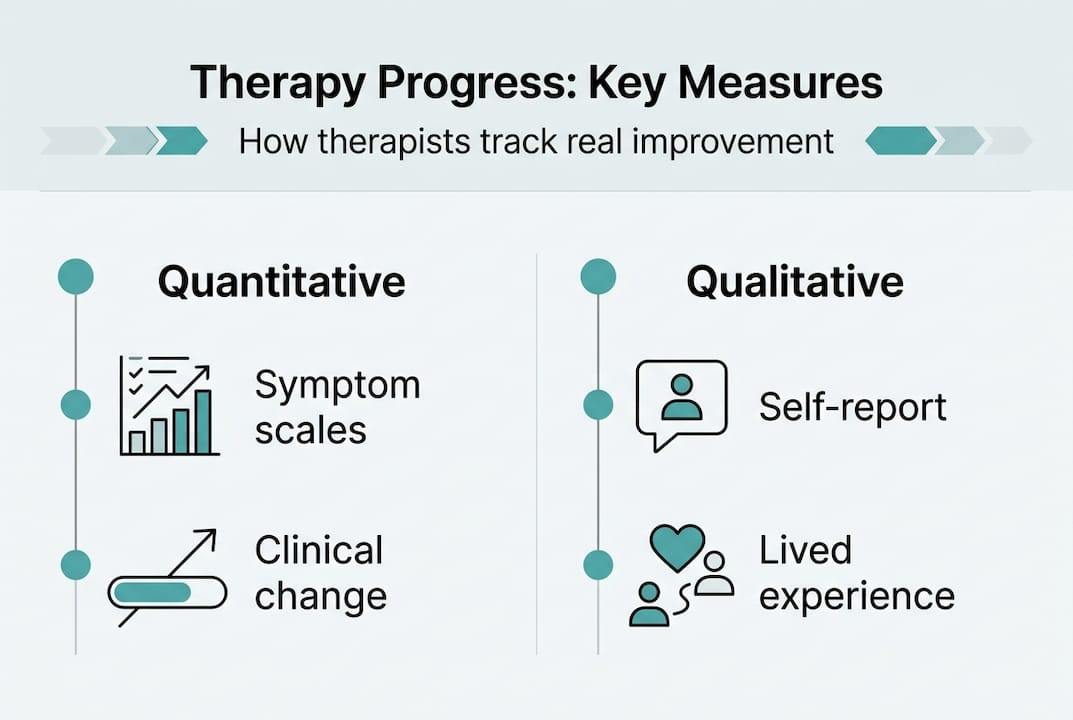
You might notice you're handling conflict differently, or that situations which once felt overwhelming now feel manageable. Emotional control, understanding your triggers, and developing healthier coping strategies are all signs that therapy is doing its job.
Other qualitative gains clients commonly report after successful therapy include:
- Feeling more comfortable in social situations
- Reduced self-criticism and greater self-compassion
- Clearer thinking and better decision-making
- A stronger sense of personal identity and values
- More agency over choices and life direction
- Improved ability to set and maintain boundaries
Comparing methods: Symptoms, self-report, and lived experience
There are several ways to measure therapy outcomes, and each has its strengths and limitations. Understanding the differences helps you interpret your own progress more accurately.
| Method | What it measures | Strengths | Limitations |
|---|---|---|---|
| Symptom scales | Specific clinical symptoms | Objective, standardised | May miss personal meaning |
| Self-report tools | Your own perception of change | Captures lived experience | Potential for bias |
| Clinician ratings | Therapist's assessment | Professional perspective | May not reflect your view |
| Life functioning | Day-to-day changes | Practical and meaningful | Hard to quantify |
Research shows that self-reports show smaller effects than clinician ratings (effect size g=0.75 versus g=0.87), but this does not mean clients overestimate their improvement. It simply reflects that clinician and self-ratings capture different dimensions of change. Your perspective on your own progress is not just valid, it is essential.
The role of the therapeutic alliance and process dynamics
One of the most consistent findings in therapy research is that the relationship between you and your therapist matters enormously. The therapeutic alliance refers to the bond you share, your collaboration on tasks, and your agreement on goals. Alliance is robustly linked to outcomes across a meta-analysis of 295 studies, with a correlation of r=0.278.
Beyond the alliance itself, dynamic shifts in emotions and growing insight during sessions predict improvement independently of diagnosis. This means that what happens inside the therapy room, moment to moment, genuinely shapes your results.
Key alliance checkpoints to reflect on:
- Do you feel genuinely heard and understood?
- Are your goals clearly defined and agreed upon?
- Does your therapist offer honest, constructive feedback?
- Do you feel safe enough to share difficult thoughts?
- Is there a sense of working together rather than being assessed?
'It's not just the method, but the quality of the relationship, that drives change.'
Applying these insights: How to track your own therapy progress
You don't have to wait for your therapist to tell you whether therapy is working. There are practical steps you can take to monitor your own progress and get more from every session. Measurement, open dialogue, and personal reflection all help maximise the benefit you gain from therapy.
Here is a straightforward process to follow:
- Set measurable goals at the start. Be specific about what you want to change, whether that's managing anxiety in social settings or sleeping more consistently.
- Keep a brief journal between sessions. Note your mood, any triggers, and moments where you responded differently than you might have before.
- Review your goals regularly with your therapist. Every four to six sessions is a good rhythm for a structured check-in.
- Ask for feedback directly. A good therapist will welcome the question: 'Do you think I'm making progress?'
- Track emotional and behavioural changes at home. Progress often shows up in daily life before it shows up in a session.
- Raise concerns if you feel stuck. If you've felt no shift after several weeks, it's worth discussing whether your approach needs adjusting.
Trusting both the data and your lived experience gives you the fullest picture of where you are and where you're heading.
Finding the right support for your therapy journey
Understanding how therapy success is measured is a powerful first step. But knowing what to look for is only useful if you're working with the right therapist from the beginning.

At GuideMe, we believe everyone deserves the support you deserve from a therapist who truly fits your needs. Our platform combines human expertise with AI-powered matching to create an in-depth therapy plan tailored to you, before you even attend your first session. We take the guesswork out of finding the right fit, so you can focus on making real, measurable progress. If you're ready to start your therapy journey with clarity and confidence, GuideMe is here to help you take that next step.
Frequently asked questions
How long does it usually take to see success in therapy?
Many people see reliable improvement within 8 to 20 sessions, though timelines vary depending on the person and the nature of the difficulty being addressed.
Do I need symptom scales to know if therapy is working?
Symptom scales are helpful but not essential. Broader personal changes in relationships, daily functioning, and emotional control are equally valid signs that therapy is having a positive effect.
Are all types of therapy equally effective?
For depression and many common difficulties, CBT and STPP show similar outcomes when properly delivered, suggesting the approach matters less than the quality of the work.
How important is my relationship with my therapist?
A strong, honest alliance is one of the best predictors of positive outcomes. Alliance robustly predicts success across hundreds of studies, making it one of the most important factors in your therapy experience.