

TL;DR:
- Starting therapy can be overwhelming, but clarifying your needs, preferences, and budget helps facilitate the process.
- Research using directories, insurance, or community resources enables you to find suitable therapists efficiently.
- Reaching out with prepared questions and confirming details ensures a smooth appointment setup, making therapy more accessible and less daunting.
Thinking about starting therapy is a significant decision, and yet many people find themselves stuck before they even pick up the phone. The process can feel confusing, especially if you're not sure where to look, what to say, or whether you'll be able to afford it. You're not alone in feeling that way. This guide walks you through every stage of setting up a therapy session, from clarifying what you're looking for to confirming your first appointment, so you can move forward with confidence rather than guesswork.
Table of Contents
- Understanding what you need before scheduling therapy
- Finding therapists and exploring your options
- Making contact and setting up your appointment
- Confirming your session and setting yourself up for success
- Why scheduling therapy often feels daunting (and what really helps))
- Ready to take your next step?
- Frequently asked questions
Key Takeaways
| Point | Details |
|---|---|
| Clarify your needs | Understanding what you want from therapy makes finding and scheduling sessions much easier. |
| Use trusted directories | Directories like those from the APA help you safely find qualified therapists suited to your requirements. |
| Prepare before you reach out | Having your details and list of questions ready streamlines booking your first session. |
| Choose sustainable times | Picking realistic appointment times supports ongoing attendance and positive progress. |
| Emotional readiness matters | Feeling nervous is normal—taking small steps toward booking makes the process more manageable. |
Understanding what you need before scheduling therapy
Before you start searching for a therapist, it helps to spend a little time thinking about what you're actually looking for. This step feels small, but it makes every other part of the process easier and quicker.
Start with your reasons for seeking support. People come to therapy for many different reasons. You might be struggling with anxiety, low mood, relationship difficulties, work-related stress, grief, or a general sense of feeling overwhelmed. You don't need to have everything figured out before your first session, but having a rough sense of your main concern will help you identify therapists who specialise in those areas and communicate clearly when you make contact.
Think about your personal preferences. Therapy works best when you feel comfortable, so it's worth considering a few practical factors early on:
- Format: Would you prefer in-person sessions, online video appointments, or telephone sessions? Online therapy has become much more widely available and can suit people with busy schedules or limited mobility.
- Practitioner gender: Some people feel more at ease speaking with a therapist of a particular gender. This is a completely valid preference and worth noting.
- Location: If you plan to attend in person, how far are you willing to travel? Staying within a manageable distance makes it easier to attend consistently.
- Language: If English is not your first language, or if you would feel more comfortable speaking in another language, look for therapists who offer sessions in your preferred language.
- Type of therapy: You may have heard of cognitive behavioural therapy (CBT), psychotherapy, or counselling. If you have a preference, note it down. If you're unsure, that's fine too.
Check your schedule honestly. Think about which days and times you can realistically commit to on a recurring basis. Morning sessions before work, lunchtime slots, evenings, or weekends all have different availability depending on the therapist. Being realistic now prevents you from booking a slot you can't consistently keep.
Establish your budget. Therapy costs vary considerably. In the UK, private therapy typically ranges from £50 to £150 per session. The NHS offers talking therapies through the Improving Access to Psychological Therapies (IAPT) programme, which are free but may involve a waiting period. Some employers offer Employee Assistance Programmes (EAPs) that include free sessions. Know what you can afford before you start approaching therapists.
Pro Tip: Write down your preferences, budget, and availability before you begin searching. Having these notes to hand means you can filter options quickly and communicate clearly when you contact a therapist. Established directories and referral sources can help you find therapists to then schedule, so going in prepared saves time.
Finding therapists and exploring your options
After considering what you need, the next step is to research who can meet those needs and where to find them. There are several reliable routes you can take, and using more than one increases your chances of finding a good match.

Online directories are one of the most accessible starting points. APA and NAMI recommend directories, insurance look-up tools, and community referral sources as reliable first steps. These directories allow you to filter by location, specialisation, accepted insurance, and more. In the UK, directories such as those provided by professional bodies list registered, qualified practitioners.
Insurance provider directories are another option. If you have private health insurance that covers mental health, your provider will have a list of approved therapists. Using this route means your sessions may be partially or fully covered, which significantly reduces cost.
Employee Assistance Programmes (EAPs) are offered by many employers and often include a set number of free therapy sessions. Contact your HR department to find out what your employer provides.
GPs and community centres can also connect you with support. Your GP can refer you to NHS talking therapies, and community organisations sometimes offer low-cost or subsidised counselling services.
Here's a comparison of the main search options to help you decide which suits you best:
| Search method | Cost implications | Speed of access | Filtering options |
|---|---|---|---|
| Online directory | Varies by therapist | Fast | High (location, type, specialism) |
| Insurance directory | Often covered | Moderate | Moderate |
| EAP (employer) | Usually free | Fast | Low |
| GP referral (NHS) | Free | Slow (waiting list) | Low |
| Community centre | Low cost | Moderate | Low |
How to use an online therapist locator, step by step:
- Open the directory website and navigate to the search or find-a-therapist section.
- Enter your location or postcode to see therapists near you.
- Apply filters based on your preferences: specialism, session format, gender, language, or insurance accepted.
- Review the profiles of therapists that appear in your results. Look at their qualifications, their approach, and any introductory statements they provide.
- Create a shortlist of two to four therapists who seem like a potential fit.
- Check each therapist's website or profile for any further information on their availability and fees.
- Prepare your notes from the previous section and get ready to make contact.
Having a shortlist rather than contacting just one person is sensible. Not every therapist will have availability, and some may not be the right fit on closer inspection. Keeping options open gives you flexibility and keeps the process moving. You can find a helpful therapy resource list to support your search.
Making contact and setting up your appointment
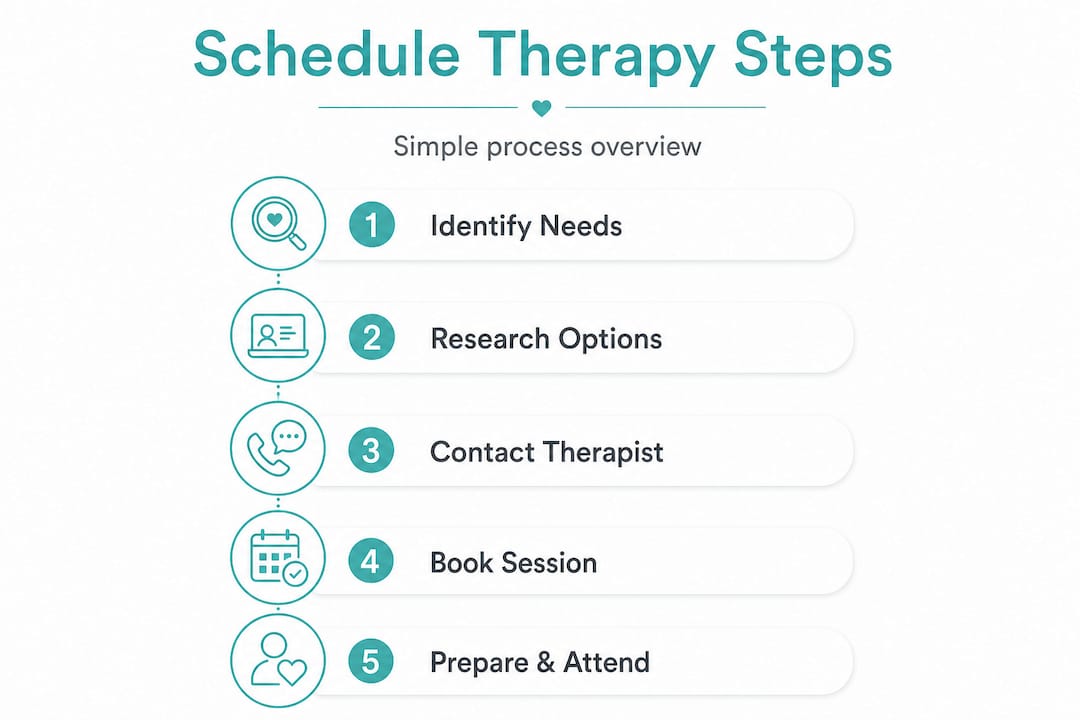
With a shortlist in hand, you're ready to contact your chosen therapist and navigate the logistics of scheduling your session. This is where many people feel nervous, but it doesn't need to be complicated.
Prepare before you reach out. Whether you're sending an email, filling out a contact form, or calling, having the following information ready will make the exchange much smoother:
- Your name and contact details
- Your preferred time slots and days
- A brief, general reason for seeking therapy (you don't need to share everything at this stage)
- Your payment method or insurance details
- Any specific requirements, such as language preference or accessibility needs
NAMI suggests steps such as contacting your insurance company, using community referrals, and scheduling via online locators as part of a structured approach to finding and booking support.
Questions to ask when you make contact:
- What session slots are currently available?
- What are the fees per session, and do you offer a sliding scale?
- What is your cancellation policy and how much notice is required?
- Do you have experience working with my particular concern?
- How long are the sessions, and how frequently do you recommend meeting?
Here's a step-by-step guide to making contact:
- Choose your preferred contact method. Most therapists offer email, a contact form on their website, or a phone number.
- If calling, prepare a brief script. For example: "Hello, my name is [name]. I'm looking for support with [general concern]. I'm wondering if you have any availability and whether you'd be happy to have a brief chat before I book."
- If emailing or using a form, keep your message concise. Introduce yourself, mention your general reason for seeking help, state your availability, and ask about their fees and next steps.
- Wait for their response. Most therapists reply within one to three working days.
- Once you receive a reply, ask any outstanding questions and, when you're happy, confirm a time slot.
- Request written confirmation of your appointment details.
- Follow up if you don't hear back. A polite follow-up after a few days is completely appropriate.
- Don't put all your hope on one therapist. Contact two or three from your shortlist simultaneously to avoid delays.
- Be honest but brief. You don't need to share your full history in the first message. A general outline is enough.
Pro Tip: Have your calendar open when you're waiting for a response. If the therapist offers you a slot, you can confirm it immediately rather than losing it while you check your diary. You can also review first therapy appointment tips to feel even more prepared.
Confirming your session and setting yourself up for success
After you've made contact, the process doesn't end. Confirming your booking and preparing thoughtfully will help ensure you start therapy on the right foot.
Confirm the details of your appointment clearly. Once a time is agreed, check the following before you finish the conversation or close the email thread:
- The exact date and time of the session
- Whether it's in person or online, and the address or video link
- The cost of the session and accepted payment methods
- The cancellation policy and how to reschedule if needed
- What you should bring or prepare, if anything
Make attending your appointment as easy as possible. Choosing a session time that truly works for you is more important than it might seem. Asking about scheduling outside typical hours can make a real difference if your availability is limited. Evening and weekend slots exist for a reason.
Here's a look at common appointment slot options and what to consider for each:
| Time slot | Potential benefit | Potential challenge |
|---|---|---|
| Early morning (7–9am) | Start the day with focus | Requires early rising and preparation |
| Lunchtime (12–2pm) | Breaks up the working day | Limited time to decompress afterwards |
| Late afternoon (4–6pm) | Natural transition from work | High demand, fewer available slots |
| Evening (6–8pm) | After work, flexible | Mental fatigue after a long day |
| Weekend | Relaxed, no work pressure | Less availability from many therapists |
"The appointment time you can actually keep is always better than the ideal time you can't."
Set yourself up to attend consistently. Once your first appointment is confirmed, take these steps to protect that commitment:
- Add the appointment to your calendar immediately, including travel time or log-in preparation.
- Set a reminder for 24 hours before and again two hours before the session.
- If attending online, test your video and audio connection beforehand.
- Tell someone you trust, if you feel comfortable doing so. Accountability can help.
- If you need to reschedule, contact the therapist as early as possible. Most are understanding when given reasonable notice.
Why scheduling therapy often feels daunting (and what really helps)
Here's something that most practical guides don't acknowledge: knowing exactly what to do doesn't automatically make it easy to do it. Many people read every step, understand every instruction, and still find themselves putting off the first contact for days or weeks. That's not a failure of information. It's a very human response to vulnerability.
Asking for help, especially with your mental health, requires a degree of courage. It involves admitting that things aren't quite right, and that can feel exposing. Even the act of typing a message to a therapist can stir up feelings of self-doubt or fear of judgement. Conventional advice tends to skip this part entirely, as though the barrier is purely logistical. It often isn't.
What actually helps isn't waiting until you feel completely ready, because that moment rarely arrives. What helps is breaking the process into very small actions. Today, write down your preferences. Tomorrow, look at one directory. The day after, read two therapist profiles. Each action is manageable on its own, and each one makes the next feel slightly less daunting.
It also helps to reframe what "starting therapy" means. You're not committing to years of weekly sessions from the moment you send an email. You're simply gathering information. The first contact is not an irreversible decision. It's a conversation.
People who feel the most anxious about overcoming therapy anxiety often benefit from recognising that the discomfort is part of the process, not a sign that they're doing something wrong. Booking an appointment when you feel uncertain is still progress. In fact, it might be the most meaningful step you take.
Pro Tip: Don't wait for total confidence before booking. Sending that first message, even if it feels uncomfortable, is already progress. The confidence tends to come after the action, not before.
Ready to take your next step?
Taking the step to seek therapy is significant, and you shouldn't have to navigate it alone. GuideMe is here to support you at every stage, from understanding your mental health needs to finding and booking the right therapist.

Through GuideMe Therapy services, you receive an in-depth therapy plan tailored to your situation, matched with a therapist who genuinely fits your needs and preferences. The platform is both human led and AI powered, which means expert care and smart matching work together to take the guesswork out of finding the right support. Whether you're just beginning your search or ready to book, GuideMe makes the next step clear, straightforward, and far less overwhelming. You deserve support that starts well from the very beginning.
Frequently asked questions
What information do I need to provide when booking a therapy session?
You'll usually need your contact details, preferred time slots, insurance or payment information, and a general reason for seeking therapy. NAMI outlines steps such as contacting your insurance provider and using community referral sources as part of the booking process.
Can I reschedule or cancel a therapy appointment once booked?
Yes, most therapists allow changes with adequate notice. Always ask about the cancellation policy when booking so you know exactly how much notice is required.
How do I know if a therapist is right for me before the first session?
Check their qualifications, areas of experience, and therapeutic approach, then ask a few initial questions to assess whether you feel comfortable. Many therapists offer a brief introductory call, and the APA Psychologist Locator provides filtering tools to help you evaluate options before making contact.
Are online directories safe to use for finding therapists?
Yes. Established resources such as the APA Psychologist Locator list only licensed, vetted practitioners, making them a reliable and safe starting point for your search.
What if my preferred appointment time isn't available?
Ask about alternative slots, including evening or weekend appointments. Scheduling outside typical hours is a reasonable request and many therapists accommodate it when they can.