

TL;DR:
- Clear, meaningful goals are essential for effective and lasting therapy outcomes.
- Use the CLEVER framework to set personalized, context-based therapy goals before applying SMART criteria.
- Regularly track progress and revise goals to ensure alignment with your evolving priorities and life circumstances.
Therapy can feel frustrating when you don't know whether you're actually moving forward. Many people attend sessions regularly but still feel lost, unsure of what they're working towards or how to measure progress. The truth is, unfocused therapy rarely produces lasting change. Research consistently shows that clear, personally meaningful goals are one of the strongest predictors of successful outcomes. This guide will walk you through a structured, step-by-step approach to setting therapy goals that are measurable, achievable, and genuinely rooted in what matters most to you.
Table of Contents
- Preparing to set therapy goals: What you need to know
- Step-by-step: How to define your therapy goals
- Common pitfalls and how to avoid them
- Tracking progress and adjusting your goals
- The uncomfortable truth about therapy goal-setting
- Ready to make progress? Take your next step
- Frequently asked questions
Key Takeaways
| Point | Details |
|---|---|
| Start with context | Begin goal setting with what truly matters to you, not generic objectives. |
| Use measurable methods | Apply evidence-based frameworks like CLEVER and SMART for clearer progress tracking. |
| Prioritise personal ownership | Patient-chosen goals increase motivation and are proven to deliver better therapy outcomes. |
| Adjust as you go | Regularly review and adapt your therapy goals as your needs and circumstances change. |
Preparing to set therapy goals: What you need to know
Understanding why most people struggle with therapy goals makes it clear how vital effective goal-setting really is. Many people enter therapy with a general sense of wanting to "feel better" or "manage stress." These are understandable starting points, but they aren't goals. Without specificity, it becomes nearly impossible to track progress or know when you've succeeded.
There are two distinct types of goals worth understanding. Outcome goals describe the end result you want, such as feeling less anxious in social situations. Process goals describe the steps or behaviours you'll practise to get there, such as attending weekly sessions and completing thought-challenging exercises. Both matter, and combining them gives you a clearer, more actionable picture of your journey.
Before you even start writing goals down, there are key things to gather and reflect on:
- Your personal values and what truly matters to you in daily life
- A brief narrative of your history and current life circumstances
- Your emotional patterns and recurring triggers
- Any previous therapy experiences and what did or didn't work
- Your level of motivation and readiness to engage
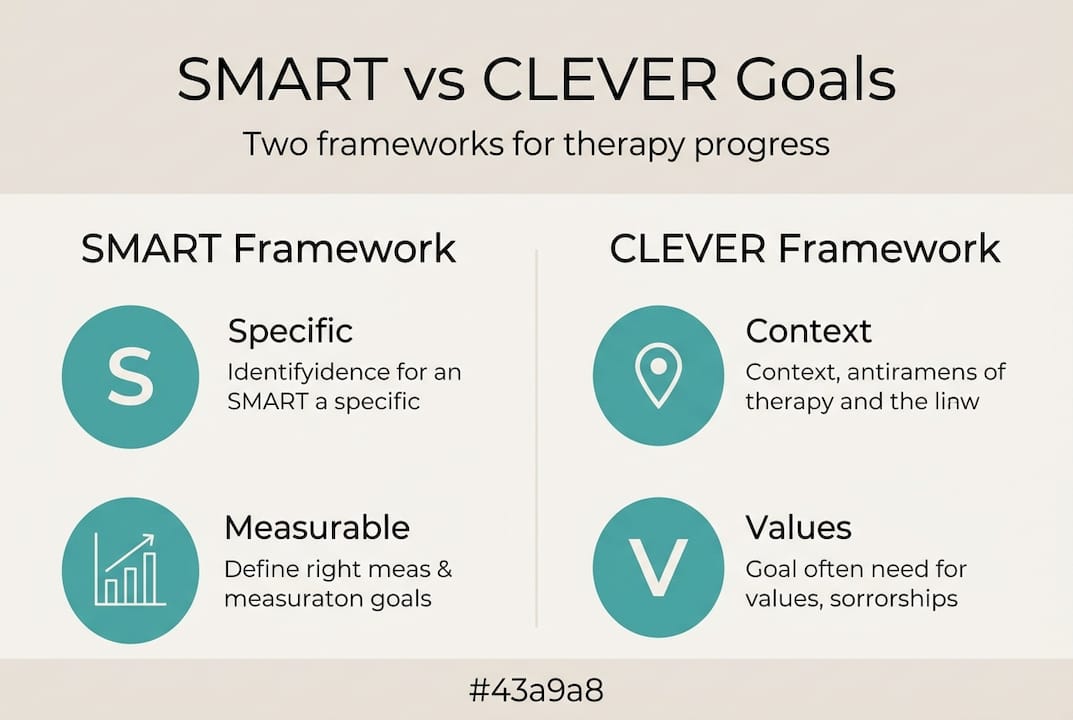
This groundwork connects directly to an evidence-based framework called CLEVER. Research recommends you define CLEVER goals first (Context, Life narrative, Engagement, Values, Emotions, Relevance) before applying more structured formats like SMART, particularly for people dealing with chronic conditions or multiple challenges. CLEVER ensures your goals are shaped by your lived experience rather than generic templates.
| CLEVER element | What it means for you |
|---|---|
| Context | Your current life situation and environment |
| Life narrative | Your personal history and how it shapes your needs |
| Engagement | Your readiness and motivation to take part |
| Values | What genuinely matters to you |
| Emotions | Key emotional patterns you want to address |
| Relevance | Whether the goal actually connects to your real life |
You and your therapist also need to agree on what success looks like. Misaligned expectations between therapist and client are a common source of stagnation. Starting with using data-driven goal setting as a shared foundation creates a more productive therapeutic relationship from the start.
Pro Tip: Before your next session, spend 10 minutes writing down three things you value most in your daily life. These become the foundation of goals that feel genuinely worth working towards.
Step-by-step: How to define your therapy goals
Once you're clear on your context and values, it's time to put structure to your goals. The following sequence helps you move from personal insight to concrete, trackable targets.
- Identify your core priorities. Using your CLEVER reflections, write down the two or three areas of your life or wellbeing that matter most. These could relate to relationships, work, self-esteem, or emotional regulation.
- Draft outcome goals. For each priority, write a sentence describing the change you want to see. Keep it personal and specific to your actual life, not a textbook definition of wellness.
- Convert to SMART goals. Refine each outcome goal so it is Specific, Measurable, Achievable, Relevant, and Time-bound. For example: "I will practise one grounding technique each morning for the next four weeks."
- Share and refine with your therapist. Bring your goals to your next session. Collaborative therapy goal setting is important because your therapist can help you calibrate ambition with realism.
- Choose a tracking method. Decide how you'll document progress. A simple journal, a mood tracking app, or a printed worksheet all work well.
- Set a review date. Agree with your therapist on when you'll formally revisit and assess your goals, typically every four to six weeks.
APA guidelines recommend using data for collaborative goal setting and progress monitoring, which means tracking isn't optional. It's how you and your therapist know what's working.
SMART vs CLEVER: a quick comparison
| Feature | SMART | CLEVER |
|---|---|---|
| Primary focus | Structure and measurement | Personal meaning and context |
| Best used for | Defining specific targets | Identifying the right goals to set |
| Requires therapist input | Helpful but not essential | Strongly recommended |
| Handles complexity | Less suited to complex needs | Designed for complex, multifaceted situations |
Pro Tip: Don't try to create five goals at once. Start with one clear, personally meaningful goal and build from there. Quality of focus matters more than quantity.
Common pitfalls and how to avoid them
Even with the right methods, there are common traps that can derail your progress. Knowing them in advance gives you a real advantage.
The most frequent mistakes include:
- Setting goals that are too broad or vague, such as "I want to be happier"
- Adopting goals that your therapist suggested but that don't feel personally meaningful
- Ignoring emotional readiness and jumping straight to action steps
- Failing to revisit or update goals as your circumstances change
- Measuring progress only through symptom reduction rather than broader life improvement
One of the most underappreciated issues is the mismatch between therapist-imposed goals and patient priorities. Goal congruence between client and therapist is often lower than assumed, yet patient-set goals independently predict therapeutic success. In other words, a goal your therapist values but you don't is unlikely to produce lasting change.
"Goals that feel externally imposed rather than personally owned tend to reduce motivation and engagement. The client's own priorities are a stronger predictor of positive outcomes than clinician-derived targets."
Recalibrating when you notice misalignment is straightforward. You don't need to abandon the therapeutic relationship. Simply bring your own priorities into the conversation explicitly. Use phrases like "I want to focus on this because it matters most to me right now" to gently redirect the work.
For further reading on therapy goal alignment tips and overcoming alignment challenges, both resources offer practical guidance on keeping therapy centred on what you actually need.
Independent goal setting, where you draft your goals before sessions rather than only within them, is one of the most effective strategies available. It ensures your voice remains central rather than being shaped purely by clinical frameworks.
Tracking progress and adjusting your goals
Setting goals is powerful, but tracking and refining them makes therapy transformative. Progress monitoring is not just an administrative task. It's what separates therapy that drifts from therapy that produces measurable, lasting improvement.
Here's a straightforward sequence for tracking your goals effectively:
- Record your starting point. Before working towards a goal, note your current state. For example, rate your anxiety in specific situations on a scale of 1 to 10.
- Log consistently. Update your records weekly, even briefly. Patterns become visible over time.
- Review with your therapist. Bring your tracking data to sessions. This creates a shared, evidence-based picture of progress.
- Interpret the results honestly. Progress isn't always linear. A plateau doesn't mean failure. It often signals a need for adjustment.
- Celebrate achievements. When you meet a goal, acknowledge it. Then decide whether to extend it, replace it, or graduate to a new challenge.
Patient-chosen goals improve engagement and show larger effect sizes compared to standardised symptom checklists. This means your personalised goals are a stronger signal of progress than generic measures.

Common tracking methods and their benefits
| Tracking method | Best for | Frequency |
|---|---|---|
| Mood journal | Emotional patterns and daily wellbeing | Daily or every other day |
| Goal rating scale | Measuring specific goal progress | Weekly |
| Session notes | Capturing insights and shifts in thinking | After each session |
| Standardised questionnaires | Comparing to baseline over time | Monthly |
For practical support with monitoring therapy progress, structured tools can make this process much easier and more consistent over time.
The uncomfortable truth about therapy goal-setting
After learning the evidence-based methods, consider this real-world perspective on what actually matters. Most therapy guidance places the therapist at the centre of the goal-setting process. But the research tells a different story.
Therapist-driven structures, however well-intentioned, can inadvertently sideline the client's actual priorities. When goals feel like they belong to the clinician rather than you, motivation drops quietly and consistently. Many people don't voice this. They simply disengage.
The evidence on practical experience with goal setting is clear: goals you choose yourself, grounded in your own values and life context, are more predictive of lasting change than any clinician-approved framework. This isn't a criticism of therapists. It's a reminder that your voice in the process is not just welcome. It is essential.
The practical wisdom here is simple. Draft your goals before your sessions. Revisit them regularly outside the therapy room. And if a goal stops feeling relevant to your actual life, update it without guilt. Goals are not contracts. They are living tools that should evolve as you do.
Ready to make progress? Take your next step
If you've been feeling uncertain about whether therapy is really working for you, you're not alone. Having a clear, structured approach to goal-setting changes that experience entirely.
GuideMe is built to support exactly this kind of intentional, progress-focused therapy experience. Whether you're just starting out or looking to get more from your current sessions, you can explore therapy goal tools and access resources designed to help you set, track, and achieve goals that genuinely matter. Our human-led, AI-powered matching process also ensures you're working with a therapist who aligns with your priorities from the very beginning, making every session count.
Frequently asked questions
What is the CLEVER framework in therapy goal setting?
The CLEVER framework stands for Context, Life narrative, Engagement, Values, Emotions, and Relevance. Research recommends you apply CLEVER before SMART to ensure your goals are grounded in personal meaning before adding measurable structure.
Why should goals in therapy be patient-chosen?
Patient-chosen goals improve treatment engagement and produce stronger outcomes because they connect to what genuinely motivates you, making it far more likely you'll stay committed throughout the process.
How do I know if my therapy goals are effective?
Effective goals feel personally relevant, are clearly measurable, and show traceable progress over time. APA guidelines recommend using consistent data and monitoring to evaluate whether your goals are delivering real results.
What should I do if my therapist's goals feel disconnected from my own?
Raise it directly in your next session. Patient-led goals predict success independently of therapist-set targets, so advocating for your own priorities is not only reasonable but clinically important.