

TL;DR:
- Therapist-guided workshops offer personalized feedback, accountability, and social learning that many find beneficial for emotional growth.
- However, self-help approaches can be equally effective depending on individual goals, severity of issues, and personal preferences.
Many people searching for emotional wellbeing support face a genuine dilemma: is working with a therapist in a structured workshop setting actually worth it, or can self-help approaches deliver the same results? It is a fair question, and the answer is more nuanced than most people realise. Therapist-guided workshops can offer distinct advantages for personal growth and coping skills, but whether they are the right fit depends on your goals, your circumstances, and the type of support you are looking for. This article lays out what the evidence says, what you can realistically expect, and how to make a confident, informed decision.
Table of Contents
- How to evaluate therapist-guided workshops
- Top benefits of therapist-guided workshops
- Are therapist-guided workshops always better than self-help?
- Choosing the right approach for your needs
- Why context matters more than format choice
- Find a therapist-guided workshop that suits you
- Frequently asked questions
Key Takeaways
| Point | Details |
|---|---|
| Personalised feedback | Therapist guidance delivers direct, adaptive feedback that accelerates emotional growth. |
| Flexible formats | Brief and structured workshops provide effective options for varied schedules. |
| Evidence-driven choice | Research shows no one-size-fits-all; the best results depend on context and fit. |
| Accountability boost | Guided groups can enhance motivation and commitment through therapist and peer support. |
| Decision confidence | Understanding the distinctions helps you choose the right path for wellbeing improvements. |
How to evaluate therapist-guided workshops
Before you commit to any workshop format, it helps to have a clear framework for deciding what kind of support will serve you best. Not every personal growth goal requires the same level of professional input, and recognising this from the start can save you time, money, and frustration.
There are four main criteria worth considering when evaluating your options.
- Need for expert feedback: Some goals, such as managing anxiety, improving communication in relationships, or processing grief, involve complex emotional patterns that genuinely benefit from professional observation and personalised input. If your goal falls into this category, therapist guidance offers something a workbook or podcast simply cannot.
- Motivation and consistency: If you find it difficult to stay consistent with self-directed programmes, structured sessions with a therapist or facilitator can provide the external rhythm and accountability you need to keep progressing.
- Social support needs: Many people find that working through personal challenges in a group setting, with shared experiences and peer connection, accelerates their growth. Therapist-guided workshops often create a safer environment for this kind of social learning.
- Type and severity of the issue: Milder stress or general personal development goals may respond well to self-guided tools. More persistent emotional difficulties often benefit from professional input, even in a workshop format rather than one-to-one therapy.
Research confirms that both guided and self-guided formats can be effective, but outcomes depend heavily on the context and the specific needs of each person. This is not a one-size-fits-all question, which is exactly why taking time to evaluate your own situation matters.
Understanding the role of therapist presence in a workshop can also help you see where professional guidance adds the most value and where it may be optional.
Pro Tip: If you are unsure whether a therapist-guided workshop is right for you, a single consultation with a therapist can clarify your needs and help you match to the right format before investing time or money in a programme.
Top benefits of therapist-guided workshops
Once you have evaluated your needs, it is worth looking closely at the specific gains that therapist-guided workshops tend to offer. These are not abstract claims. They are practical, real-world advantages that people consistently report when working within a professionally facilitated structure.
-
Personalised feedback that adapts to you. A trained facilitator can observe how you respond to exercises, challenge unhelpful patterns in real time, and adjust the session focus based on what is actually happening for you. Self-help materials are static. A therapist-guided workshop is responsive.
-
Motivation through structured accountability. Scheduled sessions, clear programme milestones, and a facilitator who knows your name create a meaningful sense of commitment. This structure is particularly valuable for people who have tried self-help approaches before and found that motivation fades after the first few weeks.
-
Safe social learning in a group setting. One of the most underrated benefits of therapist-guided workshops is the opportunity to learn from others who are facing similar challenges. Sharing experiences, practising new communication skills, and receiving peer feedback in a professionally managed environment can produce insights that individual work alone rarely achieves. Structured group support benefits particularly from therapist presence when it comes to social learning and aligning goals across participants.
-
Professional alignment of workshop goals with your personal growth. A therapist brings clinical knowledge to the design and delivery of a workshop. This means the activities, discussions, and frameworks you work with are chosen deliberately to support specific outcomes, not just general wellbeing. That intentionality makes a real difference over time.
-
A structured pathway that reduces overwhelm. People who are navigating emotional difficulties often feel paralysed by the volume of available self-help content. A guided workshop removes that burden by providing a clear, sequenced pathway that has already been designed with your type of goal in mind.
Effective goal alignment in workshops is one of the clearest markers of a well-designed therapist-guided programme and is worth asking about before you enrol.
Pro Tip: Do not overlook the value of peer feedback within group workshops. Insights from fellow participants, guided by a skilled facilitator, can often reach places that one-to-one professional feedback does not.

Are therapist-guided workshops always better than self-help?
This is where it is important to be honest rather than promotional. Therapist-guided workshops are not automatically superior to self-help approaches in every situation. The evidence is more balanced than many people expect.
| Therapist-guided workshops | Self-help approaches | |
|---|---|---|
| Personalised input | High: real-time feedback and adaptation | Low: fixed content, no adaptation |
| Flexibility | Lower: fixed schedule and format | High: your pace, your time |
| Cost | Higher: professional facilitation adds expense | Lower: many free or low-cost options |
| Accountability | High: built-in structure and check-ins | Lower: depends on self-discipline |
| Social learning | High: group dynamics and peer exchange | Limited unless community-based |
| Access | Can be restricted by geography or availability | Widely accessible online |
| Outcome certainty | Context-dependent; not always better | Can match guided formats in some areas |
The table above shows that the advantages of therapist guidance are real but not universal. Some research indicates that guidance may not change outcomes compared to well-structured self-help in certain contexts. Similarly, professionally moderated groups are not always superior to structured self-administered psychoeducation when it comes to mood disturbance outcomes.
"The question is not whether therapist-guided or self-help is better in the abstract. The question is which format fits your specific goals, your readiness, and your circumstances right now."
There is also genuine uncertainty about delivery modes in the broader research, which means that claiming one format always outperforms another would be misleading. What matters most is the quality and fit of the programme, not simply whether a therapist is present.
That said, for those seeking group workshop presence as part of a structured growth plan, therapist-guided formats do tend to provide a more cohesive and professionally aligned experience than peer-only groups.
Choosing the right approach for your needs
Armed with a clearer picture of both formats, the practical question becomes: how do you actually decide? There are several factors worth weighing before you commit to either a therapist-guided workshop or a self-help programme.
- Your schedule and availability. Therapist-guided workshops typically run on a fixed timetable. If your work or family commitments make that difficult, a self-guided programme may be more realistic in the short term.
- Your readiness and openness. Some people find the idea of a group setting uncomfortable, at least initially. If you are not yet ready to share personal experiences with others, a self-guided approach may be a useful first step before moving to a guided workshop.
- Whether you need peer support. If connection with others who understand your experience is important to you, a group-based therapist-guided workshop offers something that solo self-help cannot replicate.
- The severity and complexity of the issue. Persistent low mood, chronic anxiety, relationship difficulties, or trauma-related challenges are more likely to benefit from professional facilitation than general personal development goals.
- How much structure you need. Some people thrive with autonomy and find rigid schedules counterproductive. Others need the external structure of scheduled sessions to make consistent progress.
It is also worth considering practicality and time investment. Research on brief therapist-guided workshops shows that session dose and feasibility matter significantly. Ultra-brief workshop formats, sometimes consisting of just a few structured sessions, can serve as a pragmatic alternative to longer programmes when time or access is limited. Pilot studies suggest these shorter formats are feasible and can produce meaningful early benefits, even if more outcome data is still needed to confirm long-term effects.
Statistic to note: In several pilot studies, participants consistently rated brief therapist-guided workshops as preferable to open-ended self-help formats, citing practicality and the sense of professional support as key reasons for their preference.
The takeaway here is that choosing between formats does not have to be a permanent decision. You can start with a brief guided workshop to assess fit, then decide whether to continue, switch, or complement it with self-guided tools.
Why context matters more than format choice
Here is a perspective that most articles on this topic avoid: the debate between therapist-guided and self-help approaches is often framed as a competition, and that framing is not particularly helpful.
The uncomfortable truth is that delivery modality and supervision level do not guarantee superiority in every outcome area. What actually drives results is the match between the format and the individual, combined with consistent effort and honest tracking of progress.
Many people approach this decision with a kind of loyalty to one format. They either believe that professional guidance is always the gold standard, or they are convinced that self-directed learning is more empowering. Both positions can get in the way of making a genuinely useful choice.
The smarter approach is to treat format as a variable rather than a fixed identity. Try a brief therapist-guided workshop. Track how you feel after each session. Notice whether the structured feedback is producing real shifts in how you think or respond to difficult situations. Then adjust.
Self-help is not second best. For many people, with the right tools and a clear goal, it is entirely sufficient. The research supports this. But for goals that involve interpersonal skills, complex emotional patterns, or the need for accountability and professional observation, therapist guidance adds something that self-directed approaches genuinely cannot replicate.
The wisest stance is not to ask "which format is better?" but rather "which format is better for me, right now, for this specific goal?" That shift in framing leads to better decisions and, ultimately, better outcomes.
Find a therapist-guided workshop that suits you
Taking the step to seek professional support is meaningful. You deserve a process that feels clear, supported, and tailored to your actual needs rather than a generic programme that may or may not fit.
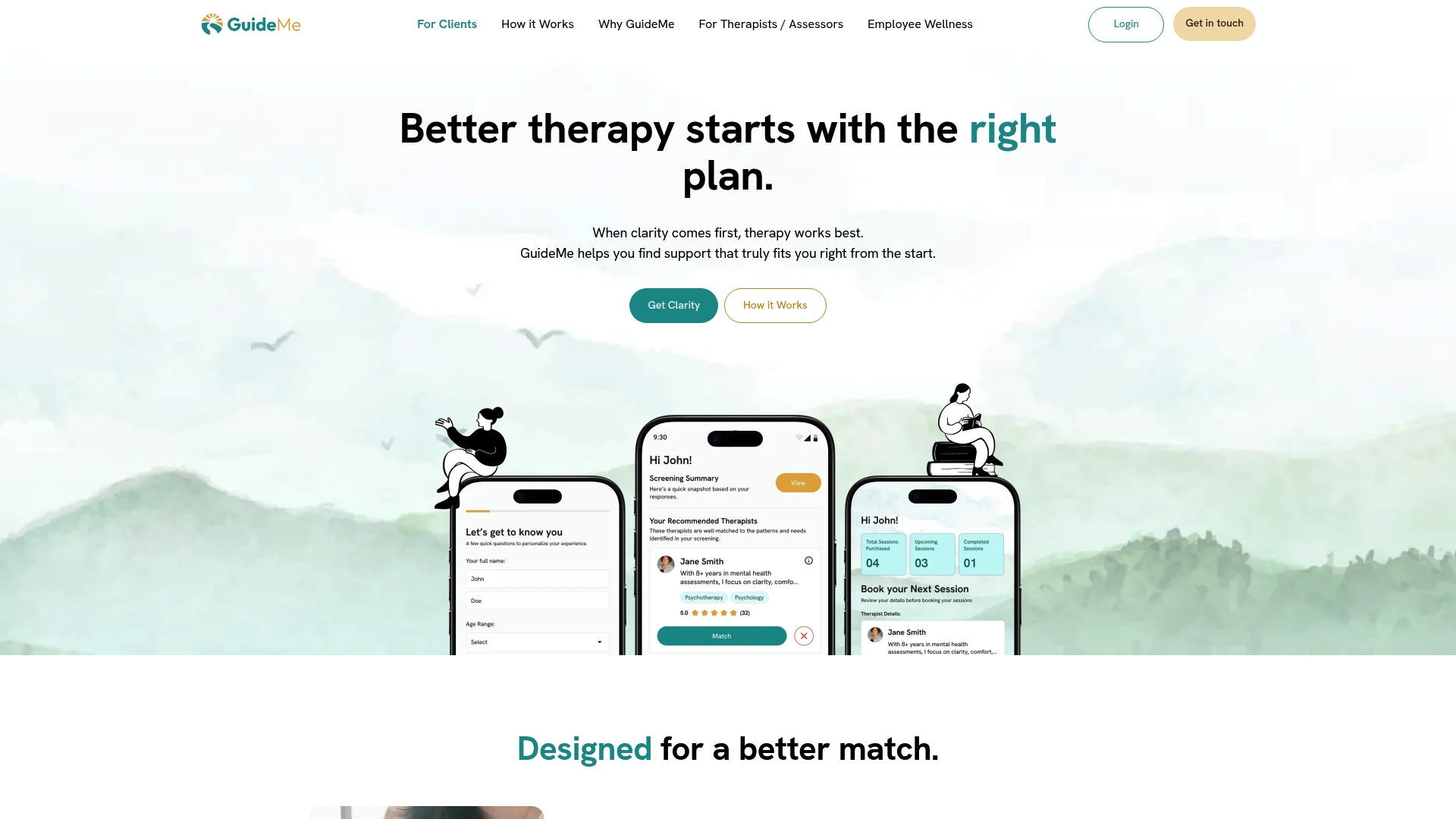
At GuideMe, we understand how confusing it can be to navigate the world of therapy and structured support. That is why we combine human expertise with intelligent matching to help you find the right therapist and the right format for your personal growth goals. Whether you are exploring therapist-guided workshops or looking for a full therapy plan, therapist-guided workshops at GuideMe are designed to match you with the right professional support from the very start. You do not have to figure this out alone. We are here to make the process straightforward, personal, and genuinely useful.
Frequently asked questions
How do therapist-guided workshops differ from self-help groups?
Therapist-guided workshops feature professional facilitation with structured goals and feedback, while self-help groups are peer-led and less formal. The key difference is the presence of professional goal alignment and structured support within a managed setting.
Is there strong evidence that therapist guidance always helps?
Research shows that guidance does not always produce better outcomes than self-help; context and personal fit are the key determining factors. The quality and relevance of the programme matter more than the mere presence of a therapist.
Can brief workshops be effective?
Pilot studies indicate that ultra-brief workshops are feasible alternatives and can be helpful, especially when time is a practical constraint, though further outcome data is still being gathered. Short, structured formats can serve as an accessible entry point to therapist-guided support.
What types of goals suit therapist-guided workshops best?
Goals that require personal feedback, social practice, or external accountability tend to benefit most from therapist input. Interpersonal skills, emotional regulation, and processing complex feelings are areas where professional facilitation typically adds the most value over self-guided approaches.