

TL;DR:
- Legal therapy support helps individuals manage stress during legal disputes without offering legal advice.
- Engaging early and choosing experienced therapists can improve mental health outcomes and court perceptions.
- Combining therapy with mediation or legal proceedings offers a layered approach that benefits emotional wellbeing.
Going through a legal dispute is one of the most stressful experiences a person can face. Whether you are dealing with a difficult divorce, a contested custody arrangement, or workplace harassment, the emotional toll can feel overwhelming. Many people focus entirely on the legal process and forget that their mental health needs attention too. Research shows that joint physical custody is linked to better child mental health outcomes, with 79.8% reporting good mental health compared to 67.9% in sole custody arrangements. Legal therapy support addresses this gap directly, giving you practical tools to protect your wellbeing while navigating the demands of the law.
Table of Contents
- What is legal therapy support?
- How therapy interacts with legal proceedings
- Comparing legal approaches: mediation, litigation, and therapy
- Applying legal therapy support to your situation
- What most guides miss about legal therapy support
- Discover supportive solutions for legal therapy
- Frequently asked questions
Key Takeaways
| Point | Details |
|---|---|
| Legal therapy defined | Legal therapy support helps individuals navigate mental health issues during legal matters by connecting legal and psychological expertise. |
| Evidence matters | Empirical studies show mediation resolves legal disputes more efficiently and supports child wellbeing, especially in custody cases. |
| Confidentiality is key | Therapy records are generally private unless explicitly released or court-ordered. |
| Choose wisely | Understanding each legal approach's risks and benefits is crucial to finding the right support for your situation. |
| Expert support available | Accessing specialised legal therapy can significantly improve outcomes and provide peace of mind during complex legal challenges. |
What is legal therapy support?
Legal therapy support is a term used to describe therapeutic services that are specifically relevant to people who are involved in legal proceedings. It does not mean that your therapist gives you legal advice. Instead, it means working with a trained mental health professional who understands how legal stress affects emotional wellbeing and can help you manage it constructively.
The professionals involved in this space include:
- Licensed therapists and counsellors who have experience working with individuals during divorce, custody disputes, or employment disputes
- Family mediators with mental health backgrounds who facilitate communication between parties
- Forensic psychologists who provide assessments for court proceedings
- Social workers embedded in legal or child welfare settings
Each of these professionals plays a distinct role, and understanding who does what helps you access the right support at the right time.
A key concept underpinning this field is therapeutic jurisprudence, which promotes the idea that law itself can have therapeutic or anti-therapeutic effects on individuals, and that legal processes should aim to minimise harm to mental health without compromising justice. This means that courts, legal professionals, and therapists increasingly work together to consider psychological outcomes alongside legal outcomes.
People who benefit most from therapy for legal situations include:
- Parents going through divorce or custody disputes who need support managing their own emotions while protecting their children's wellbeing
- Employees experiencing workplace harassment or unfair dismissal who face prolonged uncertainty and stress
- Individuals navigating domestic abuse situations where legal protection and mental health care must work together
- Children and young people who are caught up in adult legal disputes and need age-appropriate therapeutic support
Understanding who this type of support is for helps you recognise whether it applies to your own situation. Many people assume therapy is only for severe mental illness, but legal therapy support is for anyone experiencing significant stress connected to a legal matter.
Pro Tip: Be aware that therapy records are generally protected by legal privilege, meaning your therapist cannot be forced to share session notes without your consent or a court order. Always clarify this with your therapist before starting sessions if you are involved in legal proceedings.
How therapy interacts with legal proceedings
With an understanding of what legal therapy support is, let us look at how it plays out in real-life legal proceedings.
Therapy does not exist in isolation from the legal process. In many family law cases, therapy is actively encouraged or even ordered by the court. The most common scenarios where therapy intersects with legal matters include divorce and separation, child custody disputes, workplace harassment claims, and situations involving domestic abuse.
Here is a practical step-by-step overview of how to manage your mental health proactively during legal proceedings:
- Seek therapy early. Do not wait until you are in crisis. Starting therapy at the beginning of a legal dispute helps you build coping strategies before the most stressful moments arrive.
- Choose a therapist experienced in your situation. A therapist familiar with family law dynamics or employment disputes will understand the pressures you are facing without needing extensive background context from you.
- Understand confidentiality rules. Therapy records are privileged in divorce and custody cases, meaning they are generally protected unless you choose to waive that privilege or a court specifically orders disclosure.
- Communicate with your legal team. Let your solicitor know you are attending therapy. They may want to consider how this fits into your overall legal strategy.
- Keep a record of your attendance. Evidence that you are actively managing your mental health can be beneficial in custody proceedings.
- Focus on co-parenting skills if children are involved. Therapists can help both parents communicate more effectively for the benefit of the children, even when the adult relationship has broken down.
"Courts increasingly favour parents who take a proactive approach to managing their mental health, as this demonstrates stability and commitment to their children's welfare."
This proactive stance matters enormously in custody proceedings. Research confirms that courts favour proactive mental health management, particularly because the family court system focuses on the best interests of the child as its primary principle.
In workplace harassment cases, therapy plays a different but equally important role. An experienced therapist helps you process the psychological harm caused by harassment, build confidence before formal hearings, and maintain functioning in day-to-day life. The prolonged nature of employment disputes means that without therapeutic support, many people find that their mental health deteriorates significantly over months or even years of legal proceedings.

Pro Tip: If family therapy during legal disputes is relevant to your situation, look for therapists who specifically mention co-parenting support or family mediation on their profiles. This signals familiarity with the particular pressures you are navigating.
Comparing legal approaches: mediation, litigation, and therapy
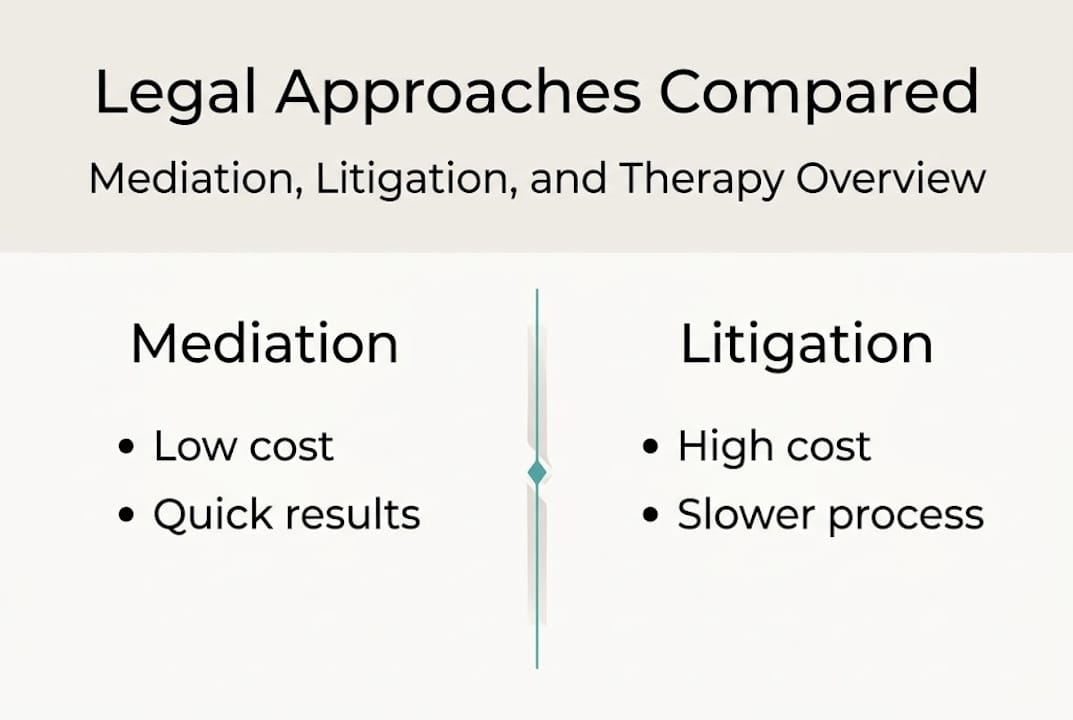
Understanding the role of therapy brings us to how different legal approaches impact outcomes and satisfaction. It is important to recognise that mediation, litigation, and therapy are not competing alternatives. They serve different purposes, but they interact in ways that affect the overall experience and outcome.
| Approach | Cost | Speed | Satisfaction | Therapy compatible? |
|---|---|---|---|---|
| Mediation | Lower | Faster | Generally higher | Yes, strongly |
| Litigation | Higher | Slower | Often lower | Yes, but more complex |
| Therapy alone | Lowest | Ongoing | High for wellbeing | Central to all |
| Combined approach | Moderate | Variable | Highest overall | By design |
Research shows that mediation resolves cases faster and at lower cost than litigation, with higher satisfaction rates reported by participants. Court triage systems, for example, resolve approximately 80% of cases within a single hearing when mediation is offered early. This is a significant finding because it suggests that most people who enter the court system do not actually need to go through a full trial.
Key statistic: 80% of family court cases referred to triage mediation resolve in a single hearing, compared to months or years of contested litigation.
However, it would be misleading to suggest that mediation is always the right choice. Critics note that therapy cannot replace specialist forensic roles such as court-ordered psychological assessments or expert witness reports. Similarly, mediation can be inappropriate when there is a significant power imbalance between parties, such as in situations involving domestic abuse or coercive control. In those cases, the protections offered by formal litigation may be essential.
The most effective outcomes tend to come from combining approaches. For example, a person going through a contested custody dispute might use:
- Individual therapy to process their own emotions and build resilience
- Mediation to negotiate practical arrangements with their former partner
- Litigation only if mediation fails or is unsafe
- Child-focused therapy to support the children separately
This layered approach recognises that legal disputes are rarely just legal problems. They are deeply human situations with emotional, relational, and practical dimensions that each require specific forms of support.
Applying legal therapy support to your situation
After weighing the different approaches, it is vital to know how to put legal therapy support into practice for your specific circumstances.
The first step is honest self-assessment. Ask yourself whether your current emotional state is affecting your decision-making, your parenting, your work performance, or your relationships. If the answer is yes to any of these, legal therapy support is likely to be helpful.
When preparing for therapy during a legal matter, consider the following checklist:
- Clarify your goals. Are you seeking emotional support, help with co-parenting, stress management, or all three?
- Research therapist credentials. Look for therapists who mention experience in family law contexts, divorce support, or workplace trauma.
- Discuss confidentiality upfront. Ask your therapist clearly how records are handled if your case goes to court.
- Inform your legal team. Your solicitor should know you are attending therapy so they can advise on any implications.
- Commit to regular sessions. Sporadic attendance limits the benefit. Consistent sessions build the coping capacity you need for sustained legal stress.
Research consistently shows that joint custody arrangements produce better mental health outcomes for children, and courts are increasingly aware of this evidence. Parents who demonstrate a willingness to support positive arrangements, and who show they are managing their own mental health responsibly, are viewed more favourably by family courts.
Here is a practical overview of common situations and recommended therapy approaches:
| Situation | Recommended therapy type | Key focus area |
|---|---|---|
| Divorce (without children) | Individual therapy | Grief, identity, decision-making |
| Contested custody | Individual + co-parenting therapy | Parental stability, communication |
| Workplace harassment | Trauma-focused therapy | Confidence, functioning, processing |
| Domestic abuse + legal action | Trauma therapy + safety planning | Safety, empowerment, recovery |
| Children in legal disputes | Child-focused or play therapy | Emotional expression, stability |
Pitfalls to avoid include using therapy as a substitute for expert legal advice. Your therapist supports your mental health; your solicitor handles the law. Confusing these roles can lead to misunderstandings about what your rights actually are.
Another common mistake is failing to consider confidentiality before disclosing sensitive information in sessions. While therapy is generally privileged, specific circumstances can complicate this. Understanding the rules in advance, with support from accessing legal support services, protects you from unintended consequences.
What most guides miss about legal therapy support
Most articles on this subject present legal therapy support as a straightforward, universally beneficial resource. The reality is more nuanced, and missing that nuance can lead to costly mistakes.
The first trap is assuming that therapy automatically improves legal outcomes. Attending therapy is a positive step, but it is not a guarantee that courts will rule in your favour. Courts consider many factors, and therapy is one piece of a much larger picture.
The second, and often underestimated, issue is power imbalance. Critics consistently note that neither therapy nor mediation can substitute for proper legal protection when one party holds significantly more power than the other. In cases involving financial coercion, emotional manipulation, or physical danger, insisting on mediation or therapy-led resolution can actually harm the more vulnerable party.
Practical wisdom here means being honest about the nature of your situation before choosing an approach. Not every dispute is a misunderstanding that good communication can resolve. Some situations require formal legal protection first, with therapy playing a supportive role throughout, rather than a central one. Choosing the right framework from the start protects both your mental health and your legal position.
Discover supportive solutions for legal therapy
If you are dealing with the stress of a legal dispute and are not sure where to begin with your mental health, you do not have to figure it out alone. Finding the right therapist for your specific situation makes a real difference to how well you cope and how clearly you think during difficult times.

GuideMe is a therapy navigation platform that is both human led and AI powered. It helps you understand your mental health needs with an in-depth therapy plan, then matches you with a therapist who genuinely fits your situation, including those experienced in legal contexts such as divorce, custody, or workplace disputes. If you are ready to take a practical next step, explore legal therapy support through GuideMe and find the right therapist from the very beginning.
Frequently asked questions
Is therapy confidential during legal proceedings?
Generally, therapy records are privileged unless waived by the client or specifically ordered by a court, meaning your therapist cannot be compelled to share session content without your knowledge.
Can legal therapy support influence custody decisions?
Yes. Courts favour parents who demonstrate proactive mental health management, as it signals stability and a commitment to the child's wellbeing.
Is mediation always better than litigation?
Not always. While mediation resolves cases faster and more cost-effectively in most situations, power imbalances can make mediation unsafe or unsuitable, in which case formal litigation provides necessary protection.
How can I find qualified legal therapy support?
Start by seeking therapists who specifically list experience with divorce, custody, or workplace disputes; check their credentials, read reviews, and ask upfront about how they handle confidentiality in legal contexts.