
Matching with a therapist who meets your clinical needs, communicates in your preferred format and aligns with your insurance or identity is often a muddled process in therapist matching software. Many platforms either limit network diversity, require you to navigate sparse profile details or lack clarity on insurance and session costs until late in the process. This article compares four therapist matching software solutions on evidence of matching accuracy, fee transparency and communication options so you can select one that reduces trial and error and supports ongoing engagement from the first session.
Table of Contents
GuideMe
At a Glance
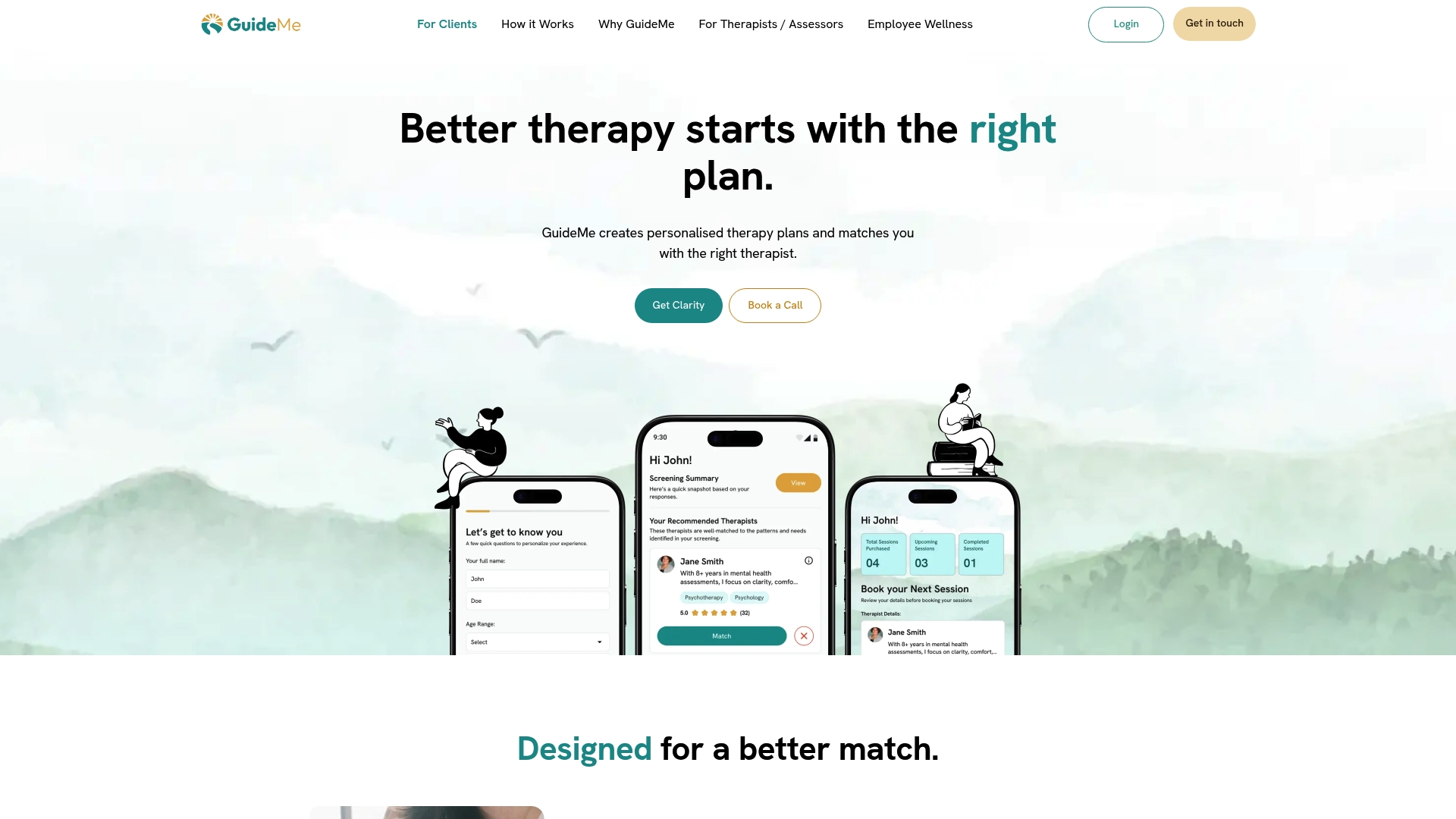
Human-led matching backed by AI, created and shaped by a practising psychotherapist, underpins GuideMe. The vendor advertises that this combination produces clearer therapy plans and reduces dropout rates while improving retention and outcomes.
Core Features
GuideMe starts with a structured intake that yields personalised therapy plans from the initial screening. That plan feeds a thoughtful therapist matching process that uses clinical judgement alongside automated suggestions.
The platform also offers ongoing member resources and check-ins, plus practice tools for therapists and assessors to manage referrals and client notes confidentially.
Key Differentiator
A practising psychotherapist designed the intake, plan and matching workflow. That clinical authorship shows through the platform's emphasis on a clear plan before referral rather than a blind therapist list, which changes how matches are chosen and explained to members.
Pros
-
Helps reduce mismatches. Members receive a written plan and explanatory notes, so the therapist and client start with shared objectives rather than guessing.
-
Supports clinicians. The platform provides onboarding and management tools that let therapists track progress and follow the plan supplied after screening.
-
Ongoing engagement. Regular check-ins and resources keep members active between sessions and make follow-up less ad hoc.
-
Clinically informed design. The intake and matching process reflects practising clinical thinking rather than a purely algorithmic profile match.
Cons
- Availability is region-dependent; international access and public pricing details are limited, so some potential members will need to confirm local coverage before committing.
Who It's For
Individuals who want a guided, clinically informed route into therapy rather than searching therapist directories alone. Also suitable for therapists and assessors seeking a platform that supplies screened referrals and a clear care plan to begin sessions faster.
Unique Value Proposition
Producing a clear, actionable therapy plan at screening changes the first session dynamic. Instead of using intake time to map problems and goals, the therapist can start with a shared brief from day one, which shortens early churn and raises the odds of sustained engagement.
That upfront plan also gives employers and referral partners a concise summary to discuss support without exposing clinical detail.
Real World Use Case
Someone unsure where to start completes GuideMe's screening in one sitting, receives a tailored plan outlining focus areas and suggested approaches, then gets matched to a therapist whose expertise aligns with the plan. The therapist begins work with a clear brief, reducing time spent on initial goal-setting.
Website: https://guidemetherapy.com
Mental Health Match

At a Glance
Accepts all major insurance providers, including in-network options, which makes finding a covered therapist easier for many people. The site also emphasises verified licence checks on every profile so you can confirm credentials before booking.
Core Features
The platform includes a vendor-advertised research-based matching survey that asks about symptoms, preferences, and practical constraints to suggest therapists. Detailed therapist pages list approach, specialisms, and whether they offer online or in-person sessions.
The directory verifies licence status for listed clinicians and provides insurance filtering so you can show only therapists who are in-network. Account creation is free for clients and therapists can onboard with documented credentials.
Key Differentiator
Combines referenced clinical research with a curated, verified directory so matches rest on profile detail rather than sparse bios. That emphasis on verifiable credentials and insurance filtering shapes the product toward clients prioritising professional accreditation and lower out-of-pocket costs.
Pros
-
Accessible free search: the platform is free for clients to use and lets you filter by insurance to reduce fees.
-
Clear verification: each therapist profile shows licence verification and listed approaches, which helps you evaluate clinical fit before contacting someone.
-
Flexibility of format: therapists indicate whether they offer online or in-person sessions, making it easy to find the format you prefer.
-
Therapist-facing onboarding: clinicians can create verified profiles quickly, which tends to surface actively practising professionals rather than dormant listings.
Cons
-
The vendor reports sparse and mixed user sentiment, with criticism aimed at perceived exclusionary policies toward certain professionals, so community experience may vary.
-
Some reviewers describe restrictive credentialing rules that appear to limit inclusion of alternative training or less conventional licenced backgrounds.
-
Fee transparency for clients paying out of pocket is thin; there is limited publicly available information about typical session costs.
When It May Not Fit
If you need full price transparency for self-paying therapy, this platform may frustrate. If your professional background falls outside common credential tracks you may find the onboarding rules limiting. Those are specific gaps to weigh before committing.
Who It's For
Clients who prioritise confirmed credentials and insurance coverage will find this useful. Therapists holding standard licences who want a channel to receive matched referrals will also benefit from the verified directory and simple onboarding.
Real World Use Case
Someone with social anxiety completes the matching survey, filters for clinicians who accept their insurer and offer online sessions, and receives a shortlist of verified therapists nearby. They message a chosen clinician and schedule a first appointment within days.
Website: https://mentalhealthmatch.com
Mind and Match
At a Glance
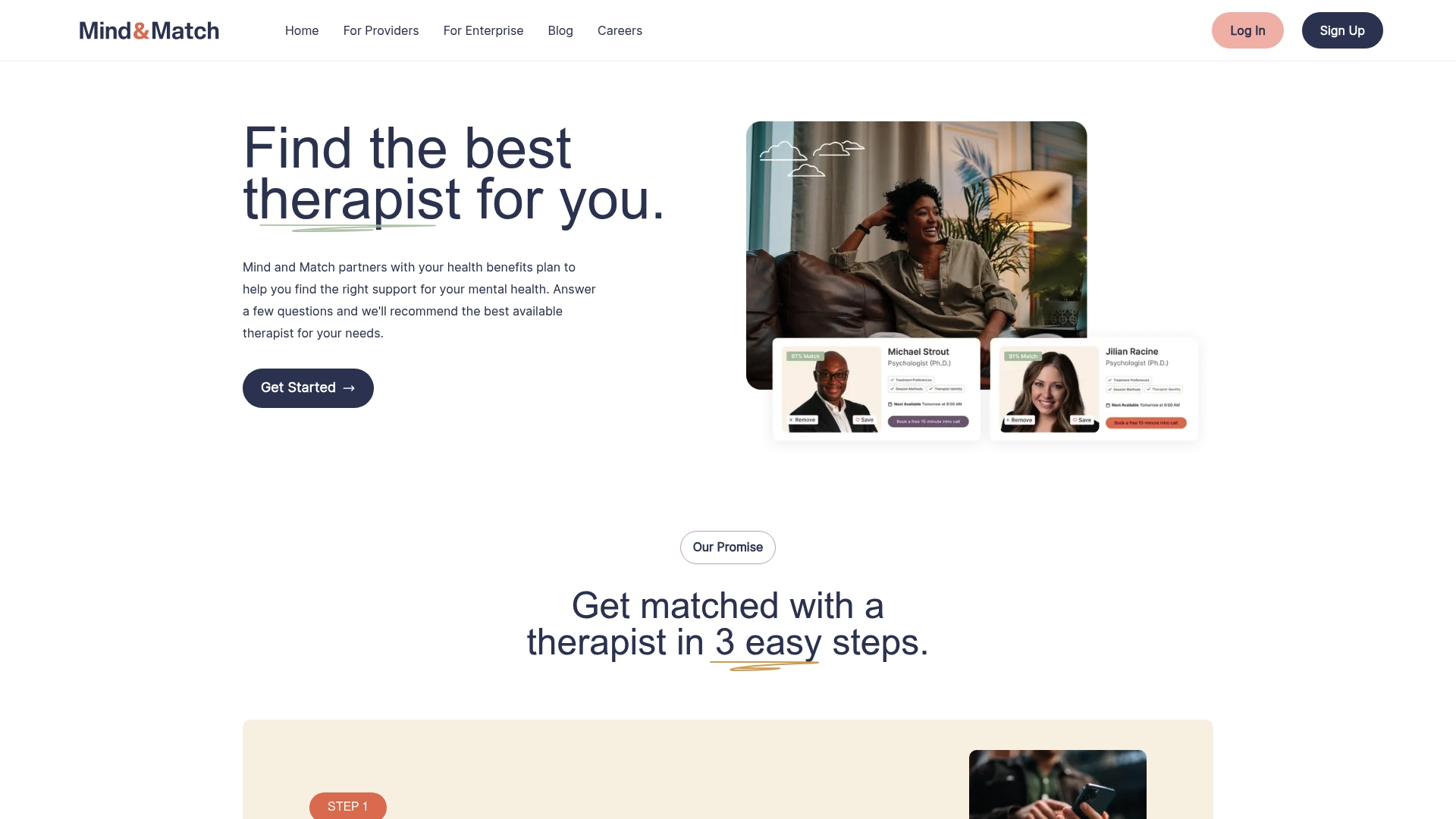
Mind and Match partners with health benefits plans and supports interstate telehealth while streamlining credentialling and reimbursement for in-network therapists. The vendor describes a research-driven matching algorithm that factors identity, treatment approach and in-session preferences to produce curated therapist suggestions.
Core Features
The platform opens with a quick preferences form that asks identity and therapy-style questions to narrow matches.
- Uses a research-driven matching algorithm to score therapists against those preferences.
- Lets you schedule a free intro call with shortlisted providers so you can verify fit before booking regular sessions.
- Limits its network to licensed psychologists and integrates with employer health benefits for in-network capacity expansion.
Key Differentiator
Mind and Match's central claim is that its matching logic weights identity preferences and therapy method equally with clinical fit, which aims to reduce mismatches early. That research focus sets it apart from directories that rely on self-reported specialties alone, though the claim originates in the vendor's own materials.
Pros
- Streamlined onboarding speeds you from sign up to intro call in under a week for most users. That reduces the usual friction of therapist searches.
- Personalised matches focus on identity and in-session preferences, not just checkbox specialisms, which can be helpful for minority identities seeking cultural fit.
- Easy online scheduling and integrated intro calls remove the need for dozens of emails to find availability.
- The network’s emphasis on licensed psychologists gives a single-provider type to compare, which simplifies expectations about training and scope of practice.
- Enterprise tools for credentialling and reimbursement mean employers can expand in-network access without building processes from scratch.
Cons
- Pricing and coverage details are not published publicly, so you will need to contact the company to learn cost or benefits compatibility.
- The platform is primarily telehealth-focused, so users who require or prefer in-person therapy will find options limited.
- Public third-party review data is sparse, which makes independent verification of user experience harder.
When It May Not Fit
If you want a very large, mixed network that includes counsellors, coaches and in-person providers, Mind and Match may feel narrow. Organisations that need transparent rate cards up front will have extra procurement work since pricing is not published.
Who It's For
Adults seeking teletherapy with licensed psychologists who value identity-aware and research-informed matching. Also useful for HR teams and benefits managers looking to increase in-network psychological capacity across states.
Real World Use Case
A user completes the brief preferences form, receives a shortlist of psychologists ranked by match score, books a free intro call and proceeds with weekly teletherapy. The process confirms stylistic fit before committing to a clinician.
Pricing
The vendor does not publish a standard retail pricing model. Pricing and in-network arrangements appear to be handled through direct inquiry with Mind and Match or via employer benefits partnerships.
Website: https://mindandmatch.com
BetterHelp
At a Glance
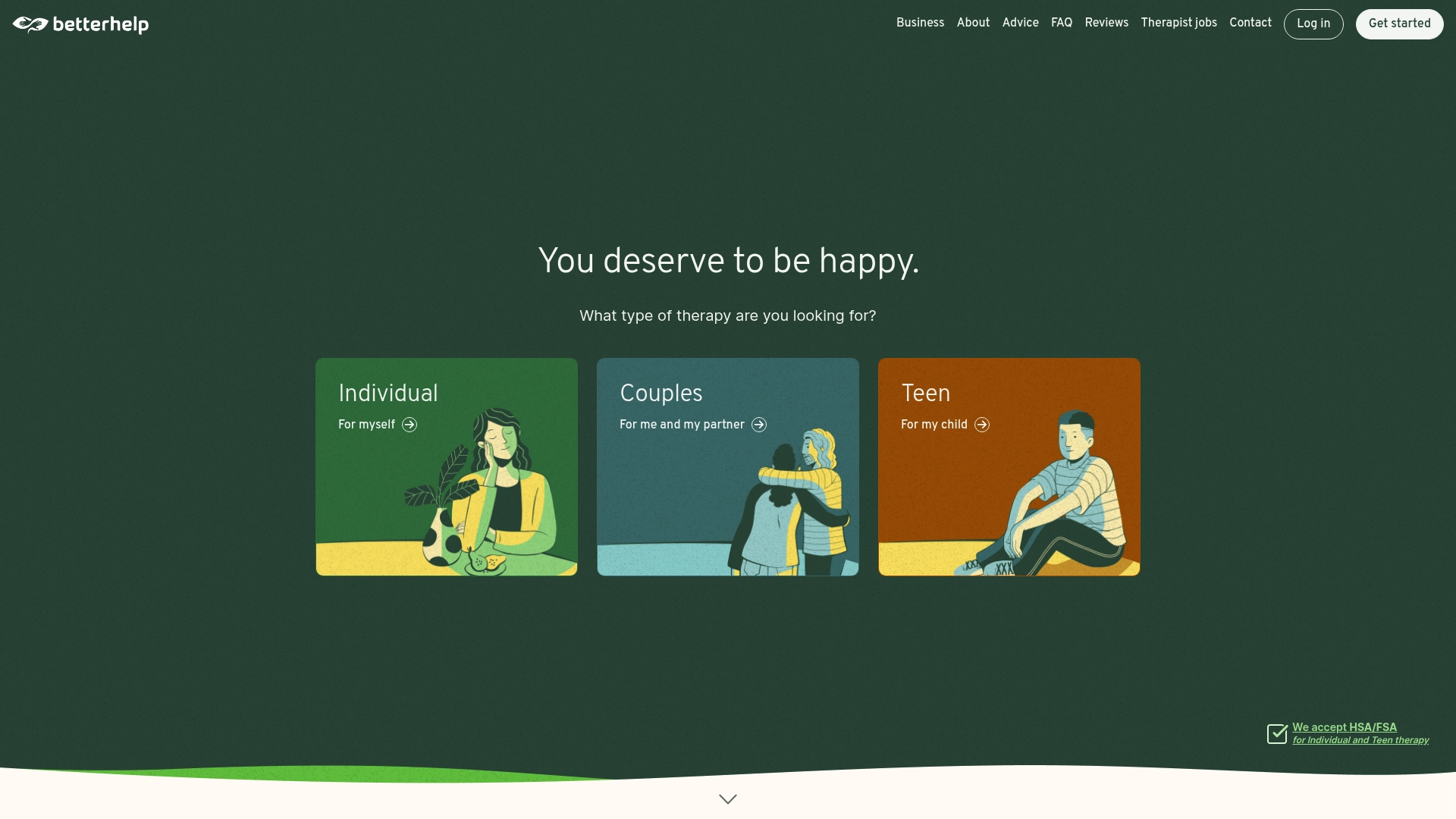
BetterHelp reports it has helped more than 5 million people since 2013 and claims a network of over 31,000 licenced providers. The platform centralises text, live chat, audio and video therapy so you can pick the format that fits your week.
Core Features
- Licenced therapists across disciplines: psychologists, LPCs, LCSWs and LMFTs available for matching.
- Multiple communication channels including messaging and scheduled video sessions so therapy fits shift work or travel.
- Digital worksheets and modules to complement sessions and track progress between meetings.
- Group sessions and live seminars run by therapists, plus flexible provider switching when relationships don’t fit.
Key Differentiator
BetterHelp’s scale is the signal: that provider network claim and the reported user reach underpin its matching algorithm and scheduling depth. Because the vendor advertises such scale, you can usually find therapists with niche specialisms or varied availability more quickly than on smaller platforms.
Pros
- Convenient access from any device lets you keep continuity when travel or work hours vary; the mix of messaging and video reduces missed sessions.
- The breadth of licenced providers increases the chance of a clinical fit for issues such as anxiety, depression, trauma or relationship work.
- Digital worksheets give tangible homework between sessions, helping therapy feel structured rather than ad hoc.
- Switching therapists is straightforward, which lowers the friction of finding a better therapeutic match without restarting the intake process.
- Group seminars add a lower-cost learning option for common concerns like sleep or stress management.
Cons
- Billing and cancellation processes have been reported as opaque; some users describe unexpected charges or difficulty pausing subscriptions.
- Customer support responsiveness varies, so resolving payment or scheduling problems can take longer than expected.
- Matching and therapist availability do not always meet every user’s timing or specialty needs despite the platform’s scale claim.
- Insurance integration is inconsistent, which means some users face higher out-of-pocket costs for ongoing care.
When It May Not Fit
If you need an official diagnosis for legal or medical processes, BetterHelp is limited; its service is not set up for court-ordered assessments or forensic evaluations. For urgent or crisis care the platform is not appropriate; emergency services or local crisis teams are the correct route.
Who It's For
Adults, teens and couples who prefer online therapy and want flexible communication options. It suits people juggling shift work, frequent travel or caregiving responsibilities who value quick access to licenced clinicians rather than in-person appointments.
Real World Use Case
A busy software engineer uses messaging for day-to-day check-ins and a 50-minute video slot fortnightly. That blend keeps momentum between sessions and avoids taking time off work for face-to-face appointments, making regular therapy feasible.
Pricing
Plans typically range between $70 and $100 per week, billed monthly, with some plans compatible with certain insurance providers. Exact cost varies by region and therapist availability.
Website: https://betterhelp.com
<|markdown## Therapist Matching Platform Analysis
Selecting a suitable therapist matching platform can significantly influence the quality of care and satisfaction. Each platform offers distinct features that prioritise different user needs.
Matching Methods and Personalisation
GuideMe presents a unique approach by combining clinical expertise with algorithmic suggestions. Its process includes generating a written therapy plan during the intake stage, which supports therapists and clients in achieving focused initial sessions. In comparison, Mind and Match emphasises user preferences, such as therapy style and identity, in its match scores, which is beneficial when trust-building and compatibility hold primary importance. While Mental Health Match and BetterHelp rely on broad matching criteria and therapist search capabilities, GuideMe's structured pre-session documentation enables a higher degree of personalisation and preparedness.
Access, Scale, and Flexibility
BetterHelp provides breadth with its extensive network of caregivers, covering vastly varied specialisms and practical access scenarios via video, text, or chat-based therapy options. This scalability supports clients with diverse and niche requirements. Conversely, GuideMe and Mind and Match focus on well-defined optimised networks instead of maximising therapist variety. Mental Health Match balances these by offering search tools grounded in credential verification and insurance integration, ensuring quality control yet accommodating a reasonable volume of choices. This breadth facilitates users who care about convenience paired with selection.
Pricing Transparency and Insurance Compatibility
The pricing models and insurance handling vary across all platforms. Mental Health Match provides accessible information for in-network searches, supporting cost-conscious users. In contrast, GuideMe and Mind and Match require verifying coverage individually, potentially adding steps to cost evaluation. BetterHelp generally functions on out-of-pocket arrangements but publishes estimated costs, aiding budgeting reliability across its vast service model.
Best Fit Recommendations
- GuideMe: Excelling in users seeking detailed therapy plans structured around initial assessments for improved therapist-client collaboration.
- BetterHelp: Catering to diverse needs with asynchronous communication and session format flexibility across a large provider network.
- Mental Health Match: Addressing practicality by enabling insurance filtering and employing credential verification for quality assurance.
- Mind and Match: Focusing on telehealth clients valuing identity-conscious matching.
Our Pick Recommendation
GuideMe is in its ability to prepare clients and therapists prior to the consultation phase, positioning the cared experience early. However, for extensive networks or flexible pricing assurance, platforms like BetterHelp or Mental Health Match meet those edges effectively, demonstrating that the "right choice" is situational.
Therapist Matching Platforms Comparison
Choosing the right therapist matching platform involves evaluating the balance of features, user support, and pricing transparency that best suits individual needs.
| Product Name | Key Differentiator | Best For | Pricing | Notable Limitation |
|---|---|---|---|---|
| Guidemetherapy | Clinically authored therapy intake and matching workflow | Guided therapy entry and clinician support | Not disclosed | Regional service limitations |
| Mental Health Match | Verified therapist credentials and insurance filtering | Insurance-prioritised directory searches | Not disclosed | Limited transparency for self-pay session fees |
| Mind and Match | Research-driven algorithm prioritising identity and session preferences | Teletherapy with licensed psychologists | Not disclosed | Primarily telehealth-focused with limited reviews |
| BetterHelp | Large therapist network with flexible session formats | Busy individuals preferring online sessions | $70-$100/week | Inconsistent insurance integration and support |
Find Your Ideal Therapist with Guidemetherapy for a Clearer Start
Choosing the right therapist without guessing can feel overwhelming, especially when many platforms only offer lists without a clear plan. The article highlights how crucial it is to have a structured intake and a personalised therapy plan from the beginning to reduce mismatches and improve engagement.
Guidemetherapy offers exactly that human-led and AI-powered guidance to create a therapy plan tailored to you before you even meet your therapist. This approach ensures you start with shared objectives rather than uncertainty.
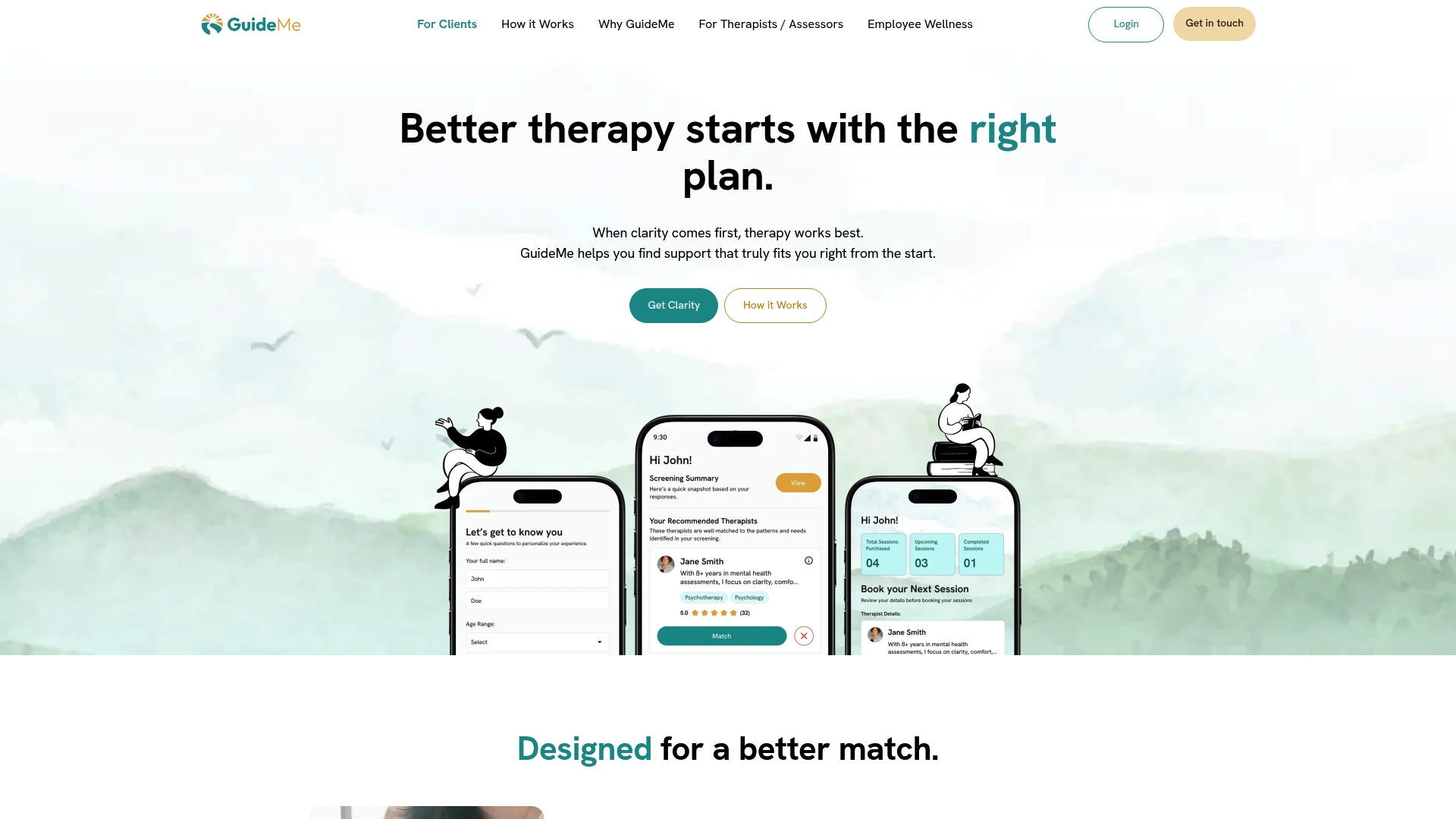
Take control of your mental health by visiting Guidemetherapy and complete their screening to receive your personalised therapy plan and therapist match today. Stop guessing and begin your sessions with confidence and clarity.
Frequently Asked Questions
How does Guidemetherapy improve therapy outcomes?
Guidemetherapy generates personalised therapy plans from each screening, which helps members and therapists start on the same page. This is enabled by its structured intake process that yields clearer plans before referrals. Using a clear therapy plan increases engagement and reduces dropout rates for clients.
What is the difference between BetterHelp and Guidemetherapy?
BetterHelp offers a diverse network of over 31,000 licensed providers, enhancing the chances of finding a therapist who meets specific needs. Guidemetherapy, on the other hand, focuses on producing personalised therapy plans upfront, which helps establish shared objectives and improves the initial session's dynamic.
Which platform provides ongoing member support?
Guidemetherapy includes regular check-ins and resources to help keep members engaged between therapy sessions. These ongoing member resources are designed to facilitate continuity and make follow-ups more effective.
Can I use Mind and Match if I prefer in-person therapy sessions?
Mind and Match is primarily telehealth-focused and may have limited options for in-person therapy sessions. Users seeking face-to-face interactions would benefit from considering Guidemetherapy, which does not limit therapist connections based on format constraints.
Does Mental Health Match support verification of therapist credentials?
Yes, Mental Health Match verifies the licence status of listed clinicians, ensuring that users can confirm the credentials of therapists before booking. This feature complements Guidemetherapy's focus on matching clients with therapists based on clinical judgement and automated suggestions.