

TL;DR:
- Mindfulness in therapy involves structured, evidence-based skills that help individuals relate differently to their thoughts and feelings. Its effectiveness relies on a combination of attention monitoring, experiential acceptance, and psychoeducation, not just meditation practice. While beneficial for many, mindfulness requires patience, proper sequencing, and skilled guidance to achieve lasting emotional and cognitive change.
Mindfulness is widely talked about, yet widely misunderstood. Many people assume it simply means sitting quietly and focusing on your breath, or that it is a self-help technique you practise on a meditation app. In a therapeutic context, mindfulness is something quite different. It is a structured, evidence-backed set of skills that trained therapists use to help people relate differently to their thoughts, feelings, and physical sensations. This article explains what mindfulness really means in therapy, how it works scientifically, what the evidence says about its effectiveness, and where its genuine limits lie.
Table of Contents
- What is mindfulness and how does it feature in therapy?
- How mindfulness-based interventions work: The science explained
- How effective is mindfulness for mental health?
- Limits, debates and practical considerations
- Why the real power of mindfulness is often underappreciated
- Explore therapy options with mindfulness at their core
- Frequently asked questions
Key Takeaways
| Point | Details |
|---|---|
| Not just meditation | Therapeutic mindfulness involves various structured programmes that go beyond meditation to include education and practical skill-building. |
| Multiple mechanisms | Mindfulness supports mental health by improving attention, encouraging acceptance, and helping regulate emotions. |
| Evidence suggests moderate impact | Research indicates mindfulness-based therapies can moderately reduce symptoms, especially in depression, but results vary. |
| Personalised approach matters | Adapting mindfulness techniques with a therapist’s support maximises effectiveness and avoids common pitfalls. |
What is mindfulness and how does it feature in therapy?
Mindfulness, in a clinical sense, refers to intentional, present-moment awareness practised with a non-judgmental attitude. That is the core definition used across therapy settings. But what actually happens in mindfulness-informed therapy goes well beyond guided meditation.
Mindfulness-based interventions (MBIs) are structured programmes that train people in present-moment attention alongside an attitude of non-judgment and acceptance. The most widely studied MBIs include Mindfulness-Based Cognitive Therapy (MBCT) and Mindfulness-Based Stress Reduction (MBSR). Both follow a structured format, typically delivered over eight weeks, and combine formal meditation practices with psychoeducation and informal daily exercises. Critically, research suggests their therapeutic effects depend on multiple mechanisms, not meditation practice alone.
There is an important distinction between informal mindfulness and structured MBIs:
- Informal mindfulness means bringing moment-to-moment awareness into everyday activities, such as eating, walking, or listening to someone speak, without formal practice.
- Structured MBIs are clinical programmes with a defined curriculum, homework components, group or individual sessions, and psychoeducation about how the mind and emotions work.
- Psychoeducation forms a core part of MBIs. Clients learn why their minds behave the way they do, not just how to breathe differently.
- Daily integration is emphasised throughout. The goal is to make mindful awareness part of ordinary life, not a separate activity reserved for practice sessions.
You can explore MBIs in practice to understand how these interventions are embedded within broader therapy plans.
"Mindfulness programmes work because of a combination of factors: the meditation practice itself, the psychoeducational content, informal practice in daily life, and the cultivation of attentional and acceptance skills. Reducing the approach to 'just meditation' misses much of what makes it clinically meaningful."
Learning about mindfulness therapy methods can help you understand which specific approach might suit your needs before you begin working with a therapist. The range of methods available means that mindfulness-informed therapy is considerably more varied and adaptable than most people initially expect.
How mindfulness-based interventions work: The science explained
Understanding why mindfulness produces change in therapy requires moving past the surface-level idea that relaxation is the goal. The science points to specific psychological mechanisms, and they are more nuanced than many popular accounts suggest.
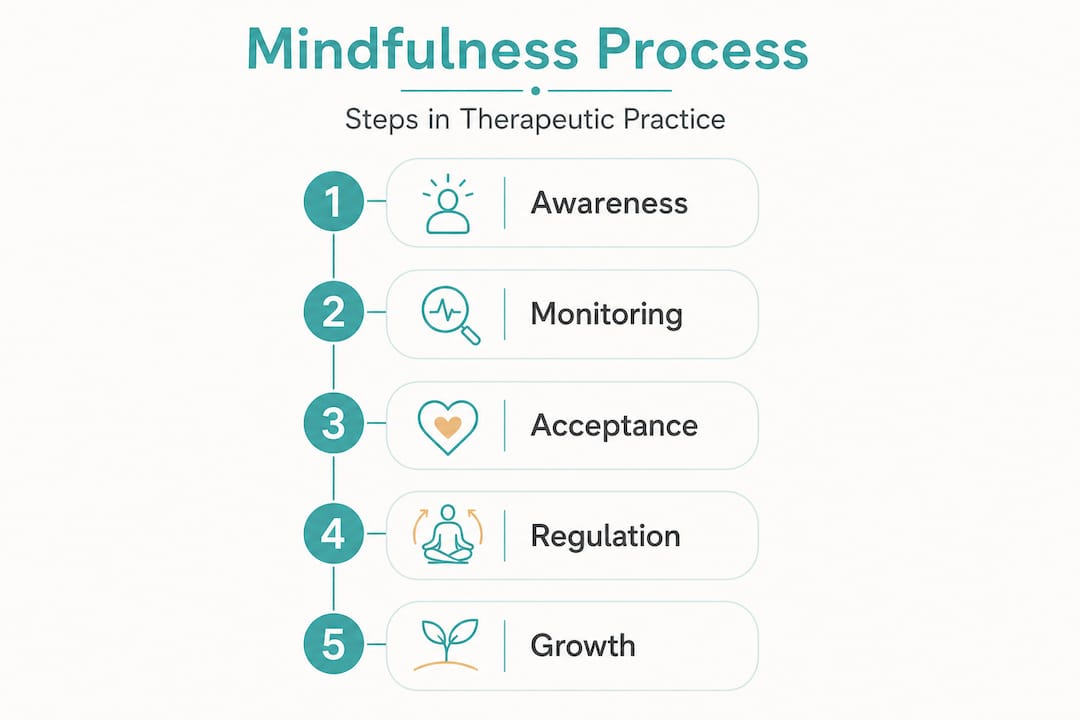
One of the most important theoretical frameworks is Monitor and Acceptance Theory, or MAT. This theory proposes that two distinct but interrelated skills drive the effects of mindfulness training: attention monitoring and experiential acceptance. MAT research defines attention monitoring as the ongoing awareness of present-moment sensory and perceptual experiences, drawing on selective and executive attention networks in the brain. Experiential acceptance is defined as a non-judgmental, open, and receptive stance towards whatever arises in awareness.
Crucially, MAT predicts that these are dissociable skills. A person can practise attention monitoring without acceptance, and the theory warns this can initially increase agitation or distress. This is why therapists carefully sequence skill-building across sessions rather than simply encouraging more meditation from the outset.
The table below summarises how these mechanisms compare:
| Mechanism | What it involves | Therapeutic function | Potential risk without balance |
|---|---|---|---|
| Attention monitoring | Noticing present-moment experience via selective attention | Builds awareness of patterns and triggers | May heighten distress if practised alone |
| Experiential acceptance | Non-judgmental openness towards thoughts and feelings | Reduces avoidance and emotional reactivity | Less effective without awareness first |
| Emotion regulation | Changing how you relate to emotional states | Decreases intensity of distressing emotions | Requires both monitoring and acceptance |
| Cognitive shifts | Noticing thoughts as mental events, not facts | Reduces rumination and self-critical thinking | Needs psychoeducation to support insight |
Pro Tip: If you have ever tried mindfulness and found it made you feel more anxious, you are not alone and you have not failed. This is a well-documented effect when monitoring is practised without the acceptance component. A skilled therapist can help you rebalance and build both skills together.
There is also strong evidence linking mindfulness practice to changes in attentional regulation, a core cognitive function involved in how we focus and shift attention deliberately. Learning to modulate attention in therapy supports clients in stepping back from rumination, a mental pattern strongly associated with both depression and anxiety. Exploring stress reduction techniques can give you a practical sense of how attention-based training fits into a broader wellbeing plan.

How effective is mindfulness for mental health?
The evidence for mindfulness-based interventions is genuinely substantial, but it requires careful reading. Mindfulness is not a universal cure, and the strength of its effects depends on a number of important variables.
For depression specifically, Mindfulness-Based Cognitive Therapy has the strongest evidence base. A UK-based randomised controlled trial found that MBCT improved outcomes for people with depression who had not experienced remission after prior psychological treatment through NHS Talking Therapies. The study is significant because it reflects real-world clinical conditions rather than ideal laboratory settings. It also highlights that approximately 50% of people do not achieve remission through standard stepped care pathways alone, underscoring the need for further treatment options.
More broadly, a meta-analysis of randomised trials found that mindfulness-based interventions are effective in reducing depressive symptoms across different diagnoses, with effect sizes ranging from small to large. This transdiagnostic finding is important. It means MBIs may offer benefit not only for those with a formal diagnosis of depression but also for people experiencing depressive symptoms alongside other conditions.
Several factors shape how effective MBIs are likely to be for any given person:
- Intervention type: MBCT and MBSR have distinct structures and aims. MBCT was specifically designed for recurrent depression, whilst MBSR targets stress-related conditions more broadly.
- Adherence and home practice: Research consistently shows that clients who engage with between-session exercises benefit more than those who only attend sessions.
- Study quality: Many positive findings come from studies with small samples or limited controls. The most robust evidence comes from well-designed randomised trials.
- Comparator conditions: Effect sizes often differ depending on whether MBIs are compared to a waiting list, treatment as usual, or another active therapy.
- Individual fit: A person's baseline symptoms, previous therapy experience, and readiness to engage with present-moment practices all affect outcomes.
"The evidence for mindfulness-based interventions continues to grow, but the honest clinical picture is one of moderate average effects with meaningful variation. It works well for many people and is worth considering, particularly as a further-line option when previous treatments have not produced remission."
This measured assessment matters because it helps you set realistic expectations. Mindfulness-informed therapy is likely to support your wellbeing meaningfully, but it works best when it is part of a thoughtfully constructed treatment plan rather than a standalone quick fix.
Limits, debates and practical considerations
Mindfulness in therapy is well-supported by evidence, but there are genuine debates among researchers and clinicians that are worth knowing about before you begin.
One significant area of discussion concerns how well mindfulness can be combined with cognitive-behavioural therapy (CBT). Conceptual critiques suggest that mindfulness and CBT may have different, and at times conflicting, philosophical aims. CBT traditionally focuses on identifying and changing the content of unhelpful thoughts. Mindfulness, by contrast, encourages a stance of observing thoughts without attempting to change them. This tension is not always resolved neatly in practice, and different therapists navigate it in different ways.
There are also practical limits to consider:
- Not everyone benefits equally. People with certain trauma histories or dissociative symptoms may find present-moment attention practices uncomfortable or destabilising without careful therapeutic support.
- Initial discomfort is common. As MAT research predicts, beginning to notice your thoughts and feelings more clearly can feel confronting before it feels helpful. This is normal, but it is important to flag with your therapist.
- MBIs require commitment. Eight-week structured programmes with home practice requirements suit some people but not others. There are shorter and more flexible formats available, but these may have different levels of evidence behind them.
- Cultural fit matters. Mindfulness practices have roots in Buddhist traditions, and some adaptations for Western clinical settings are more culturally neutral than others. It is worth discussing this with a therapist if it is relevant to you.
- Access and cost vary. MBCT is available in some NHS services, but access is not universal and waiting times can be lengthy.
Pro Tip: Before beginning any mindfulness-based programme, ask your therapist how they plan to sequence monitoring and acceptance skills. A thoughtful answer signals they understand the evidence and will support you appropriately if initial discomfort arises.
If you are considering exploring mindfulness-informed therapy, a good first step is to gain an overview of mindfulness-based interventions and understand which formats might suit your current situation and goals. Being informed means you can have more productive conversations with a therapist from the outset.
Why the real power of mindfulness is often underappreciated
Most articles about mindfulness in therapy focus on what it is and whether it works. Fewer ask a more interesting question: why do so many people underestimate what it can actually offer?
The honest answer is that the cultural conversation around mindfulness has done the clinical reality something of a disservice. When mindfulness is packaged as an app, a wellbeing trend, or a five-minute breathing exercise, it creates an expectation of immediacy. People try it, feel that nothing much has changed after a week, and conclude it is not for them. That experience is understandable, but it misses the point.
The real value of mindfulness in therapy lies in what happens over time, with skilled support. Attentional regulation, experiential acceptance, and emotional flexibility are learnable skills. Like any skill, they develop gradually through consistent practice and thoughtful integration into daily life. A knowledgeable therapist does not simply introduce mindfulness and step back. They sequence the skill-building carefully, help you notice when avoidance creeps in, and support you in adapting practices to your specific patterns and needs.
There is also something important in recognising that the benefits of mindfulness training extend well beyond symptom reduction. People who build genuine mindfulness skills often report lasting changes in how they relate to difficulty. Not because difficult things stop happening, but because they have developed a different relationship with their own inner experience. That kind of change is not dramatic or immediate. It is quiet, steady, and often more durable than the relief that comes from any single therapeutic technique.
The public appetite for fast results and clear formulas is entirely human and understandable. But if you are actively seeking therapy and you want to know whether mindfulness is worth your time, the more useful question is: are you prepared to practise a set of skills with patience, and do you have the right support around you? When the answer to both is yes, the evidence suggests the investment is worthwhile.
For practical mindfulness advice that connects you to the right therapeutic support, taking a personalised approach from the beginning makes a real difference.
Explore therapy options with mindfulness at their core
If this article has helped you understand what mindfulness in therapy actually involves, you may be wondering what a next step looks like. Knowing the evidence is one thing. Finding the right therapist and the right approach for your specific situation is another.

GuideMe is built to help you do exactly that. As a therapy navigation platform that is human led and AI powered, GuideMe creates an in-depth therapy plan tailored to your mental health needs, then matches you with a therapist who is genuinely suited to your goals. Whether you are interested in mindfulness-based therapy options like MBCT or MBSR, or you want to explore how mindfulness might complement another approach, GuideMe helps you move from feeling uncertain to making clearer, more confident choices about your care. The right support, from the right therapist, changes the experience of therapy entirely.
Frequently asked questions
Can mindfulness-based therapy work for anxiety as well as depression?
Mindfulness-based interventions have demonstrated benefits for both anxiety and depression, with a transdiagnostic evidence base showing effect sizes ranging from small to large depending on the individual and the specific programme used.
Is mindfulness therapy suitable for everyone?
Mindfulness is broadly helpful but not universally appropriate. Some people may initially find that attention monitoring alone increases distress, which is why it is important to work with a therapist who can tailor the approach to your particular needs and readiness.
How long does it take to see results from mindfulness in therapy?
Most people begin to notice meaningful changes after several weeks of consistent practice. However, research consistently shows that effects depend on intervention components, adherence, and individual factors rather than following a fixed timeline.
Can mindfulness in therapy be used alongside traditional talking therapies?
Mindfulness can complement other therapeutic approaches, but it is worth knowing that some conceptual tensions exist between mindfulness aims and CBT's content-change philosophy, making therapist experience in integrating both approaches an important factor.