

Supporting someone through therapy is one of the most meaningful things you can do, but it can also feel uncertain. You want to help, yet you're unsure what that actually looks like in practice. Too much involvement can feel intrusive; too little can feel like abandonment. The good news is that evidence shows the right kind of support genuinely improves outcomes. Research confirms that family involvement improves functioning and reduces the burden on the person receiving care. This guide gives you clear, practical steps to become a positive, grounded presence in someone's therapeutic journey.
Table of Contents
- Understanding your role as a supporter
- Preparing to support: What you need to know first
- Step-by-step: How to actively support therapy clients
- Avoiding common pitfalls and knowing your limits
- Measuring progress and adjusting your approach
- A fresh perspective on supporting therapy clients
- Connect with resources to enhance your support
- Frequently asked questions
Key Takeaways
| Point | Details |
|---|---|
| Family involvement matters | Supportive family or friends can boost therapy outcomes and lower crisis risk. |
| Preparation is key | Know your boundaries, resources, and communication tools before supporting someone in therapy. |
| Active support strategies | Use goal-setting, strengths focus, and open dialogue to help therapy clients progress. |
| Self-care for supporters | Look after your own wellbeing and seek help when needed to continue effective support. |
Understanding your role as a supporter
Having set the stage for the importance of support, let's clarify what that role really looks like in practice. Being a supporter does not mean becoming a therapist. Your role is to listen, encourage, and create a safe space, not to diagnose, advise, or fix.
This distinction matters. When supporters try to take on a therapeutic role, it often creates pressure for the person in therapy and can undermine the professional work already happening. Your value lies in consistency and care, not clinical expertise.
Research is clear on the benefits of getting this right. Family interventions reduce perceived criticism from relatives, improve functioning, and lower hospitalisation rates. That is a significant finding. It means your involvement, when done well, can have measurable, real-world impact.
"The most powerful thing a supporter can offer is a non-judgemental presence. You do not need to have the answers. You just need to show up consistently."
Here are the core principles of a healthy supportive role:
- Listen actively without interrupting or redirecting the conversation to your own experiences
- Encourage attendance and engagement with therapy without pressuring or monitoring
- Respect confidentiality and avoid asking probing questions about session content
- Avoid offering unsolicited solutions, especially ones framed as "have you tried just..."
- Do not project your expectations onto their recovery timeline or progress
Multicomponent approaches, which combine emotional support with practical help and education, consistently outperform simple information-giving. Exploring family education programmes can give you structured ways to build these skills rather than relying on instinct alone.
Preparing to support: What you need to know first
Once you understand your unique place in the process, it is important to be well prepared before offering hands-on support. Jumping in without preparation can lead to well-meaning but unhelpful behaviour.

Start by learning the basics. Confidentiality is one of the most important principles in therapy. The person you are supporting has the right to privacy about what they discuss with their therapist. Understanding this upfront prevents friction later.
Multicomponent interventions consistently outperform psychoeducation alone, which means combining emotional readiness with practical tools gives you a stronger foundation. Here is a quick overview of useful resources:
| Resource type | Example | Purpose |
|---|---|---|
| Reading materials | Mental health guides, therapy explainers | Build your understanding of the process |
| Support groups | Carer support networks, peer forums | Share experiences and reduce isolation |
| Helplines | Mind, Samaritans, Rethink | Access immediate guidance or crisis support |
| Online platforms | Therapy resources | Navigate therapy options and planning tools |
Before you offer support, prepare yourself emotionally too. Ask yourself whether you have the capacity right now. Supporting someone else while you are struggling is unsustainable and can lead to resentment or burnout.
Key things to learn before stepping in:
- What confidentiality means and why it must be respected
- How to practise active listening without offering judgement
- Where your boundaries are and how to communicate them kindly
- What the person you are supporting actually wants from you
Pro Tip: Have an open, honest conversation with your loved one before offering support. Ask them directly: "What would be most helpful for you right now?" Their answer might surprise you, and it will make your support far more effective.
Step-by-step: How to actively support therapy clients
Armed with preparation and understanding, you are ready to put support into action using these evidence-based steps. Effective support is not passive. It involves deliberate, thoughtful actions that reinforce the work happening in therapy.
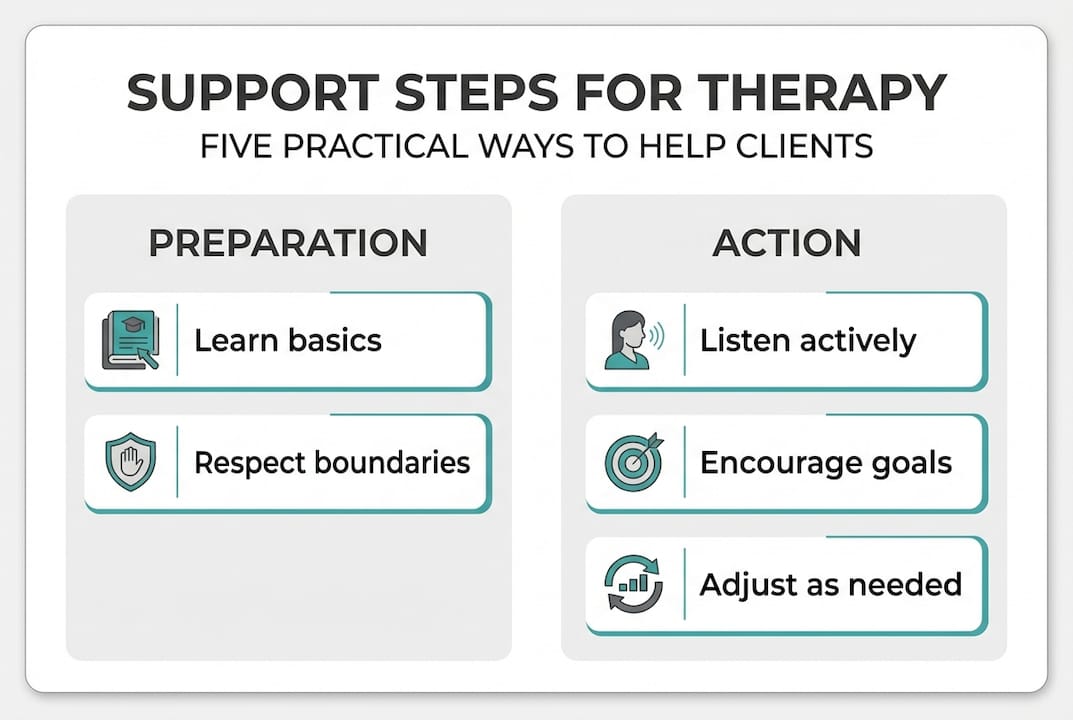
Therapists are encouraged to use collaborative goal-setting and strengths-focused approaches with clients, and research shows that family support amplifies these techniques significantly. You can mirror this at home.
Follow these steps to provide meaningful, active support:
- Ask open questions. Instead of "Are you feeling better?", try "How have things been feeling for you this week?" Open questions invite reflection rather than yes or no answers.
- Set small goals together. If your loved one is working on a specific challenge, ask if there is anything you can do to support that goal. Keep it collaborative, not directive.
- Focus on strengths. Notice and name what they are doing well. Progress in therapy is often slow, and acknowledgement of small wins matters enormously.
- Celebrate progress, however small. Recognising effort, not just outcomes, reinforces motivation and builds confidence.
- Attend a family education programme if one is available. These structured sessions teach motivational strategies and communication skills that directly support the therapeutic process.
- Stay consistent. Show up in the same reliable way each week rather than offering intense support sporadically.
Pro Tip: Use "I" statements when discussing difficult topics. Saying "I feel worried when I don't hear from you" is far less likely to trigger defensiveness than "You never tell me how you are doing."
For broader therapy guidance on how to navigate the support process, structured platforms can help you stay informed without overstepping.
Avoiding common pitfalls and knowing your limits
While active support is powerful, it is equally essential to notice common missteps and take care of yourself in the process. Even the most well-intentioned supporters can slip into patterns that are unhelpful or even harmful.
| Supportive action | Overstepping or unhelpful action |
|---|---|
| Listening without judgement | Telling them what they should feel |
| Encouraging therapy attendance | Demanding updates on session content |
| Offering practical help when asked | Taking over decisions for them |
| Checking in regularly | Monitoring their behaviour constantly |
| Sharing your own feelings calmly | Making their recovery about your needs |
Recognise when you are doing too much. Signs include feeling responsible for their progress, becoming anxious when they have a difficult week, or neglecting your own needs entirely. These are signals to step back and reassess.
You also need support. Evidence-based education for supporters through programmes like NAMI's Family-to-Family teaches coping strategies and self-care specifically for people in your position. These are not optional extras. They are essential.
Signs you may need to access support resources for yourself:
- You feel emotionally exhausted after interactions
- You are losing sleep over their situation
- You feel resentful or frustrated more often than not
- Your own mental health is declining
"You cannot pour from an empty cup. Supporting someone else sustainably requires that you attend to your own wellbeing with the same care and consistency."
Measuring progress and adjusting your approach
After thoughtful action and attention to boundaries, it is time to consider results and keep improving your supportive efforts. Progress in therapy is rarely linear, and your role as a supporter will need to evolve over time.
Family interventions lower hospitalisation rates, which reflects genuinely improved outcomes. Knowing what progress looks like helps you stay encouraged during slower periods.
| Indicator of progress | Ongoing challenge to monitor |
|---|---|
| More open communication | Withdrawal or reluctance to talk |
| Achieving agreed goals | Repeated crises or setbacks |
| Reduced conflict at home | Increased tension or arguments |
| Greater independence | Over-reliance on your support |
| Positive engagement with therapy | Frequent missed sessions |
Here is how to adjust your approach as needs change:
- Review regularly. Every few weeks, reflect on whether your support still matches what is needed. Needs shift as therapy progresses.
- Ask for feedback. Check in with your loved one about whether your support feels helpful or overwhelming.
- Speak with the therapist if appropriate. Only do this with the client's knowledge and consent, but a brief conversation can help align your efforts.
- Reduce involvement gradually as the person gains confidence and independence. Stepping back at the right time is a form of support too.
- Celebrate milestones together. Acknowledging progress reinforces positive change and strengthens your relationship.
A fresh perspective on supporting therapy clients
Most people assume that better support means doing more. More check-ins, more resources, more involvement. But this assumption often gets in the way.
The supporters who make the most difference are not the ones who do the most. They are the ones who do the right things consistently. A brief, genuine check-in every few days is more valuable than an intense conversation once a month. Consistent support builds trust over time, and trust is what makes the therapeutic environment at home feel safe.
There is also a contrarian truth worth sitting with: sometimes pulling back is the most supportive thing you can do. When someone in therapy is building autonomy and self-efficacy, a supporter who steps in too readily can inadvertently undermine that growth. Allowing space for struggle, within reason, is an act of confidence in the person you are supporting.
Empathy and flexibility matter more than any single tool or technique. The ability to read what is needed in a given moment, and to adjust accordingly, is what separates effective supporters from well-meaning ones who still cause friction.
Pro Tip: Regular, light-touch check-ins are more effective than infrequent deep conversations about personal issues. A simple "How are you doing today?" carries more weight when it happens reliably.
Connect with resources to enhance your support
Supporting someone through therapy is a learning process, and you do not have to figure it out alone. The steps in this guide give you a strong foundation, but having the right tools behind you makes a real difference.

GuideMe is designed to help people navigate the therapy journey with clarity and confidence. Whether you are supporting therapy clients or seeking to understand the process better, GuideMe offers personalised therapy plans, expert-backed resources, and therapist matching to ensure the right support is in place from the start. It is human led and AI powered, making the experience feel both informed and personal. Explore what GuideMe can offer you and the people you care about.
Frequently asked questions
What is the most effective way to support someone in therapy?
Active listening, encouragement, and respecting boundaries are the most effective approaches. Family involvement improves functioning and reduces burden, making consistent, non-intrusive support one of the most evidence-backed strategies available.
Should I speak to my loved one's therapist directly?
Contact the therapist only if the client requests or consents, as confidentiality and autonomy are central to the therapeutic relationship. Acting without consent can damage trust and disrupt the therapy process.
How can I tell if my support is helpful?
Signs include improved communication, goal achievement, and reduced conflict or crises at home. Research shows that family interventions reduce perceived criticism and lower hospitalisation rates, reflecting meaningful improvement in day-to-day functioning.
What should I do if I feel overwhelmed while supporting?
Seek support from education programmes or helplines and prioritise your own self-care to maintain balance. NAMI's Family-to-Family programme and similar resources teach coping strategies specifically designed for people in a supporting role.