

TL;DR:
- Specialty therapy focuses on specific problems or populations with expert training and evidence-based methods.
- Matching your needs with both a therapist's specialty and treatment modality enhances therapy outcomes.
- Finding the right fit involves considering your concern, preferences, practical factors, and asking targeted questions.
Many people assume therapy is therapy. You book an appointment, you talk to someone, and things gradually improve. But this picture leaves out something important: the difference between general support and a targeted, specialist approach can significantly affect how much progress you make and how quickly. If you have been struggling with trauma, an eating disorder, relationship difficulties, or a specific mental health diagnosis, finding a therapist who specialises in that area is not a luxury. It is often the difference between feeling stuck and feeling genuinely supported. This guide explains what specialty therapy is, how it differs from general practice, and how to find the right match for your specific needs.
Table of Contents
- What is specialty therapy?
- Therapy modalities vs specialties: A crucial distinction
- Examples of specialty therapies and when to consider them
- The personalised matching process: Finding your best-fit therapist
- A fresh perspective: Why "specialty therapy" is more than a label
- Take the next step with personalised guidance
- Frequently asked questions
Key Takeaways
| Point | Details |
|---|---|
| Specialty means tailored support | Specialty therapy provides directed care for particular problems or groups. |
| Modality matters too | Different methods work for different problems so matching style and focus is crucial. |
| Personalised matching improves results | Connecting your unique needs to the right specialist yields better outcomes. |
| Evidence guides selection | Choose therapies supported by research for your specific issues. |
What is specialty therapy?
Now that we have outlined the promise of greater precision in therapy, let us break down what "specialty therapy" actually means.
Specialty therapy refers to mental health treatment that is focused on a defined area of practice. Rather than offering support across a broad range of concerns, a specialist therapist concentrates their training, experience, and clinical methods on particular problems or populations. This might mean working exclusively with children, focusing solely on trauma recovery, or specialising in eating disorders and body image concerns.
The American Psychological Association offers a clear professional definition:
"In psychology and mental health, 'specialty' refers to a defined area of professional practice characterised by a distinctive configuration of competent services for specified problems and populations."
This definition is useful because it highlights two key elements: the focus (particular problems) and the people (specified populations). A specialist is not simply a therapist who has read a few extra articles. They have pursued dedicated training, supervised clinical hours, and often formal credentialling in their area of focus. That depth of experience shapes how they assess your situation, how they structure sessions, and which interventions they choose.
When you encounter "specialty therapy" in practice, it typically appears in one of three forms:
- Clinician focus: A therapist whose caseload is built around one area, such as anxiety disorders or perinatal mental health, giving them concentrated experience with that group.
- Protocol-based treatment: Structured, evidence-based programmes designed specifically for a condition, such as Prolonged Exposure for post-traumatic stress disorder (PTSD) or Maudsley Family Therapy for eating disorders.
- Diagnosis-oriented practice: Therapists who work specifically within diagnostic categories, such as autism spectrum disorder (ASD), obsessive-compulsive disorder (OCD), or borderline personality disorder (BPD).
It is worth noting how this differs from seeing a general therapist. A general practitioner in therapy is trained to support a wide range of concerns and can be genuinely helpful, particularly for mild to moderate difficulties, life transitions, or relationship stress. However, when a problem is complex, longstanding, or falls into a clearly defined diagnostic category, a general approach may not provide the targeted methods or the depth of understanding that specialist training offers. Choosing between the two is not about which is better overall. It is about which is better for you and your specific situation.

Therapy modalities vs specialties: A crucial distinction
Understanding what makes a therapy "specialty" brings up another source of confusion: the difference between the kind of therapy and how it is delivered.
People often use the words "therapy type," "modality," and "specialty" interchangeably, but they describe different things. Getting clear on this distinction helps you have more productive conversations with potential therapists and make more informed decisions.
A therapy modality refers to the specific method or technique used during sessions. Cognitive Behavioural Therapy (CBT), Dialectical Behaviour Therapy (DBT), Eye Movement Desensitisation and Reprocessing (EMDR), and person-centred therapy are all modalities. As therapy modalities are defined, they are specific methods that can be matched to different symptoms and goals, and this is a key mechanism behind how specialised therapy is delivered in practice. In other words, a modality is the how of treatment.
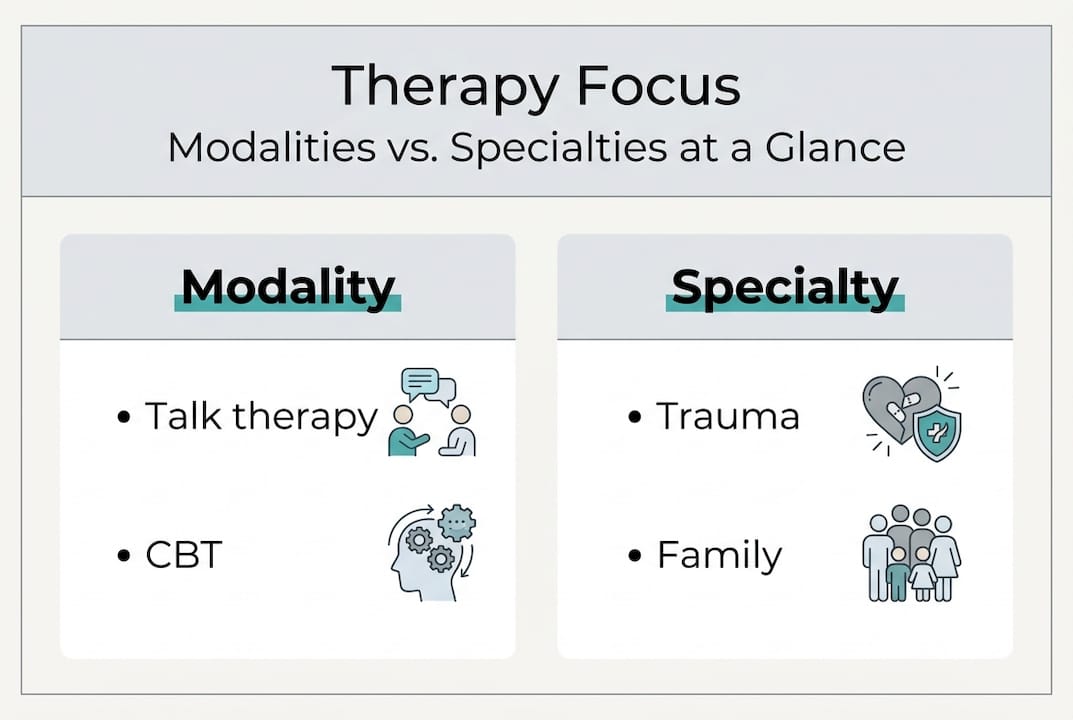
A specialty, by contrast, is the who and what. It defines the population the therapist works with and the types of problems they focus on.
| Feature | Modality | Specialty |
|---|---|---|
| Definition | The method or technique used | The focus area or population |
| Example | CBT, EMDR, DBT | Trauma, eating disorders, adolescents |
| Answers the question | How is therapy delivered? | Who is it for and what does it target? |
| Can overlap? | Yes, one modality suits multiple specialties | Yes, one specialty uses multiple modalities |
Consider this example: a trauma-focused therapist (the specialty) might use EMDR, Somatic Experiencing, or trauma-focused CBT (the modalities). The specialty tells you the focus. The modality tells you the tool. Both matter. A skilled trauma specialist using an inappropriate modality may not produce the results you need, and a skilled CBT practitioner without trauma training may inadvertently miss important clinical considerations.
This is why personalised therapist matching that accounts for both specialty and modality is so valuable. It is not enough to find someone who "does CBT." You need someone whose specialty aligns with your needs and whose chosen modality fits the way you process and respond to treatment.
Pro Tip: When you research therapists, look for two things on their profile: the populations they work with (specialty) and the methods they use (modality). If both align with your needs, that is a strong foundation for a productive relationship.
Examples of specialty therapies and when to consider them
With these distinctions in mind, it is helpful to see what real-world specialty therapies look like and when you might need them.
Specialty therapy is not a niche concept reserved for severe or rare conditions. Many common mental health concerns are addressed far more effectively when a specialist is involved. Here is a quick overview of some of the most established specialty areas:
| Specialty area | Focus | Common methods used |
|---|---|---|
| Trauma therapy | PTSD, childhood trauma, abuse | EMDR, trauma-focused CBT, somatic therapy |
| Eating disorder therapy | Anorexia, bulimia, binge eating | CBT-E, Maudsley approach, DBT |
| Child and adolescent therapy | Developmental, behavioural, emotional issues | Play therapy, family systems, CBT |
| Couples and family therapy | Relationship conflict, communication, attachment | EFT, systemic therapy, Gottman method |
| Perinatal mental health | Postnatal depression, birth trauma, anxiety | Trauma-informed CBT, attachment-based therapy |
| OCD and anxiety disorders | OCD, phobias, health anxiety | ERP (Exposure and Response Prevention), CBT |
These specialties are supported by strong research. For example, CBT has broad evidence across multiple disorders, while other approaches are more precisely targeted to specific conditions. This matters when you are choosing where to invest your time, energy, and money.
How do you recognise when a specialty approach is what you need? Here are some practical steps:
- Name your primary concern clearly. Is it a specific diagnosis, a recurring pattern, a life circumstance, or a relationship issue? The more specific you can be, the easier it is to identify the right specialty area.
- Consider the history. If you have tried general therapy before without significant progress, a more targeted specialist may be the appropriate next step.
- Think about the impact. Is this concern affecting your daily functioning, relationships, or physical health? Higher impact often signals a need for more focused expertise.
- Look at evidence-based guidance. Some conditions, such as PTSD and OCD, have clear clinical guidelines recommending specific specialist approaches. These exist for good reason.
- Consult your GP or a mental health professional. If you are unsure, a primary care provider or mental health practitioner can offer a referral or recommendation based on your clinical picture.
Consider a practical example. Imagine someone who has been experiencing persistent difficulty eating, distorted thoughts about their body, and a complicated relationship with food for several years. A general therapist may offer valuable emotional support, but a therapist who specialises in eating disorders and uses matching your needs to an evidence-based protocol such as CBT-Enhanced (CBT-E) is likely to produce more meaningful, lasting change. The specialist brings not just technique but also a nuanced understanding of the psychological, physiological, and social dimensions of the condition.
The personalised matching process: Finding your best-fit therapist
Knowing which type of therapy you need is just one side of the equation. Now let us look at how you can actually find your ideal match.
Finding the right therapist involves more than browsing a directory and picking someone with a good photo. It requires a considered process of self-reflection, research, and direct questions. The quality of the therapist-client relationship is consistently one of the strongest predictors of therapy outcomes. So getting this match right from the beginning saves you time, reduces frustration, and increases the likelihood of real progress.
When working through the matching process, it helps to differentiate between three distinct factors. First, consider the therapist's specialty focus: which populations and problems do they primarily work with? Second, consider the modality or technique they use and whether it aligns with your preferences and your condition's evidence base. Third, consider the treatment plan structure: do they offer open-ended therapy, time-limited programmes, or structured protocols with clear milestones?
Here are the key factors to consider when searching for a specialist therapist:
- Your primary concern: Is it a diagnosed condition, a relational issue, or a life event? Let this guide your search for a relevant specialty.
- Your preferences for approach: Do you prefer structured, goal-focused sessions or a more exploratory, open-ended style? Both are valid and different modalities reflect these styles.
- Practical considerations: Location, online availability, cost, and session frequency all affect whether you can sustain treatment long enough to benefit from it.
- The therapist's experience: Years in practice matter less than specific experience with people who share your concerns. Ask directly how many clients with your issue they have worked with and what their outcomes have been.
- Cultural fit and personal comfort: Feeling understood and respected by your therapist is not a bonus; it is a clinical necessity. Do not settle for someone who does not feel like a genuine fit.
When you first contact a prospective therapist, many will offer a short introductory call. Use it. Ask specific questions rather than waiting to see how things unfold.
Pro Tip: Ask a potential therapist: "What does your typical client look like, and what does a treatment plan for someone with my concerns usually involve?" This tells you immediately whether their experience and approach are aligned with your needs.
When matching involves both specialty and modality, outcomes tend to improve. Using evidence-based approaches as a baseline for your search gives you confidence that the methods your therapist uses have been tested and shown to work for people in similar situations to yours.
A fresh perspective: Why "specialty therapy" is more than a label
The standard framework for specialty therapy is genuinely useful. It gives people language and structure for what can feel like a confusing landscape. But it is worth challenging one assumption that often goes unexamined: that finding the right label or category is the goal.
Many people spend significant time and energy identifying whether they need a "trauma therapist" or an "anxiety specialist," but the real value is not in the category. It is in what happens inside the relationship and whether the approach evolves with you. Specialties are starting points, not fixed destinations. The most effective therapy tends to involve ongoing adjustment, where the therapist responds to what is and is not working for you specifically, not just what the protocol prescribes for the average person with your diagnosis.
There is also a strong argument that your own self-awareness and active participation matter as much as the therapist's credentials. Being clear about your learning style, what has not worked in the past, and what you genuinely want from therapy shapes outcomes in ways that no label alone can. Our approach to matching is grounded in this understanding. Collaboration and curiosity, on your part and your therapist's, are what drive progress. Use the specialty framework to get started, but do not let it limit your expectations of what therapy can look like for you.
Take the next step with personalised guidance
Now that you understand how specialty therapy works and how to find the best fit, you might be wondering how to begin your own search.
GuideMe is a therapy navigation platform built to help you make sense of your mental health needs and get matched with the right therapist from the start. Rather than leaving you to search through lengthy directories or guess at which specialty applies to your situation, GuideMe combines human insight with AI-powered tools to create an in-depth therapy plan tailored to you. The result is a clearer, more confident starting point for your therapy journey. If you are ready to move from confusion to clarity, start your personalised matching today and take the first step towards support that truly fits.
Frequently asked questions
How is speciality therapy different from general therapy?
Speciality therapy targets specific problems or populations using tailored, evidence-based methods, unlike general therapy which addresses a broader range of concerns. The APA defines specialty as a defined area of professional practice focused on specified problems and populations.
What are examples of speciality therapies?
Examples include trauma-focused therapy, child and adolescent therapy, couples and family therapy, eating disorder treatment, and OCD-specific interventions. Many of these are supported by strong clinical research, with CBT showing broad evidence across multiple conditions and other approaches being more precisely targeted.
Do I need a specialist therapist for anxiety or depression?
If your anxiety or depression is chronic, complex, or has not improved with general support, a specialist with targeted training and specific techniques may offer significantly better outcomes. Therapy modalities like CBT are evidence-based and effective across multiple psychiatric disorders, and a specialist can apply them with greater precision.
How do I choose the right specialty therapist for me?
Consider your main challenges, identify the relevant specialty area, and ask prospective therapists about both their specialty focus and the modalities they use. Differentiating between specialty focus, modality, and treatment plan structure gives you a clear framework for making a well-informed decision.