

TL;DR:
- Clarifying your needs and goals before searching streamlines the therapy process and enhances fit.
- The therapeutic relationship and personal compatibility are stronger indicators of success than credentials alone.
- Most people find their ideal therapist after trying one to three options, emphasizing trial and trust.
Starting therapy for the first time can feel confusing and even a little overwhelming. You might not know where to look, what qualifications matter, or how to tell if a therapist is right for you. The good news is that this process becomes far less daunting when you break it into clear, manageable steps. This guide walks you through everything, from clarifying your needs before you search, to recognising a good fit once sessions begin, so you can move forward with confidence and find support that genuinely works for you.
Table of Contents
- Understanding what you need and want from therapy
- Where and how to search for therapists
- Checking therapist qualifications and compatibility
- Meeting, testing the fit, and making decisions
- Reviewing progress and when to seek change
- A better way to find therapy: It's not just about credentials
- How GuideMe can help you find the right therapist
- Frequently asked questions
Key Takeaways
| Point | Details |
|---|---|
| Start with clarity | Journaling your needs and expectations makes it easier to find the right therapist. |
| Use a shortlist approach | Select and contact three therapists, trial sessions are often needed for a good match. |
| Check both credentials and fit | Professional licensing is important, but feeling comfortable with your therapist is crucial to success. |
| Review your progress regularly | Monitoring your feelings and progress helps you know when to continue or seek change. |
| Help is available | Tools and directories, like Guide Me, can simplify your search and offer personal support. |
Understanding what you need and want from therapy
Once you've decided to seek help, the first step is to understand exactly what support you're looking for. Many people skip this stage and jump straight into searching for therapists online, which often leads to feeling lost within minutes. Taking even 20 to 30 minutes to reflect on your needs before you begin your search makes the whole process much more focused.
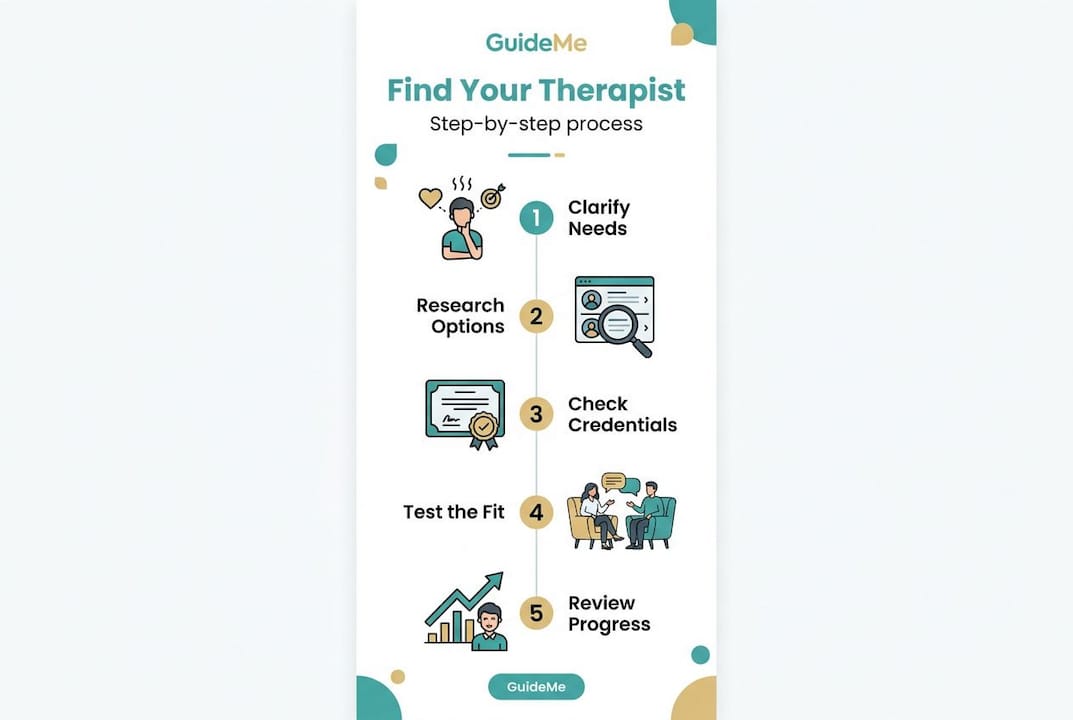
Start by thinking about the issues you want to address. Are you dealing with anxiety, low mood, relationship difficulties, or something more specific like grief or trauma? Write this down. Then consider what you want therapy to achieve. Do you want practical coping tools, or are you looking for space to explore deeper patterns in your thinking and behaviour? These are different goals, and different therapists specialise in different approaches.
Practical factors matter just as much as clinical ones. Think about:
- Location: Do you prefer in-person sessions, or would online therapy suit your schedule better?
- Cost: What is your budget per session, and does your insurance cover any mental health treatment?
- Availability: What days and times work for you consistently?
- Therapist background: Do you have a preference around gender, cultural background, or lived experience?
Pro Tip: Keep a short journal for a few days before you start searching. Note situations that felt difficult, thoughts that repeated, or feelings you struggled to manage. This gives you concrete information to share with a potential therapist from session one.
Research on psychotherapy outcomes suggests that good therapist matching leads to around 75% improvement in presenting issues, and that most people find their right fit after trying one to three therapists. Starting with a clear picture of your own needs speeds up that process considerably. When it comes to choosing a therapist, self-awareness at this stage is one of the most valuable tools you have.
Where and how to search for therapists
With your priorities set, you're ready to search for therapists efficiently and safely. The sheer number of directories and websites available can feel overwhelming, but a structured approach makes shortlisting much simpler.
The table below summarises the main places to find therapists, along with what each option offers:
| Search method | Best for | Key features |
|---|---|---|
| Online directories | Broad searches with filters | Filter by location, issue, modality, cost |
| GP referral | NHS or subsidised therapy | Free at point of access, can be slower |
| Workplace EAP | Employed individuals | Short-term, confidential, often free |
| Private practice websites | Specific therapist research | More detail on background and approach |
| Charity and community services | Those on low incomes | Sliding scale fees, specialist support |
Here is a straightforward process for building your shortlist when finding therapists online:
- Choose two to three directories to avoid duplicating your search unnecessarily.
- Apply filters for your specific issue, preferred therapy type, location, and cost range.
- Read profiles carefully, paying attention to how the therapist describes their approach and the language they use.
- Check insurance compatibility before getting too invested in a particular candidate.
- Note down three to five therapists who feel like a potential match based on profile content and stated experience.
The APA guidance on finding a therapist emphasises verifying credentials, confirming experience with your specific concerns, and checking insurance compatibility as part of this early stage. It also highlights the importance of looking for evidence-based approaches, meaning therapy types that have been studied and shown to work.
Understanding your insurance options is worth doing early. Mental health insurance can vary significantly in what it covers, so checking your policy or speaking to your insurer before booking a session prevents unexpected costs.
Pro Tip: When reading therapist profiles, pay attention to whether they explain their approach in plain language. A therapist who can clearly describe what they do and why is likely to communicate well in sessions too.
Checking therapist qualifications and compatibility
With a shortlist in hand, it's time to examine each therapist's background and fit more closely. Qualifications in therapy can be confusing because there are many different professional titles and licensing bodies. Understanding the basics helps you make clearer choices.
Common credentials include:
- Psychologist (DClinPsy or CPsychol in the UK): Doctoral level training, often specialising in assessment and complex conditions.
- Psychotherapist or counsellor (BACP or UKCP registered): Trained in therapeutic practice, with varying levels of experience and specialism.
- CBT therapist (BABCP accredited): Specialises in cognitive behavioural therapy, a structured, evidence-based approach.
- Psychiatrist: A medical doctor who can prescribe medication as well as provide therapy.
As the APA confirms, no single credential is superior in every situation. What matters most is that your therapist is properly licensed, experienced with your type of difficulty, and transparent about their methods. When reviewing therapist credentials, look for registration with a recognised professional body, not just a self-assigned title.
Evidence-based therapies, such as cognitive behavioural therapy (CBT), EMDR for trauma, or interpersonal therapy (IPT) for depression, have research behind them demonstrating their effectiveness. Asking a prospective therapist which approach they use and why is entirely appropriate.
"A good therapist will welcome questions about their approach and be transparent about how they work. If a therapist becomes defensive or dismissive when asked about their methods, that is a warning sign worth taking seriously."
Red flags to watch out for include:
- Reluctance to discuss qualifications or professional registration
- Vague or evasive answers about their therapy approach
- Promises of rapid or guaranteed results
- Lack of clarity around fees, cancellation policies, or confidentiality
- Pressure to commit to long-term treatment before any sessions have taken place
You should also confirm insurance coverage at this stage. Understanding therapy insurance coverage in detail before your first session removes financial uncertainty and lets you focus on the work itself.
Meeting, testing the fit, and making decisions
After checking credentials and ruling out red flags, you're ready for the most important stage: testing the personal fit. This is the part many first-time therapy-seekers underestimate.

The quality of the relationship between you and your therapist, known in research as the therapeutic alliance, is one of the strongest predictors of whether therapy will work for you. A meta-analysis of 295 studies found that the therapeutic alliance accounts for around 8% of outcome variance. That might sound small, but it is consistently a stronger predictor of success than the specific therapy technique used.
Research also shows that matched therapists lead to greater symptom reduction, and that the first three sessions are particularly critical for engagement, especially in digital or online therapy settings.
When you meet a therapist for the first time, structure your experience by paying attention to the following:
- Do you feel comfortable speaking openly? You do not need to share everything immediately, but you should not feel judged or rushed.
- Does the therapist listen carefully and reflect back what you've said? Good listening is a foundational skill.
- Do they explain what therapy will look like and what your role is? Selecting the right therapist involves checking that they can set clear, shared expectations.
- Do they show genuine understanding of your specific concerns, rather than giving generic responses?
- Do they invite you to ask questions and respond to them honestly?
Clinical psychologist Jonathan Shedler notes that shared understanding of problems is more important than diagnosis alone, and that between-session work, such as journalling or practising skills, is a positive sign of an engaged therapy process. Trusting your instincts about whether you feel a "click" is also valid, and should not be dismissed.
Pro Tip: After each initial session, take five minutes to write down how you felt during and after the meeting. This simple habit makes it much easier to compare your experiences across a few therapists and make a well-informed decision.
If the first therapist does not feel right, that is normal. Most people try one to three therapists before finding a strong fit. Moving on is not a failure. It is part of the process.
Reviewing progress and when to seek change
Once you've begun, it's vital to check that therapy is benefiting you and adapt as needed. Therapy is not a passive process. You are an active participant, and it is reasonable to expect to notice some change, even subtle, within the first six to eight sessions.
Signs that therapy is working include feeling more able to manage difficult situations, gaining new understanding of your patterns, feeling less alone with your struggles, or noticing gradual improvements in mood or relationships. Research confirms that therapy with good fit leads to around a 75% improvement rate, which is a strong outcome when the conditions are right.
Signs it may be time to reassess include:
- You dread sessions consistently, not just occasionally
- You feel no connection with your therapist after several sessions
- Your goals have not been revisited or updated
- You feel worse in a persistent, unexplained way
- Your therapist does not address concerns you raise about progress
When this happens, the first step is to raise your concerns with your therapist directly. A skilled therapist will welcome honest feedback and adjust their approach. If things do not improve, changing therapists is a reasonable and healthy choice. Monitoring therapy progress is not about being difficult; it is about advocating for your own wellbeing.
Pro Tip: Set a personal review point at sessions four and eight. Ask yourself honestly whether you feel the work is going somewhere. This keeps you engaged and prevents months passing without meaningful change.
A better way to find therapy: It's not just about credentials
Here is a perspective that gets overlooked too often. When people start searching for a therapist, they often focus heavily on qualifications. They look for the longest list of letters after a name, the most impressive training history, or the most well-known therapeutic model. It feels logical, but the research does not fully support this approach.
The evidence points clearly in a different direction. The quality of the match and the working relationship between client and therapist predicts outcomes more reliably than credential level alone. This does not mean qualifications do not matter. They absolutely do, and professional registration is non-negotiable. But a highly credentialled therapist who does not understand your concerns or communicate in a way that works for you will deliver weaker results than a well-trained therapist with whom you have a strong working relationship.
The people who tend to have the best therapy experiences are not necessarily those who found the most impressive therapist. They are the ones who came prepared, stayed actively involved, and were willing to try more than one therapist before settling. They trusted their own instincts alongside the evidence.
There is also a tendency to wait for the "perfect" match before committing to anything. This waiting often means weeks or months pass without any support at all. An iterative approach, where you try a therapist, reflect honestly, and move on if needed, is far more effective than holding out for certainty before you begin.
Learning to trust the process, and your own responses within it, is itself a valuable skill. If you are curious about how GuideMe helps you find therapy, you will see that this human-led, structured approach is built around exactly these principles.
How GuideMe can help you find the right therapist
Finding the right therapist does not have to mean months of uncertainty and trial and error. GuideMe is designed to take the complexity out of this process from the very beginning.
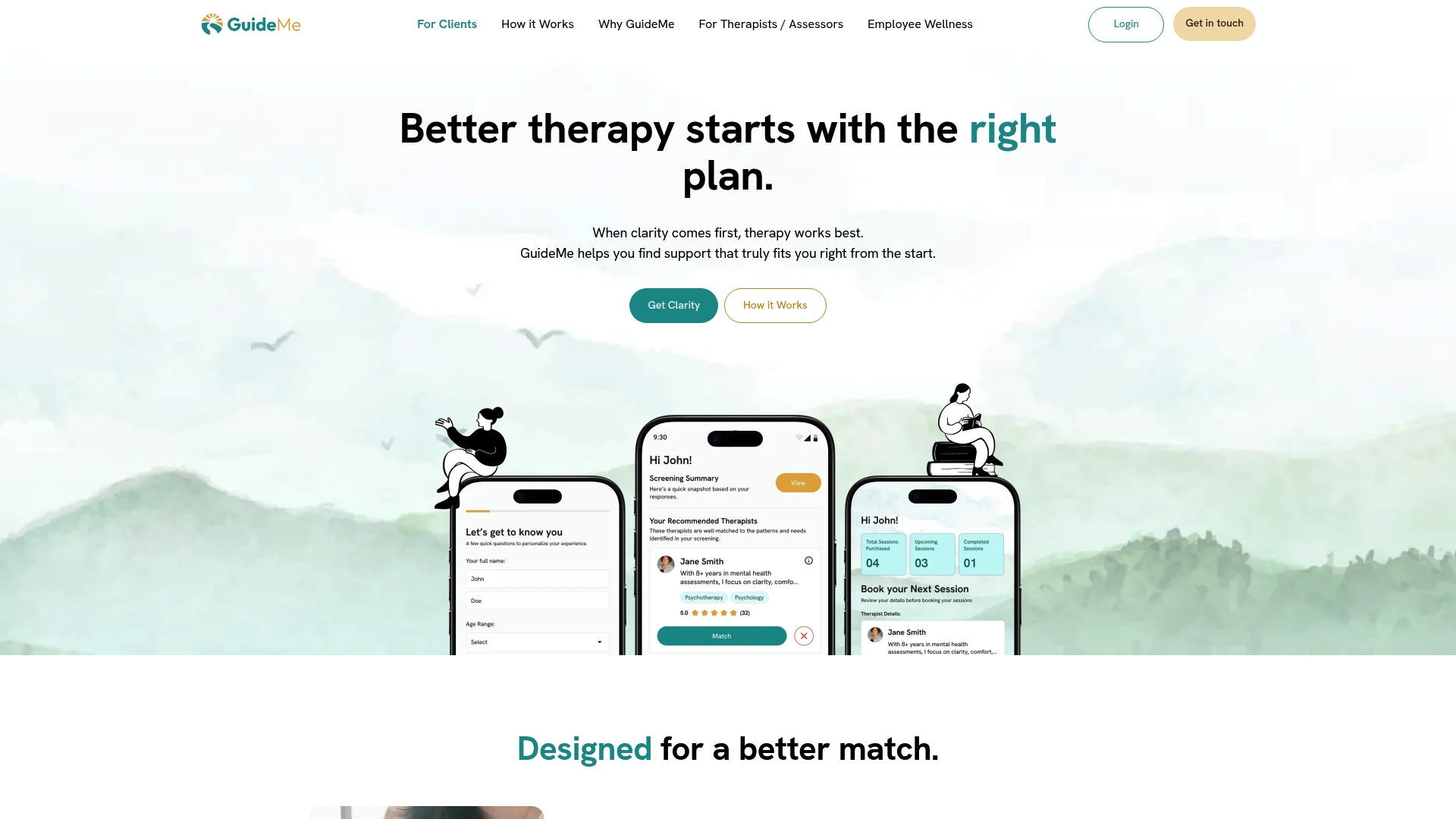
GuideMe combines an in-depth therapy plan with AI-powered matching to connect you with a therapist who genuinely fits your needs, not just your postcode. The platform guides you through understanding your mental health, setting your goals, and identifying what kind of support is most likely to help. Whether you are at the very start of your search or have already tried therapy and want a better fit, GuideMe supports every stage. Get matched to therapists who are right for you, and start your journey with a clearer, more confident first step.
Frequently asked questions
How many therapists should I try before settling?
Most people find their right fit after trying one to three therapists, as personal fit takes priority over settling for the first available option. It is completely normal to meet more than one before making a decision.
Which credentials are important when choosing a therapist?
Look for a professionally licensed or registered therapist, but the working relationship often predicts success more reliably than qualifications alone. Registration with a recognised UK body such as BACP, UKCP, or the BPS is a minimum standard to expect.
How will I know if the therapist is a good fit?
A good fit typically means you feel comfortable, heard, and understood within the first few sessions. Research shows the therapeutic alliance is one of the strongest predictors of positive therapy outcomes, so trusting your instincts matters.
Can I check if my insurance will cover therapy?
Yes, and it is best to confirm insurance compatibility before booking your first session to avoid unexpected costs. Contact your insurer directly and ask specifically about mental health or psychological therapy cover.
What should I do if therapy isn't working?
First, raise your concerns directly with your therapist, as a skilled practitioner will adapt their approach. If there is still no progress, trying a new therapist or a different therapeutic approach is a reasonable and healthy next step.