
TL;DR:
- Clarify your specific mental health needs and practical preferences before beginning your search.
- Use reputable directories, applying filters systematically to narrow down your options efficiently.
- Combine personal referrals with verified credential checks to ensure the best therapist fit and expertise.
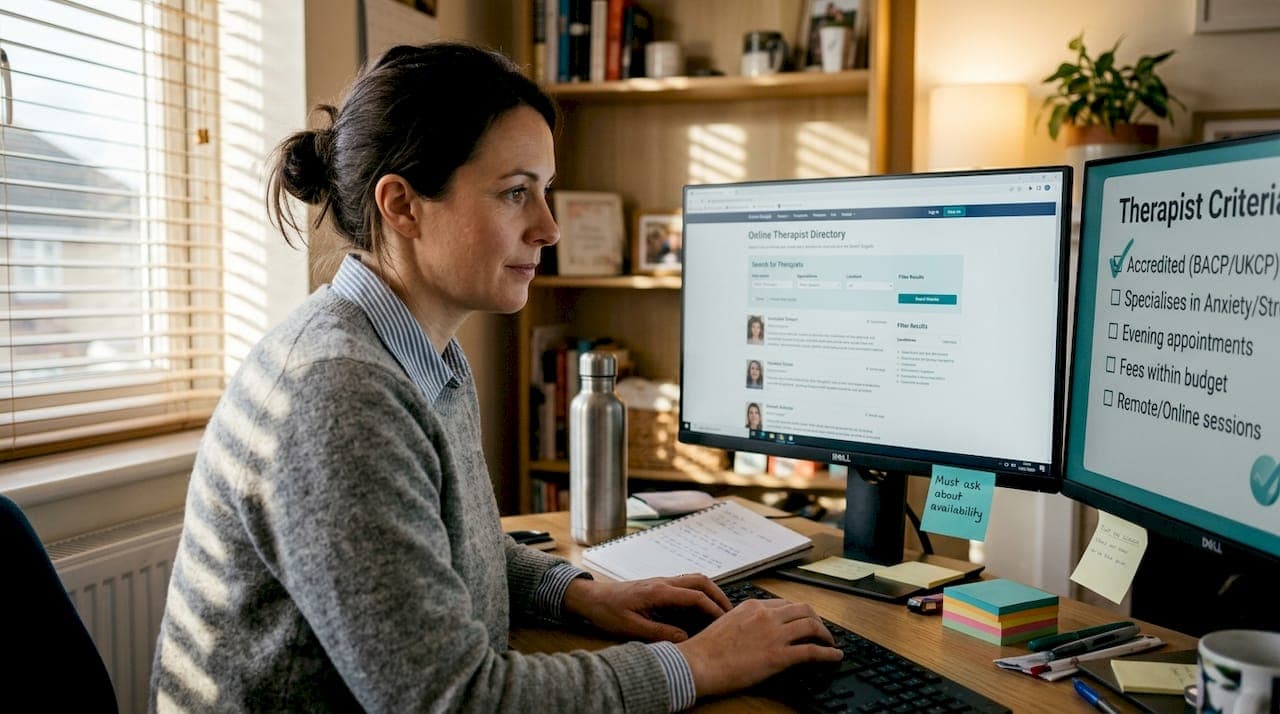
Finding the right therapist can feel genuinely overwhelming. You open a directory, see thousands of profiles, and suddenly you're not sure where to begin. What type of therapy do you need? Does insurance matter? Should you go online or in-person? These questions pile up fast, and the fear of choosing the wrong person can stop you from starting at all. The good news is that a clear, structured approach cuts through that noise. This guide walks you through exactly how to narrow your options, use the right tools, and make a confident choice without spending weeks feeling lost.
Table of Contents
- Clarify your needs before you search
- Use trusted directories and smart filters
- Combine personal referrals with directory validation
- Match on evidence, not just profile details
- Why efficient therapist search is about confidence, not speed
- Take the next step towards the right therapist
- Frequently asked questions
Key Takeaways
| Point | Details |
|---|---|
| Prepare before searching | Clarify what you need from therapy to make the search much faster and more focused. |
| Use vetted directories | Filter therapists using platforms that verify credentials to ensure safety and quality. |
| Combine referrals and filters | Blend personal recommendations and objective directory checks for the best shortlist. |
| Prioritise fit over speed | Strong rapport and outcome evidence matter more than rushing to the first available therapist. |
Clarify your needs before you search
The single biggest mistake people make when searching for a therapist is jumping straight into directories without knowing what they are looking for. It feels productive, but it usually leads to scrolling through hundreds of profiles that are not relevant to you. A few minutes of honest self-reflection before you search will save you hours later.
Start by thinking about why you want therapy. Are you dealing with anxiety, depression, relationship difficulties, or something else entirely? Being specific here matters. A therapist who specialises in trauma may not be the best fit for someone managing work-related stress, even if both are highly qualified. Self-assessment first means identifying specific issues, preferred therapy modality, budget and insurance, and personal demographics before you open a single directory.
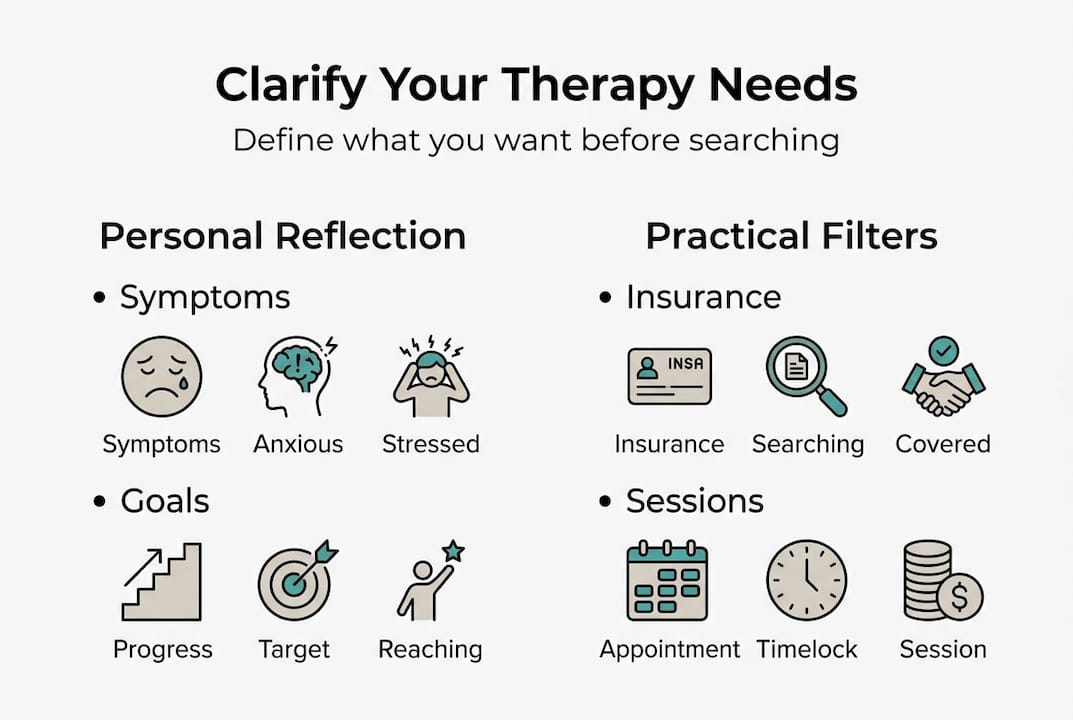
Next, think about practical requirements. Do you need someone who accepts your insurance? Would you prefer online sessions to fit around work, or is in-person contact important to you? Do you have a preference for a therapist's gender, cultural background, or language? These are not trivial details. They directly affect how comfortable and open you will feel in sessions, which in turn affects how much progress you make.
Once you have clarifying therapy goals in mind, the process becomes much more focused. You are no longer browsing. You are filtering with purpose.
Here are the five things to define before you start searching:
- Your primary concern: What specific issue or challenge are you seeking support for?
- Therapy format: Online, in-person, or a mix of both?
- Budget and insurance: What can you afford, and does your provider have a network?
- Demographic preferences: Gender, cultural background, language spoken?
- Availability: What days and times work for you consistently?
Pro Tip: Write these five points down before you open any directory. Having them in front of you means you can filter quickly and avoid getting distracted by profiles that do not match your actual needs.
This preparation stage is not about being rigid. It is about giving yourself a starting point that is grounded in what you actually need, rather than what happens to appear first on a list.
Use trusted directories and smart filters
With your needs clearly defined, you are ready to use online directories effectively. Not all directories are equal. The most reliable ones verify therapist credentials before listing them, which means you are not wasting time on unqualified practitioners. Established directories like Psychology Today and the APA Psychologist Locator offer verified credentials and robust filtering tools.
Here is a quick comparison of what to look for in a directory:
| Feature | What to check |
|---|---|
| Credential verification | Are therapists licensed and verified? |
| Filter options | Can you filter by issue, insurance, gender, language? |
| Telehealth availability | Does it show online therapy options? |
| Demographic filters | Can you filter by cultural background or specialism? |
| Profile detail | Do profiles include approach, fees, and availability? |
Once you have chosen a reputable directory, use the filters in a logical order. Here is a step-by-step approach that works:
- Start with your primary challenge: Filter by the specific issue you identified in your self-assessment.
- Add insurance or budget: Narrow to therapists who accept your plan or fit your price range.
- Apply specialism filters: Look for therapists trained in the modality you prefer, such as CBT or person-centred therapy.
- Add demographic preferences: Filter by gender, language, or cultural background if these matter to you.
- Check availability: Confirm session times match your schedule before saving a profile.
Following this order typically reduces a directory of thousands down to a manageable shortlist of 10 to 20 therapists. That is a number you can actually review properly.
Pro Tip: Use more than one directory. Cross-referencing two or three reputable sources improves your chances of finding a strong match and helps confirm that a therapist appears consistently, which adds credibility.
Combine personal referrals with directory validation
Online directories are powerful, but they are not the only tool available to you. Personal referrals from people you trust can add a layer of confidence that a profile alone cannot provide. The key is to use referrals alongside directory checks, not instead of them.
When someone you trust recommends a therapist, it carries weight. They have direct experience of that person's approach, reliability, and manner. That is genuinely useful information. But a personal recommendation does not replace the need to verify credentials independently. Licensure can lapse, specialisms can change, and what worked for one person may not suit your specific needs.
Referrals from GPs, friends, and insurers are most effective when cross-referenced with verified directories to confirm current standing.
Here are the best referral sources and how to validate each one:
- Your GP or primary care doctor: Ask for names, then check each one in a verified directory to confirm active licensure.
- Friends or family: Take note of their experience, but confirm the therapist's credentials and check whether their specialism fits your needs.
- Your insurance provider: Request a list of in-network therapists, then cross-check profiles in directories for more detail.
- Employee Assistance Programmes (EAPs): Many employers offer short-term counselling referrals. Validate these the same way.
- Mental health charities and helplines: Organisations such as Mind or Samaritans can often point you towards qualified local support.
"The most effective approach combines trusted personal recommendations with independent verification of credentials and fit. Neither alone is sufficient."
Never skip checking current licensure, even when a referral comes from someone you completely trust. A quick check in a directory takes two minutes and gives you real peace of mind before you commit to a first session.
Match on evidence, not just profile details
You have a shortlist. Now comes the part that many people overlook: actually testing whether a therapist is the right fit for you. A polished profile and strong credentials are a good start, but they do not guarantee a productive working relationship.

Evidence-based matching and a strong therapeutic alliance consistently improve outcomes. Platforms that use structured matching report 93% of users being matched successfully on the first attempt, with 89% remaining with their therapist long-term. That is a significant difference compared to choosing based on a profile alone.
The data on matched versus unmatched therapy is worth understanding:
| Approach | Outcome |
|---|---|
| Random or unguided selection | Higher dropout, slower progress |
| Structured matching | Greater symptom reduction, better retention |
| Matched for severe cases or minorities | Significantly better outcomes reported |
Matched patients show greater symptom reduction, particularly for people with more severe presentations or those from minority backgrounds. The process of matching matters, not just the qualifications on a profile.
Before committing to ongoing sessions, most therapists will offer an initial consultation or introductory call. Use it. This is your opportunity to assess rapport, communication style, and whether their approach feels right for you.
After your first session or consultation, ask yourself:
- Did you feel genuinely listened to, without judgement?
- Were your goals and concerns discussed clearly?
- Did the therapist explain their approach in a way that made sense to you?
- Did you feel comfortable enough to be honest?
- Do you feel cautiously optimistic about working with this person?
If the answer to most of these is yes, that is a strong sign. If something felt off, that is worth paying attention to. Switching therapists after one or two sessions is not a failure. It is a sensible response to poor fit, and it protects your time and wellbeing.
Why efficient therapist search is about confidence, not speed
There is a common assumption that streamlining your therapist search is mainly about saving time. In our experience, that misses the point. The real benefit of a structured process is the confidence it builds. When you know you have checked credentials, used smart filters, sought referrals, and tested fit, you stop second-guessing yourself. That mental clarity makes a real difference to how you show up in therapy.
Cutting corners tends to backfire. Skipping credential checks or jumping to a therapist without testing fit might feel faster, but it often leads to early dropout, wasted money, and the discouraging sense that therapy simply does not work for you. It does work. The process just needs to be right.
Another misconception is that demographic match is the most important factor. Research suggests otherwise. Therapeutic alliance, which is the quality of the working relationship, consistently predicts outcomes more strongly than shared background alone. Focus on clarifying therapy goals and testing fit early, and you are far more likely to stay engaged and make lasting progress.
Invest properly in the search process up front. It makes everything that follows shorter, more effective, and far less stressful.
Take the next step towards the right therapist
You now have a clear, evidence-backed process for finding a therapist who genuinely suits your needs. Preparation, smart filtering, referral validation, and fit testing all work together to give you a shortlist you can trust.
GuideMe is built to support you through every one of these steps. Our platform combines human expertise with AI-powered matching to help you understand your mental health needs, build a personalised therapy plan, and get matched with the right therapist from the start. If you are ready to stop feeling overwhelmed and start making real progress, find your therapist with GuideMe today. Confident action now is the best way to move forward.
Frequently asked questions
What if I live in a rural area with few therapists nearby?
Consider telehealth providers, which significantly expand your options. Rural and underserved areas benefit from interstate licensure compacts that allow therapists to practise across state lines, making quality care more accessible.
How do I know if a therapist is properly qualified?
Check their credentials using verified directories such as Psychology Today or the APA Psychologist Locator, and always confirm their licence is current before booking your first session.
What should I do if my first matched therapist doesn't feel right?
Switching is completely normal and often the right decision. Therapeutic alliance is the strongest predictor of success, so if the fit is poor after one or two sessions, request another match without hesitation.
Are online therapy platforms as effective as seeing someone in person?
Yes, when the therapeutic alliance is strong. Research shows that online therapy can be just as effective as face-to-face sessions, provided the relationship between client and therapist is solid.
What urgent steps should I take if I'm in a crisis?
In an emergency, do not search directories. Contact crisis services such as the 988 Lifeline or your local emergency services immediately for the support you need right now.