

TL;DR:
- Therapist-client rapport, built on trust and mutual understanding, is a key predictor of therapy success. Most of the positive outcomes in therapy are attributed to the strength of the therapeutic relationship rather than specific techniques. Active communication, patience, and addressing ruptures can deepen rapport, improving overall therapy effectiveness.
Therapist-client rapport: why it matters for outcomes
Most people starting therapy focus on finding the right approach, whether that is cognitive behavioural therapy, psychodynamic work, or another method. Yet research across 295 studies involving more than 30,000 patients consistently shows that the quality of the relationship between you and your therapist predicts outcomes more reliably than any specific technique. This guide explains what therapist-client rapport truly is, what the evidence tells us, and how you can actively build, assess, and strengthen that connection for a better therapy experience.
Table of Contents
- Defining therapist-client rapport
- Evidence for rapport's importance
- Nuances and challenges in building rapport
- Applying rapport: practical tips for clients
- Our perspective: the underestimated power of rapport
- How GuideMe supports positive rapport
- Frequently asked questions
Key Takeaways
| Point | Details |
|---|---|
| Rapport drives results | The quality of therapist-client rapport predicts therapy success even more than particular treatment techniques. |
| Core conditions matter | Empathy, congruence, and positive regard form the basis of strong therapeutic connection. |
| Repair is possible | Even after disagreements, rapport can be rebuilt with open communication and collaboration. |
| Evidence is consistent | Research across 30,000 patients shows rapport impacts therapy outcomes regardless of modality. |
Defining therapist-client rapport
Rapport in therapy is more than simply getting along with your therapist. It refers to the quality of the working relationship, built on trust, mutual understanding, and a shared sense of purpose. Therapists and researchers often call this the therapeutic alliance, and it sits at the heart of almost every effective therapy model.
The most widely referenced framework for understanding rapport comes from Carl Rogers, the founder of person-centred therapy. Rogers identified three core conditions that he believed were necessary and sufficient for therapeutic change to occur.
- Empathy: The therapist's ability to understand and reflect your inner world accurately. Not just acknowledging that you feel a certain way, but genuinely grasping what that experience is like for you.
- Congruence (also called genuineness): The therapist showing up as a real person rather than hiding behind a professional role. Authentic responses, including honest feedback, build credibility and trust over time.
- Unconditional positive regard: Accepting you fully, without judgement, regardless of what you share. This makes it safe to be honest, which is essential for meaningful therapeutic work.
These three conditions are not abstract ideals. Empirical benchmarks confirm that when these elements are present, clients engage more consistently, remain in therapy longer, and report better outcomes. Rapport, in this sense, is both an art and a science.
A common misconception is that rapport just means your therapist is friendly or easy to talk to. In reality, rapport includes moments of challenge and discomfort. A therapist who challenges your assumptions, gently, and within a trusting relationship, is demonstrating strong rapport rather than undermining it. Warmth matters, but it is only one component of a deeper professional bond.
Another misconception is that rapport develops automatically over time. In fact, it requires active effort from both sides. Therapists are trained to build connection through rapport building guidelines, but clients also play a vital role by communicating openly, sharing feedback, and staying engaged with the process.
It is also worth understanding why rapport often outperforms technique. Different therapy methods share a significant amount of common ground. Active listening, reflection, and collaborative goal-setting appear across nearly every approach. Rapport is the vehicle through which these shared elements become effective. A flawless CBT protocol delivered by a therapist you do not trust is far less likely to help than a more flexible approach within a strong, trusting relationship.
"The quality of the therapeutic relationship is not a backdrop to good therapy. In many cases, it is the therapy."
Understanding this changes how you approach finding and working with a therapist. The question shifts from "what method does this therapist use?" to "can I build a genuine working relationship with this person?"
Evidence for rapport's importance
The case for rapport is not based on opinion. It is backed by some of the most substantial evidence in all of psychotherapy research.
A landmark meta-analysis examined data from 295 studies and 30,000 patients and found a correlation of r = 0.278 (d = 0.579) between therapeutic alliance and therapy outcomes. To put that in context, this is a medium-to-large effect by social science standards. It accounts for roughly 8% of the total variance in whether therapy works, which may sound modest but is actually substantial when you consider how many factors influence mental health outcomes.

| Factor | Effect on therapy outcomes |
|---|---|
| Therapeutic alliance / rapport | r = 0.278 (accounts for ~8% variance) |
| Empathy (therapist) | r = 0.28, d = 0.58 |
| Specific technique or model | Smaller and less consistent |
| Goal consensus between client and therapist | Significant, similar to alliance |
What makes this evidence particularly compelling is its consistency. The effect of rapport holds across different therapy types, different client populations, and different outcome measures. Whether the goal is reducing depression, managing anxiety, or improving relationships, rapport is a reliable predictor.
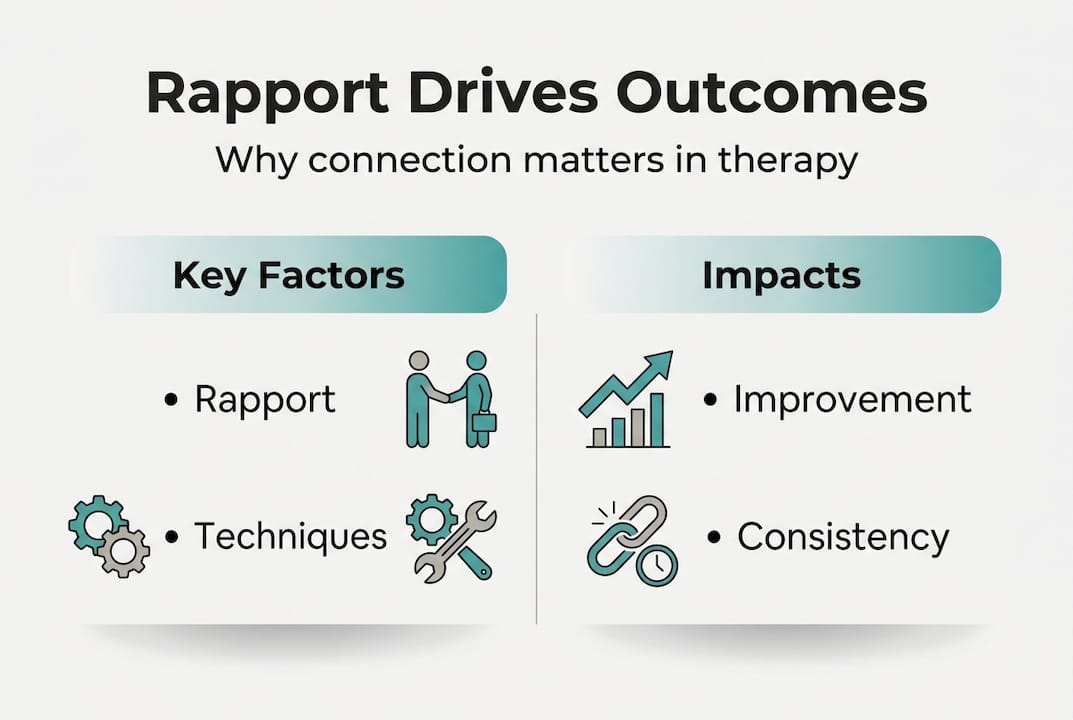
The American Psychological Association (APA) task force on empirically supported therapy relationships found that alliance is demonstrably effective, rating it alongside empathy (r = 0.28, d = 0.58) and goal consensus as among the strongest predictors of positive outcomes. Importantly, this research placed these relational factors above the predictive power of specific techniques in many comparative trials.
This does not mean technique is irrelevant. Evidence-based methods matter, especially for particular conditions. But it does mean that if you are weighing up what to prioritise when choosing or evaluating a therapist, the quality of the relationship deserves more attention than the letters after their name or the specific model they practise.
Key takeaway: Across decades of research and tens of thousands of patients, no single factor consistently predicts therapy outcomes as reliably as the quality of the therapist-client relationship. That is a remarkable finding, and one that has real implications for how you approach your own therapy journey.
Nuances and challenges in building rapport
Building rapport is rarely straightforward. Several factors can complicate the process, and understanding them helps you navigate therapy more effectively.
Therapy involves a wide range of presenting issues, and some of them make rapport-building particularly challenging. Research on complex clinical scenarios highlights several important nuances.
- Psychosis and delusional thinking: When clients experience psychosis, directly challenging beliefs can damage trust and push them further away. Skilled therapists instead listen for the underlying truth or emotional reality beneath the delusion, often related to trauma, fear, or unmet needs. This approach preserves rapport while still providing effective support.
- Trauma histories: Clients with significant trauma histories are more sensitive to ruptures in the therapeutic relationship. A misattuned comment, a perceived judgement, or even a slight shift in the therapist's tone can feel amplifying and threatening. Trauma-informed practice requires therapists to be especially consistent, transparent, and careful with boundaries.
- Cultural differences: Cultural background shapes how people understand distress, express emotion, and relate to authority figures. Without cultural humility, which means genuinely acknowledging the limits of one's own cultural knowledge and actively seeking to understand the client's frame of reference, therapists risk misreading behaviour or inadvertently causing offence. Direct and respectful broaching of cultural topics, rather than ignoring them, strengthens rather than weakens rapport.
One important and often overlooked aspect of rapport is that the relationship is bidirectional. Most people think of rapport as something the therapist builds with the client. But research confirms that symptoms and rapport influence each other mutually. When your mental health symptoms improve, you often feel more able to engage and trust, which strengthens rapport. And when rapport strengthens, symptoms tend to improve. This creates a positive feedback loop, but it also means that difficult periods in your mental health can naturally strain the therapeutic relationship, which is not a sign of failure.
Ruptures in rapport, moments when the connection feels damaged or strained, are normal and perhaps inevitable. A disagreement about the direction of therapy, feeling unheard, or sensing that your therapist does not fully understand you can all create ruptures. The good news is that repaired ruptures often deepen the relationship rather than undermine it. A therapist who notices a rupture, names it, and works through it with you is demonstrating exactly the kind of responsiveness that builds lasting trust. You can access practical clinical rapport tips to help navigate these moments.
Pro Tip: If something your therapist says or does leaves you feeling dismissed or misunderstood, try naming it directly in the next session. Something as simple as "I felt a bit unheard last week when..." can open a productive conversation and actually strengthen your relationship.
Applying rapport: practical tips for clients
Knowing that rapport matters is one thing. Actively building and maintaining it is another. Here are concrete steps you can take as a client.
- Check in with your own feelings early on. After the first few sessions, ask yourself honestly: do I feel safe enough to share difficult things with this person? Do I feel understood, even if we do not always agree? These early signals matter and are worth paying attention to.
- Communicate your needs clearly. Therapists are skilled, but they are not mind readers. If you need more structure, more warmth, or a different kind of challenge, say so. Most therapists welcome this feedback and will adjust their approach.
- Share when something is not working. If a session leaves you feeling worse or confused, bring it up. Silence around these moments allows misalignment to grow. Naming discomfort, even when it feels awkward, is a direct investment in the relationship.
- Engage actively with the process. Rapport is not built only in sessions. Completing between-session tasks, reflecting on what comes up, and returning with honest observations about what helped or did not, all of these actions signal your investment and deepen the collaboration.
- Give it time, but not too much time. Rapport takes a few sessions to develop. However, if after six to eight sessions you still feel fundamentally unheard or misunderstood, it may be worth discussing a referral to a different therapist. Persistence matters, but so does fit.
It is worth noting that some research highlights that ruptures in rapport are not failures but genuine opportunities. When both client and therapist work through a difficult moment collaboratively, the resulting trust is often deeper than if nothing had gone wrong. This reframes the uncomfortable moments of therapy as part of the process, not obstacles to it.
Self-advocacy is a skill many people have not practised in professional settings. Therapy is one of the few spaces where your active participation in shaping the relationship is not just welcomed, it is essential. Seeking out therapist-client rapport advice before or during therapy can help you feel more prepared and confident in doing exactly that.
Pro Tip: Before each session, spend two minutes thinking about what felt useful and what felt less useful since you last met. Sharing this at the start of your session is one of the simplest and most effective ways to keep the relationship aligned with your actual needs.
Our perspective: the underestimated power of rapport
At GuideMe, we believe rapport is still the most underestimated factor in therapy, both by clients and by clinicians. Clients often focus on credentials, methods, or availability when choosing a therapist. Clinicians sometimes lean too heavily on manualised protocols, following structured steps with precision but occasionally at the cost of genuine connection.
What our expertise in matching clients with therapists consistently shows us is that even the most evidence-based treatment falls flat when the relationship is not right. And conversely, clients who feel genuinely understood and respected tend to make progress even through difficult patches, because the relationship itself is what holds them through it.
The research agrees. Rapport is not a nice bonus. It is the foundation. And yet most people go into therapy without ever being told to actively invest in the relationship, to speak up, to flag discomfort, or to treat the connection as something they co-create rather than receive. That gap between what the evidence shows and what clients actually know is something we are committed to closing.
How GuideMe supports positive rapport
Finding a therapist you connect with should not be left to chance. At GuideMe, we take a human-led, AI-powered approach to mental health support that prioritises the quality of fit between you and your therapist from the very beginning.
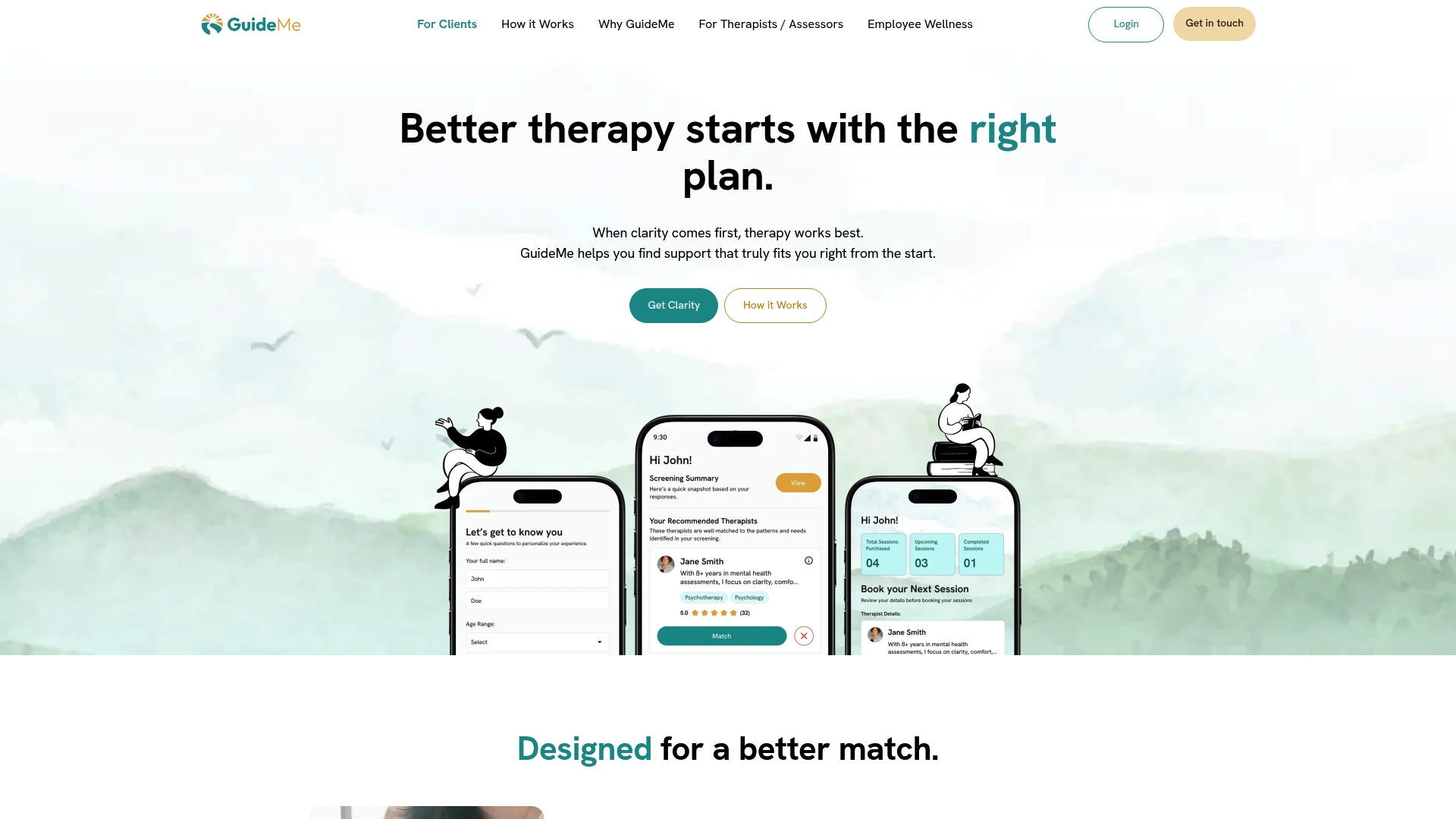
Our platform starts with an in-depth therapy plan, helping you understand your own mental health needs before you even speak to a therapist. We then use that understanding to match you with a therapist whose style, approach, and values are genuinely suited to you. This is not a generic search tool. It is a thoughtful process designed to give you the best possible foundation for building the kind of rapport that research shows truly makes a difference. If you are ready to start therapy on the right footing, GuideMe is here to help.
Frequently asked questions
What is therapist-client rapport in therapy?
Rapport in therapy describes the quality of connection, trust, and mutual respect between client and therapist. Rogerian core conditions, including empathy, congruence, and positive regard, form the foundation of this relationship and are consistently linked to better client engagement and outcomes.
How does rapport affect therapy outcomes?
Therapist-client rapport is one of the most consistent predictors of therapy success. Across 295 studies and more than 30,000 patients, it accounts for approximately 8% of outcome variance, a figure that holds across different therapy types and client populations.
Can rapport be repaired after problems or disagreements?
Yes. Ruptures in rapport are a normal part of the therapeutic process. Research confirms that when both client and therapist address and work through a rupture collaboratively, it often deepens trust rather than permanently damaging the relationship.
What are signs of strong therapist-client rapport?
Strong rapport typically includes feeling genuinely understood, trusting your therapist enough to share difficult material, and having a shared sense of the goals and direction of your therapy. Core conditions like empathy and unconditional positive regard are visible markers of a well-established therapeutic relationship.