

TL;DR:
- Therapist qualifications vary based on training, supervision, and license type, influencing competence and scope.
- Psychologists hold doctoral degrees and can perform assessments, while master's-level therapists primarily provide talk therapy.
- The quality of the therapist-client relationship, or therapeutic alliance, is vital for effective treatment outcomes.
Most people assume that any therapist they see has gone through the same training. That assumption is understandable, but it is not accurate. Therapist qualifications vary considerably depending on the role, the specialism, and even the state or region where they practise. Knowing the difference between a licensed counsellor, a psychologist, and an associate therapist can help you make a more informed choice about your mental health care. This guide breaks down what those credentials actually mean, how licensure works in practice, and what really matters when you are choosing someone to work with.
Table of Contents
- What qualifications do therapists need?
- Psychologists versus therapists: Key differences in credentials
- Licensure, state variations, and telehealth access
- Edge cases, core competencies, and therapist impact
- What most people miss when choosing a therapist
- Find your ideal therapist with GuideMe
- Frequently asked questions
Key Takeaways
| Point | Details |
|---|---|
| Licensure matters | Therapist licensure ensures strict standards for education and supervised experience, helping you make safer choices. |
| Psychologists vs therapists | Psychologists hold doctoral degrees and can conduct psychological testing, while therapists usually have a master's and focus on counselling. |
| State regulations | Licensure and telehealth rules vary by state, so always check your therapist’s eligibility where you live. |
| Core competencies | Therapists’ attitudes, skills, and knowledge shape outcomes, but the therapeutic relationship itself matters most. |
| Therapy outcomes | Research shows psychotherapy is effective, with most clients experiencing significant improvement. |
What qualifications do therapists need?
Becoming a therapist in the United States involves several clear stages, and each one matters. The process typically begins with a master's degree in a relevant field such as counselling, social work, or marriage and family therapy. After completing their degree, trainee therapists must accumulate a significant number of supervised clinical hours before they can apply for full licensure. The therapist licensure process requires a master's degree, 2,000 to 4,000 supervised clinical hours, and passing a national exam.
Those supervised hours are not just a formality. They represent real clinical work with real clients, carried out under the guidance of a fully licensed professional. This stage is where trainee therapists develop the practical skills that cannot be taught in a classroom. The volume of hours required reflects how seriously the profession takes client safety and therapeutic competence.
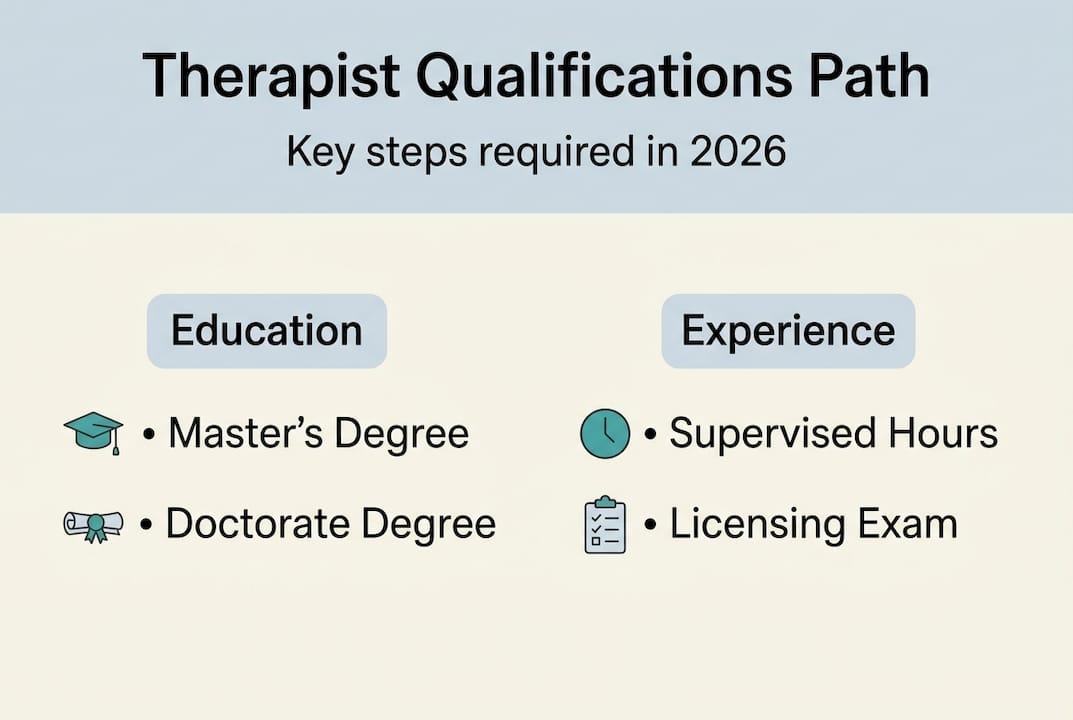
Once supervised hours are complete, candidates must pass a national licensing exam. These exams test knowledge across areas including ethics, assessment, treatment planning, and clinical practice. The specific exam depends on the licence type being pursued.
Here is a summary of the main licence types and their requirements:
| Licence type | Degree required | Supervised hours | Primary exam |
|---|---|---|---|
| Licensed Professional Counsellor (LPC) | Master's | 2,000 to 4,000 | NCE or NCMHCE |
| Licensed Clinical Social Worker (LCSW) | Master's (MSW) | 2,000 to 3,000 | ASWB Clinical |
| Licensed Marriage and Family Therapist (LMFT) | Master's | 2,000 to 4,000 | MFT National Exam |
| Licensed Psychologist | Doctoral (PhD/PsyD) | 1,500 to 4,000 | EPPP |
What does this mean for you as a client? It means that any fully licensed therapist you see has completed years of education, thousands of hours of supervised practice, and passed a rigorous national exam. That is a meaningful baseline of competence and accountability.
Key things to look for when reviewing a therapist's credentials:
- Licence type: Confirms their area of training and specialism
- Licence status: Should be active and in good standing in your state
- Supervised hours completed: Relevant if they are still in an associate or pre-licensed role
- Exam passed: Indicates the standard of assessment they have met
Psychologists versus therapists: Key differences in credentials
Understanding these basics, it is equally important to know the differences between psychologists and therapists. The two terms are often used interchangeably in everyday conversation, but they refer to quite different levels of training and scope of practice.
Therapists at the master's level hold degrees such as an MSW, MA, or MS. They are trained to provide talk therapy, support clients through mental health challenges, and develop treatment plans. Psychologists, on the other hand, hold a doctoral degree, either a PhD or a PsyD. Psychologist licensure details confirm that psychologists require a doctoral degree, 1,500 to 4,000 supervised hours, and specialist exams such as the EPPP.
One of the most significant differences in scope is psychological testing. Psychologists are trained to administer and interpret standardised assessments for conditions such as ADHD, learning disabilities, and personality disorders. Master's-level therapists generally do not carry out this type of formal assessment.
"The distinction between a therapist and a psychologist is not about who is better. It is about who is trained for what. Both play vital roles in mental health care."
What a licensed therapist typically does:
- Provides individual, couples, or group therapy
- Develops and reviews treatment plans
- Supports clients through anxiety, depression, trauma, and relationship difficulties
- Refers clients to psychiatrists or psychologists when specialist input is needed
What a licensed psychologist typically does:
- Provides therapy (same as above)
- Conducts psychological assessments and diagnostic testing
- Offers expert opinions in legal or educational settings
- Supervises trainee therapists and psychologists
For most people seeking therapy for anxiety, depression, or relationship issues, a master's-level therapist is entirely appropriate. A psychologist may be the right choice if you need formal assessment, a complex diagnosis, or specialist input for a particular condition.
Licensure, state variations, and telehealth access
As you consider different types of therapists, understanding the effects of state regulations is vital. Therapy licensure in the United States is managed at the state level, which means there is no single national licence that allows a therapist to practise everywhere. Each state sets its own requirements for education, supervised hours, exams, and renewal.

This creates a practical challenge, particularly for people who move between states or want to access therapy online. A therapist licensed in California cannot automatically practise with a client in New York. Historically, this has limited client choice and created unnecessary barriers to care.
Fortunately, interstate compacts are changing this. Interstate therapy access is now supported by PSYPACT for psychologists, covering around 40 states, and the Counseling Compact for therapists, covering more than 20 states. These agreements allow eligible practitioners to work with clients across state lines, which is especially relevant for telehealth.
What to check when choosing an online therapist:
- State of licensure: Is their licence issued in a state that covers your location?
- Compact participation: Are they registered under PSYPACT or the Counseling Compact?
- Licence status: Is it current, active, and in good standing?
- Specialism: Does their training match your needs?
Pro Tip: Always confirm your therapist is authorised to practise in your state before your first session. You can usually verify this through your state's licensing board website, which is publicly accessible and free to use.
Telehealth has made therapy more accessible than ever, but it has also made it easier to accidentally see someone who is not properly authorised to work with you. A quick licence check takes minutes and gives you genuine peace of mind.
Edge cases, core competencies, and therapist impact
Beyond licensing, nuanced factors play a significant role in therapy experiences. Not every therapist you encounter will be fully licensed. Some are working towards licensure and carry titles such as "associate therapist," "pre-licensed counsellor," or "registered intern." These practitioners are still in supervised roles, which means their work is reviewed by a licensed supervisor. Seeing a pre-licensed therapist is not inherently a problem, but you should know their status and who oversees their practice.
Prescriptive authority is another area worth understanding. In most states, psychologists cannot prescribe medication. However, in five states, including Louisiana, New Mexico, Idaho, Iowa, and Illinois, psychologists with additional training may have prescriptive authority. If medication is part of your care, you will typically need to see a psychiatrist.
Some states also require background checks for therapists as part of the licensure process, including fingerprinting. This is not universal, but it reflects the commitment many states have to client safety.
Research has identified therapist core competencies across four categories: attitude, personality, knowledge, and skills, with 30 competencies identified in total. These include things like empathy, cultural awareness, ethical practice, and the ability to build a strong working relationship with clients.
The outcomes data is encouraging. Therapy effectiveness statistics show a 75% improvement rate for clients, with effect sizes of g=0.73 for depression and g=1.18 for OCD and PTSD. These are meaningful results that reflect the genuine impact of skilled therapeutic work.
Here are four key factors that influence therapy outcomes:
- Therapeutic alliance: The quality of the relationship between client and therapist
- Therapist competence: Technical skills and clinical knowledge
- Treatment approach: Whether the method suits the client's needs
- Client engagement: Active participation and openness to the process
What most people miss when choosing a therapist
With a solid grasp on credentials, it is time for a reality check about what really matters most. Qualifications are essential. They protect you, establish ethical standards, and ensure a minimum level of competence. But they do not tell the whole story.
Research consistently shows that the therapeutic alliance, meaning the quality of the relationship between you and your therapist, is one of the strongest predictors of a good outcome. Alliance research shows a correlation of r=0.28 between alliance quality and therapy outcomes, while common factors across therapies may account for as much as 80% of the variance in results.
This means that a highly credentialled therapist who does not feel like the right fit for you may produce worse results than a less decorated therapist with whom you feel genuinely understood. Rapport matters. Feeling safe matters. Shared goals matter.
We think people spend too much time comparing letters after a therapist's name and not enough time asking whether they feel comfortable in the room. Both things matter, but the relationship is where the real work happens.
Pro Tip: In your first session, ask your therapist how they approach building the therapeutic alliance. Their answer will tell you a great deal about how they work and whether their style suits you.
Find your ideal therapist with GuideMe
If you are ready to put this knowledge into practice, here is how to take the next step.

Navigating therapist qualifications can feel overwhelming, especially when you are already dealing with something difficult. GuideMe is built to make that process clearer and more manageable. The GuideMe Therapy platform combines human expertise with AI-powered matching to help you understand your needs, review therapist profiles, and find someone who is genuinely right for you. You do not have to figure this out alone. GuideMe helps you move from confusion to confidence, so you can start therapy feeling supported from the very first session.
Frequently asked questions
What is the difference between a licensed therapist and an associate therapist?
A licensed therapist has completed all required education, supervised hours, and exams, while an associate therapist is still accumulating supervised experience under the oversight of a fully licensed professional.
Can psychologists prescribe medication?
In most states, psychologists cannot prescribe medication, but in five US states with additional specialist training they may have prescriptive authority.
How effective is psychotherapy for mental health?
Psychotherapy has approximately a 75% improvement rate for clients and shows strong results across conditions including depression, OCD, and PTSD.
Do all therapists need background checks?
Background checks and fingerprinting are required in some states as part of the licensure process, but this requirement is not consistent across all states.