

TL;DR:
- Managers face higher stress and burnout due to dual accountability and emotional labor.
- Support programs combining therapy, coaching, and stress management improve well-being and reduce organizational costs.
- Overcoming stigma and structural barriers is crucial for effectively supporting managerial mental health.
Most organisations invest in employee well-being programmes and overlook the people running them. Managers are often expected to support their teams through stress, conflict, and change, all while managing their own pressures in silence. Yet managers experience higher rates of stress, burnout, and mental health issues than non-supervisory employees. This guide is for HR managers and team leaders who want to change that. You will find the evidence, the practical models, and the honest challenges involved in building genuine therapy support for the people who lead your organisation.
Table of Contents
- The hidden pressures faced by managers
- How therapy and support programmes help managers thrive
- Best-practice models for supporting managers: What works
- Practical challenges and what most leaders overlook
- A fresh perspective: Why supporting managers with therapy is strategic, not optional
- How GuideMe can help your managers flourish
- Frequently asked questions
Key Takeaways
| Point | Details |
|---|---|
| Managers face unique pressures | Leadership roles involve high stress, isolation, and responsibility requiring dedicated support. |
| Therapy delivers measurable benefits | Evidence shows therapy reduces manager burnout, absenteeism, and boosts workplace effectiveness. |
| Multiple support models exist | EAPs, coaching, and specialised trainings all offer strong returns when tailored to managers’ real needs. |
| Prevention saves organisations money | Proactive therapy and training prevent costly manager turnover and disablement, delivering high ROI. |
| Healthy managers build healthy teams | Supporting your leaders’ well-being multiplies positive impact across the entire organisation. |
The hidden pressures faced by managers
Managers occupy a uniquely difficult position in any organisation. They are accountable upward to senior leadership and downward to their teams, often absorbing pressure from both directions simultaneously. This dual accountability creates a form of role conflict that is rarely acknowledged in standard well-being conversations.
The data is clear. Managers with broader spans of control are more likely to experience poor work-life balance and intentions to quit. In large organisations, a single manager may be responsible for ten or more direct reports, each with their own performance issues, personal difficulties, and development needs. The emotional labour involved is substantial and largely invisible.
Several factors make managerial stress distinct from general workplace stress:
- Role conflict and ambiguity: Managers are expected to enforce policies they may personally disagree with, creating internal tension.
- Isolation: Senior employees often feel they cannot be open about their own struggles without appearing weak or incompetent.
- Responsibility without control: Managers are held accountable for team outcomes but rarely have full control over resources, processes, or decisions.
- Emotional labour: Regularly supporting distressed employees takes a significant psychological toll over time.
"The expectation that managers can absorb unlimited pressure while remaining effective leaders is not realistic. It is a structural problem that requires a structural response."
The consequences extend beyond the individual. When managers struggle, teams feel it. Absenteeism rises, decision-making suffers, and staff turnover increases. Therapy solutions for burnout are increasingly recognised as a necessary response, not a luxury. For organisations operating in high-demand sectors, including therapy for managers in healthcare, the stakes are even higher. Burnout in clinical leadership directly affects patient outcomes, not just organisational metrics.

The hidden cost of ignoring managerial mental health is significant. Replacing a manager typically costs between 50% and 200% of their annual salary, and that figure does not account for the disruption to team performance during the transition period.
How therapy and support programmes help managers thrive
The evidence for therapy as an effective intervention for managers is growing. Therapy and stress management interventions reduce managers' perceived stress, anxiety, depression symptoms, and work disability. These are not soft outcomes. Reduced work disability means fewer sick days, better decision-making, and lower turnover costs.
Different types of support produce different results. Here is a comparison of the most commonly used approaches:
| Support type | Primary benefit | Best suited for |
|---|---|---|
| Employee Assistance Programme (EAP) | Confidential access to counselling | All manager levels |
| Executive coaching | Leadership development and resilience | Senior managers |
| Group stress management training | Shared learning and peer support | Middle management |
| Individual therapy via occupational health | Clinical-grade mental health support | Managers in crisis or at risk |
The most effective approaches tend to combine more than one method. A manager who receives individual therapy alongside stress management training techniques is more likely to sustain improvements than one who receives a single intervention in isolation.
Here is a practical sequence for rolling out support:
- Assess current need using anonymous surveys or occupational health screening to identify stress levels across your management population.
- Introduce EAP access as a baseline, ensuring managers know it is confidential and genuinely available to them.
- Layer in coaching or group training for managers who would benefit from skill-building alongside therapeutic support.
- Create referral pathways to clinical therapy for managers showing signs of burnout or significant mental health difficulties.
- Review and measure outcomes at six and twelve months using absenteeism rates, engagement scores, and manager retention data.
Pro Tip: Combining therapy with ongoing leadership training produces more sustained improvements than therapy alone. Managers benefit from both emotional processing and practical skill development, and the two reinforce each other over time.
Best-practice models for supporting managers: What works
Not all support models are equally effective, and the right approach depends on the size and structure of your organisation. Methodologies include EAPs with executive coaching, HRV (heart rate variability) consultations, stress management training, and manager-specific therapy via occupational health.
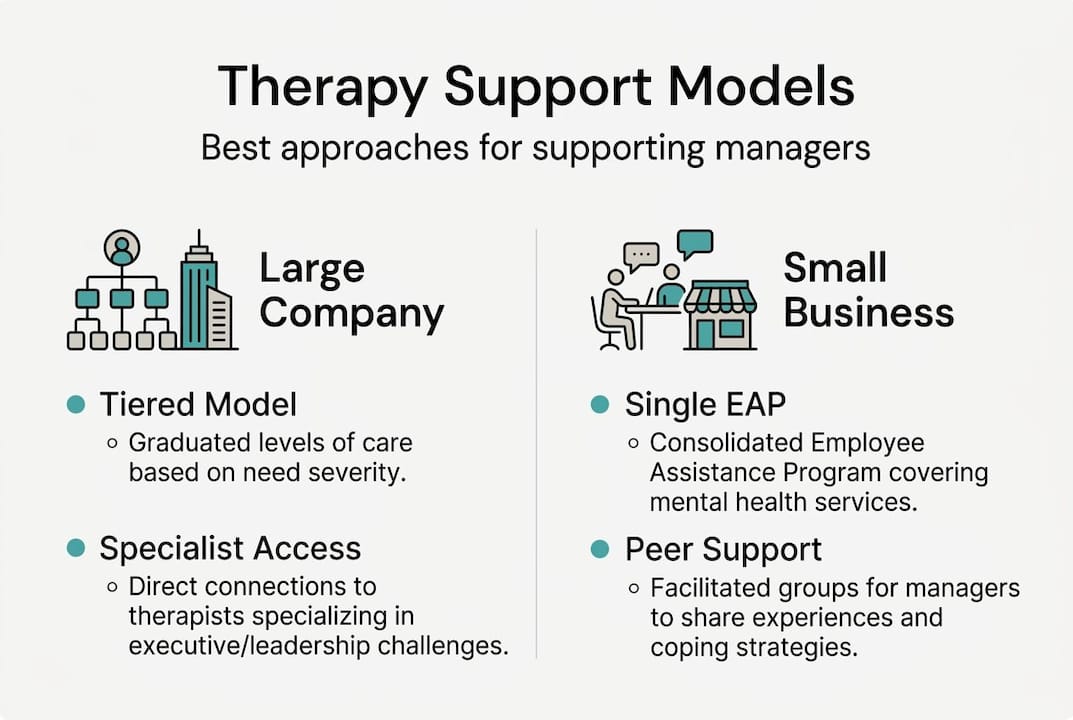
For larger organisations, a tiered model works well. Tier one provides universal access through an EAP. Tier two offers targeted coaching or group programmes for managers identified as higher risk. Tier three delivers individual clinical therapy for those with significant needs. This structure ensures resources are allocated where they are most needed.
For SMEs, a tiered model may not be financially viable. In smaller organisations, a single well-chosen EAP with a strong coaching component often delivers the best return. The key is ensuring managers actually use it, which requires active normalisation from senior leadership.
The return on investment is compelling. ROI on manager training and support can reach up to 312%, with wellness programmes returning more than three pounds for every pound spent. Organisations that invest in manager support also report a 35% reduction in staff turnover, alongside measurable reductions in absenteeism. These figures make a strong business case for wellness programme ROI insights to be presented to senior decision-makers.
Key features of effective support models include:
- Confidentiality: Managers must trust that accessing support will not affect their career prospects.
- Accessibility: Support should be available outside standard working hours, given that many managers work extended days.
- Relevance: Generic employee programmes often miss the specific challenges managers face. Tailored content produces better engagement.
- Line manager buy-in: When senior leaders visibly use and endorse support services, uptake across the management population increases significantly.
Practical challenges and what most leaders overlook
Even well-designed support programmes fail if the underlying culture does not support them. The most common reason managers do not access therapy is stigma. There is a persistent belief in many organisations that seeking help signals weakness, and this belief is strongest among people in leadership roles.
The second major challenge is the blurring of roles. Many managers are informally expected to act as emotional support for their teams, absorbing distress without any training or support of their own. Managers are not therapists and placing that burden on them causes burnout and increases organisational risk.
"When managers are expected to counsel their teams without boundaries or support, the organisation is essentially outsourcing its mental health provision to people who are not equipped to provide it."
The practical obstacles HR managers most commonly report include:
- Time constraints: Managers feel they cannot justify taking time for their own support when their workload is already excessive.
- Lack of clear referral pathways: Managers do not know how to access support or who to contact, so they do not act.
- No policy clarity: Without a written policy that normalises support, managers assume it is not genuinely encouraged.
- Fear of confidentiality breaches: Concerns that their employer will be informed of what they discuss in therapy prevent many from engaging.
Pro Tip: Train managers to signpost rather than counsel. Equip them with clear language for directing team members to professional support, and make sure they know that their role is to refer, not to resolve. This protects both the manager and the employee.
Addressing setting workplace boundaries clearly in your policy documentation removes ambiguity and gives managers permission to protect their own well-being without guilt.
A fresh perspective: Why supporting managers with therapy is strategic, not optional
There is a tendency to frame manager well-being as a compassionate add-on, a nice thing to offer if the budget allows. That framing is outdated and, frankly, costly.
Managers shape the day-to-day experience of every person in their team. Their emotional state, their communication style, and their resilience under pressure directly influence team culture, productivity, and retention. When a manager is struggling, the effects ripple outward to every person they lead.
Forward-thinking organisations are beginning to treat managerial mental health support as a core business function, not a benefit. The evidence supports this shift. The organisations that see the strongest returns on their well-being investment are those that prioritise the people responsible for delivering that well-being to others.
Ignoring manager needs does not save money. It transfers the cost to absenteeism, turnover, and underperformance, all of which are far more expensive than a well-structured therapy programme. The question is not whether your organisation can afford to support its managers. It is whether it can afford not to.
How GuideMe can help your managers flourish
If you are ready to move from insight to action, GuideMe offers a clear and accessible route to therapy support for managers that is confidential, tailored, and genuinely effective.

GuideMe is a therapy navigation platform that combines human expertise with AI-powered matching to connect managers with the right therapist from the very beginning. Rather than leaving managers to navigate a confusing system alone, GuideMe creates an in-depth therapy plan that reflects each person's specific needs and circumstances. For HR managers and team leaders, this means you can offer your people a structured, supportive pathway into therapy, without the uncertainty that so often prevents people from taking that first step. Reach out to GuideMe today and give your managers the support they deserve.
Frequently asked questions
Why do managers need therapy support more than other employees?
Managers experience higher rates of stress, burnout, and mental health issues than non-supervisory employees, driven by unique pressures including role conflict, isolation, and responsibility for others' well-being.
What types of therapy support are most effective for managers?
Best-practice models include EAPs, executive coaching, and targeted stress management training. Methodologies such as EAPs with coaching and occupational health therapy consistently produce the strongest outcomes when used in combination.
How does supporting managers with therapy impact the whole organisation?
It reduces absenteeism, lowers staff turnover, and improves team performance. ROI on manager support can reach up to 312%, making it one of the highest-return investments an organisation can make in its people.
What if a manager resists therapy due to stigma or time pressure?
Normalising support through visible senior endorsement, offering flexible access, and framing therapy as a performance tool rather than a crisis response all help. Executives resist due to stigma but tend to benefit most once they engage.