

TL;DR:
- Research shows similar effectiveness across various therapy modalities, emphasizing personalized fit.
- The quality of the client-therapist relationship is a key factor in therapy success.
- Choosing the right therapist and approach depends on individual needs, preferences, and alliance.
Choosing therapy can feel genuinely overwhelming. There are so many approaches, so many acronyms, and so little guidance on where to begin. What surprises many people is that research shows comparable effectiveness across leading therapy modalities, with effect sizes ranging from small to large depending on the condition. So the question is rarely "which therapy is best" but rather "which therapy is best for you." This article breaks down the most common approaches, explains what the evidence actually says, and helps you think through what might suit your needs and circumstances.
Table of Contents
- Comparing therapy modalities: CBT, psychodynamic, and more
- How effectiveness and evidence vary across approaches
- Choosing a therapy: practical factors and fit
- Applying your understanding: moving from confusion to clarity
- What most guides miss: therapy is a partnership, not just a process
- Ready to find your path? Explore therapy support with GuideMe
- Frequently asked questions
Key Takeaways
| Point | Details |
|---|---|
| Comparable effectiveness | Major therapy modalities deliver similar outcomes for many mental health issues. |
| Personal fit matters | Therapeutic alliance and client comfort drive success more than approach alone. |
| Research guides choice | Evidence-based factors like diagnosis and trauma history help match therapies to needs. |
| Practical application | Understanding therapy approaches empowers confident self-assessment and progress. |
Comparing therapy modalities: CBT, psychodynamic, and more
With the landscape introduced, let's take a closer look at how the most prominent therapy approaches compare. Understanding these differences is the first step toward selecting therapy modalities with confidence rather than guesswork.
Cognitive Behavioural Therapy (CBT) is perhaps the most widely recognised approach. It is a structured, goal-oriented approach that focuses on the relationship between thoughts, feelings, and behaviours. Sessions are typically time-limited, practical, and skills-based. You learn to identify unhelpful thought patterns and replace them with more balanced ones.
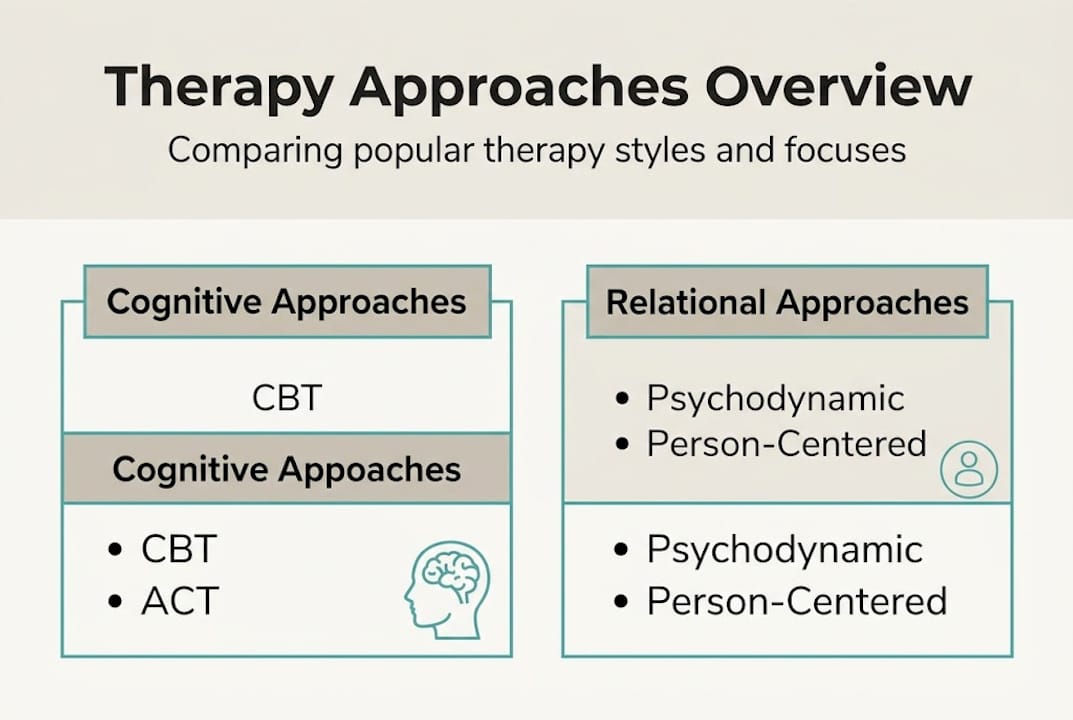
Short-term psychodynamic therapy (STPP) works differently. It draws on the idea that current difficulties are often rooted in past experiences and unconscious patterns. Rather than teaching specific skills, it encourages reflection and insight. Importantly, STPP shows equivalent efficacy to CBT for major depression, which challenges the assumption that CBT is automatically the superior choice.
Acceptance and Commitment Therapy (ACT) is a newer development within the cognitive behavioural tradition. It focuses less on changing thoughts and more on accepting them, while committing to actions aligned with your values. It is particularly useful for chronic pain, anxiety, and situations where rigid thinking creates distress.
EMDR (Eye Movement Desensitisation and Reprocessing) uses bilateral stimulation, often guided eye movements, to help the brain reprocess distressing memories. It is most commonly used for trauma and PTSD.
Person-centred therapy, a humanistic approach, prioritises the therapeutic relationship itself. The therapist offers empathy and unconditional positive regard, and the client leads the direction of sessions.
Here is a quick comparison to help you see the differences at a glance:
| Approach | Focus | Typical use | Evidence base |
|---|---|---|---|
| CBT | Thoughts and behaviours | Anxiety, depression, OCD | Strong, well-established |
| STPP | Unconscious patterns, past | Depression, relationship issues | Strong, comparable to CBT |
| ACT | Acceptance, values | Anxiety, chronic conditions | Growing, solid |
| EMDR | Trauma reprocessing | PTSD, trauma | Strong for PTSD |
| Person-centred | Relationship, self-growth | General wellbeing, self-esteem | Moderate, widely used |
Key things to keep in mind:
- No single approach works for everyone
- Duration varies: CBT and STPP are often short-term; person-centred can be open-ended
- Many therapists integrate elements from multiple approaches
- Your comfort with the style matters as much as the evidence
How effectiveness and evidence vary across approaches
Having explored the differences in approaches, it is crucial to understand how evidence shapes their use. Not all therapies have been studied equally, and effect sizes vary by condition.
CBT has the largest body of research behind it. It is highly effective for anxiety, depression, and PTSD, with effect sizes ranging from g=0.73 for depression to g=1.25 for specific phobias. These are considered large effects in psychological research.
But CBT is not the only well-supported option. The broader picture, drawn from hundreds of studies, shows that psychotherapy generally yields small to large effects across disorders, with no significant differences between bona fide approaches in direct comparisons. This is sometimes called the "Dodo Bird Verdict" in research circles: all have won, and all deserve prizes.
Here is how effect sizes compare across common conditions:
| Condition | CBT effect size | Psychodynamic effect size | EMDR effect size |
|---|---|---|---|
| Depression | g=0.73 | Equivalent to CBT | Moderate |
| Anxiety disorders | g=0.80-1.00 | Moderate | Limited data |
| Phobias | g=1.25 | Limited data | Limited data |
| PTSD | Large | Moderate | Large |
"The therapeutic alliance, the quality of the collaborative relationship between client and therapist, consistently emerges as one of the strongest predictors of therapy outcomes, often more predictive than the specific modality used." This insight from therapy outcomes research reflects a growing consensus in the field.
What this means practically is that choosing a therapy based purely on its label may be less important than choosing a therapist you trust and a format that fits your life. The evidence supports trying a well-established approach, but it also reassures you that there is no single "correct" path.
Choosing a therapy: practical factors and fit
With evidence in mind, many people wonder how to actually make the best therapy choice for themselves. The research is helpful, but it does not make the decision for you.
Here is a practical framework for narrowing down your options:
- Identify your primary concern. Are you dealing with anxiety, depression, trauma, relationship difficulties, or something else? Some approaches are better suited to specific issues.
- Consider your preferred style. Do you want structured exercises and homework, or would you prefer open-ended reflection? CBT suits the former; psychodynamic or person-centred suits the latter.
- Think about time and commitment. CBT is often 8 to 20 sessions. Open-ended approaches can run for months or years. Be honest about what you can sustain.
- Ask about the therapist's approach. Many practitioners blend methods. A therapist who uses CBT as a foundation but draws on ACT or attachment theory may offer a more flexible fit.
- Revisit after a few sessions. You do not have to commit permanently. If something does not feel right after three or four sessions, it is reasonable to reassess.
It is also worth knowing that not everyone responds to short-term therapy. Research shows that 20 to 25% of people in depression trials show no reliable change or even deterioration. Complex trauma, in particular, may need a trauma-focused approach like EMDR rather than general CBT.
The therapeutic alliance matters enormously. Common factors like alliance explain a significant portion of the variance in outcomes across all approaches, often more than the technique itself.

Pro Tip: When you meet a potential therapist for the first time, pay attention to how safe and heard you feel. That feeling is data. A strong connection early on is one of the best predictors of a good outcome.
Finding the right finding therapy fit is not about getting it perfect immediately. It is about being informed enough to make a thoughtful start.
Applying your understanding: moving from confusion to clarity
After considering how to choose, here is how you can confidently apply your understanding and nurture your progress.
Let's quickly recap the main approaches:
- CBT: Structured, skills-based, short-term, strong evidence across many conditions
- STPP: Reflective, insight-focused, comparable to CBT for depression
- ACT: Values-based, acceptance-focused, useful for chronic or recurring issues
- EMDR: Trauma-specific, uses bilateral stimulation, strong for PTSD
- Person-centred: Relationship-led, client-directed, emphasises self-actualisation and empathy
When you attend your first session, you can expect the therapist to ask about your history, your current difficulties, and what you hope to achieve. This is not a test. It is the beginning of a collaborative process. Most therapists will also explain their approach and invite questions.
Use this self-assessment checklist to feel more prepared:
- What am I hoping therapy will help me with?
- Am I open to structured exercises, or do I prefer open conversation?
- How much time can I realistically commit each week?
- What has or has not worked for me in the past?
- Am I comfortable with the therapist's communication style?
Pro Tip: Keep a simple notebook after each session. Jot down what felt useful, what surprised you, and any questions that came up. Bringing these notes to your next session helps you get more from the process and shows your therapist what is resonating.
Your therapy journey guidance does not need to be perfect from the start. It just needs to begin with enough information to move forward with confidence.
What most guides miss: therapy is a partnership, not just a process
As you reflect on these choices, it is vital to consider another dimension often left out of traditional guides. Most articles focus heavily on modality comparisons, as though choosing the right technique is the primary driver of success. But the evidence tells a more nuanced story.
Common factors like alliance explain a substantial portion of therapy outcomes, often more than the specific approach used. That means the relationship you build with your therapist, and the trust you bring to it, is not secondary to the method. It is central.
Therapy is co-created. You are not a passive recipient of a technique. Your openness, your willingness to reflect, and your honesty in sessions shape the results just as much as the therapist's training. This is not a burden. It is actually empowering.
A checklist for cultivating an effective partnership:
- Be honest about what is not working, including within the therapy itself
- Ask your therapist to explain their reasoning when something is unclear
- Give yourself permission to feel uncertain without abandoning the process
- Acknowledge progress, even when it feels small
Choosing a modality matters. But choosing a therapist you genuinely connect with may matter more.
Ready to find your path? Explore therapy support with GuideMe
To put your knowledge into practice, consider using support to guide your next steps. Understanding therapy approaches is valuable, but knowing where to go next can still feel uncertain.
GuideMe is a therapy navigation platform that combines human expertise with AI-powered matching to help you find the right therapist from the beginning. Rather than leaving you to search alone, GuideMe creates an in-depth therapy plan tailored to your needs and connects you with a therapist who suits your preferences, goals, and style. If you are ready to move from understanding to action, explore therapy guidance and support and take the next step with clarity and confidence.
Frequently asked questions
Are all therapy modalities equally effective?
Research shows no significant differences between bona fide therapy approaches in direct comparisons, though some modalities may suit specific conditions or individual preferences better than others.
Which therapy approach works best for depression?
Both CBT and psychodynamic therapy have strong evidence for depression. STPP shows equivalent efficacy to CBT for major depression, making personal fit and therapist alliance key deciding factors.
When is EMDR preferred over other therapies?
EMDR is especially well-suited to trauma and PTSD. It uses bilateral stimulation to reprocess traumatic memories and is recommended when addressing past trauma is the primary goal.
What factors help therapy be most successful?
A strong client-therapist alliance, personal comfort with the approach, and genuine engagement in sessions are among the most significant predictors of positive outcomes. Common factors like alliance consistently outweigh modality differences in research findings.