

Many people assume counselling is only for those in crisis, but this is a widespread misconception that stops people from getting support they genuinely need. Counselling is, in fact, a versatile and evidence-based form of support that addresses a broad range of everyday concerns, from managing stress and navigating life changes to processing grief and making difficult decisions. Counselling addresses present-focused issues and is solution-oriented, making it distinct from longer-term psychotherapy. Understanding what counselling truly offers is the first step towards making clearer, more confident choices about your mental health.
Table of Contents
- What is counselling?
- How counselling differs from psychotherapy
- Key counselling methodologies and techniques
- Effectiveness of counselling: Evidence and outcomes
- Counselling boundaries, limitations and best practices
- How to choose the right counsellor or therapist
- Connecting with support: Next steps with GuideMe
- Frequently asked questions
Key Takeaways
| Point | Details |
|---|---|
| Counselling is versatile | It supports a broad range of everyday mental health needs, not just crises. |
| Evidence-based methods matter | Proven approaches like CBT and MI drive effective outcomes and should be prioritised when choosing a therapist. |
| Boundaries support effectiveness | Counsellors and clients should respect professional limits to ensure safety and results. |
| Assess your needs first | Match current and specific concerns to counselling, deeper ongoing patterns to psychotherapy. |
| Therapist fit is critical | A strong therapeutic alliance is essential for success, so prioritise rapport and evidence-based practice. |
What is counselling?
Counselling is a structured, professional relationship in which a trained counsellor helps you explore your thoughts, feelings, and behaviours in relation to specific concerns. The main goal is to support you in developing practical strategies and gaining clarity, rather than conducting deep psychological analysis. It is a collaborative process, and you remain in control of the direction and pace.
Counselling primarily addresses specific, present-focused issues such as grief, career decisions, relationship difficulties, and mild mental health concerns. It sits within a broader spectrum of mental health support, which also includes psychotherapy, psychiatry, and peer support. Knowing where counselling fits helps you make better decisions when choosing therapy options.
Common areas counselling can help with include:
- Grief and bereavement
- Work-related stress and burnout
- Relationship and communication difficulties
- Anxiety and low mood
- Life transitions such as divorce, redundancy, or retirement
- Decision-making and personal development
Pro Tip: You do not need to be in crisis to benefit from counselling. If you are facing a significant life transition or simply feeling stuck, counselling can provide valuable clarity and direction.
How counselling differs from psychotherapy
Counselling and psychotherapy are often used interchangeably, but they are not the same. Understanding the distinction helps you choose the right type of support for your situation.

Counselling is short-term and solution-focused, typically addressing present issues over a defined number of sessions. Psychotherapy, by contrast, is longer-term and targets deeper, ongoing patterns rooted in past experiences. Both are effective, but they suit different needs and circumstances.
CBT is structured and pragmatic while humanistic approaches are relational and non-directive, illustrating how even within these two fields there is significant variety in method and style.
| Feature | Counselling | Psychotherapy |
|---|---|---|
| Duration | Short-term (6–20 sessions) | Long-term (months to years) |
| Focus | Present issues and solutions | Deep-rooted patterns and past experiences |
| Methods | CBT, person-centred, MI | Psychoanalysis, schema therapy, EMDR |
| Depth | Practical and solution-oriented | Exploratory and insight-focused |
| Best suited for | Specific, current concerns | Complex, longstanding difficulties |
Key differences at a glance:
- Counselling tends to be more structured and time-limited
- Psychotherapy often involves exploring childhood or unconscious patterns
- Both require a strong therapeutic relationship to be effective
- Neither is universally superior; the right choice depends on your needs
If you are unsure whether you need counselling or psychotherapy, a good starting point is to reflect on whether your concerns are recent and specific, or longstanding and complex.
Key counselling methodologies and techniques
Counselling draws on several well-established, evidence-based approaches. Knowing what these involve helps you understand what to expect in sessions and how to evaluate whether a practitioner is right for you.
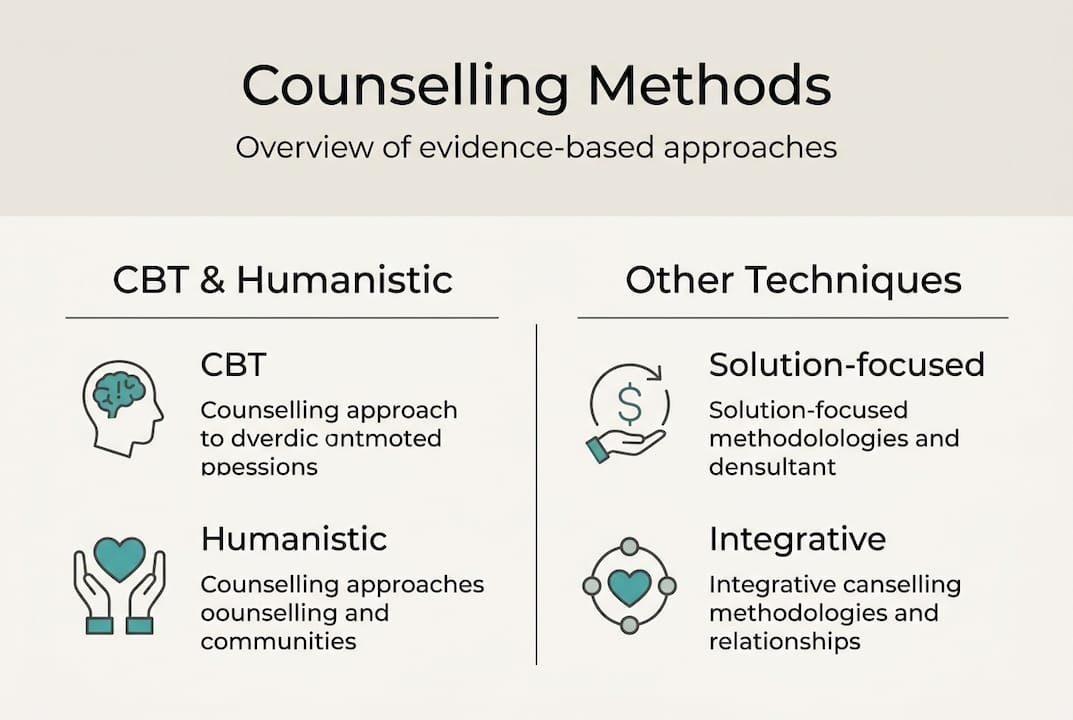
CBT, Motivational Interviewing, and humanistic approaches are among the core methodologies used in counselling. Reflective listening and encouragement are key techniques that support the therapeutic process across all of these frameworks.
Core approaches include:
- Cognitive Behavioural Therapy (CBT): Focuses on identifying and changing unhelpful thought patterns and behaviours
- Motivational Interviewing (MI): Helps you explore ambivalence and build motivation for change
- Person-centred (humanistic) counselling: Prioritises your autonomy and self-directed growth within a supportive relationship
- Solution-focused brief therapy: Concentrates on your strengths and desired outcomes rather than problems
What to expect from a typical counselling session:
- A check-in on how you have been feeling since the last session
- Exploration of a specific concern or theme you want to address
- Use of techniques such as reflective listening, guided questioning, or thought records
- Collaborative goal-setting or reviewing progress towards existing goals
- A brief summary and any agreed actions or reflections to consider before the next session
Research consistently shows that a strong therapeutic alliance predicts success across all approaches, meaning the relationship you build with your counsellor matters as much as the method used.
Pro Tip: When vetting a potential counsellor, ask directly which evidence-based methodologies they use and how they tailor their approach to individual clients. A good counsellor will welcome this question.
Effectiveness of counselling: Evidence and outcomes
One of the most common concerns people have is whether counselling actually works. The evidence is clear and reassuring.
Meta-analyses show that counselling produces large effect sizes for depression (g=0.73), anxiety (g=0.83 to 1.25), and PTSD (g=1.18). CBT in particular yields a Hedges' g above 1.0 for PTSD and phobias, and between 0.5 and 1.0 for depression and anxiety. These are considered large and clinically meaningful effects.
| Condition | Effect size (Hedges' g) | Interpretation |
|---|---|---|
| Depression | 0.73 | Large benefit |
| Anxiety disorders | 0.83–1.25 | Large to very large benefit |
| PTSD | 1.18 | Very large benefit |
| Phobias (CBT) | Above 1.0 | Very large benefit |
These results hold not only in controlled research trials but also in routine UK clinical practice and across diverse, non-Western contexts. This matters because it means the benefits you read about in studies are likely to translate to real-world support.
Statistic to note: Counselling matches the efficacy seen in controlled trials when delivered in routine care settings, meaning you do not need to be in a research study to experience meaningful results.
The evidence strongly supports counselling as a first-line option for a wide range of common mental health concerns. It is not a last resort. It is a well-validated, practical form of support.
Counselling boundaries, limitations and best practices
Counselling is effective for many concerns, but it is not the right fit for every situation. Knowing its limitations is just as important as understanding its strengths.
Counsellor personal mental health boundaries prevent burnout and protect the quality of care. Counselling is also not ideal for severe or complex disorders that require psychological diagnostics or psychiatric intervention. In these cases, a referral to a clinical psychologist or psychiatrist may be more appropriate.
Signs you may need a different type of support:
- Your difficulties are longstanding and deeply rooted in early experiences
- You are experiencing symptoms of a severe mental health condition such as psychosis or bipolar disorder
- You require a formal diagnosis or medication management
- Previous counselling has not produced meaningful improvement
- Your safety or the safety of others is at risk
Counsellors must model help-seeking behaviour and integrate methods based on individual client needs. This means a good counsellor will tell you honestly if they feel another form of support would serve you better, and will help you access it. Understanding counselling boundaries protects both you and your practitioner.
Pro Tip: If you have a complex presentation or have not responded to standard counselling, seek a specialist. Boundaries in the therapeutic relationship are not barriers; they are safeguards that keep the process effective and ethical.
How to choose the right counsellor or therapist
Finding the right professional can feel overwhelming, especially if you are new to seeking support. A structured approach makes the process much more manageable.
Assess whether your issues are specific and current before deciding between counselling and therapy. Seek practitioners who use evidence-based methods and prioritise building a strong therapeutic alliance.
Steps to finding the right fit:
- Define your concern clearly. Is it a specific, present issue or something longstanding and complex?
- Match your need to the right type of support. Use the counselling vs psychotherapy distinction to guide your decision.
- Review practitioner credentials. Look for accreditation from recognised bodies such as the BACP or UKCP.
- Ask about their approach. Enquire about the methodologies they use and their experience with your specific concern.
- Assess the fit after your first session. Did you feel heard, respected, and comfortable? This matters enormously.
- Review progress regularly. Good counselling should produce noticeable shifts within a reasonable timeframe.
Checklist for evaluating a counsellor:
- Uses evidence-based methods relevant to your concern
- Has relevant experience and recognised accreditation
- Communicates clearly and without jargon
- Respects your pace and autonomy
- Encourages honest feedback about the process
Pro Tip: It is entirely acceptable to change counsellor if the fit does not feel right after a few sessions. A good therapeutic relationship is foundational to progress, and finding the right person is worth the effort. If you want structured guidance, find the right therapist with a platform designed to match you based on your specific needs.
Connecting with support: Next steps with GuideMe
Understanding counselling is a meaningful first step, but knowing where to turn next is just as important. Finding the right counsellor or therapist is not always straightforward, and the wrong match can make the process feel discouraging before it has even begun.
GuideMe is built to change that. Our platform combines human expertise with AI-powered matching to help you understand your mental health needs through an in-depth therapy plan, then connects you with a therapist who is genuinely suited to your situation. You can explore our counselling resources to deepen your understanding, or go straight to our directory of therapists to find a qualified professional who fits your needs, your preferences, and your pace. Getting the right support from the start makes the entire experience more effective and more comfortable.
Frequently asked questions
What issues can counselling help with?
Counselling supports grief, stress, anxiety, relationship problems, and life transitions through solution-focused sessions that address present, specific concerns.
How effective is counselling for depression and anxiety?
Meta-analyses show large effect sizes for depression and anxiety, with CBT producing particularly strong results and clinically meaningful improvements in routine care settings.
When should I choose counselling vs psychotherapy?
Opt for counselling if your concerns are specific and recent; choose psychotherapy if you are dealing with deep-rooted, longstanding patterns that require more exploratory work.
What is a therapeutic alliance and why does it matter?
A therapeutic alliance is the quality of the relationship between you and your therapist. Research shows it strongly predicts positive outcomes across all therapeutic approaches, regardless of the method used.
Are there limitations to counselling?
Counselling may not suit severe or complex disorders that require diagnostic expertise; clear professional boundaries help prevent burnout and maintain the quality and safety of the therapeutic process.