

TL;DR:
- Therapist empathy significantly improves therapy outcomes, with a medium effect size around r=0.28.
- Genuine empathy involves attuned listening, understanding unspoken feelings, and maintaining professional boundaries.
- Both client and therapist contribute to the quality of empathic connection, which enhances the therapeutic alliance.
Empathy is far more than being kind or offering a sympathetic ear. Research confirms that therapist empathy correlates with meaningfully better client outcomes, with effect sizes around r=0.28 (d=0.58). That is a statistically robust finding across dozens of studies, and it tells us something important: the quality of understanding your therapist brings to the room genuinely shapes how well therapy works for you. If you have ever wondered whether the emotional connection in therapy actually matters, or felt unsure about what to look for in a therapist, this article is for you.
Table of Contents
- What is empathy in therapy?
- The impact of empathy on therapeutic outcomes
- How empathy is expressed and measured in therapy
- Pitfalls, boundaries, and adapting empathy in therapy
- Why empathy is more nuanced than most people think
- Explore empathetic therapy options with Guide Me
- Frequently asked questions
Key Takeaways
| Point | Details |
|---|---|
| Empathy drives change | Therapist empathy significantly boosts therapy outcomes, as shown in large studies. |
| Beyond kindness | Empathy means attuned, responsive support—not just feeling for someone. |
| Adaptability matters | Therapists must tailor empathy to each client, avoiding one-size-fits-all approaches. |
| Boundaries prevent harm | Balancing empathy with clear boundaries protects both client and therapist. |
| Choose wisely | Clients can optimise their therapy experience by seeking therapists who practise authentic empathy. |
What is empathy in therapy?
Building on that opening point, let's clarify what empathy actually means in a therapeutic setting, because it is frequently misunderstood.
Most people equate empathy with sympathy, but they are quite different. Sympathy is feeling for someone, often from a distance. Empathy is the active effort to understand someone's experience as though you were inside it, while still remaining yourself. In therapy, empathy goes further still. It is a disciplined, attuned form of understanding that a trained therapist consciously offers as part of their practice.
Compassion is related but distinct too. Compassion involves the desire to alleviate suffering. Empathy, in the therapeutic sense, is about accurately perceiving what the client is experiencing, whether that is fear, grief, confusion, or relief. A therapist does not need to have lived your experience to be empathetic. They need the skill and intention to genuinely receive it.
The clearest articulation of therapeutic empathy comes from person-centred therapy, developed by Carl Rogers. In this model, empathy is a core condition, alongside congruence (therapist authenticity) and unconditional positive regard (non-judgmental acceptance). Rogers argued these three conditions were necessary and sufficient for meaningful therapeutic change. That is a bold claim, and decades of research have tested it rigorously.
What does "attuned" empathy look like in practice? It means the therapist tracks not just what you say but how you say it. They notice shifts in your tone, pauses before difficult words, or the emotion you do not quite name. They reflect this back in a way that helps you feel genuinely seen. This is not performance. It is a trained skill that good therapists work to refine throughout their careers. Understanding the core conditions in counselling can help you recognise whether your therapist is truly offering this quality of engagement.
"The good therapist feels the client's private world as if it were their own, but without ever losing the 'as if' quality." — Carl Rogers
That "as if" quality is crucial. Empathy in therapy is not about a therapist losing themselves in your experience. It is about holding your world carefully, while remaining grounded in their own professional perspective.
The impact of empathy on therapeutic outcomes
Now that empathy's role is defined, it is vital to see how it actually impacts recovery and change, because the evidence is striking.
Meta-analytic findings confirm that therapist empathy has an effect size of approximately r=0.28 (d=0.58), which is considered a medium effect in psychological research. To put that in context, this is comparable to the effect sizes seen for specific therapeutic techniques in many studies. In other words, who your therapist is and how they engage with you matters just as much as the type of therapy they use.
One of the key mechanisms is the therapeutic alliance, which refers to the collaborative relationship and bond between therapist and client. Empathy is a central ingredient in building that alliance, and the alliance itself accounts for approximately 8% of outcome variance across treatments. That may sound modest, but when you consider that therapeutic outcomes are influenced by dozens of interacting factors, 8% attributed to the relationship quality alone is substantial.

| Factor | Approximate contribution to outcomes |
|---|---|
| Therapeutic alliance (including empathy) | ~8% |
| Specific therapeutic techniques | ~8% |
| Expectancy and placebo effects | ~4% |
| Client factors (motivation, severity) | ~40% |
| Measurement and study variability | Remaining variance |
This table illustrates that no single factor explains all of therapy's effectiveness. But the alliance, anchored in empathy, consistently shows up as one of the most reliable contributors to positive change.
Pro Tip: When evaluating a new therapist, notice how you feel after your first session. Do you feel heard? Are you willing to share more next time? These early signals reflect the empathic quality of the relationship, and research suggests the alliance formed in early sessions is one of the strongest predictors of eventual outcome.
It is also worth noting that these findings hold across different therapeutic modalities. Whether you are engaging in cognitive behavioural therapy, psychodynamic therapy, or integrative approaches, a therapist's empathic capacity makes a measurable difference. The core conditions in counselling are not exclusive to any single school of thought; they are cross-cutting qualities that strengthen any therapeutic approach.
How empathy is expressed and measured in therapy
With the evidence in hand, let's turn to how empathy truly shows up in sessions and how you might notice it yourself.
Researchers have gone beyond asking clients "do you feel understood?" They have actually measured physiological responses. Skin conductance studies show that physiological concordance between therapist and client, where their nervous systems move in synchrony, correlates positively with perceived empathy (r=0.47, p=0.03) and more positive social-emotional interactions. This suggests genuine empathy has measurable physical consequences. When a therapist is truly attuned, your body often registers it even before your conscious mind does.
So how is empathy actually expressed in a session? Here are the key behavioural indicators:
- Reflective listening: The therapist accurately summarises or paraphrases what you have shared, demonstrating they have genuinely taken it in rather than preparing their next response.
- Validation: They acknowledge your emotional experience without rushing to problem-solve or reassure, letting you know your feelings make sense.
- Tracking non-verbal cues: They notice hesitation, changes in posture, or shifts in your voice and respond to what is unspoken as much as what is spoken.
- Naming the unspoken: An empathic therapist might gently say, "It sounds like there's some sadness underneath that, is that right?" rather than waiting for you to name it yourself.
- Adjusting their pace: They slow down when you need more time, or gently press when they sense you are skirting around something important.
- Repairing moments of misattunement: No therapist gets it right every time. A genuinely empathic therapist notices when they have missed the mark and addresses it directly rather than moving on.
Advanced empathy also involves something called intellectual humility, which means the therapist holds their intuitions loosely, checks their assumptions with you, and remains curious rather than certain. Research shows this quality actually improves intuitive accuracy. It also means skilled therapists practise mindfulness to prevent what researchers call empathic distress, where absorbing a client's pain begins to affect the therapist's own wellbeing.
Pro Tip: Pay attention to whether your therapist asks clarifying questions rather than assuming they know how you feel. A question like "Tell me more about what that felt like for you" is a sign of genuine empathic curiosity, not a scripted technique.
Understanding these signals helps you become a more active participant in your own therapy. You do not have to passively receive what a therapist offers. You can notice, reflect, and even name when something feels off.
Pitfalls, boundaries, and adapting empathy in therapy
While empathy is powerful, it is important to understand its limitations and complexities, especially when boundaries or individual preferences come into play.
One of the most important critiques of therapeutic empathy is what some clinicians have called empathy as performance anxiety. When empathy is mandated or treated as a box to tick, it can become forced and hollow. Some therapists, particularly those newer to practice or working in systems that monitor their style, may perform empathy in a way that clients actually find unsatisfying or even unsettling. Genuine empathy cannot be scripted.
There is also the risk of overemphasis distorting professional boundaries. A therapist who becomes excessively emotionally involved may struggle to maintain the clarity and objectivity that clients also need. Good therapy requires both warmth and structure.
| Healthy empathy in therapy | Problematic empathy in therapy |
|---|---|
| Attuned and responsive to client's needs | Forced or performative responses |
| Maintains clear professional boundaries | Over-involvement that blurs boundaries |
| Adapts style to individual client | One-size-fits-all emotional tone |
| Supports client autonomy | Creates emotional dependency |
| Combined with evidence-based technique | Replaces structured clinical thinking |
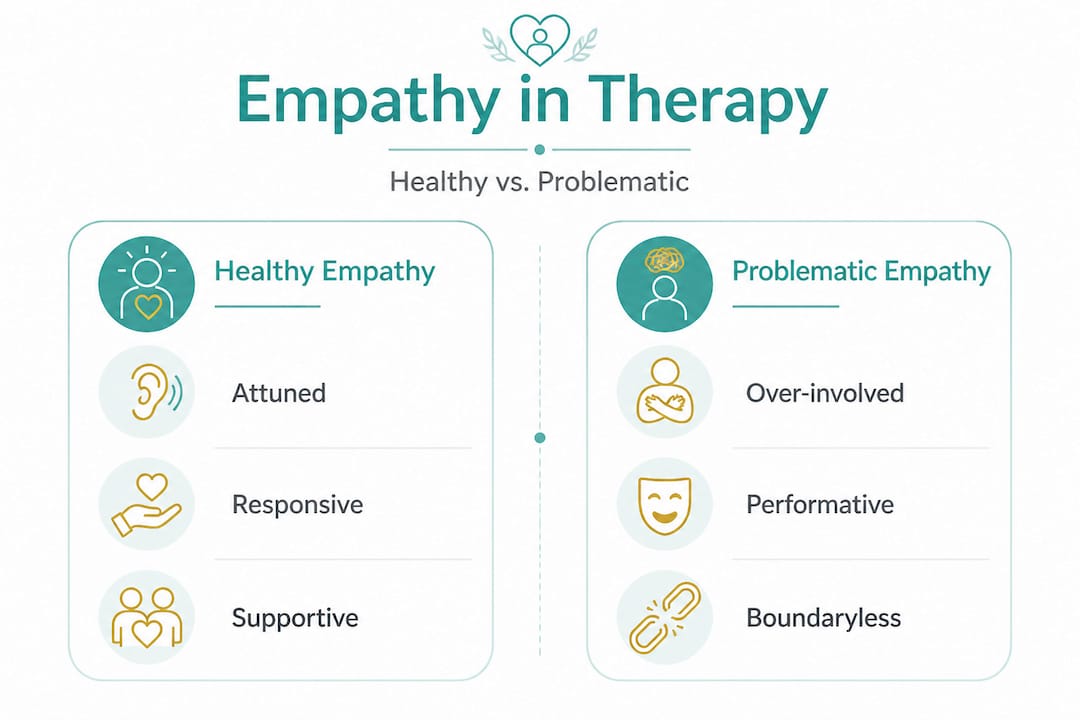
Not every client responds to high levels of emotional attunement in the same way. Some clients, particularly those with experiences that make trust difficult, may initially find a strongly empathic approach uncomfortable or suspicious. Adapted empathy approaches recognise that different people need different levels and types of empathic engagement. A skilled therapist adjusts accordingly rather than applying a standard approach to every person.
Here is what you should be aware of as a client:
- Empathy does not mean agreement. A good therapist can deeply understand your experience while also offering honest, sometimes challenging perspectives.
- Feeling understood is not the same as feeling comfortable. Genuine empathy sometimes involves naming difficult truths rather than validating everything you say.
- You are allowed to give feedback. If the level of emotional attunement feels too much or too little, you can say so. A responsive therapist will adjust.
- Boundaries protect you. A therapist who maintains clear professional limits is not being cold; they are creating the safe structure that makes empathy therapeutic rather than blurring.
Understanding these nuances helps you advocate for yourself in therapy. Exploring resources about the core conditions in counselling can help you build a clear picture of what a well-balanced therapeutic relationship should look like.
Why empathy is more nuanced than most people think
There is a widespread assumption that empathy in therapy simply means a warm, caring therapist who listens well. That framing, while appealing, misses the full picture and can actually lead clients to make poorer choices when selecting or evaluating a therapist.
The most effective therapeutic empathy is not about emotional warmth alone. It is a calibrated, skilled practice that involves reading what is unsaid, adapting to individual needs, maintaining professional boundaries, and sometimes offering gentle challenge. A therapist who is endlessly validating and never challenges you is not necessarily highly empathic. They may simply be avoiding discomfort, theirs as much as yours.
We also think the client's role in this dynamic is underappreciated. Empathy is not something that happens to you in therapy. It is co-created. When you show up prepared to reflect on your own experience, to name what feels right and what does not, and to give your therapist honest feedback, you actively shape the quality of the empathic connection. The best therapeutic relationships are ones where both people are genuinely trying to understand.
There is also a credibility issue worth naming. Some clients assume that a therapist who seems emotionally expressive or visibly moved by their story is more empathic than one who is quieter but deeply attentive. This is not reliably true. Research on physiological concordance and intellectual humility suggests that the most skilled empathic therapists are often those working with careful, quiet attunement rather than dramatic emotional display.
Finally, empathy is not a substitute for the right match. You can work with a very empathic therapist who is not right for your specific needs, presentation, or goals. Empathy enhances the work, but it functions alongside therapeutic approach, training, specialisation, and the quality of the therapeutic relationship as a whole.
Explore empathetic therapy options with Guide Me
Finding a therapist who combines genuine empathic skill with the right training and approach for your needs is not always straightforward. Many people spend months in therapy that does not quite fit before making a change, often because they did not know what to look for from the start.

Guide Me is a therapy navigation platform that helps you understand your mental health needs in depth and get matched with a therapist who is genuinely well-suited to you. The process is both human-led and AI-powered, meaning you benefit from both thoughtful clinical insight and smart matching technology. Rather than browsing directories and hoping for the best, you receive a personalised therapy plan and support in finding a therapist whose empathic style, training, and specialisation align with what you actually need. Taking the right first step makes the entire experience more supported, more comfortable, and more effective.
Frequently asked questions
Does a therapist's empathy guarantee better outcomes?
Empathy strongly correlates with improved outcomes, with effect sizes around r=0.28, but it is one factor among several and does not guarantee success on its own.
Can too much empathy be harmful in therapy?
Over-empathising or forced empathy may cause performance anxiety for therapists and discomfort for some clients, which is why maintaining clear professional boundaries is essential.
How can I tell if my therapist is truly empathetic?
Genuine empathy involves attuned listening and adaptability, including responsiveness to unspoken feelings and the intellectual humility to check their assumptions rather than presuming they know how you feel.
Is empathy important in all types of therapy?
While empathy is central to person-centred approaches, research confirms the therapeutic alliance accounts for approximately 8% of outcome variance consistently across different treatment models, making empathy relevant in all modalities.