
TL;DR:
- Two-thirds of people with mental health issues do not seek help due to therapy stigma. Stigma manifests as public judgment, self-blame, and systemic barriers, delaying treatment. Reducing stigma involves education, positive representation, social contact, and systemic reforms.
Around two-thirds of people worldwide with mental health difficulties never seek professional help, and stigma is the primary reason. That is not a small gap. It represents millions of people quietly struggling, convinced that reaching out would invite judgement, shame, or worse. Therapy stigma is not simply shyness or preference. It is a deeply rooted social force that shapes decisions, silences conversations, and keeps people from getting support that could genuinely change their lives. Understanding what therapy stigma actually means, where it comes from, and what can be done about it is one of the most important conversations we can have.
Table of Contents
- What is therapy stigma?
- How does therapy stigma affect individuals and society?
- Cultural and community perspectives on therapy stigma
- What helps reduce therapy stigma?
- Why therapy stigma persists, and what we rarely discuss
- Finding safe, stigma-free support
- Frequently asked questions
Key Takeaways
| Point | Details |
|---|---|
| Therapy stigma defined | Therapy stigma means facing unfair judgement and barriers when seeking mental health support. |
| Major impact | Stigma keeps millions from getting help, harming health and quality of life. |
| Cultural differences | Stigma is particularly strong in some cultures, shaped by traditions and beliefs. |
| Reduction strategies | Education, social contact, and open conversations all make a positive difference. |
| Support is available | Safe, non-judgemental help can bridge the gap left by stigma. |
What is therapy stigma?
Once we recognise the scale of the problem, defining exactly what therapy stigma means helps lay the groundwork for understanding its effects.
Therapy stigma refers to the negative stereotypes, prejudice, and discrimination directed at people who seek or consider psychological therapy. It is not one single thing. It operates across several layers, and each layer creates its own set of barriers.
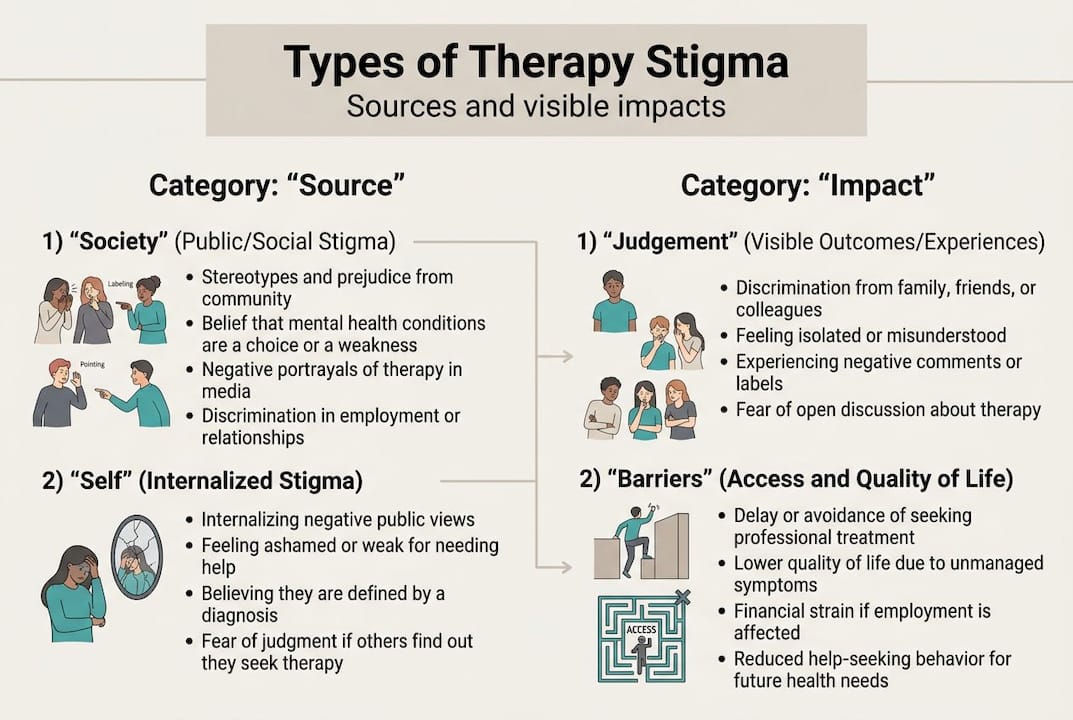
Public stigma is what most people picture first. It is the judgement, gossip, or dismissiveness that can come from friends, family, colleagues, or even strangers. Comments like "you just need to toughen up" or "therapy is for people who can't cope" are examples of public stigma in action.
Self-stigma, sometimes called internalised stigma, is often more damaging. This is when a person absorbs those social messages and starts to believe them. They feel ashamed of their own struggles, question whether they deserve help, or worry that needing therapy means something is fundamentally wrong with them.
Structural stigma is less visible but equally harmful. It refers to the ways policies, institutions, and systems can disadvantage people with mental health needs. This includes limited insurance coverage for therapy, inadequate mental health provision in healthcare, or legal and workplace consequences tied to mental health disclosures.
There is also a useful distinction between direct stigma and indirect stigma. Direct stigma involves fear of judgement from others. Indirect stigma involves doubts about whether therapy even works, which can be reinforced by cultural narratives or a lack of positive role models who openly discuss their therapy experience.
The mechanisms behind stigma involve three interconnected processes:
- Stereotypes: Oversimplified beliefs about people in therapy (e.g., they are weak or unstable)
- Shame and emotional avoidance: Feelings of embarrassment that prevent open discussion
- Behavioural avoidance: Actively choosing not to seek help to avoid being labelled
| Type of stigma | Source | Key impact |
|---|---|---|
| Public/social | Society, peers, media | Fear of judgement, social withdrawal |
| Self/internalised | Personal beliefs | Shame, low self-worth, delayed help-seeking |
| Structural | Systems and institutions | Access barriers, policy gaps |
Pro Tip: Recognising which type of stigma affects you most is the first step. Once you can name it, you can begin to challenge it. Platforms focused on reducing stigma in therapy can help you understand your own barriers before you even book a session.
How does therapy stigma affect individuals and society?
With a clear definition in place, it is important to understand the real stakes. How do these attitudes and judgements affect those who might need help the most?

Stigma delays or prevents help-seeking, worsens symptoms over time, and increases both social isolation and treatment gaps. These are not abstract outcomes. They translate into real suffering for real people.
The consequences of therapy stigma include:
- Worsened mental health symptoms due to delayed or absent treatment
- Social isolation as people hide their struggles
- Reduced self-esteem and increased self-blame
- Higher rates of crisis intervention and hospitalisation
- In severe cases, increased mortality risk
"For many people living with mental health difficulties, social stigma is harder to bear than the condition itself."
This reflects a pattern seen consistently in research. The fear of being judged can feel more overwhelming than the symptoms a person is already managing.
Here is how stigma typically progresses for someone considering therapy:
- Awareness: The person recognises they are struggling and considers seeking help.
- Hesitation: Concerns about what others will think begin to surface.
- Internalisation: They start to feel ashamed of needing support.
- Avoidance: They decide not to seek therapy to protect their reputation or self-image.
- Deterioration: Without support, symptoms worsen, making it harder to eventually reach out.
At a societal level, the picture is equally concerning. Structural barriers, such as limited mental health funding and inconsistent insurance coverage, compound personal stigma. People from lower-income backgrounds or marginalised communities often face both greater stigma and fewer accessible services. A strategy to reduce therapy stigma must account for these overlapping disadvantages, not just individual attitudes.
Cultural and community perspectives on therapy stigma
These attitudes are not the same everywhere. Culture, religion, and tradition shape how stigma is experienced and challenged in families and communities around the world.
In many collectivist societies, mental health struggles are seen as a reflection on the entire family, not just the individual. Seeking therapy can feel like an act of betrayal, an admission that the family has failed. This is particularly evident across parts of Asia, the Middle East, and Africa, where stigma significantly lowers help-seeking odds by up to 26% in some countries such as Pakistan.
Cultural beliefs that shape attitudes towards therapy include:
- Supernatural explanations: Mental distress attributed to spiritual causes, making therapy seem irrelevant or even offensive
- Family honour: The belief that seeking outside help exposes private family matters
- Religious frameworks: Some communities view emotional suffering as a test of faith, discouraging professional intervention
- Gender norms: Men in particular may face pressure to appear strong and self-sufficient
- Distrust of institutions: Historical mistreatment by healthcare systems can make communities wary of professional services
It is worth noting that stigma is not universal or fixed. Some communities have strong traditions of collective care and open emotional expression. Global stigma research shows that attitudes vary widely even within countries, depending on urban versus rural settings, generational differences, and exposure to mental health education.
Professional stigma within healthcare is also worth acknowledging. Some GPs, nurses, and even mental health workers hold unconscious biases about therapy, which can affect referrals and the quality of conversations patients receive. Stigma does not only live in the general public. It can be present in the very systems designed to help.
Nuance matters here. Broad generalisations about any culture can themselves cause harm. The goal is to understand context without reinforcing stereotypes.
What helps reduce therapy stigma?
Recognising the complex roots of stigma points us towards solutions. What do we know actually works to challenge these harmful judgements?
Anti-stigma programmes, especially those involving social contact, have been shown through meta-analyses to modestly but meaningfully improve help-seeking intentions. Social contact, meaning direct interaction with people who have sought therapy and benefited from it, is consistently one of the most effective tools available.
Here are practical steps individuals can take:
- Educate yourself: Learn about what therapy actually involves. Misconceptions fuel stigma.
- Share your own story: If you feel safe to do so, talking openly about therapy normalises it for others.
- Challenge stigmatising language: Gently correct comments that frame therapy negatively.
- Seek out positive representations: Films, books, and podcasts that portray therapy honestly can shift attitudes over time.
- Support others without judgement: Simply listening without dismissing someone's struggles reduces stigma in your immediate circle.
- Advocate for structural change: Support policies that improve mental health access and insurance coverage.
Public campaigns and peer support programmes have shown promise globally. When people see someone they respect openly discussing their therapy experience, the perceived social cost of seeking help drops considerably. The evidence-backed approaches to combat therapy stigma tend to combine education with lived experience, rather than relying on information alone.
Structural change remains essential. Individual attitude shifts matter, but without accessible, affordable services, even willing help-seekers can be left without options. Reviewing mental health stigma recovery research shows that the most durable reductions in stigma come from combining personal, community, and systemic efforts together.
Pro Tip: A single honest conversation with a friend about your own mental health experience can do more to reduce stigma in your immediate world than sharing an awareness post online. Small, consistent actions build lasting change.
Why therapy stigma persists, and what we rarely discuss
Bringing all these threads together reveals a stubborn truth: therapy stigma often survives where it is least expected.
Many people assume stigma is primarily a public problem, something that exists out there in society. But self-judgement is frequently the more powerful barrier. People who would never judge a friend for going to therapy still feel ashamed when they consider it for themselves. That gap between how we treat others and how we treat ourselves is where stigma does its quietest damage.
Anti-stigma campaigns often focus on visibility and awareness. These matter. But they rarely address the real-world constraints that keep people silent: family pressure, workplace consequences, or the experience of being dismissed by a healthcare professional. When someone musters the courage to ask for help and is met with indifference or scepticism from a GP, the damage to their willingness to try again can be profound.
From our perspective at GuideMe, what genuinely moves the needle is not one-off awareness days. It is consistent, small conversations and structural reform working together. Finding evidence-backed stigma solutions that address both the personal and the systemic is where real progress lives.
Finding safe, stigma-free support
If reading this has resonated with you, you are not alone. Therapy stigma is real, but it does not have to be the final word on whether you get support.
GuideMe Therapy is built around the understanding that finding the right therapist should feel safe, not daunting. GuideMe combines human expertise with AI-powered matching to create a therapy plan tailored to you, helping you find the right therapist from the very beginning. There is no judgement here, only a thoughtful, supportive process designed to make your first step into therapy feel manageable. You deserve support that respects your courage in reaching out. GuideMe is ready to help you take that step.
Frequently asked questions
What is meant by therapy stigma?
Therapy stigma refers to social judgement, shame, and discrimination faced by people who seek or consider psychological therapy. It includes negative stereotypes and discrimination that make people feel ashamed of needing professional support.
How does therapy stigma stop people from getting help?
Stigma causes many people to hide their struggles, delay treatment, and avoid mental health support altogether. Stigma delays help-seeking and widens treatment gaps, often leaving people to manage alone for far longer than necessary.
Is therapy stigma the same worldwide?
No, therapy stigma varies widely across cultures and communities. It tends to be stronger where family honour, religious norms, or collectivist values shape attitudes, with stigma higher in collectivist societies across parts of Asia, the Middle East, and Africa.
What actually reduces therapy stigma?
Education, sharing positive experiences, and regular social contact with people who have benefited from therapy all help. Anti-stigma programmes involving social contact have shown the most consistent results in improving help-seeking intentions across different populations.