

Many people assume finding a therapist is like choosing a doctor: credentials matter most, and any qualified professional will do. This overlooks a crucial truth. The relationship you build with your therapist, known as client-therapist fit, shapes your therapy outcomes more than you might expect. Research shows that therapeutic alliance predicts treatment success across all therapy types. This guide explains what client-therapist fit means, why cultural competence strengthens it, how it works across different therapy formats, and practical steps to find your ideal match.
Table of Contents
- Understanding client-therapist fit and the therapeutic alliance
- The role of cultural competence in enhancing client-therapist fit
- Comparing client-therapist fit across therapy options and modalities
- How to find your ideal therapist: practical steps for ensuring a good fit
- Explore expert-guided therapy matching with GuideMe
Key takeaways
| Point | Details |
|---|---|
| Alliance drives outcomes | The quality of your relationship with your therapist consistently predicts better treatment results. |
| Cultural fit matters | Therapists with cultural competence build stronger alliances, especially for clients from diverse backgrounds. |
| Modality flexibility | Client-therapist fit remains equally important whether you choose online or face-to-face therapy. |
| Personal preferences count | Understanding your communication style and comfort needs helps identify suitable therapists. |
| Practical assessment works | Initial consultations and targeted questions reveal whether a therapist matches your requirements. |
Understanding client-therapist fit and the therapeutic alliance
Client-therapist fit centres on the therapeutic alliance: a collaborative partnership between you and your therapist built on mutual trust, respect, and shared goals. This alliance forms the foundation of effective therapy, regardless of the specific techniques your therapist employs. When you feel understood, supported, and genuinely connected to your therapist, you engage more deeply in the therapeutic process.
Research consistently demonstrates that alliance quality correlates with better outcomes at r = .278 across diverse therapy approaches and settings. This correlation holds true whether you pursue cognitive behavioural therapy, psychodynamic approaches, or any other modality. The strength of your relationship with your therapist matters more than the specific school of thought they follow.
The alliance operates across three dimensions: the emotional bond between you and your therapist, agreement on therapy goals, and consensus about the tasks and methods used to achieve those goals. When these elements align, you experience therapy as a safe space where genuine change becomes possible. Measuring alliance quality through client-therapist relationship measures helps therapists adjust their approach to strengthen your connection.
"The therapeutic alliance represents the collaborative and affective bond between therapist and patient, encompassing agreement on goals and tasks."
Your therapist's ability to attune to your needs, validate your experiences, and adapt their style to match your preferences directly influences alliance strength. Some clients thrive with structured, directive approaches, whilst others prefer exploratory, client-led sessions. Neither style is inherently superior; what matters is finding the approach that resonates with you. Strong alliances develop when therapists recognise and honour your individual preferences.
Internet-based therapy shows the same alliance-outcome relationship as traditional face-to-face sessions, proving that the fundamental dynamics of client-therapist fit transcend delivery format. Whether you meet your therapist in person or through a screen, the quality of your relationship remains the critical factor in your therapy success.
The role of cultural competence in enhancing client-therapist fit
Cultural competence transforms good therapy into excellent therapy, particularly for clients from diverse or marginalised backgrounds. A culturally competent therapist possesses awareness of their own cultural biases, knowledge about different cultural worldviews, and skills to work effectively across cultural differences. This competence directly strengthens the therapeutic alliance by creating an environment where you feel truly seen and understood.
Evidence shows that clients from marginalised groups achieve better outcomes when working with culturally competent therapists. These therapists recognise how cultural identity, systemic oppression, and lived experiences shape mental health. They avoid imposing dominant cultural assumptions and instead honour your unique perspective. This validation builds the trust essential for deep therapeutic work.
Cultural competence encompasses three core components:
- Awareness: recognising personal biases and how cultural background influences therapeutic interactions
- Knowledge: understanding diverse cultural practices, values, and the impact of systemic inequalities on mental health
- Skills: applying culturally appropriate interventions and communication styles that respect your worldview
When your therapist demonstrates cultural competence, you feel safe sharing experiences related to race, ethnicity, sexual orientation, gender identity, disability, or other aspects of your identity. This safety transforms the therapeutic relationship from merely professional to genuinely collaborative. You spend less energy explaining basic cultural contexts and more energy addressing the issues that brought you to therapy.
Pro Tip: During initial consultations, ask prospective therapists about their experience working with clients who share your background or identity. Notice whether they acknowledge limitations honestly and demonstrate commitment to ongoing cultural learning. A therapist's willingness to discuss cultural competence openly often signals their capacity to build strong client-therapist relationship measures with diverse clients.
Cultural competence extends beyond matching demographic characteristics. A therapist from your cultural background may lack cultural competence, whilst a therapist from a different background may demonstrate exceptional cultural awareness. Focus on finding someone who actively works to understand your perspective and addresses power dynamics thoughtfully.
Comparing client-therapist fit across therapy options and modalities
Therapy delivery has evolved dramatically, offering multiple formats that suit different lifestyles and preferences. Understanding how client-therapist fit operates across these options helps you choose the modality that best serves your needs. The therapeutic alliance remains crucial regardless of format, though each modality presents unique considerations.

Research confirms that alliance-outcome associations remain consistent in face-to-face and internet-based psychotherapy. This finding challenges assumptions that online therapy might compromise relationship quality. Therapists adapt their relational skills to maintain alliance strength across different delivery methods, ensuring you receive effective support whether you meet in person or virtually.
| Feature | Face-to-face therapy | Online therapy |
|---|---|---|
| Relationship building | Full nonverbal cues visible | Adapted communication through video |
| Convenience | Travel required to therapist's office | Access from home or any private location |
| Fit considerations | Physical presence enhances connection for some | Technology comfort affects engagement |
| Alliance quality | Strong when therapist matches preferences | Equally strong with appropriate therapist match |
| Cultural competence | Demonstrated through in-person interactions | Conveyed through verbal and visual cues |
Several factors influence which modality supports better client-therapist fit for you:
- Communication style: Some people connect deeply through face-to-face interaction, whilst others feel more comfortable with the slight distance video provides
- Practical constraints: Online therapy eliminates geographical barriers and scheduling conflicts that might prevent you from meeting ideal therapists
- Comfort with technology: Your ease using video platforms affects how naturally you engage in online sessions
- Privacy needs: Home-based therapy offers convenience but requires private space; office visits guarantee confidential environments
Therapists skilled in building alliances adjust their approach based on modality. In online sessions, they might check in more frequently about connection quality, use screen-sharing for collaborative exercises, or adapt body language to remain visible on camera. These adaptations preserve the relational elements that make therapy effective.
Your personal preferences matter more than general modality advantages. If you thrive on in-person connection and have access to suitable therapists locally, face-to-face therapy might suit you best. If you value convenience, need access to specialists unavailable nearby, or prefer the comfort of your own space, online therapy could strengthen your client-therapist relationship measures by removing practical barriers to consistent engagement.
How to find your ideal therapist: practical steps for ensuring a good fit
Finding a therapist who matches your needs requires intentional effort, but following a structured approach makes the process manageable and increases your chances of establishing a strong alliance from the start. These practical steps guide you from self-reflection through initial sessions.
-
Clarify your preferences and needs: Reflect on what matters most to you in a therapeutic relationship. Consider whether you prefer directive or exploratory approaches, value cultural background matching, need specific expertise, or have communication style preferences.
-
Research potential therapists thoroughly: Look beyond credentials to understand therapists' specialisations, theoretical orientations, and experience with clients like you. Read profiles carefully, noting how therapists describe their approach and values.
-
Prepare questions for initial consultations: Most therapists offer brief phone or video consultations. Ask about their experience with your presenting concerns, their typical approach to therapy, and how they build relationships with clients.
-
Assess cultural competence explicitly: Enquire about their experience working with clients from your background, their approach to addressing cultural factors in therapy, and their commitment to ongoing cultural learning.
-
Notice your emotional response: Pay attention to how you feel during initial contact. Do you sense warmth and genuine interest? Does the therapist listen carefully and respond thoughtfully? Trust these impressions.
-
Evaluate after the first session: Strong alliances often develop quickly, but give yourself one or two sessions to assess fit. Notice whether you feel comfortable sharing, whether the therapist's style matches your needs, and whether you sense potential for a productive relationship.
-
Communicate openly about fit concerns: If something feels off, discuss it with your therapist. Good therapists welcome feedback and adjust their approach. This conversation itself reveals whether the therapist can respond to your needs.
Pro Tip: Trust your instincts about rapport and openness during early sessions. Research shows that your subjective sense of connection often predicts alliance quality better than objective therapist credentials. If you feel genuinely heard and understood, you have likely found a good match.
Platforms that facilitate informed matching, like those offering personalised therapy matching processes, streamline this journey by considering your preferences, needs, and circumstances upfront. These services reduce trial and error by connecting you with therapists whose approach, expertise, and style align with your requirements.
Remember that finding the right therapist sometimes requires trying more than one. Ending a therapeutic relationship that isn't working demonstrates self-awareness, not failure. Each consultation teaches you more about what you need, refining your ability to identify suitable matches.
Explore expert-guided therapy matching with GuideMe
Finding a therapist who truly fits your needs transforms therapy from a clinical obligation into a genuinely supportive experience. GuideMe simplifies this crucial process through personalised matching that considers your unique circumstances, preferences, and goals. Our platform combines human expertise with intelligent technology to connect you with therapists suited to your specific requirements.
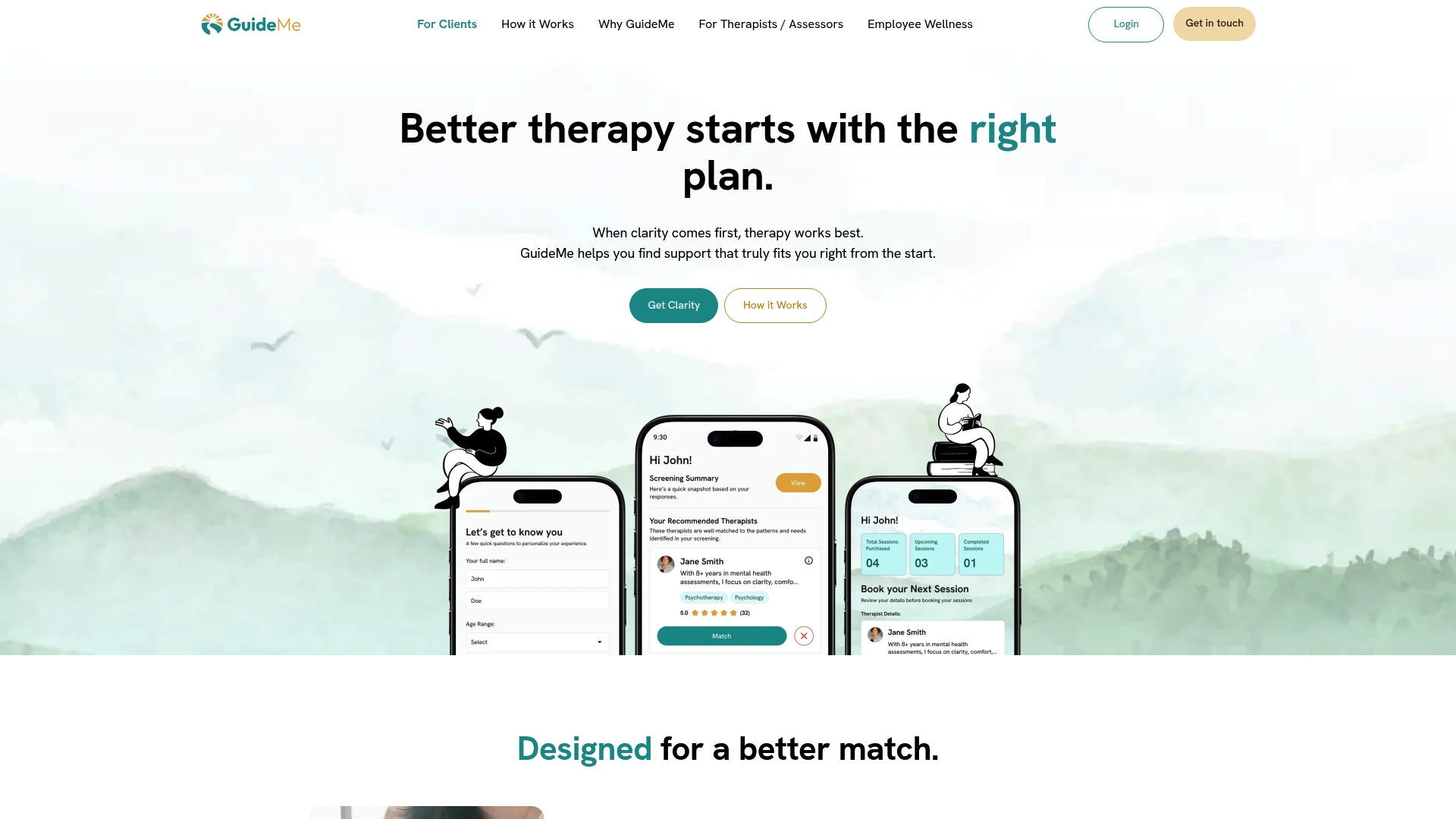
GuideMe creates an in-depth therapy plan that helps you understand your mental health needs before matching begins. This foundation ensures recommendations align with both your clinical needs and personal preferences. We consider factors like communication style, cultural background, therapy approach, and practical requirements to identify therapists who offer the strong alliance quality that drives successful outcomes.
Our therapy matching service guides you through each step, from initial assessment through your first sessions, ensuring you feel confident and supported throughout your therapy journey. Start building the therapeutic relationship that will support your mental health goals.
FAQ
What factors determine client-therapist fit?
Client-therapist fit emerges from multiple interacting factors, with therapeutic alliance quality at the centre. Communication style compatibility matters significantly; some clients prefer direct, structured guidance whilst others thrive with exploratory, client-led approaches. Cultural competence influences fit profoundly, especially for clients from diverse backgrounds who need therapists aware of systemic and cultural factors. Personal preferences around therapist demographics, theoretical orientation, and session structure also shape whether you feel comfortable and understood enough to engage deeply in therapy.
How can I assess if a therapist is a good fit before starting therapy?
Initial consultations provide valuable opportunities to evaluate potential fit through direct interaction. Prepare specific questions about the therapist's approach, experience with your concerns, and style of building relationships with clients. Notice your emotional response during these conversations; feeling heard, respected, and comfortable sharing preliminary information often signals good potential for alliance development. Pay attention to whether the therapist demonstrates genuine curiosity about your needs and adapts their communication style to match yours, as these behaviours predict strong therapeutic relationships.
Does client-therapist fit matter differently in online vs face-to-face therapy?
Therapeutic alliance remains equally critical regardless of delivery format, with alliance-outcome correlations approximately the same in face-to-face and internet-based psychotherapy. The fundamental elements of fit, including communication compatibility, cultural competence, and emotional connection, operate similarly across modalities. Practical considerations differ; online therapy requires comfort with technology and suitable private space, whilst face-to-face therapy involves travel and scheduling around office hours. Prioritise client-therapist fit over modality preference, as relationship quality drives outcomes more than delivery format.
Why is cultural competence important for client-therapist fit?
Cultural competence builds the trust and respect necessary for strong therapeutic alliances by creating space where clients feel genuinely understood within their cultural context. Clients from marginalised groups experience better outcomes with culturally competent therapists who recognise how identity, systemic oppression, and cultural values shape mental health. Without cultural competence, clients often spend therapeutic energy explaining basic cultural contexts rather than addressing core concerns. Culturally aware therapists validate your experiences, avoid imposing dominant cultural assumptions, and adapt interventions to honour your worldview, strengthening the collaborative partnership essential for effective therapy.