

TL;DR:
- The therapy assessment serves as an essential foundation, helping therapists understand clients’ backgrounds and goals. It involves collecting comprehensive information through intake forms, history, and rapport building while assessing relational patterns and risks. Collaborative approaches, like Therapeutic Assessment, actively involve clients, fostering trust and mutual understanding from the very first session.
Starting therapy can feel overwhelming, especially when you’re not sure what to expect from the very first session. Many people assume therapy begins with immediate problem-solving, but what is therapy assessment is a question worth understanding before you ever walk through the door. The assessment phase is the essential foundation of effective therapy. It shapes everything that follows, from your treatment plan to the approach your therapist takes. This guide explains what the therapy evaluation process involves, why it matters, and how understanding it can help you find the right therapist and get more from your sessions from day one.
Table of Contents
-
Collaborative therapeutic assessment: empowering clients in the process
-
Preparing for your therapy assessment: practical steps and what to bring
-
The value of assessment: why initial sessions deserve your patience
Key Takeaways
| Point | Details |
|---|---|
| Purpose of assessment | Therapy assessment gathers your history and goals to personalise treatment plans effectively. |
| Assessment process | Initial sessions involve intake forms, interviews, confidentiality briefing, and discussion of payment. |
| Client collaboration | Therapeutic assessment encourages your active involvement for deeper insight and better outcomes. |
| Preparation matters | Bringing documents and information beforehand streamlines your first session and reduces stress. |
| Ongoing evaluation | Therapists review assessment data regularly to adjust treatments and support your progress. |
What does a therapy assessment involve?
A therapy assessment is your first structured conversation with a therapist. It is not about diving straight into your deepest struggles. Instead, it is a purposeful process of gathering information so your therapist can understand who you are, what you are experiencing, and what kind of support will help most.
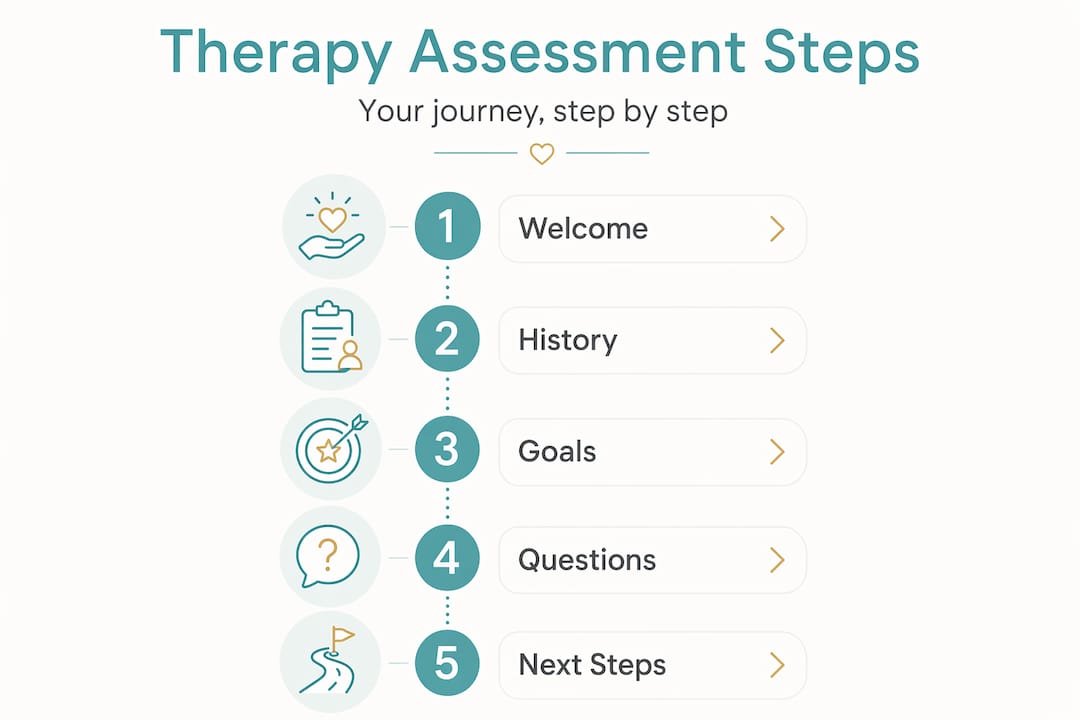
Initial therapy assessment sessions typically last 45 to 60 minutes, focusing on intake interviews to gather your history, current symptoms, and goals. That time goes quickly, and it covers a lot of ground.
Here is what you can typically expect during the session:
-
Intake forms: You will often complete paperwork before or at the start of your session covering your personal history, current concerns, and any previous mental health treatment.
-
Goal setting: Your therapist will ask what you hope to achieve from therapy, giving early shape to your treatment plan.
-
History gathering: This includes your family background, relationships, work life, physical health, and any significant life events.
-
Confidentiality review: Your therapist will explain confidentiality in therapy assessments, including the legal limits, such as situations involving risk of harm to yourself or others.
-
Insurance and payment: Therapy assessments include a review of consent forms and a practical discussion about how sessions will be funded.
-
Rapport building: Your therapist will begin establishing a safe, respectful relationship, setting the tone for your work together.
You are not expected to have all the answers ready. The process of preparing for a therapy assessment can help you feel more settled walking in.
How therapists gather and use information during assessment
Understanding what happens in assessment is one thing. Knowing how therapists work with that information is what gives the process real meaning.
Therapists do not simply ask questions and note your answers. They are listening to multiple layers at once: your words, your silences, your emotional responses, and the patterns that emerge across everything you share. They build what is called a holistic picture, which considers your mental health, physical health, relationships, work context, and personal history together.
Standardised screeners like PHQ-9 or GAD-7 are often used to establish a symptom baseline, though they are never used as standalone diagnoses. They simply give your therapist a structured starting point for understanding how you are feeling right now.
There is also a lot happening beneath the surface during assessment. Therapists assess relational style, coping strategies, and safety risks quietly during intake, without immediately feeding back observations, because building safety comes first. Rushing into trauma disclosure before trust is established can cause genuine harm, not help.
Here is what a therapist is quietly evaluating during your first sessions:
-
How you relate to others and whether certain relational patterns stand out
-
Your current coping strategies and whether they are serving you well
-
Any immediate risk factors, such as thoughts of self-harm, that need careful attention
-
Your readiness and motivation for the therapeutic process
-
How comfortable you appear discussing different topics, which helps with pacing
Pro Tip: You do not need to share everything in your first session. A good therapist will pace the process to your comfort. If something feels too soon to discuss, it is absolutely fine to say so.
Reading through therapy assessment preparation tips before your first appointment can help you understand the kind of questions likely to come up and reduce any anxiety about what to share.
Collaborative therapeutic assessment: empowering clients in the process
The therapy evaluation process has evolved significantly over recent decades. Traditional assessment often positioned the therapist as the expert and the client as the subject being evaluated. A different model, called Therapeutic Assessment (TA), changes that dynamic entirely.
In Therapeutic Assessment, clients are involved in each step of the process, including generating their own questions and participating in interpreting results. This approach consistently leads to higher adherence to recommendations and greater therapeutic engagement.
Here is how a collaborative therapeutic assessment typically unfolds:
-
You bring your questions. You identify what you most want to understand about yourself, which directs the focus of the assessment.
-
You participate in selecting tools. Rather than simply sitting tests, you are part of choosing which measures are most relevant to your situation.
-
Results are interpreted together. Your therapist shares findings with you in plain language and invites your perspective on whether they feel accurate.
-
Insights emerge in real time. Because you are involved throughout, useful realisations often happen during the assessment itself, not weeks later.
-
A shared narrative is created. The process ends with a story about your experience that feels meaningful and true to you.
“Stephen Finn emphasises treating clients as experts on themselves, building stronger therapeutic alliances.”
This approach does more than collect data. It builds the kind of trust and mutual respect that makes therapy genuinely effective. You can read more about the therapeutic assessment approach and how it differs from standard clinical intake models.
Preparing for your therapy assessment: practical steps and what to bring
Knowing what to expect and understanding the process is vital, but preparing well for your therapy assessment ensures a smoother, more productive experience from the outset.

Bring your insurance card, photo ID, list of medications, previous therapy or medical records, and a timeline of your concerns. Arriving 10 to 15 minutes early gives you time to complete any remaining paperwork without feeling rushed.
Here is a practical checklist for your first appointment:
-
Photo ID and your insurance card if you have one
-
A list of current medications, including dosages
-
Any previous therapy notes or psychological assessments if available
-
A rough timeline of your main concerns, including when they started
-
A short list of questions you want to ask your therapist
-
Your preferred payment method confirmed in advance
Pro Tip: Jot down two or three things you definitely want your therapist to know about you before the session. Having them written down means you are less likely to forget them if you feel nervous in the room.
Understanding costs ahead of time also reduces stress. Sessions may cost between $100 and $300 depending on your location and provider. Checking your insurance coverage for therapy before your first session avoids unwelcome surprises.
| What to bring | Why it matters |
|---|---|
| Photo ID | Required for registration and records |
| Insurance card | Confirms your coverage from the start |
| Medication list | Helps therapist understand your full health picture |
| Previous records | Avoids repeating the same history unnecessarily |
| Timeline of concerns | Gives structure to what can feel like a complicated story |
| Questions for your therapist | Ensures you get the clarity you came for |
You can use the therapy assessment preparation checklist on GuideMe to organise everything in one place before your appointment.
How therapy assessments shape personalised treatment plans
Finally, let us look at how everything gathered during assessment becomes the foundation of your ongoing care.
Assessment information does not sit in a file. It actively shapes your treatment. APA guidelines emphasise using multiple sources, sound psychometrics, and collaboration in evaluation to inform treatment plans, which typically develop across one to three sessions. That multi-session structure allows for depth and accuracy rather than rushed conclusions.
Once treatment begins, assessment does not stop. Routine review of assessment data allows therapists to collaboratively adjust your treatment plan as your needs change, improving outcomes over time. This is sometimes called measurement-based care, and it keeps therapy responsive rather than static.
Key benefits of this ongoing evaluation approach include:
-
Symptom monitoring that tracks whether your treatment is actually working
-
Goal realignment when circumstances or priorities change
-
Early identification of any new concerns that emerge during treatment
-
Stronger therapeutic alliance built through regular, open dialogue about progress
-
Evidence-based adjustments to technique or frequency based on real data
| Assessment approach | Client involvement | Outcome focus |
|---|---|---|
| Traditional assessment only | Low, therapist-led | Diagnosis and referral |
| Integrated therapy and assessment | High, collaborative | Tailored, evolving treatment |
Understanding the importance of ongoing assessment is what separates therapy that genuinely moves forward from therapy that simply marks time.
The value of assessment: why initial sessions deserve your patience
Here is an honest observation: most people who feel frustrated with therapy early on are frustrated with the assessment phase. It feels slow. It feels like admin. They came for help and they are filling in forms and answering background questions. That frustration is completely understandable. It is also worth reconsidering.
The assessment phase is not a delay before therapy begins. It is therapy beginning. Every question your therapist asks, every silence they allow, every piece of information you share is shaping the quality of care you receive. Rushing trauma exploration during assessment without establishing safety first does not speed up healing. It undermines it.
What most people do not realise is that the assessment phase is where the therapeutic alliance forms. Research consistently shows that the quality of the relationship between client and therapist is one of the strongest predictors of therapy success, more so than any specific technique. That relationship begins in assessment, not after it.
The collaborative model makes this even clearer. Therapeutic Assessment empowers clients to “tell a new story about yourself” through collaborative questions, which boosts therapeutic hope and engagement from the very first session. That is not a small thing. That is a shift in how you understand yourself, happening before formal treatment has even properly started.
Patience in the early sessions is not passive waiting. It is active participation in building the conditions under which real change becomes possible. And you can explore the depth in therapy assessment further if you want to understand more about how the early therapeutic relationship shapes long-term outcomes.
How GuideMe supports your therapy assessment journey
If you are ready to take the next step, GuideMe can help you confidently prepare for your therapy assessment and get the support you deserve.

GuideMe is a therapy navigation platform that combines human expertise with AI-powered matching to help you find the right therapist from the very beginning. Feeling lost about what to expect from your first assessment session is exactly the kind of problem GuideMe is built to solve. You will find practical preparation guides, checklists, and clear information about insurance and confidentiality so you walk into your assessment feeling informed and ready. Most importantly, GuideMe therapy assessment support connects you with therapists who are the right fit for your specific needs, not just whoever is available. Your therapy experience should feel supportive from the first session onward.
Frequently asked questions
What is the main purpose of a therapy assessment?
The therapy assessment helps your therapist understand your history, current challenges, and goals so they can create a treatment plan that is genuinely tailored to you. As one intake model describes it, it is about building a coherent picture of your life and concerns to guide appropriate treatment planning.
How long does the first therapy assessment session usually last?
Initial therapy assessment sessions generally last between 45 and 60 minutes, allowing enough time for thorough intake, history gathering, and the formation of initial goals.
What should I bring to my first therapy assessment?
Bring your insurance card, photo ID, a list of medications, previous records, and a timeline of concerns. Arriving 10 to 15 minutes early helps you complete any paperwork without feeling rushed before the session begins.
What is therapeutic assessment and how is it different from traditional assessment?
Therapeutic assessment is a collaborative approach where you actively participate in generating questions and interpreting results. This involvement leads to higher adherence and stronger therapeutic alliances compared with traditional, therapist-led evaluation models.
Are therapy assessment sessions covered by insurance?
Insurance coverage varies considerably, so it is important to verify your provider’s policies before your first appointment. Without coverage, sessions typically cost between $100 and $300 depending on location and the therapist’s experience level.