

TL;DR:
- Guided therapy combines self-help content with professional support, increasing engagement and effectiveness.
- Research shows guided therapy has high success rates, comparable to in-person treatment for many conditions.
- It is especially suitable for mild to moderate issues, offering flexibility and overcoming access barriers.
Many people assume that guided therapy is somehow a lesser option compared to sitting face to face with a therapist. That assumption is worth questioning. Guided self-help is as effective as in-person CBT for many common mental health conditions, which challenges the idea that traditional therapy is always the gold standard. This article explains what guided therapy is, how it works, what the evidence says about its effectiveness, who it suits best, and how to decide whether it might be right for you.
Table of Contents
- What is guided therapy?
- What makes guided therapy effective?
- Guided therapy versus other options
- Who is guided therapy for?
- Our perspective: Why guided therapy works and what most people miss
- Start your guided therapy journey
- Frequently asked questions
Key Takeaways
| Point | Details |
|---|---|
| Evidence-based results | Guided therapy is as effective as traditional in-person therapy for many common conditions. |
| Personalised support | You receive structure, feedback, and encouragement from trained guides, making it more engaging and effective than self-help alone. |
| Greater flexibility | Guided therapy fits your schedule and comfort, lowering access barriers and stigma. |
| Best for mild to moderate difficulties | It works especially well for anxiety, depression, and when stepped care is appropriate. |
What is guided therapy?
Guided therapy is a structured approach that combines self-help materials with regular support from a trained professional. You work through content, exercises, or programmes at your own pace, but you are not doing it alone. A guide, who may be a counsellor, psychologist, or trained support worker, checks in with you regularly to review your progress, answer questions, and adjust your plan as needed.
This is different from traditional in-person therapy, where sessions are typically led entirely by the therapist in a clinical setting. It is also different from unguided self-help, such as reading a workbook or using a mental health app without any professional input. Guided therapy sits between these two models, offering the flexibility of self-directed learning with the structure and accountability of professional support.
RCTs confirm guided internet CBT provides significant symptom reduction compared to care-as-usual, which shows that the professional element genuinely matters. Without that layer of support, many people struggle to stay on track or apply what they are learning.
Here are the key features that define guided therapy:
- Structured content: Sessions or modules follow a clear, evidence-based framework
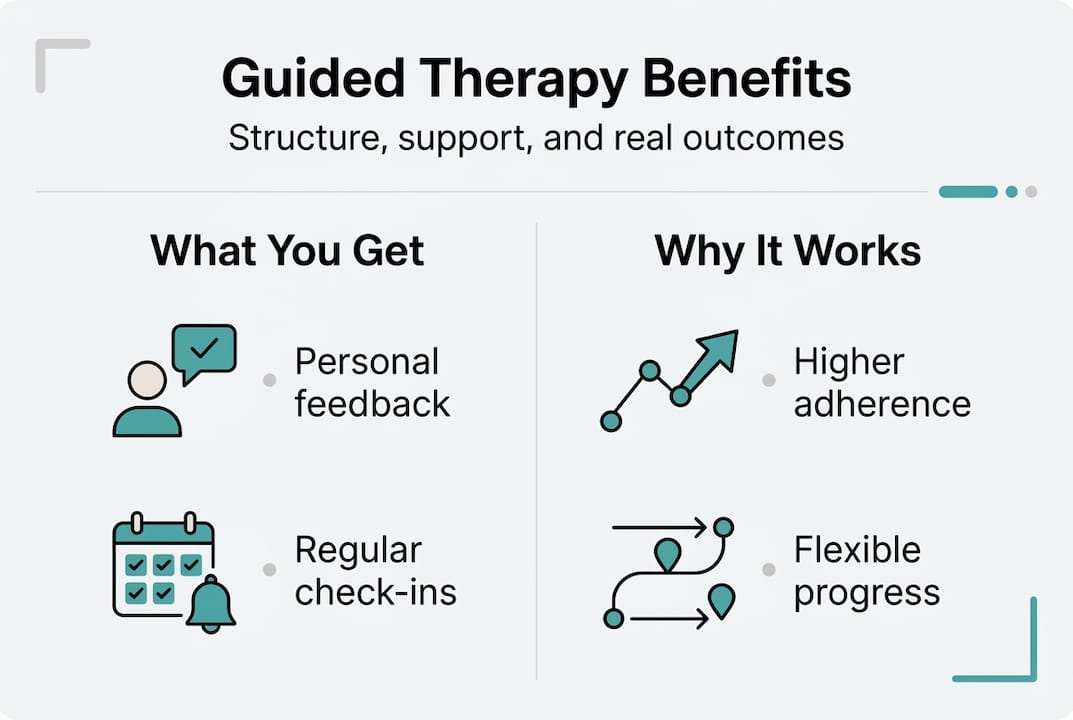
- Regular check-ins: A guide provides feedback, encouragement, and personalisation
- Flexibility: You can engage at times that suit your schedule
- Professional oversight: Trained professionals in therapy ensure the approach is appropriate for your needs
- Adaptability: Your plan can be adjusted based on your progress and feedback
| Feature | Guided therapy | In-person therapy | Unguided digital |
|---|---|---|---|
| Professional support | Yes | Yes | No |
| Flexible scheduling | Yes | Limited | Yes |
| Personalised feedback | Yes | Yes | No |
| Cost accessibility | Higher | Lower | Lowest |
| Accountability | Moderate to high | High | Low |
This combination of structure, support, and flexibility is what makes guided therapy a genuinely distinct and valuable option for many people.
What makes guided therapy effective?
The research behind guided therapy is robust and growing. Studies consistently show that people who receive guided support alongside structured content achieve significantly better outcomes than those who go it alone.
One of the most striking findings is that 76 to 79% show reliable improvement in guided self-help therapy. That is not a marginal benefit. It reflects a model that works for the majority of people who engage with it properly.
For depression specifically, the data is equally encouraging. Guided internet CBT outperforms care-as-usual by 2.5 points on the PHQ-9, which is a standardised tool used to measure depression severity. A 2.5 point difference on this scale represents a clinically meaningful improvement, not just a statistical one.
| Outcome metric | Guided therapy | Unguided self-help | In-person CBT |
|---|---|---|---|
| Reliable improvement rate | 76 to 79% | 40 to 50% | 75 to 80% |
| PHQ-9 reduction (depression) | 2.5 points above care-as-usual | Minimal | Comparable |
| Adherence to programme | Moderate to high | Low | High |
| Drop-out rate | Lower than unguided | High | Low |
The reason for these strong outcomes comes down to a few key factors. First, having a guide creates accountability. When someone is checking in on your progress, you are more likely to complete exercises and stay engaged. Second, personalised feedback helps you apply what you are learning to your specific situation rather than working through generic content. Third, the structure of guided therapy reduces the overwhelm that many people feel when they try to manage their mental health independently.

Pro Tip: When choosing a guided therapy programme, look for one where the guides have relevant clinical training and experience. The quality of guidance matters as much as the quality of the content itself.
These factors together explain why guided therapy consistently produces outcomes that rival traditional in-person care, often at lower cost and with greater accessibility.
Guided therapy versus other options
Knowing that guided therapy is effective is useful, but understanding where it fits compared to other options helps you make a more informed decision.
Compared to unguided digital tools, guided therapy has a clear advantage. Guidance matters more for adherence than the format of therapy itself, and this shows up in the data. People using unguided apps or workbooks frequently drop out before completing the programme, which limits any potential benefit. The addition of a guide changes that dynamic significantly.
Compared to traditional face-to-face therapy, guided therapy is considered equivalent for many common mental health conditions. However, there are situations where in-person care remains the better choice.
"The presence of a guide is not just a nice addition, it is often the difference between completing therapy and abandoning it. Accountability and personalised support are what turn good content into real change."
Here is a practical breakdown of when each option tends to work best:
When guided therapy is a strong fit:
- Mild to moderate anxiety or depression
- Busy schedules that make regular in-person appointments difficult
- Preference for working at your own pace
- Living in an area with limited access to local therapists
- Wanting professional therapist support without the formality of a clinical setting
When in-person therapy may be more appropriate:
- Severe or complex mental health conditions
- Crisis situations requiring immediate intervention
- Conditions where nonverbal communication is central to treatment
- When a strong therapeutic relationship in person is clinically indicated
Guided therapy is not a compromise. For the right person in the right circumstances, it is genuinely the most practical and effective route to meaningful support.
Who is guided therapy for?
Guided therapy is not a one-size-fits-all solution, but it is well-suited to a wide range of people and conditions. Understanding who benefits most helps you assess whether it is the right starting point for you.
The evidence supports guided therapy most strongly for mild to moderate presentations of depression, anxiety, eating disorders, chronic pain, and even some presentations of psychosis within a stepped care framework. Guided therapy is best used within stepped care, beginning with lower intensity support and moving to more intensive options if needed. This approach ensures you receive the right level of care without unnecessary escalation.
Guided therapy also helps overcome some of the most common barriers to accessing mental health support. These include geographical distance from services, concerns about stigma, cost, and the difficulty of fitting regular appointments into a busy life. The flexibility of guided therapy removes many of these obstacles without sacrificing the quality of support.
Here is a simple process for deciding whether guided therapy suits your situation:
- Assess your current symptoms: Are they mild to moderate in severity? Guided therapy is likely a good starting point.
- Consider your schedule: Do you need flexibility around work, family, or other commitments? Guided therapy accommodates this well.
- Think about your support preferences: Do you want regular check-ins without full clinical sessions? Guided therapy provides this balance.
- Reflect on past experiences: Have you tried unguided self-help and struggled to stay consistent? A guide can make a real difference.
- Speak to a professional: If you are unsure about the right level of support, a brief screening conversation can help clarify your options.
Pro Tip: Be honest with yourself about how much support you genuinely need. Choosing a lower-intensity option when you need more intensive care can delay your recovery. There is no benefit in underestimating your needs.
If your symptoms are severe, or if you are in crisis, please seek in-person professional support as a priority.
Our perspective: Why guided therapy works and what most people miss
Most articles about guided therapy focus on the content, the modules, the evidence base. What they often overlook is something simpler and more human: the impact of being seen.
When someone checks in on your progress, asks how you are finding the exercises, and adjusts your plan based on your answers, it changes how you engage with the process. It is not just about accountability in an abstract sense. It is about feeling that your experience matters to someone who knows what they are doing.
We believe the real value of guided therapy is not the format. It is the relationship between structure and readiness. Many people are not ready for intensive in-person therapy, whether due to anxiety about the process, practical barriers, or simply not knowing where to start. Guided therapy meets people where they are.
The uncomfortable truth is that the best therapy format is the one you will actually complete. Drop-out rates in unguided digital tools are high precisely because motivation alone is rarely enough. Small moments of personalised guidance, a brief message acknowledging your progress, a gentle prompt to revisit an exercise, can be the difference between finishing and giving up. That is not a small thing. That is the whole point.
Start your guided therapy journey
If you have been thinking about getting support for your mental health but are not sure where to begin, guided therapy offers a structured, evidence-based, and genuinely supportive starting point.
At GuideMe, we combine human expertise with smart technology to help you understand your mental health and find the right therapist from the start. You will receive an in-depth therapy plan tailored to your needs, matched with a therapist who is right for you. It is not about finding any therapist. It is about finding the right one. If you are ready to take that step, start with guided therapy and discover what the right support can do for you.
Frequently asked questions
Is guided therapy safe and effective for everyone?
Guided therapy is as effective as face-to-face therapy for common mental health concerns, but those with complex or severe conditions may need more intensive in-person support.
How does guided therapy improve results compared to unguided self-help?
Guided therapy ensures higher adherence than unguided options by providing structure, accountability, and personalised feedback that keeps you engaged throughout the process.
What support can I expect in guided therapy?
You can expect personalised feedback on your progress, encouragement from a trained guide, and flexible adjustment of your goals as your needs evolve throughout therapy.
Is guided therapy confidential and secure?
Most reputable guided therapy programmes operate under strict confidentiality standards and use secure, encrypted platforms to protect your privacy at every stage.