

Therapy is one of the most powerful tools available for mental health, but many people walk into their first session expecting it to do all the heavy lifting. The truth is, what happens between sessions matters just as much as what happens during them. Research increasingly shows that outcomes beyond symptom relief include self-awareness, agency, and personal growth, and these are shaped significantly by how you care for yourself outside the therapy room. If you've ever wondered why progress feels slow despite regular sessions, the missing piece might be closer than you think.
Table of Contents
- What is self-care and why does it matter in therapy?
- How self-care amplifies therapy outcomes
- Self-care in therapy: Addressing misconceptions and challenges
- Practical ways to integrate self-care into your therapy journey
- Enhance your wellbeing: Take the next step with GuideMe
- Frequently asked questions
Key Takeaways
| Point | Details |
|---|---|
| Holistic benefits | Self-care in therapy boosts self-awareness, agency, and life satisfaction, not just symptom relief. |
| Research backed | Multiple studies support integrating self-care practices with therapy for better outcomes. |
| Actionable steps | Simple, practical strategies can help anyone start applying self-care to their therapy journey today. |
| Avoid pitfalls | Self-care should be personal and flexible—avoid one-size-fits-all approaches or self-blame. |
What is self-care and why does it matter in therapy?
Self-care in the context of therapy isn't about bubble baths or expensive retreats. It's about the deliberate, everyday actions you take to support your mental, emotional, and physical wellbeing in ways that reinforce what you're working on with your therapist. Think of it as the practice that keeps the insights from your sessions alive during the rest of your week.
The misconception that self-care is a luxury is one of the most damaging ideas in mental health culture. When you're navigating anxiety, depression, or trauma, self-care becomes a clinical necessity, not an indulgence. Holistic models that prioritise self-care recognise this, treating the whole person rather than just the presenting symptoms.
Here are some examples of therapeutic self-care that genuinely support your progress:
- Journalling: Processing thoughts and emotions between sessions to deepen self-reflection
- Mindful breathing: Regulating your nervous system during moments of stress or overwhelm
- Boundary setting: Protecting your emotional energy in relationships and at work
- Regular sleep: Consolidating emotional learning and building resilience
- Gentle movement: Releasing stored tension and improving mood through physical activity
- Digital breaks: Creating space for rest and reducing anxiety from constant connectivity
Clients increasingly want more than just symptom reduction from therapy. Clients value self-awareness and self-understanding as core outcomes, not just the absence of distress. Self-care is the bridge between what you learn in therapy and who you become outside of it.
"Self-care is not selfish. You cannot serve from an empty vessel." This principle sits at the heart of sustainable therapeutic progress.
How self-care amplifies therapy outcomes
Self-care doesn't just complement therapy. It actively deepens it. When you practise self-care consistently, you build the internal resources that make therapy more effective: greater self-awareness, stronger emotional regulation, and a clearer sense of your own agency.
The evidence is compelling. A meta-analysis on self-care found an effect size of d=0.77 for reducing psychological distress and increasing self-compassion. That's a large effect by research standards, comparable to many established therapeutic interventions. Self-care isn't a soft add-on; it's a measurable force for change.
Pairing mindful tech habits for wellness with your therapy work is one practical example of how everyday choices compound over time. Each small act of self-care reinforces the neural pathways and emotional habits your therapist is helping you build.
Here's how outcomes differ when self-care is actively integrated into the therapeutic process:
| Outcome area | Therapy without self-care | Therapy with active self-care |
|---|---|---|
| Symptom relief | Moderate improvement | Sustained improvement |
| Self-awareness | Limited between sessions | Deepened through daily reflection |
| Emotional agency | Dependent on therapist prompts | Increasingly self-directed |
| Resilience | Slow to build | Strengthened through consistent habits |
| Life satisfaction | Partial gains | Broader, more lasting gains |
| Relapse prevention | Higher risk | Reduced through self-regulation skills |
The pattern is clear. Therapy addresses the roots of your struggles, while self-care tends the soil so those roots can hold. One without the other leaves you more vulnerable to setbacks. Together, they create the conditions for genuine, lasting change.
Self-care also shifts your relationship with therapy itself. Instead of arriving at sessions feeling passive or overwhelmed, you come prepared, having reflected on your week, noticed your patterns, and practised the tools your therapist has introduced. That shift from passive recipient to active participant is one of the most powerful transformations therapy can offer.

Self-care in therapy: Addressing misconceptions and challenges
For all its benefits, self-care is also one of the most misunderstood concepts in mental health. Done poorly or without guidance, it can actually add pressure rather than relieve it. Understanding the common traps helps you avoid them.
One of the most prevalent pitfalls is self-blame. If your self-care routine slips during a difficult week, it's easy to interpret that as personal failure. But life is unpredictable, and rigid self-care routines can become another source of stress rather than relief. The goal is flexibility, not perfection.
Another common issue is treating self-care as a substitute for addressing real external pressures. Systemic barriers such as financial stress, workplace demands, or lack of social support can't be resolved by journalling alone. Self-care works best when it's part of a broader plan that acknowledges the full context of your life. For those in caring roles, support for caregivers is a reminder that external support structures matter enormously alongside personal practice.
Watch out for these signs that your self-care approach may need adjusting:
- You feel guilty when you miss a self-care activity
- Your routine feels like a chore rather than a source of restoration
- You're using self-care to avoid difficult emotions rather than process them
- You feel more isolated because self-care has become a solitary, rigid ritual
- You're exhausted by the effort of maintaining your routine
Research overwhelmingly supports integration of self-care with therapy, not as a replacement for professional support, but as a complement that enhances it.
Pro Tip: Bring your self-care plan into your therapy sessions. Your therapist can help you identify which practices align with your therapeutic goals and which might be adding unnecessary pressure. Self-care should feel like relief, not another item on your to-do list.
It's also worth noting that self-care is not selfish. Many people, particularly those who have spent years prioritising others, feel uncomfortable dedicating time and energy to their own wellbeing. Reframing self-care as a prerequisite for showing up fully in your relationships and responsibilities can make it feel more justifiable and sustainable.
Practical ways to integrate self-care into your therapy journey
Knowing that self-care matters is one thing. Building it into your life in a way that actually sticks is another. Here's a step-by-step framework to help you make self-care a genuine part of your therapeutic progress.
1. Reflect on your current habits Before adding anything new, take stock of what you're already doing. What's helping? What's draining you? Honest reflection is the starting point for meaningful change.
2. Discuss self-care with your therapist Share your reflections in your next session. Your therapist can help you identify which self-care practices are most relevant to your therapeutic goals. Therapy guidance works best when it's personalised to your specific needs.
3. Set achievable, specific goals Vague intentions like "I'll be kinder to myself" rarely translate into action. Choose one or two concrete practices and schedule them into your week. Small and consistent beats ambitious and sporadic every time.
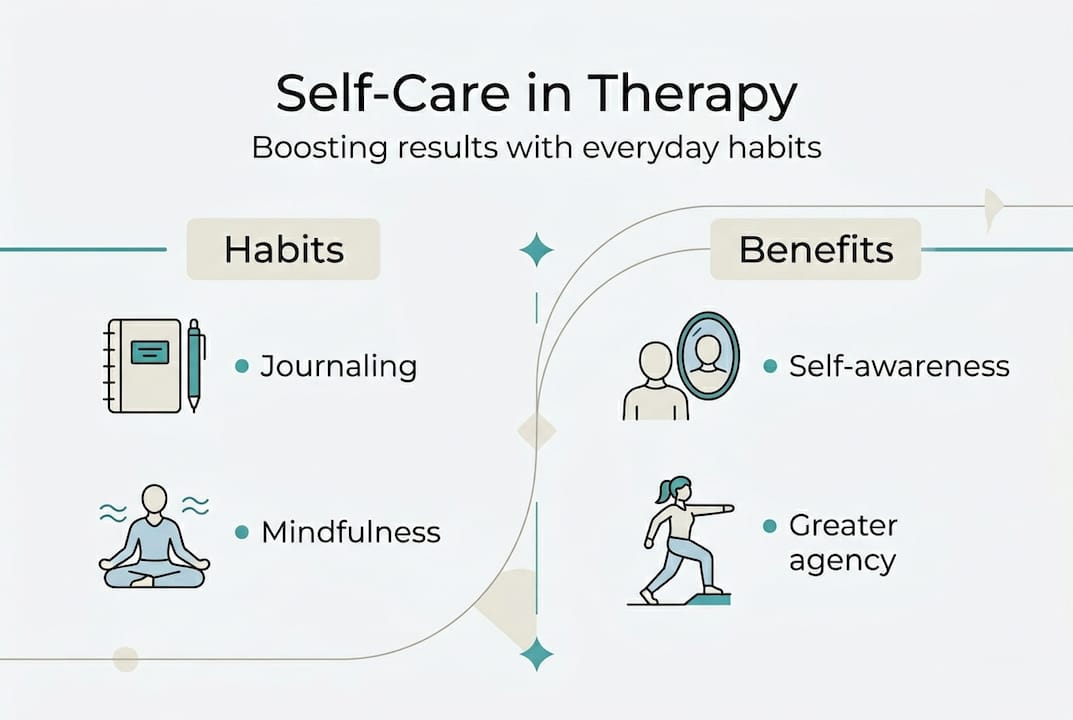
4. Track your progress Keep a simple self-care log. Note what you did, how it felt, and whether it seemed to support your mood or energy. Client-reported outcomes highlight agency and adaptive processing as key benefits of therapy, and tracking your own experience builds exactly that kind of self-directed awareness.
5. Adapt as you go Your needs will change as therapy progresses. What felt supportive in the early stages may need to evolve. Review your self-care plan regularly and adjust it in collaboration with your therapist.
Here's a practical reference for matching self-care activities to their therapeutic benefits:
| Self-care activity | Primary therapeutic benefit | Best time to practise |
|---|---|---|
| Journalling | Self-awareness, emotional processing | Evening or after sessions |
| Mindfulness meditation | Stress reduction, present-moment focus | Morning or during breaks |
| Regular sleep routine | Resilience, emotional regulation | Nightly |
| Gentle movement or walking | Mood improvement, tension release | Morning or lunchtime |
| Boundary setting | Emotional safety, reduced overwhelm | Ongoing, as situations arise |
| Prioritising offline time | Mental rest, reduced anxiety | Evenings and weekends |
| Social connection | Belonging, perspective, emotional support | Weekly |
Pro Tip: Keep a self-care log for at least four weeks. Patterns will emerge that reveal which practices genuinely restore you and which ones you're doing out of obligation. That insight is gold for your therapy work.
The most important thing to remember is that self-care isn't a performance. It's not about doing the "right" things to appear well. It's about genuinely attending to your own needs so that you can engage more fully with the therapeutic process and with your life.
Enhance your wellbeing: Take the next step with GuideMe
Understanding the role of self-care in therapy is a meaningful first step, but putting it into practice alongside the right therapeutic support makes all the difference. The quality of your therapeutic relationship, the fit of your therapist's approach, and having a clear plan from the start all shape how much progress you make.

GuideMe is a therapy navigation platform that helps you understand your mental health through an in-depth therapy plan and matches you with the right therapist from the beginning. It's human led and AI powered, designed to make the process of finding support feel less overwhelming and more personal. If you're ready to experience therapy and self-care support that works together, GuideMe can help you take that next step with confidence. Your wellbeing deserves more than guesswork.
Frequently asked questions
Does self-care replace the need for therapy?
No. Self-care supports and enhances therapy, but the two work together rather than one substituting for the other. Both play essential roles in lasting personal growth.
What are some simple self-care practices for therapy clients?
Journalling, mindfulness exercises, consistent sleep, and setting healthy boundaries are all effective ways to practise self-care alongside therapy without adding pressure to your routine.
Can self-care improve therapy results?
Yes. Research shows large psychological benefits from self-care, including improved self-compassion, greater agency, and higher life satisfaction, all of which directly support therapeutic progress.
What if I find self-care difficult or overwhelming?
Talk to your therapist. Collaborative planning ensures your self-care approach is tailored to your personal circumstances rather than adding to your burden.