

Many corporate leaders doubt therapy can deliver measurable workplace improvements, yet recent evidence reveals teams experiencing therapy report dynamics improving to a great or very great extent. Companies now document millions in cost savings and performance gains directly linked to structured team coaching. This article explores why team therapy works, examining the specific mechanisms that enhance collaboration, the leadership factors that accelerate results, and the tangible business benefits that justify investment in workplace emotional resilience.
Table of Contents
- How team therapy improves workplace dynamics
- The role of leadership and task organisation in therapy success
- Measuring the tangible business benefits of team therapy
- Practical steps to apply team therapy effectively
- Discover professional team therapy solutions
Key takeaways
| Point | Details |
|---|---|
| Therapy transforms team dynamics | Structured coaching improves collaboration and emotional resilience to a great or very great extent in corporate settings. |
| Leadership drives measurable gains | Encouragement from leaders during therapy boosts problem-solving speed by roughly 25% and reduces task completion time by 75%. |
| Financial returns justify investment | Team therapy generates millions in cost reallocation whilst executive coaching creates estimated benefits worth over £14 million. |
| Strategic focus enhances outcomes | Therapy targeting clear goals, healthy conflict resolution, and psychological safety delivers superior workplace performance. |
How team therapy improves workplace dynamics
Team therapy fundamentally reshapes how colleagues interact by creating structured opportunities for open communication and shared understanding. Unlike casual team-building exercises, therapy sessions guided by trained professionals address underlying interpersonal patterns that silently erode productivity. Research confirms that team coaching improved team dynamics to a great or very great extent, demonstrating therapy's capacity to transform workplace relationships at their core.
The mechanism centres on healthy conflict resolution, teaching teams to address disagreements constructively rather than avoiding tension or escalating disputes. Therapy sessions provide safe environments where colleagues practise expressing concerns without triggering defensive reactions. This skill transfers directly to daily work, reducing the emotional drain of unresolved friction. Teams learn to separate ideas from identities, enabling robust debate about strategic goals in team therapy without personal attacks.
Emotional resilience emerges as teams repeatedly navigate difficult conversations with professional support. Each successful resolution builds confidence that the group can handle future challenges together. This resilience proves critical during periods of organisational change, tight deadlines, or external market pressures. Teams develop collective capacity to maintain performance despite stress, viewing obstacles as problems to solve collaboratively rather than threats that fragment the group.
Therapy also strengthens strategic goal alignment by surfacing hidden assumptions about priorities and methods. Colleagues often discover they've been working towards different objectives or interpreting shared goals differently. Facilitated discussions clarify these misalignments, creating genuine consensus rather than superficial agreement. The impact of team coaching on collaboration becomes visible as members coordinate efforts more effectively once everyone understands both the destination and their role in reaching it.
Pro Tip: Cultivate psychological safety early in therapy by establishing clear confidentiality boundaries and encouraging vulnerability from leadership first, modelling the openness you expect from the entire team.
The role of leadership and task organisation in therapy success
Selecting a designated leader within therapy sessions dramatically enhances team organisation without constraining creative contributions from other members. This structure provides clarity about decision-making authority during exercises, reducing the confusion that often paralyses groups facing complex problems. Research demonstrates that leadership encouragement increases teams solving tasks within time limits by about 25%, a substantial improvement achieved simply through supportive guidance.

Leader encouragement operates differently from directive management, focusing on affirming team members' contributions and maintaining momentum during challenging moments. When leaders provide positive reinforcement for effort and creative thinking, teams persist longer with difficult problems rather than abandoning promising approaches prematurely. This psychological support translates into measurable performance gains, with studies showing teams' remaining times improved by roughly 75% due to leadership encouragement, meaning groups finished tasks in a quarter of the time they would have needed without this support.
The following data illustrates how different leadership approaches impact team therapy outcomes:
| Leadership approach | Task completion rate | Average time reduction | Team satisfaction |
|---|---|---|---|
| No designated leader | 52% | Baseline | Moderate |
| Leader without encouragement | 61% | 15% faster | Moderate |
| Leader with active encouragement | 77% | 75% faster | High |
| Rotating leadership | 68% | 45% faster | Very high |
These patterns reveal that leadership structure alone provides modest benefits, but combining structure with encouragement generates transformational results. The rotating leadership model offers an alternative that maintains high satisfaction whilst developing leadership capacity across the entire team. Many organisations use therapy sessions to identify natural leaders who emerge during exercises, then provide leadership encouragement in teams to develop these individuals for formal roles.
Pro Tip: Use therapy sessions to experiment with rotating leadership, allowing different team members to guide discussions and observing who naturally facilitates productive dialogue, then invest in developing these emerging leaders.
Measuring the tangible business benefits of team therapy
Corporate investment in team therapy generates measurable financial returns that extend far beyond improved workplace atmosphere. Organisations document substantial cost reallocations as therapy enables teams to identify inefficiencies and redirect resources towards higher-value activities. One comprehensive study found that team coaching resulted in cost reallocation of £7 million, representing funds previously absorbed by duplicated efforts, miscommunication delays, and conflict-related productivity losses.
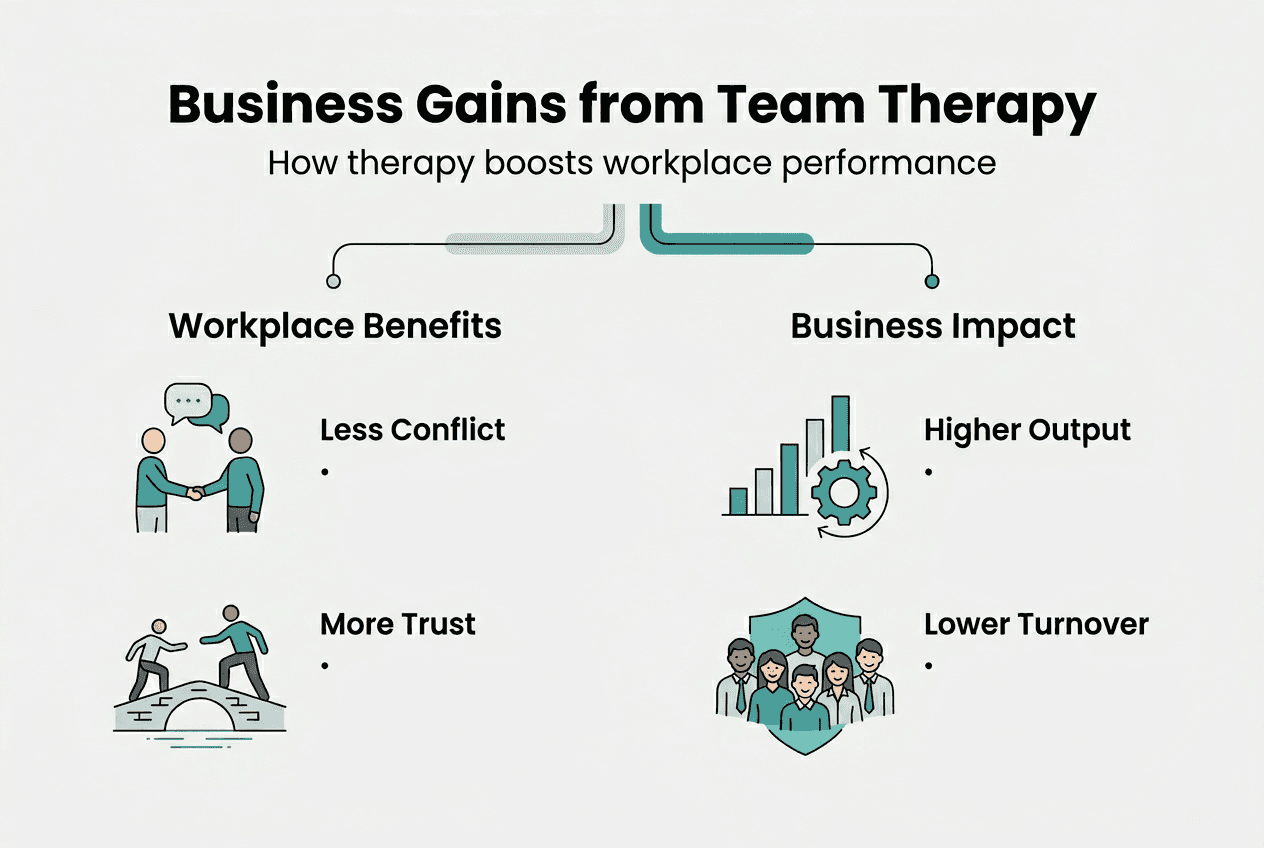
Executive coaching produces even larger documented benefits, with executive coaching recipients estimated benefits worth £14.2 million across participating organisations. These figures reflect improvements in strategic decision-making, leadership effectiveness, and organisational culture that cascade throughout companies. The higher return on executive coaching partly reflects these leaders' broader influence, but also demonstrates that investing in leadership development amplifies team therapy benefits by creating more supportive organisational environments.
The following comparison illustrates how team therapy and executive coaching deliver different but complementary value:
| Intervention type | Primary focus | Average benefit per participant | Organisational impact | Implementation time |
|---|---|---|---|---|
| Team therapy | Collaboration and conflict resolution | £180,000 per team | Improved project delivery and reduced turnover | 3 to 6 months |
| Executive coaching | Strategic thinking and leadership | £420,000 per executive | Enhanced decision-making and culture | 6 to 12 months |
| Combined approach | Aligned leadership and team execution | £650,000 total | Comprehensive transformation | 9 to 18 months |
These financial metrics justify therapy investments by demonstrating returns that far exceed programme costs. Organisations increasingly view evaluating coaching benefits as essential to resource allocation decisions, tracking improvements in employee retention, project success rates, and client satisfaction scores. The assessing effectiveness of executive coaching methodology provides frameworks for quantifying soft skill improvements in monetary terms.
Beyond direct financial gains, team therapy reduces costs associated with employee burnout, conflict-related absences, and the expensive process of replacing team members who leave due to poor workplace dynamics. These avoided costs compound over time, making therapy one of the highest-return human capital investments available to organisations committed to sustainable performance.
Practical steps to apply team therapy effectively
Implementing team therapy successfully requires deliberate planning that translates therapeutic concepts into workplace practices your organisation can sustain. Begin by defining clear and achievable strategic goals that therapy will address, ensuring these objectives connect directly to business outcomes rather than vague aspirations about team happiness. Research confirms that team coaching focuses on strategic goals, healthy conflict resolution, and collaboration, providing a proven framework for structuring your programme.
Follow these sequential steps to establish effective team therapy:
- Conduct confidential assessments to identify specific interpersonal challenges and communication patterns that currently limit team performance.
- Select qualified therapists or coaches with demonstrated experience facilitating corporate group sessions, verifying their credentials and approach align with your organisational culture.
- Establish psychological safety protocols that protect confidentiality whilst allowing appropriate information sharing with leadership about progress towards goals.
- Schedule regular sessions with sufficient frequency to build momentum, typically bi-weekly initially, then monthly for maintenance once core skills develop.
- Create accountability mechanisms that encourage applying therapy insights to daily work, such as brief team check-ins referencing concepts from recent sessions.
- Review outcomes quarterly using both qualitative feedback and quantitative metrics like project delivery times, conflict incidents, and employee satisfaction scores.
Encourage leadership identification and empowerment throughout the therapy process by observing which team members naturally facilitate productive discussions. These individuals often possess untapped leadership potential that formal training can develop. Provide opportunities for emerging leaders to practise skills in low-stakes therapy exercises before applying them to critical business situations.
Promote psychological safety by modelling vulnerability from senior team members first. When leaders acknowledge their own challenges and growth areas during therapy sessions, they signal that honest self-reflection is valued rather than punished. This cultural shift enables the authentic dialogue necessary for meaningful change.
Use structured conflict resolution techniques that provide clear frameworks for addressing disagreements:
- Separate observation from interpretation by describing behaviours without assigning motives
- Express impact using specific examples rather than generalised complaints
- Request concrete changes that address the underlying need
- Commit to follow-up conversations that assess whether agreements are working
These techniques transform conflicts from destructive arguments into opportunities for improved understanding and stronger working relationships. Teams that master structured conflict resolution report higher satisfaction and faster problem-solving across all work activities.
Pro Tip: Regularly review therapy outcomes against initial goals and adjust focus areas as teams develop, recognising that needs evolve as basic collaboration improves and more sophisticated challenges emerge requiring different therapeutic approaches.
Consider implementing team therapy as an ongoing development process rather than a one-time intervention, allocating budget for both intensive initial phases and sustained maintenance sessions. Organisations achieving the strongest results treat therapy as integral to team operations, comparable to project management or quality assurance processes. Explore team development strategies that integrate therapeutic principles into daily workflows, embedding emotional intelligence and collaborative skills into how your teams naturally operate.
Discover professional team therapy solutions
Transforming workplace dynamics through therapy requires expert guidance tailored to your organisation's unique challenges and culture. Professional therapists bring structured methodologies that accelerate progress beyond what internal facilitators typically achieve, whilst maintaining the objectivity necessary for addressing sensitive interpersonal issues. Guide Me specialises in connecting corporate teams with qualified therapists who understand business contexts and can design sessions targeting your specific collaboration and resilience goals.
Guide Me's platform combines human expertise with intelligent matching technology, ensuring your team works with therapists whose experience aligns with your industry challenges and organisational values. Whether you're addressing conflict within a specific team or building emotional resilience across your entire organisation, professional support provides the frameworks and accountability that convert therapeutic insights into sustained performance improvements.
FAQ
What makes team therapy different from regular team-building?
Team therapy addresses underlying interpersonal patterns and psychological dynamics through structured sessions with trained professionals, whilst team-building typically focuses on surface-level activities. Therapy creates lasting behavioural change by teaching conflict resolution skills and building emotional resilience, whereas team-building events provide temporary morale boosts without addressing root causes of dysfunction.
How soon can teams expect results from therapy sessions?
Most teams notice improved communication and reduced tension within four to six sessions, though sustainable transformation typically requires three to six months of consistent work. Early improvements often include better meeting productivity and fewer escalated conflicts, whilst deeper changes like enhanced emotional resilience and strategic alignment emerge over longer timeframes as new patterns become habitual.
Can therapy help resolve ongoing conflicts among team members?
Yes, therapy excels at resolving entrenched conflicts by providing neutral facilitation and teaching structured resolution techniques that prevent defensive reactions. Therapists help team members understand each other's perspectives and underlying needs, moving beyond positions to identify solutions that address everyone's core concerns rather than simply compromising.
Is leadership mandatory for successful team therapy?
Whilst designated leadership enhances organisation and accelerates results, therapy can succeed with rotating leadership or facilitative structures that distribute authority. The critical factor is having clear decision-making processes during sessions, whether through formal leadership roles or agreed-upon collaborative frameworks that prevent the paralysis of leaderless groups.
How is the success of team therapy measured in organisations?
Organisations measure therapy success through multiple indicators including employee satisfaction scores, project delivery metrics, conflict incident rates, and retention statistics. Financial measures like cost reallocation and productivity gains provide quantitative validation, whilst qualitative feedback about workplace relationships and psychological safety offers insight into cultural improvements that eventually drive business results.