

TL;DR:
- Many lawyers experience high stress and burnout due to demanding work environments and perfectionist culture. Therapy offers targeted, confidential support that helps lawyers process stress, set boundaries, and build resilience, improving wellbeing. However, therapy alone cannot fix toxic organizational factors, requiring a combined approach with workplace changes for sustainable mental health.
Most lawyers enter the profession with high ambitions and an equally high tolerance for hard work. Yet many lawyers report poor mental wellbeing, routinely working beyond contracted hours and carrying levels of stress that willpower alone cannot resolve. The idea that resilience is simply a character trait you either have or develop on your own is one of the most damaging myths in legal culture. Therapy offers a practical, evidence-based way to manage the specific pressures of legal work, and this guide explains exactly how and why it makes a genuine difference to your wellbeing and work-life balance.
Table of Contents
- Why stress and burnout are so common in law
- How therapy addresses lawyers' unique challenges
- Therapy works: What the research shows for lawyers and beyond
- What therapy can and cannot do for legal professionals
- What most lawyers miss: Therapy is a leadership tool, not just crisis management
- How to take the next step: Accessible therapy options for lawyers
- Frequently asked questions
Key Takeaways
| Point | Details |
|---|---|
| Lawyers face unique stress | Perfectionism, long hours, and unreachable targets drive high rates of burnout in the legal field. |
| Therapy offers practical solutions | Therapy provides confidential, skill-building support for managing stress and work pressures. |
| Evidence backs therapy’s impact | Research shows therapy consistently reduces symptoms of anxiety, depression, and burnout risk. |
| Not a substitute for culture change | Lasting wellbeing for lawyers often requires both therapy and supportive workplace practices. |
| Early support is most effective | Proactive use of therapy prevents problems rather than waiting for crisis to hit. |
Why stress and burnout are so common in law
The legal profession has always demanded a great deal from its practitioners. Long hours, precise targets, client expectations, and the constant pressure to perform without visible error create a working environment unlike almost any other. These pressures do not exist in isolation. They compound over time and, without adequate support, they push lawyers towards burnout.
Research on legal professionals identifies "high and unrelenting standards," perfectionism, and long-hours culture as the primary drivers of a toxic level of stress and ultimately burnout. The finding is not surprising to those working in the sector, but it is significant. Perfectionism, in particular, is not just a personality trait in law. It is often actively rewarded through promotion and recognition, making it very difficult for lawyers to step back and notice when it is hurting them.
The scale of the problem is considerable. Sector data consistently shows that poor mental wellbeing is widespread across law firms, barristers' chambers, and in-house legal teams alike. Lawyers report:
- Difficulty switching off after work
- Physical symptoms of stress such as disrupted sleep and fatigue
- Feelings of anxiety tied to case outcomes and billing targets
- Low confidence despite high professional performance
- Reduced enjoyment of work over time
"The legal profession's culture of demanding excellence and long hours, while commercially valuable, carries a real human cost. Stress and burnout are not personal failures. They are predictable outcomes of sustained pressure without adequate recovery."
Getting therapy guidance for lawyers early can interrupt that cycle before it escalates. Therapy specifically targets the emotional consequences of these working conditions, helping lawyers process stress, regulate their responses to pressure, and build a more sustainable relationship with their work. Understanding the mental health agency strategies that support legal professionals also helps firms and individuals make better-informed decisions about what to prioritise.
Having set out why so many lawyers face mental health challenges, it is essential to look at the distinctive advantages of therapy in this context.
How therapy addresses lawyers' unique challenges
Therapy is not a generic solution. When it is delivered well, and when a therapist understands the realities of legal work, it is a highly targeted form of support. Many lawyers hold misconceptions about what therapy involves. They picture an open-ended, emotion-heavy process with no practical outcomes. In practice, therapy for lawyers often looks quite different.
Sessions are confidential, structured, and focused on specific presenting issues. A therapist familiar with professional stress can work with a lawyer on:
- Identifying and challenging perfectionist thinking patterns
- Setting clearer personal and professional boundaries
- Developing strategies to recover from high-pressure periods
- Processing the emotional weight of difficult casework, such as trauma, conflict, or loss
- Rebuilding a sense of identity beyond billable hours
Confidential therapy options are increasingly accessible, and confidentiality is a cornerstone of the therapeutic relationship. Many lawyers worry that seeking support will be visible to colleagues or affect their professional standing. In reality, therapeutic conversations are protected, and many law-specific support programmes are designed precisely to reduce stigma and career risk. These programmes offer assessment, referrals, and often short-term counselling as a practical first step rather than a long, undefined commitment.
The table below outlines some common challenges lawyers face and how therapy typically addresses them:
| Challenge | How therapy helps |
|---|---|
| Perfectionism | Identifying distorted thinking, building realistic self-appraisal |
| Difficulty setting boundaries | Practising assertive communication, clarifying values |
| Anxiety around performance | Stress regulation techniques, cognitive reframing |
| Emotional fatigue from client work | Processing and compartmentalising difficult material |
| Burnout recovery | Gradual restoration of energy, reconnection with motivation |
| Isolation and low support | Building self-awareness and interpersonal skills |
LawCare's counselling resources confirm that counselling and therapy programmes for legal professionals prioritise practical next steps, not just open-ended conversation. They aim to reduce the burden of carrying stress alone and to give lawyers a clear path forward.
Pro Tip: When choosing a therapist, ask directly whether they have experience working with professionals in high-pressure careers. A therapist who understands billing targets and client demands will save you a great deal of explanation and get to the heart of your concerns more quickly.
Exploring client relationship strategies in therapy also shows how a solid therapeutic relationship parallels the trust-building lawyers already understand from their client work, making it easier to engage fully in the process.
Now that the mechanisms are clear, it is important to examine the empirical evidence for therapy's impact, both in general and specifically for lawyers.
Therapy works: What the research shows for lawyers and beyond
It is reasonable to ask whether therapy actually makes a measurable difference. For lawyers who are accustomed to evaluating evidence, the answer matters. The research base for therapy's effectiveness is strong and growing.
Large-scale psychotherapy research shows that therapy substantially reduces depression and anxiety at a population level, and that these gains are durable over time. This is not a marginal effect. Studies consistently show significant symptom reduction across thousands of participants, meaning the benefits are not anecdotal or limited to particular groups.
For lawyers specifically, this matters because anxiety and depression are among the most commonly reported mental health difficulties in the sector. Consider the following:
- Therapy outperforms self-help methods for lasting improvement, particularly when stress is tied to long-standing thought patterns such as perfectionism or chronic self-doubt.
- Cognitive behavioural therapy, one of the most widely researched approaches, has particularly strong evidence for reducing anxiety and improving function in high-pressure professional roles.
- Short-term therapy, often as few as six to twelve sessions, produces clinically meaningful improvements for many people with moderate stress or anxiety.
- Therapy is more effective when started early, before distress becomes entrenched. Waiting until crisis point reduces the speed of recovery.
| Approach | Best for | Evidence level |
|---|---|---|
| Cognitive behavioural therapy | Anxiety, perfectionism, performance stress | Very high |
| Person-centred counselling | Processing identity, values, and purpose | High |
| Solution-focused therapy | Short-term goal setting and resilience | Moderate to high |
| Acceptance and commitment therapy | Managing chronic stress and values alignment | High |
Exploring real-world therapy outcomes confirms that the research translates into practical change. Lawyers who engage with therapy report being better able to manage workload anxiety, make clearer decisions under pressure, and feel more settled in their sense of professional identity.
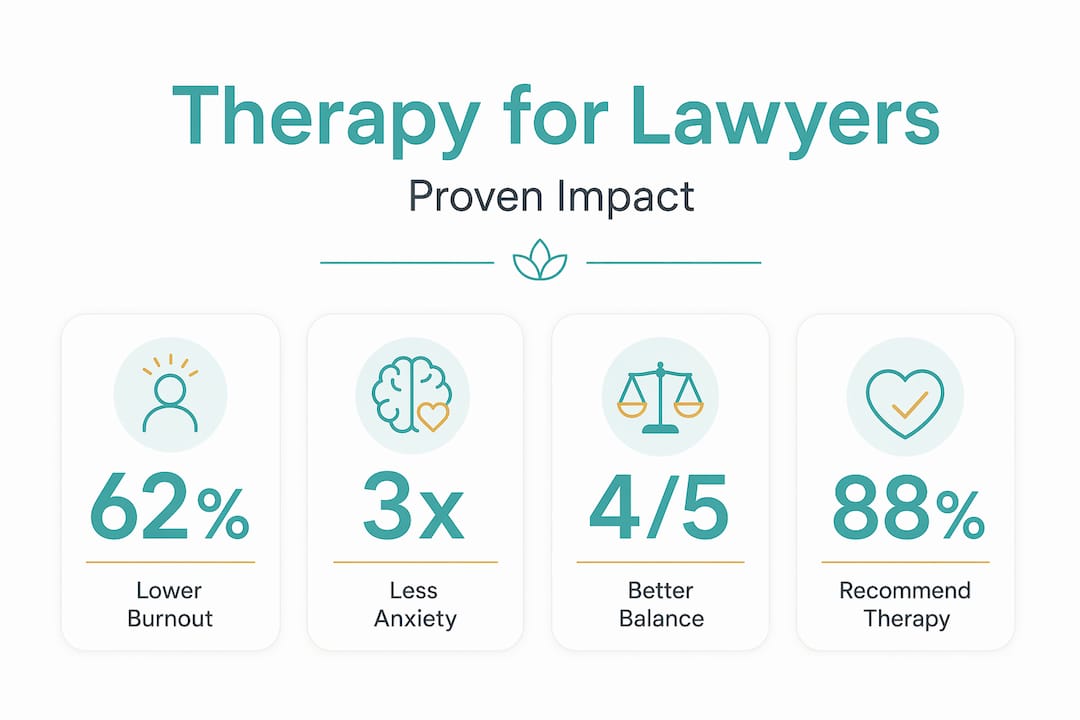
However, therapy is only one piece of the wider support picture. Understanding its role alongside greater workplace change sets realistic expectations.
What therapy can and cannot do for legal professionals
Therapy is genuinely valuable. But it is also honest to say that it has limits, and understanding those limits helps lawyers make informed choices about the support they seek.
Therapy is highly effective at helping lawyers change how they respond to pressure. It builds emotional regulation, self-awareness, and practical coping skills. What it cannot do is change a toxic working environment on its own. If the structural causes of a lawyer's distress, such as unmanageable caseloads, a culture of overwork, or inadequate management, remain unaddressed, therapy will reduce the suffering but cannot eliminate it entirely.

[Lawyer wellbeing research](https://lsbc.vic.gov.au/sites/default/files/2025-04/Research Report - 2025-04-16 - Lawyer Wellbeing Workplace Experiences & Ethics FINAL_1.pdf) is clear that therapy and counselling are one component of a broader prevention and support system. The most effective outcomes for lawyers come when therapy is combined with organisational supports, including access to paid counselling through employee assistance programmes, active management of workloads, and a workplace culture that treats wellbeing as a serious professional matter.
Here is how to think about combining therapy with wider support:
- Use therapy to process emotional responses and build coping capacity
- Use workplace resources, such as employee assistance programmes, to address structural concerns
- Speak to management or HR if workload is the primary driver of distress, ideally with the clarity and confidence that therapy can help you develop
- Seek peer support networks within the legal profession, as connection with others who understand the sector can reduce isolation
"Therapy is not about fixing yourself so you can endure a broken environment indefinitely. It is about understanding yourself well enough to make clear choices, including the choice to push for change."
Pro Tip: If you find that therapy is helping you think more clearly but your distress keeps returning, pay attention to whether the source is structural. Your therapist can help you examine whether the environment itself needs addressing, and support you in deciding what to do about it.
Therapy and supportive workplaces work best together. With realistic expectations in place, lawyers can now consider their personal path and how to approach getting support.
What most lawyers miss: Therapy is a leadership tool, not just crisis management
There is a version of therapy that most lawyers never consider, and it may be the most valuable one. Therapy is not only relevant when things have gone seriously wrong. It is a tool for building the kind of sustained, grounded performance that legal leadership actually requires.
Lawyers in senior roles set the cultural tone for entire teams. When a partner or senior associate models healthy boundaries and manages pressure with visible composure, it gives others permission to do the same. That kind of leadership is not instinctive. It is developed. Therapy is one of the most direct ways to develop it deliberately.
Waiting for crisis before seeking support is a pattern the legal sector sees repeatedly, and it consistently makes recovery harder. Stress that has been building for months or years takes longer to resolve than stress that is addressed early. Beyond the individual cost, unchecked distress in senior lawyers shapes the behaviour of junior colleagues who observe and emulate those around them. A culture of overwork persists partly because leaders model it without realising the impact.
Reframing therapy as professional development, rather than as crisis management, changes the decision to seek support entirely. You would not wait until a client relationship had completely broken down before developing your communication skills. The same logic applies to your own mental and emotional capacity. Investing in therapy proactively builds the self-awareness and emotional resilience that distinguish effective, authentic leaders from those who are simply enduring the pressure.
The lawyers who seek support early, maintain it steadily, and bring the insights from therapy into how they lead their teams are the ones who build genuinely sustainable careers. That is not a soft outcome. It is a professional advantage.
How to take the next step: Accessible therapy options for lawyers
If you have recognised yourself in any part of this guide, taking a concrete step towards support is the most useful thing you can do next. Therapy is increasingly accessible, confidential, and normalised within the legal community. You do not have to wait until things feel unmanageable to benefit from it.

GuideMe is designed to make finding the right therapist straightforward, without the confusion and uncertainty that often puts people off. The platform is human led and AI powered, creating a personalised therapy plan based on your specific needs and then matching you with a therapist who genuinely fits. For lawyers, that means a therapist who understands professional pressure, confidentiality, and the particular stresses of legal work. Explore the specialist therapist directory to find support that is built around you, not a generic process. Taking that first step does not have to be complicated, and it does not have to wait.
Frequently asked questions
Is therapy confidential for lawyers?
Yes, therapy and counselling services for lawyers are confidential. Many law-specific programmes are specifically designed to reduce stigma and career risk, ensuring that seeking support does not affect your professional standing.
How does therapy help with lawyer burnout?
Therapy provides a confidential space to process perfectionism and burnout risk, helping lawyers develop coping strategies rather than relying solely on willpower. It addresses the thinking patterns and boundary issues that fuel burnout over time.
Are there lawyer-specific therapy services?
Yes. Organisations such as LawCare offer targeted counselling resources for legal professionals, emphasising practical next steps, confidentiality, and referrals to therapists with relevant experience.
Can therapy help if my stress is mostly due to workload?
Therapy strengthens coping and self-regulation, but it works best alongside workplace changes. [Lawyer wellbeing research](https://lsbc.vic.gov.au/sites/default/files/2025-04/Research Report - 2025-04-16 - Lawyer Wellbeing Workplace Experiences & Ethics FINAL_1.pdf) confirms that therapy is one component of a broader support system, not a substitute for addressing unmanageable workloads directly.
Is therapy for lawyers supported by evidence?
Yes. Large-scale research confirms that psychotherapy is highly effective at reducing depression, anxiety, and persistent stress symptoms, with benefits that are durable and meaningful for professionals in high-pressure roles.