

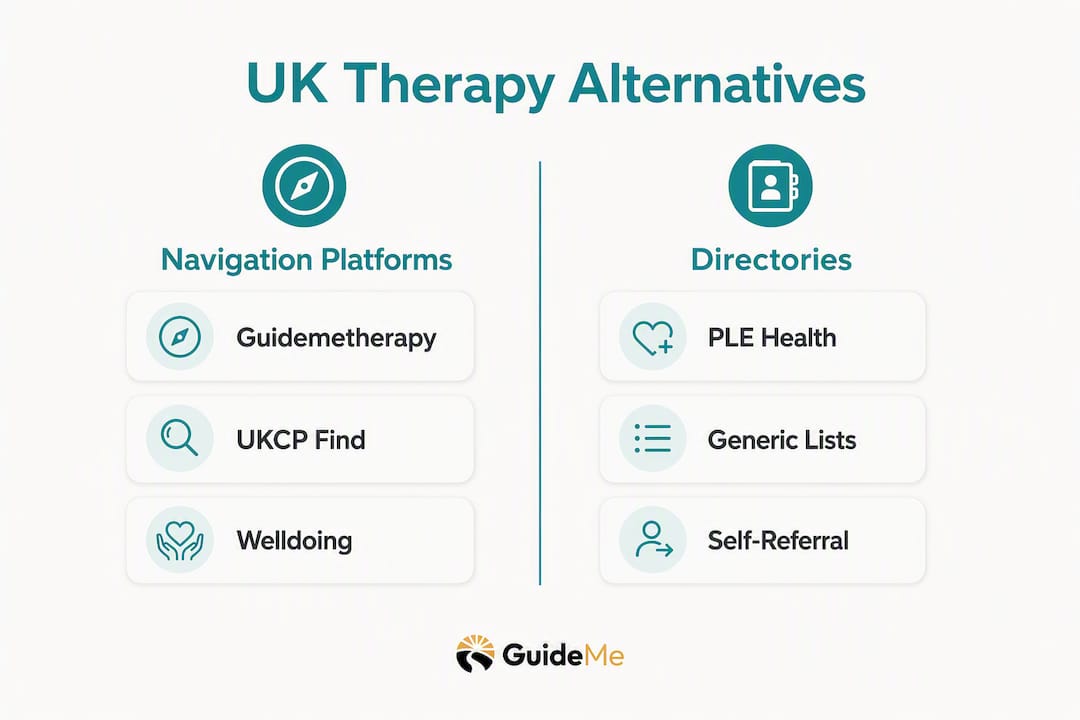
If you are looking for Online-Therapy.com alternatives in the UK, the two most reliable routes are therapy navigation platforms (which combine human-led screening with personalised matching) and verified therapist directories (which let you search independently). The clearest UK picks right now are:
- Guidemetherapy — AI-assisted and human-led matching with in-depth screening and a personalised therapy plan
- UKCP Find a Therapist — the UK Council for Psychotherapy's public register of accredited practitioners
- Welldoing — a large searchable directory with a paid MatchPlus concierge service
- PLE Health — a clinically governed platform that takes responsibility for patient pathways
UKCP and CQC guidance are the two trust signposts to check for any private provider. Typical private session costs vary per session, and most navigation platforms can match you within a few days of your initial assessment.
Table of Contents
- How do the main UK alternatives compare?
- What types of alternatives actually exist?
- How do you choose the right alternative for you?
- What should HR and procurement prioritise?
- What happens after you switch from Online-Therapy.com?
- Why do registration and governance matter so much?
- Why Guidemetherapy stands out as a UK alternative
- Key takeaways
- A note on why navigation platforms deserve priority
- Ready to find the right therapist with Guidemetherapy?
- Useful sources to verify credentials and guidance
How do the main UK alternatives compare?
UK alternatives to generic online therapy platforms fall into two primary categories: verified directories and integrated navigation platforms. The table below maps each option against the criteria that matter most.

| Guidemetherapy | UKCP Find a Therapist | Welldoing | PLE Health | |
|---|---|---|---|---|
| Best for | Individuals and organisations wanting guided matching | Self-directed searchers who want UKCP-registered practitioners | Independent searchers wanting rich filters | Those wanting a clinically governed private service |
| Matching method | AI-assisted + human clinician review | Self-search | Self-search or MatchPlus concierge | Clinical triage and referral |
| Clinical governance check | Built into platform | User verifies UKCP registration | User verifies independently | Platform takes governance responsibility |
| Format | Online, in-person, hybrid | Online and in-person | Online and in-person | Online and in-person |
| Typical cost model | Session fees via matched therapist | Therapist sets own fees | Therapist sets own fees; MatchPlus fee applies | Session fees via platform |
| Time to first session | Days (post-assessment) | Varies by therapist availability | Within three days via MatchPlus | Varies |
| Suitable for organisations | Yes — corporate packages available | No | No | Limited |
Two trust signals stand out at a glance: UKCP registration (visible on the UKCP directory and verifiable by registration number) and CQC guidance compliance for any platform operating as a clinical entity.
What types of alternatives actually exist?
UK therapy alternatives split into three practical categories, each with a meaningfully different user experience.
Therapy navigation platforms combine an initial assessment, clinician review, and personalised matching. You answer structured questions about your needs, preferences, and goals; a clinician or trained adviser then identifies the right therapeutic approach and shortlists practitioners who fit. Human-led screening identifies suitable therapeutic approach and clinician fit before the first session, which cuts the number of unsuccessful initial sessions considerably.
- Pros: fit is assessed before you spend money; ongoing support between sessions; governance is managed for you
- Cons: slightly longer onboarding than a directory; cost may be higher if the platform charges a matching fee
Verified therapist directories (UKCP, Welldoing, BACP) list practitioners who have self-declared their registration. Welldoing's directory offers filters for issue type, modality, availability, online or in-person, gender, ethnicity, and lived experience, with its MatchPlus service finding matches within three days. Directories are useful for choice, but they place the verification burden on you.
- Pros: large choice; transparent profiles; often free to browse
- Cons: you manage governance checks; no clinical triage; therapist-shopping burnout is a real risk
NHS/IAPT (Talking Therapies) is free at the point of use and accessible via self-referral for conditions such as anxiety and depression. Waiting times vary significantly by area, and the range of modalities is narrower than private options.
Pro Tip: Therapeutic alliance — the quality of the relationship between you and your therapist — is the strongest predictor of positive outcomes. Navigation platforms that screen for fit before matching reduce the likelihood of switching therapists mid-course, which saves both time and emotional energy.
How do you choose the right alternative for you?
Work through this checklist before committing to any platform or therapist.
- Confirm registration. Check the therapist's name on the UKCP, BACP, or HCPC public register. A registration number should be visible on their profile.
- Ask about clinical governance. Does the platform accept responsibility for your care pathway, or does it simply list practitioners? Clinical entities manage governance; directories do not.
- Clarify the matching method. Is matching algorithm-only, human-reviewed, or a combination? Human review tends to produce better fit.
- Check data privacy. Is the platform registered with the ICO? Does it store session notes, and who can access them?
- Confirm format and accessibility. Video, phone, text, or in-person — and does the platform support your preferred device and time zone?
- Ask for transparent pricing. What is the per-session cost? Are there platform fees on top? What happens if you need to cancel?
- Request the cancellation and refund policy in writing. Most reputable platforms offer at least 24-hour cancellation without charge.
- Ask about escalation routes. If your needs change or a crisis arises, what is the clinical pathway?
Questions to copy into an email or phone call:
- "Can you confirm your registration body and number?"
- "Who is clinically responsible for my care if something goes wrong?"
- "What is your cancellation policy and refund process?"
- "How is my therapist selected, and can I request a change if the fit is not right?"
Red flags to stop a booking: no verifiable registration, pricing only revealed after sign-up, no written clinical pathway, and no complaints process.
Pro Tip: Filter by modality and presenting issue first, then by format and accessibility — this narrows a directory of thousands to a shortlist of five or six in minutes.
What should HR and procurement prioritise?
Reactive employee assistance programmes (EAPs) that offer a generic helpline are no longer sufficient on their own. Effective organisational wellbeing requires clinical triage that directs employees to the right level of care — self-help, short-term counselling, or specialist therapy — rather than routing everyone into the same pathway.
Key features to demand from any provider:
- Clinical triage at intake, not just a self-referral form
- Pre- and post-intervention outcome measures (PHQ-9, GAD-7, or equivalent)
- Anonymised, aggregated reporting for leadership without compromising employee privacy
- Clear escalation pathways for high-risk presentations
- ICO-compliant data handling and a written data processing agreement
- Embedded support between sessions, not just session delivery
The cost-avoidance case for proactive programmes is straightforward: earlier intervention reduces the severity and duration of absence. Platforms such as Kin Wellness describe clinical screening and personalised matching as part of their organisational offering, which is the standard to benchmark against.
Employer RFP checklist:
- Request evidence of clinical governance structure and named clinical lead
- Ask for sample outcome reports (anonymised)
- Confirm GDPR and ICO compliance documentation
- Request references from comparable organisations
- Pilot with one team before full rollout; agree success metrics in advance
What happens after you switch from Online-Therapy.com?
The onboarding process varies by platform type, but here is a realistic timeline for a navigation platform.
- Day 1 — Initial assessment. You complete a structured questionnaire covering your presenting concerns, therapy history, preferred modality, format, and practical constraints (availability, budget).
- Days 1–3 — Clinician review. A trained adviser or clinician reviews your responses and identifies the most suitable therapeutic approach and practitioner profile.
- Days 2–5 — Match presented. You receive a shortlist or a single recommended therapist with a rationale. You can accept, ask questions, or request an alternative.
- Days 3–7 — First session booked. Most navigation platforms aim for a first session within a week of sign-up, depending on therapist availability.
- Ongoing — Between-session support. Better platforms provide check-ins, resources, or messaging between sessions so care does not stop when the hour ends.
You will typically be asked for: your presenting concerns, any previous therapy experience, preferred therapist characteristics, session format preference, and budget range. For cancellations and rescheduling, ask for the policy in writing before you book. Most reputable platforms require at least 24 hours' notice to avoid a charge; some offer one free reschedule per month.
Why do registration and governance matter so much?
Quality is not determined by delivery medium. A polished website does not mean a platform is clinically governed. The distinction between a listing service and a clinical entity is the single most important thing to understand when choosing a private provider.
UK registers and regulators to check:
- UKCP (UK Council for Psychotherapy) — covers psychotherapists and psychotherapeutic counsellors
- BACP (British Association for Counselling and Psychotherapy) — covers counsellors and psychotherapists
- HCPC (Health and Care Professions Council) — statutory regulator for psychologists and other regulated professions
- CQC (Care Quality Commission) — regulates providers of regulated health and social care activities in England
Verification checklist:
- Look up the therapist's registration number on the relevant public register
- Confirm the platform has a written privacy policy and clinical pathway document
- Ask for the complaints and escalation process in writing
- Check whether the platform is the clinical entity or merely a listing service
Statistic callout: The UKCP register lists thousands of accredited psychotherapists and psychotherapeutic counsellors across the UK, making it one of the largest professional registers of its kind in the country.
Why Guidemetherapy stands out as a UK alternative
Guidemetherapy is a therapy navigation platform built specifically to address the gap between finding a therapist and finding the right therapist. Rather than presenting you with a directory to browse alone, it starts with an in-depth screening process that produces a personalised therapy plan before any matching takes place.
What Guidemetherapy offers:
- In-depth screening that captures your presenting concerns, therapy history, and preferences
- A personalised therapy plan created before you are matched
- AI-assisted and human-led matching, combining algorithmic shortlisting with clinician review
- Ongoing support between sessions, not just session delivery
- Corporate and organisational packages for employers wanting embedded mental health support
Guidemetherapy suits anyone who has felt lost browsing a large directory, anyone who has had an unsuccessful first therapist match, and HR teams wanting a structured, governed solution rather than a generic EAP. For a deeper look at how therapist matching works, the platform's approach is explained in detail on the blog.
Pro Tip: If therapeutic alliance is the strongest predictor of outcomes, then the matching process is where the real work happens — before the first session, not after several unsuccessful ones.
Key takeaways
The most reliable UK alternatives to Online-Therapy.com are therapy navigation platforms that screen for fit before matching, backed by verified directories for independent searchers who prefer to choose themselves.
| Point | Details |
|---|---|
| Two main categories | Navigation platforms offer clinical screening and matching; directories offer choice but place verification on you. |
| Therapeutic alliance is primary | UKCP guidance identifies fit with your therapist as the strongest predictor of positive outcomes. |
| Governance check is non-negotiable | Verify registration on UKCP, BACP, or HCPC and confirm whether the platform is a clinical entity or a listing service. |
| Organisations need triage, not just access | Effective employer programmes require clinical triage, outcome measures, and anonymised reporting — not just a helpline. |
| Guidemetherapy | Offers in-depth screening, a personalised therapy plan, and AI-assisted human-led matching for individuals and organisations. |
A note on why navigation platforms deserve priority
The conventional wisdom says any registered therapist found through a reputable directory is a safe choice. That is true in a narrow sense, but it misses something important: finding a registered therapist and finding the right therapist are two different problems. Directories solve the first. Navigation platforms attempt to solve the second.
The evidence from clinical guidance is consistent: therapeutic alliance — the quality of the working relationship between client and therapist — matters more than modality, more than delivery format, and more than price. A platform that invests in understanding your needs before making a match is not a luxury. For anyone who has already had one unsuccessful therapy experience, it is the more efficient route.
Organisations face a version of the same problem at scale. Routing every employee through the same generic pathway wastes budget and delays recovery. Clinical triage that directs people to the right level of care from the start is what separates a functional wellbeing programme from a box-ticking exercise. For employer enquiries or bespoke matching needs, contacting Guidemetherapy's support team directly is the most direct route to a scoped solution.
Ready to find the right therapist with Guidemetherapy?
Guidemetherapy offers something the major directories cannot: a structured screening process that produces a personalised therapy plan before you meet a single therapist. That means fewer wasted sessions and a clearer path from the start.
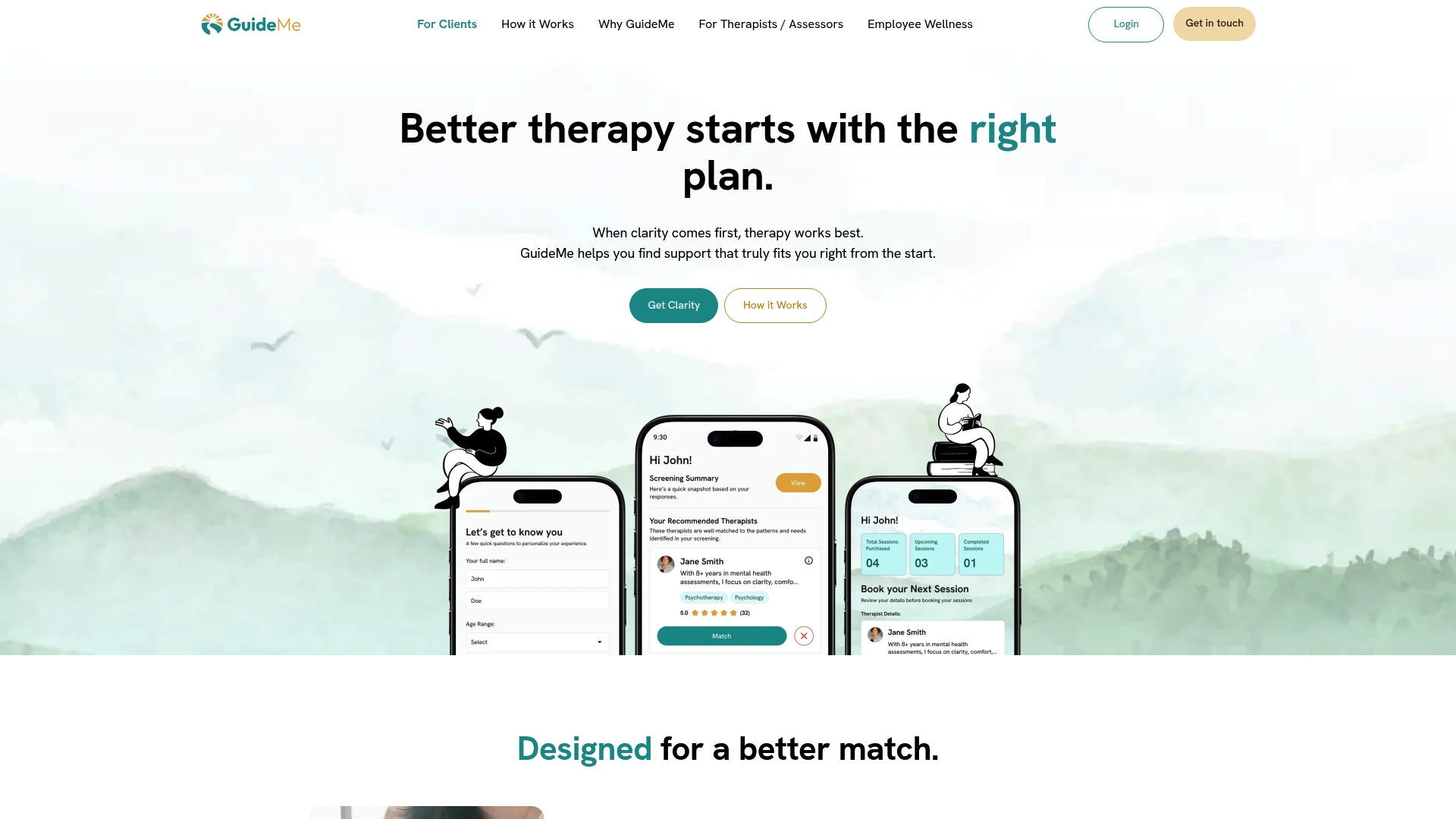
- Step one: Complete a short in-depth assessment so the platform understands your needs, preferences, and goals.
- Step two: Receive a clinician-reviewed therapist match and your personalised therapy plan, then book your first session.
Start your assessment and get matched with a therapist who fits — not just one who is available.
Useful sources to verify credentials and guidance
- UKCP Find a Therapist — search the UK Council for Psychotherapy's public register by location, modality, and issue; verify registration numbers here.
- CQC: Choosing mental health services — official CQC guidance on what to check when selecting a private mental health provider.
- NHS: How to access mental health services — covers self-referral routes, NHS Talking Therapies, and GP referral pathways.
- UKCP: How to choose a psychotherapist — clinical guidance on prioritising therapeutic alliance and what to ask a prospective therapist.
- Welldoing Find a Therapist — large UK directory with detailed filters; MatchPlus concierge service available for faster matching.
Cross-check any provider's registration number against the relevant public register before booking. Request written clinical pathways and a complaints process from any private provider. When you want governance managed for you rather than by you, a clinically governed navigation platform is the more reliable choice.