

TL;DR:
- Online financial counselling offers accessible, cost-effective support that addresses emotional and practical aspects of financial stress. It removes geographical, scheduling, and administrative barriers while focusing on the emotional drivers behind financial behaviors for lasting change. This approach emphasizes privacy, cultural competence, and personalized therapy, making it a vital resource for managing financial anxiety effectively.
Online financial counselling is defined as a form of therapeutic support that addresses both the emotional and practical dimensions of financial stress through remote, digital sessions. The advantages of online counselling for finance are clear: it removes geographic barriers, reduces costs, and provides a judgement-free space to work through the emotional patterns driving poor financial decisions. Financial therapy, the recognised industry term for this practice, goes well beyond budgeting advice. It targets the psychological roots of money-related anxiety, avoidance, and self-sabotage. Platforms like Guidemetherapy are making this support more accessible than ever, combining human expertise with AI-powered therapist matching to connect you with the right professional from the start.

1. How online counselling improves access to financial support
The most immediate benefit of virtual financial counselling is reach. Traditional in-person financial therapy is concentrated in urban centres, leaving people in rural or underserved areas with few options. Online platforms remove that barrier entirely, delivering qualified support to anyone with a stable internet connection.
Flexible scheduling is equally significant. Many people under financial stress are also managing full-time work, childcare, or caring responsibilities. Online counselling sessions can be booked in evenings, at weekends, or during lunch breaks, without the added pressure of commuting or taking time off work.
Secure video-based intake processes now verify insurance coverage and track progress digitally, removing the administrative friction that often delays in-person care. Many platforms also accept insurance with no waitlist when clients maintain scheduling flexibility, which eliminates one of the most common barriers to getting started.
Key accessibility advantages include:
- Sessions available from home, removing travel time and cost
- Evening and weekend appointment slots for working individuals
- Insurance verification handled digitally during intake
- No waitlists on many platforms when scheduling is flexible
- Access for people with mobility limitations or chronic illness
Pro Tip: When booking your first session, choose a platform that handles insurance verification upfront. This saves time and removes a common reason people delay starting.
2. Addressing the emotional side of financial stress
Financial therapy targets the emotional drivers of financial decisions, and this is where it differs most sharply from traditional financial advice. Research shows that 80 to 90% of financial decisions are influenced by emotions. That figure means most financial problems are not knowledge problems. They are emotional ones.
"Financial therapy provides a judgement-free space that targets healing emotional relationships with money for sustainable behavioural change." — Wendy Wright, LMFT
Online counselling creates a private, low-pressure environment where clients feel safer discussing shame, fear, or avoidance around money. That sense of safety is harder to achieve in a formal office setting, particularly for people who already feel embarrassed about their financial situation.
Evidence-based approaches used in online financial therapy include:
- Cognitive Behavioural Therapy (CBT): Identifies and restructures negative thought patterns around money, such as catastrophising debt or avoiding bank statements.
- Trauma-informed therapy: Addresses financial trauma rooted in childhood experiences, family patterns, or past financial crises.
- Behavioural activation: Encourages small, consistent financial actions to break cycles of avoidance and build confidence.
- Mindfulness-based techniques: Reduces anxiety responses triggered by financial decisions, helping clients think more clearly under pressure.
Understanding how therapists shape financial decisions and well-being shows that emotional healing is not a soft add-on to financial planning. It is the mechanism through which lasting change actually happens. Practitioners consistently warn that ignoring emotional behaviour limits counselling effectiveness, regardless of how sound the financial advice itself may be.
3. Cost-effective financial counselling models online
Cost is one of the most cited reasons people avoid professional support, whether therapeutic or financial. Online financial counselling addresses this directly. Lower overhead costs allow platforms to offer reduced fees compared to traditional advisory services, and subscription-based models make ongoing support financially sustainable.
| Model | Typical cost structure | Best suited for |
|---|---|---|
| Traditional financial advisor | High one-off fees, hourly billing | High-net-worth clients with complex portfolios |
| In-person financial therapist | Per-session fees, limited insurance coverage | Clients with access to urban providers |
| Online financial counselling | Subscription or per-session, insurance accepted | Individuals seeking regular, affordable support |
| AI financial tools | Free or low-cost, no personalisation | Basic information gathering only |
Subscription models are particularly well suited to people under ongoing financial stress, where a single session rarely resolves the underlying patterns. Paying a predictable monthly fee removes the anxiety of deciding whether each individual session is "worth it," which itself can be a barrier to consistent engagement.
Pro Tip: Before committing to a platform, check whether it accepts your insurance and whether it offers a free initial consultation. These two factors alone can significantly reduce your out-of-pocket cost.
4. Technology and security in online financial counselling
Online financial counselling involves sharing sensitive personal and financial information, so understanding the technology behind it matters. Reputable platforms use end-to-end encrypted video sessions and HIPAA-compliant data storage to protect client information. Security in this context is more user-dependent than in a traditional office, which means you carry some responsibility for choosing the right provider.
Before starting with any platform, verify the following:
- The platform uses end-to-end encrypted video conferencing
- Data storage is HIPAA-compliant or meets equivalent UK/EU standards
- The counsellor holds recognised professional credentials
- The platform has a clear privacy policy covering financial data
- Sessions are conducted on a private, password-protected connection on your end
The online therapy setup process is straightforward on well-designed platforms, but cutting corners on provider selection creates real risk. A few minutes spent verifying credentials and security practices at the outset protects both your data and your therapeutic experience.
5. Online counselling versus other financial support options
Understanding when online financial counselling is the right choice requires comparing it honestly with the alternatives. Each option serves a different need, and the best outcomes come from matching the tool to the problem.
| Support type | Emotional support | Personalisation | Cost | Availability |
|---|---|---|---|---|
| Online financial counsellor | High | High | Moderate | High |
| Traditional financial advisor | Low | High | High | Moderate |
| AI financial tools | None | Low | Low | Very high |
| In-person financial therapist | High | High | High | Low |
50% of Americans now use AI-driven financial guidance, but MIT Sloan research makes clear that AI tools lack the emotional intelligence to address the behavioural drivers behind financial stress. This matters because for most people experiencing financial difficulty, the problem is not a lack of information. It is a pattern of behaviour that information alone cannot change.
Hybrid models are emerging as a practical middle ground. Some platforms combine AI-powered intake and matching with human-led counselling sessions, offering the efficiency of technology alongside the depth of genuine therapeutic support. For people who are feeling lost about where to start, this approach provides structure without sacrificing the human connection that makes therapy effective. Knowing how to find the right therapist for finance-related stress is itself a skill worth developing before committing to any single platform.
Online counselling does have limitations worth acknowledging. It is not a substitute for accounting, tax advice, or legal financial guidance. Financial counselling focuses on emotional behaviours rather than technical financial planning, and clients with complex tax or legal needs will still require specialist professionals alongside their therapeutic support.
6. Cultural competency and diverse populations
Effective online financial counselling does more than translate sessions to a screen. Virtual financial programmes succeed when they incorporate cultural competency and interactive learning methodologies, making support genuinely effective across diverse populations. This is a meaningful advantage over many traditional services, which have historically been designed around a narrow demographic.
Cultural competency in financial therapy means a counsellor understands that attitudes towards debt, saving, family financial obligations, and financial shame vary significantly across cultural backgrounds. A counsellor who recognises these differences creates a more accurate and useful therapeutic relationship. Online platforms, by drawing from a wider pool of practitioners, are better positioned to match clients with counsellors who share or understand their cultural context.
Active engagement also matters more than passive information delivery. Behavioural change depends on experiential learning and active participation, not on watching videos or reading articles. The best online financial counselling programmes build in exercises, reflections, and between-session tasks that keep clients actively working on their patterns rather than passively absorbing content.
7. Starting online financial counselling without financial reports
One of the less obvious but genuinely useful aspects of online financial therapy is that you do not need to arrive prepared. Many clients benefit from starting without detailed financial reports, allowing the counsellor to observe their unfiltered emotional approach to money before any numbers are introduced. This approach often reveals more about the real problem than a spreadsheet ever could.
This is a significant departure from traditional financial advisory, where the first meeting typically involves reviewing statements, calculating net worth, and setting numerical targets. Financial therapy starts with the person, not the portfolio. That shift in starting point is what makes it effective for people whose primary struggle is emotional rather than mathematical.
The counselling approaches available in 2026 for mental health support have expanded considerably, and financial therapy now sits within a well-developed therapeutic framework. Whether you arrive with a clear picture of your finances or no picture at all, a qualified financial counsellor can work with where you are.
Key takeaways
Online financial counselling is most effective when it addresses emotional behaviour alongside practical financial guidance, making accessibility, cost, and therapeutic depth the three factors that determine its real-world impact.
| Point | Details |
|---|---|
| Emotional drivers matter most | 80 to 90% of financial decisions are emotion-led, making therapeutic support more effective than information alone. |
| Accessibility is a core advantage | Flexible scheduling, insurance acceptance, and no waitlists make online counselling easier to start and maintain. |
| Cost models favour online options | Subscription-based pricing and lower overheads make virtual counselling more affordable than traditional advisory services. |
| Security requires active verification | Choose platforms with end-to-end encryption and HIPAA-compliant storage before sharing any financial information. |
| AI tools do not replace counselling | AI financial tools lack emotional intelligence and cannot address the behavioural patterns behind financial stress. |
Why emotional support is the missing piece in financial recovery
I have worked with many people who arrived convinced their financial problems were purely practical. They wanted a budget, a plan, a set of steps to follow. What became clear, consistently, is that the plan was never the problem. The behaviour around the plan was.
Financial stress does not resolve when someone is given better information. It resolves when the anxiety, shame, or avoidance driving their decisions is addressed directly. I have seen clients who understood compound interest perfectly but could not open their bank statements. I have seen people with solid incomes who spent compulsively after stressful weeks at work, not because they lacked discipline, but because no one had ever helped them understand what that spending was doing for them emotionally.
Online counselling removes the practical barriers that stop people from getting this kind of support. No travel, no waiting rooms, no rigid appointment slots. But more than that, the privacy of a home environment often makes it easier for clients to be honest. That honesty is where the real work begins.
My advice is straightforward: do not wait until your finances are in crisis to seek support. The earlier you address the emotional patterns behind your financial decisions, the less damage those patterns cause. Online financial counselling is not a last resort. It is a practical, accessible first step.
— Yetty
Find the right support with Guidemetherapy
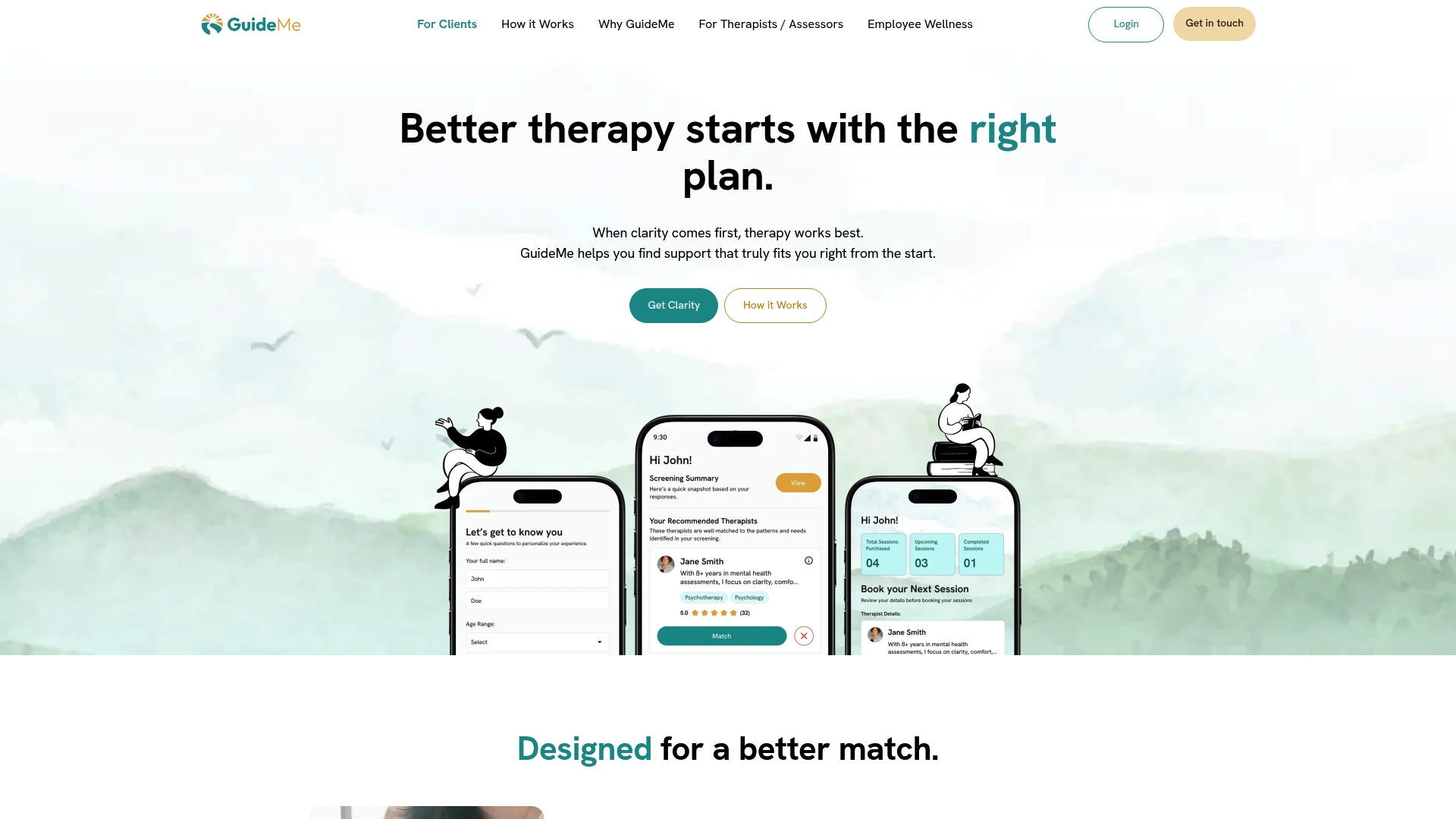
Financial stress affects your mental health, your relationships, and your daily life. Getting the right support should not be complicated. Guidemetherapy is a therapy navigation platform that combines human expertise with AI-powered matching to connect you with a counsellor who genuinely fits your needs. The platform handles insurance verification, removes waitlist delays, and creates a personalised therapy plan before your first session. Whether you are dealing with debt anxiety, avoidance patterns, or the emotional weight of financial uncertainty, Guidemetherapy helps you find clearer choices and a more comfortable path forward. Start your therapy plan today and take the first step towards financial and emotional well-being.
FAQ
What are the main advantages of online counselling for finance?
The main advantages are accessibility, cost-effectiveness, and emotional support. Online financial counselling removes geographic and scheduling barriers, offers flexible payment models, and addresses the emotional drivers behind financial decisions that traditional advisors do not cover.
Is online financial counselling the same as seeing a financial advisor?
No. Financial therapy focuses on the emotional and behavioural patterns behind financial decisions, while a financial advisor focuses on technical planning and investment strategy. Both can be useful, but they serve different needs and are not interchangeable.
How secure is online financial counselling?
Reputable platforms use end-to-end encrypted video sessions and HIPAA-compliant data storage. Users carry responsibility for verifying these features before sharing sensitive information, and sessions should always be conducted on a private, password-protected connection.
Can online financial counselling help with debt anxiety?
Yes. Evidence-based approaches such as CBT and trauma-informed therapy are used in online financial counselling to address anxiety, avoidance, and shame around debt. These methods target the emotional responses that make debt feel unmanageable, not just the numbers themselves.
Do I need to prepare financial documents before my first session?
No. Many financial therapists prefer clients to arrive without detailed financial reports, allowing the counsellor to observe emotional responses to money before introducing specific figures. This unfiltered starting point often reveals more about the underlying problem than documents alone.