
TL;DR:
- Culture is a dynamic social process encompassing shared beliefs, customs, arts, and behaviors that define human groups. It exists in tangible forms, like monuments, and intangible forms, such as oral traditions, performing arts, and rituals, continuously evolving through community choices and external influences. Protecting cultural diversity is essential for creativity, social cohesion, and human dignity, and active participation deepens understanding beyond academic study.
Culture is the ensemble of socially shared beliefs, customs, arts, and behaviours that define how human groups live and relate to one another. Anthropologists describe it as the collective social process through which communities create meaning, transmit knowledge, and organise daily life. UNESCO and scholars across cross-cultural studies agree that culture shapes identity, governs social interaction, and underpins everything from language to law. Understanding different cultures is not merely an academic exercise. For anyone seeking personal growth or a richer view of the world, it is one of the most rewarding pursuits available.
What are the main types and domains of culture?

Culture, as a recognised field of study in anthropology and the social sciences, takes many forms. Socially shared beliefs, customs, arts, and laws constitute its core, but culture also extends to subtypes such as occupational cultures, youth cultures, and regional traditions that cut across ethnicity and nationality.
The clearest way to organise cultural forms is through the distinction between tangible and intangible cultural heritage.
- Tangible heritage refers to physical objects and sites: monuments, historic buildings, artefacts, and landscapes. UNESCO's World Heritage list contains properties from 196 countries, all recognised for their universal value. That figure illustrates just how broadly humanity has left its mark on the physical world.
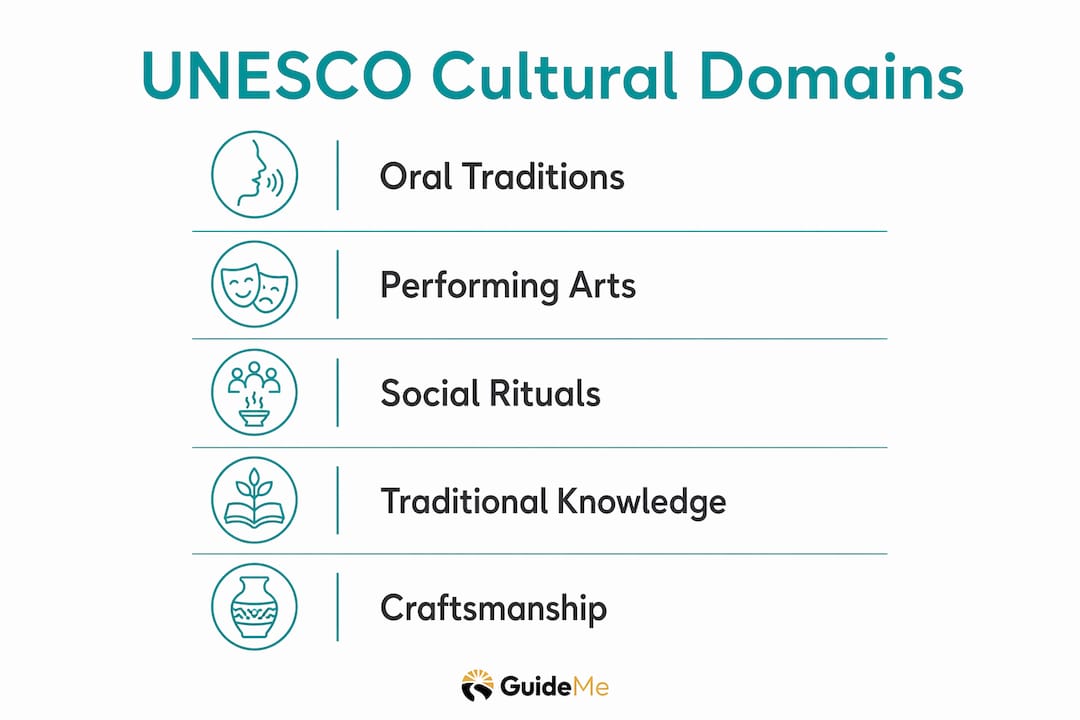
- Intangible heritage refers to living practices, expressions, and knowledge. UNESCO safeguards these under its 2003 Convention for Intangible Cultural Heritage, which identifies five major domains.
The five UNESCO domains of intangible cultural heritage
| Domain | Examples |
|---|---|
| Oral traditions and expressions | Storytelling, proverbs, epic poetry |
| Performing arts | Music, dance, theatre |
| Social rituals and festive events | Weddings, harvest festivals, ceremonies |
| Knowledge about nature and the universe | Traditional medicine, ecological knowledge |
| Traditional craftsmanship | Weaving, pottery, instrument making |
Each domain represents a living body of knowledge passed between generations. The Mongolian art of Khöömei throat singing, the Peruvian scissors dance, and Japanese Noh theatre all sit within these categories. They are not museum pieces. Communities practise them actively, adapting them to new contexts while preserving their core meaning.
Beyond UNESCO's framework, culture also operates at a group level within broader societies. Organisational cultures shape how workplaces function. Youth cultures generate new aesthetics, language, and values. These subsets remind us that cultural practices are not confined to national or ethnic boundaries.
Pro Tip: When researching global cultures for academic purposes, start with UNESCO's intangible heritage lists as a structured entry point. Each entry includes community descriptions, safeguarding measures, and multimedia resources.
Why is cultural diversity essential for human societies?
Cultural diversity is defined by UNESCO as humanity's common heritage, as necessary for human societies as biodiversity is for ecosystems. That analogy is precise and deliberate. A world with fewer living cultural traditions is a world with fewer ways of solving problems, fewer artistic forms, and fewer frameworks for understanding human experience.
"Cultural diversity is as necessary for humankind as biodiversity is for nature." — UNESCO Universal Declaration on Cultural Diversity
The practical consequences of this principle are significant. Societies that maintain genuine intercultural dialogue tend to generate more creative responses to shared challenges. When communities exchange knowledge about agriculture, medicine, architecture, or governance, each draws on a wider pool of tested ideas. The spread of Japanese fermentation techniques into European kitchens, or the influence of West African rhythmic structures on global popular music, are two clear examples of how cultural exchange enriches daily life in ways that are often invisible until you trace them back.
Protecting cultural diversity is also an ethical matter. UNESCO frames it as both a human right and an ethical imperative, one that must be upheld without infringing on fundamental freedoms. This matters because cultural suppression has historically been used as a tool of political control. Defending the right of communities to practise and transmit their traditions is inseparable from defending human dignity.
The benefits of cultural diversity include:
- Stimulating creativity and artistic innovation across communities
- Providing multiple frameworks for addressing social and environmental challenges
- Strengthening social cohesion through shared respect for difference
- Expanding individual perspectives and reducing prejudice through exposure
How do cultures evolve and adapt over time?
The most common misunderstanding about culture is that it is fixed. Anthropologists firmly reject this view. Culture is an ongoing, adaptive process shaped by individual choices and collective social sharing, not a static set of rules inherited from ancestors. This distinction matters enormously for anyone studying or engaging with different cultures.
Here is how cultural evolution typically unfolds:
- Communities actively select what to preserve. Cultural heritage is not a passive inheritance. Communities choose which traditions and legacies to maintain and transmit to future generations. A tradition survives because people find it meaningful, not simply because it is old.
- External contact reshapes practices. Trade, migration, and communication have always introduced new ideas into existing cultural frameworks. The result is not replacement but hybridisation. Brazilian Carnival, for instance, blends West African, Indigenous, and European traditions into something entirely its own.
- Crises force adaptation. Globalisation, climate change, and humanitarian emergencies all place pressure on cultural practices. Communities living in coastal regions threatened by rising sea levels face the loss not only of land but of the fishing traditions, rituals, and ecological knowledge tied to that land.
- Youth engagement determines continuity. The transmission of cultural knowledge to younger generations is the single most important factor in a tradition's survival. UNESCO's safeguarding programmes consistently prioritise intergenerational learning as the foundation of cultural resilience.
Researchers in anthropology now advocate for what is sometimes called "researching against culture," a method that identifies specific behaviours and motivations rather than reducing individuals to cultural stereotypes. The goal is precision. Knowing that a person comes from a particular country tells you something, but it does not tell you everything. Culture is better understood as a toolbox for human behaviour than as a fixed identity.
Pro Tip: If you are studying how cultures evolve for academic purposes, compare UNESCO's intangible heritage entries from the same region across different decades. The changes in how communities describe their own practices reveal the adaptation process in real time.
How can you deepen your understanding of different cultures?
Genuine cultural understanding requires more than reading about traditions. Participation in cultural exchange and experiential learning produces a depth of appreciation that no textbook alone can provide. The good news is that meaningful engagement with global cultures is more accessible than ever.
Practical ways to broaden your cultural knowledge include:
- Attend cultural events and festivals. Diwali celebrations in Leicester, Chinese New Year in London's Soho, or Notting Hill Carnival each offer direct exposure to living traditions. Observe, ask questions, and participate respectfully.
- Engage with arts from different traditions. Literature, film, music, and visual art carry cultural values in ways that analytical texts often cannot. Reading Chinua Achebe's Things Fall Apart or watching Hayao Miyazaki's films opens cultural frameworks that are difficult to access through description alone.
- Use structured academic resources. The Open Encyclopedia of Anthropology, UNESCO's heritage databases, and university open courseware from institutions such as Oxford and the London School of Economics provide rigorous, peer-reviewed material on cross-cultural studies.
- Practise respectful curiosity. Ask questions from a position of genuine interest rather than judgement. Avoid assuming that unfamiliar practices are inferior or exotic. The goal is understanding, not evaluation.
- Learn a language. Even basic competence in another language reveals how different cultures structure thought, express emotion, and organise social relationships. Mandarin's lack of tenses, for example, reflects a fundamentally different relationship with time than English grammar encodes.
Understanding cultural identity also means recognising that heritage safeguarding focuses on transmission and active renewal. When you engage with a living tradition, you are not observing a relic. You are witnessing a community's ongoing act of self-definition. That perspective transforms how you approach cultural learning.
Multicultural competency in professional settings, particularly in psychology and mental health care, has become a recognised area of practice. Therapists who understand how cultural backgrounds shape a client's experience of distress, help-seeking, and healing deliver measurably better care. Cultural awareness is not a soft skill. It is a clinical one.
Key takeaways
Culture is a dynamic, socially shared process, not a fixed identity, and understanding its forms, diversity, and evolution is the foundation of meaningful cross-cultural engagement.
| Point | Details |
|---|---|
| Culture is dynamic, not fixed | Anthropologists define culture as an ongoing adaptive process shaped by individual and collective choices. |
| Tangible and intangible heritage differ | UNESCO classifies heritage as physical sites or living practices across five distinct domains. |
| Cultural diversity is a human right | UNESCO frames protecting cultural diversity as both an ethical imperative and a fundamental freedom. |
| Communities choose what to preserve | Heritage survives because communities actively select and transmit traditions, not through passive inheritance. |
| Experiential learning deepens understanding | Direct participation in cultural events and arts produces appreciation that academic study alone cannot replicate. |
Why I think we underestimate how alive culture really is
Most people I speak with treat culture as something that belongs to the past. They picture museums, heritage sites, and folk costumes. That framing is understandable, but it misses the point almost entirely.
What strikes me most, having spent years reading across anthropology, history, and cross-cultural psychology, is how relentlessly alive culture is. It shifts in response to every generation that inherits it. The Noh theatre tradition in Japan has been practised for over 650 years, yet contemporary Noh performers are making choices about staging, audience engagement, and repertoire that their predecessors never faced. That is not dilution. That is culture doing exactly what it has always done.
I also think we are too quick to treat cultural identity as a single, stable thing. Most people I know carry multiple cultural influences simultaneously. A British-Nigerian woman who grew up in Birmingham, studied in Edinburgh, and works in Brussels is not confused about who she is. She is the product of a genuinely complex cultural formation, and that complexity is a strength, not a problem to be resolved.
The practical implication for anyone pursuing cultural learning is this: go in without a fixed idea of what you will find. The most interesting thing about any cultural tradition is rarely what the guidebook tells you. It is the gap between the official description and the lived reality. That gap is where culture actually lives.
For those of us interested in mental health and personal growth, cultural awareness also changes how we understand our own inner lives. The way you were raised to express grief, seek help, or define success is not universal. Recognising that opens up real space for self-understanding.
— Yetty
How Guidemetherapy supports your cultural and personal growth
Understanding different cultures is deeply connected to understanding yourself. The values, beliefs, and practices you grew up with shape how you experience emotions, relationships, and mental health. Guidemetherapy recognises that cultural identity is central to the therapy experience, not a background detail.

Guidemetherapy matches you with therapists who understand your cultural background and communication style. The platform's therapy matching process considers your cultural identity as a core part of finding the right fit. If you have ever felt that a therapist did not quite understand where you were coming from, that experience is exactly what Guidemetherapy is designed to address. You can also explore counselling approaches that integrate cultural sensitivity, so your therapy reflects your full self from the very first session.
FAQ
What is the definition of culture in anthropology?
Culture is defined in anthropology as the socially shared beliefs, customs, arts, and behaviours through which human groups create meaning and organise life. Anthropologists emphasise that it is a dynamic process, not a fixed set of rules.
What are UNESCO's five domains of intangible cultural heritage?
UNESCO identifies oral traditions, performing arts, social rituals, traditional knowledge about nature, and traditional craftsmanship as the five domains safeguarded under its 2003 Convention for Intangible Cultural Heritage.
Why does cultural diversity matter for society?
UNESCO's Universal Declaration on Cultural Diversity defines cultural diversity as humanity's common heritage, essential for societal vitality in the same way biodiversity sustains ecosystems. It drives creativity, dialogue, and resilience across communities.
How do cultures change over time?
Cultures evolve through community choices about which traditions to preserve, contact with other groups, responses to crises such as climate change, and the transmission of knowledge to younger generations. Change is a normal and continuous feature of all living cultures.
How does cultural background affect mental health and therapy?
Cultural background shapes how individuals express distress, seek help, and define wellbeing. Cultural considerations in therapy are now recognised as central to effective treatment, and therapist-client cultural compatibility significantly improves therapeutic outcomes.