

The most effective mental health tips for 2026 share one quality: they are small, consistent, and grounded in how the brain actually works. You do not need a complete lifestyle overhaul. What works is layering simple habits, one on top of another, until they become the default. NHS Every Mind Matters identifies seven core areas where small changes make a measurable difference, and the evidence behind each one is clear.
Here is a quick overview of the core mental health strategies covered in depth below:
- Make time for play and physical movement every day
- Prioritise sleep with a consistent schedule and a screen cutoff before bed
- Consume less news, social media, and passive scrolling
- Practise present-moment awareness through brief mindfulness or grounding exercises
- Establish a daily anchor, a small ritual that centres you amid a busy routine
- Be kind to yourself and challenge unhelpful thought patterns when they arise
- Connect with others intentionally, not just when you are struggling
- Seek support early, before things reach crisis point
- Live a healthy life through balanced nutrition, hydration, and enjoyable hobbies
- Set realistic, flexible goals that adapt when life does not go to plan
These tips are evidence-based, endorsed by NHS guidance, and shaped by the UK government's 2026 mental health strategy, which calls for a shift from crisis response to everyday prevention. The sections below go deeper on each one.
Table of Contents
- 1. Why play and physical movement belong in your mental health plan
- 2. How sleep and consuming less protect your mental health
- 3. Present-moment awareness and daily anchors to reduce overwhelm
- 4. Being kind to yourself and reframing unhelpful thoughts
- 5. Connecting with others and knowing when to seek support
- 6. Living a healthy life and doing something enjoyable for yourself
- 7. What the UK mental health landscape looks like in 2026
- 8. Get good sleep
- 9. Set realistic and flexible goals
- Key takeaways
1. Why play and physical movement belong in your mental health plan
Physical activity is one of the most well-evidenced self-care tools available, and it does not require a gym membership or a structured fitness plan. Just 30 minutes of walking each day can lift mood and support overall health, according to the National Institute of Mental Health. Small amounts add up, so even a 10-minute walk counts.

Play matters too, and not just for children. Unstructured, enjoyable activity reduces the body's stress response and restores a sense of lightness that busy adult life tends to erode. That might mean a board game with friends, a spontaneous dance in the kitchen, or an afternoon spent drawing without any goal attached.
Practical ways to build movement and play into your week:
- Walk or cycle for short journeys instead of driving
- Schedule a 15-minute outdoor break at lunchtime
- Try a group activity you actually enjoy, whether that is a dance class, a five-a-side game, or a local running club
- Keep a small item nearby that invites play, such as a sketchpad, a puzzle, or a musical instrument
- Treat movement as a mood tool, not a weight-loss exercise
Pro Tip: Anchor new habits to something you already do. A short walk after your morning coffee, or five minutes of stretching before you shower, is far more likely to stick than a habit that requires its own dedicated slot.
2. How sleep and consuming less protect your mental health
Sleep is not passive recovery. Consistent sleep stabilises the amygdala, the brain's emotional alarm system, which reduces reactivity and helps manage anxiety and low mood. Poor sleep does not just leave you tired; it makes every stressor feel larger and harder to handle.
Good sleep hygiene does not need to be complicated. The most reliable steps are also the most straightforward:
- Go to bed and wake up at the same time every day, including weekends
- Stop using screens at least 60 minutes before bed to allow your nervous system to wind down
- Keep your bedroom cool, dark, and quiet
- Avoid caffeine after 2PM and limit alcohol in the evenings
- If your mind races at bedtime, try writing down tomorrow's tasks before you switch off the light
Consuming less is the other side of the same coin. Limiting passive social media scrolling and setting a digital cutoff before bed both reduce anxiety-related rumination and improve sleep quality. This is not about disconnecting entirely. It is about being deliberate with your attention rather than handing it over by default.
Practical limits worth trying:
- Set a daily screen time limit on your phone for news and social media apps
- Designate one or two specific times to check the news rather than checking continuously
- Mute or unfollow accounts that consistently leave you feeling worse
- Replace the last 30 minutes of scrolling with something physical or creative
3. Present-moment awareness and daily anchors to reduce overwhelm
Anxiety tends to live in the future. Rumination tends to live in the past. Present-moment awareness is the practice of returning attention to right now, and brief mindfulness practices improve the brain areas responsible for attention and emotional regulation over weeks of consistent use. You do not need a meditation cushion or a dedicated app to benefit.
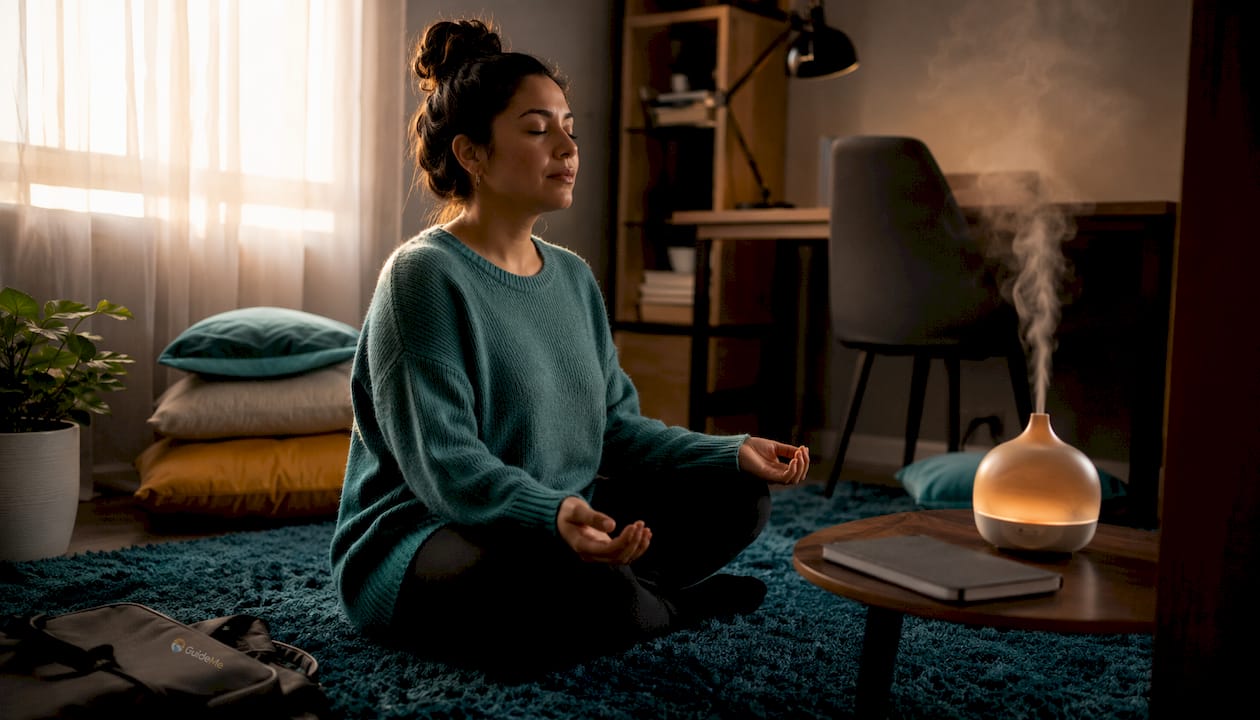
The simplest entry point is a grounding technique: name five things you can see, four you can hear, three you can touch. It takes under two minutes and interrupts the spiral of anxious thinking more reliably than most people expect.
A daily anchor takes this further. It is a specific, small moment you return to every day as a point of calm. Examples include:
- A mindful first cup of tea or coffee, phone face-down, no multitasking
- A five-minute walk at the same time each morning
- Two minutes of slow breathing before opening your emails
- A short body scan before getting out of bed
The anchor itself matters less than the consistency. Small habits under five minutes, linked to existing routines, have the strongest chance of sticking and improving wellbeing over time. NHS Every Mind Matters recommends present-moment mindfulness as one of its core ongoing mental health investments, precisely because it builds a skill rather than just providing temporary relief.
4. Being kind to yourself and reframing unhelpful thoughts
The inner critic is often the loudest voice in the room, and it rarely tells the truth. Harsh self-judgement raises cortisol, narrows thinking, and makes it harder to recover from setbacks. Self-compassion, treating yourself with the same patience you would offer a friend, is linked to greater purpose and sustained happiness.
Cognitive behavioural techniques offer a structured way to challenge the inner critic. The process is straightforward: notice the thought, question whether it is accurate, and replace it with something more balanced. You are not trying to force positivity. You are looking for a more honest perspective.
Practical steps for building self-kindness and reframing unhelpful thoughts:
- When a self-critical thought appears, ask: "Would I say this to someone I care about?"
- Write down three things that went well at the end of each day, however small
- Notice the difference between a fact ("I made a mistake") and a story ("I always get things wrong")
- Use the missed-day rule: if you skip a habit or have a difficult day, restart calmly without self-criticism rather than abandoning the effort entirely
- Practise gratitude specifically, naming what you are grateful for rather than thinking about it vaguely
NHS Every Mind Matters identifies reframing unhelpful thoughts as one of its seven core mental health tips, noting that the way we think, feel, and behave are closely linked. Recognising unhelpful patterns is the first step; changing them is a skill that develops with practice.
5. Connecting with others and knowing when to seek support
Positive relationships are not a luxury. Meaningful social connection releases oxytocin, which directly reduces stress hormones and improves mood. Loneliness, by contrast, activates the same stress pathways as physical pain. The quality of connection matters more than the quantity.
Intentional connection looks different for everyone. It might mean a weekly phone call with a friend, joining a local group around a shared interest, or simply being more present during conversations rather than half-distracted by a phone. The goal is contact that leaves you feeling seen rather than drained.
Signs that professional support may be helpful:
- Persistent low mood, anxiety, or hopelessness lasting two weeks or more
- Difficulty sleeping, concentrating, or completing everyday tasks
- Withdrawing from people and activities you usually enjoy
- Feelings of irritability or restlessness that feel out of proportion
- Thoughts of harming yourself
Seeking help early is not a sign of weakness. The UK government's 2026 mental health strategy explicitly prioritises earlier intervention, recognising that people should not have to reach crisis point before receiving support. Your GP is a good first step, and Mental Health UK provides clear guidance on accessing services. If you are unsure where to start, Guidemetherapy can help you understand your needs and find the right therapist from the beginning.
6. Living a healthy life and doing something enjoyable for yourself
Mental and physical health are not separate systems. What you eat, how much you move, and whether you make time for enjoyment all shape how you feel day to day. A balanced diet with plenty of water supports energy and focus, while caffeine and alcohol, consumed in excess, can worsen anxiety and disrupt sleep.
Hobbies and creative activities deserve a place in any self-care plan. They reduce stress, provide a sense of mastery, and offer a break from the relentless productivity that many people feel they owe the world. The NHS recommends doing something for yourself regularly, whether that is a favourite hobby, learning something new, or simply resting without guilt.
Simple ways to build enjoyment and healthy habits into daily life:
- Cook one new recipe a week using whole ingredients
- Keep a water bottle visible as a reminder to stay hydrated
- Block out one hour a week for a hobby you genuinely enjoy, treating it as a non-negotiable appointment
- Try a creative activity with no performance pressure: sketching, writing, gardening, or playing an instrument
- Spend time outdoors, even briefly. Natural light and fresh air have a measurable effect on mood
The WHO's 2026 Self-Care Month framed self-care as a proactive, accountable practice: test where you are, track what changes, and thrive as a result. That framing applies directly here. Healthy living is not about perfection; it is about building a baseline you can return to when life gets harder.
7. What the UK mental health landscape looks like in 2026
The UK is at a genuine turning point in how it approaches mental health. Around 1 in 5 people are now affected by a common mental health condition, and demand for services has risen sharply, particularly among children and young people. NHS mental health spending is forecast to increase this year, with additional funding committed over coming years for emergency departments, community centres, and Mental Health Support Teams in schools.
The government's new strategy, launched in May 2026, marks a shift from reactive crisis care to prevention and early support. It looks beyond clinical settings to schools, workplaces, and communities, asking not just how to treat mental illness but how to help people live better before they reach a breaking point.
Key features of the 2026 UK mental health approach:
- A cross-government strategy covering health, housing, education, and employment
- Expansion of community-based support and early intervention hubs
- A large majority of mental health problems are established by age 24, making early support a policy priority
- Record NHS workforce growth, with 8,500 extra mental health workers hired three years ahead of schedule
- NHS Every Mind Matters continues to provide free, evidence-based tools for everyday mental wellbeing
Effective mental health strategies, as the Milken Institute's 2026 global report notes, rely on prevention, early intervention, equitable access, and integrated support working together. No single tip or service works in isolation. Layering personal habits with community support and, where needed, professional guidance is what produces lasting change.
Guidemetherapy sits within this landscape as a therapy navigation platform, helping people understand their mental health needs and find the right therapist from the start. If you are looking for personalised therapy support and want to move beyond self-help, it offers a human-led, AI-powered matching process designed to make the first step feel manageable rather than overwhelming.
8. Get good sleep
Good sleep is one of the most direct levers you have for mental wellbeing, and it is often the first thing to suffer when life gets stressful. The relationship runs both ways: poor mental health disrupts sleep, and disrupted sleep worsens mental health. Breaking that cycle starts with consistency.
The single most effective step is a fixed wake time, kept even on weekends. Your body's circadian rhythm responds to regularity more than to the total number of hours you sleep. Pair that with a screen cutoff 60 minutes before bed, as evening screen use prevents the nervous system from downregulating, and you have the foundation of a reliable sleep routine.
If you wake in the night and cannot get back to sleep, resist the urge to check your phone. Get up, do something calm in low light, and return to bed when you feel sleepy. Lying awake in bed for long periods trains the brain to associate the bed with wakefulness, which makes the problem worse over time.
9. Set realistic and flexible goals
Goals that are too rigid tend to collapse under the weight of real life. A goal that cannot bend when circumstances change is not a plan; it is a source of guilt. The most sustainable approach combines a clear direction with built-in flexibility about how and when you get there.
Start by limiting new habits to three at a time. Introducing more than that reduces the chance that any of them stick. Choose the three that would make the biggest difference to your daily wellbeing, and build from there once they feel natural.
Practical principles for goal-setting that actually works:
- Write goals in terms of behaviour, not outcome. "Walk for 20 minutes on weekday mornings" is more useful than "get fitter."
- Review your goals monthly and adjust them when life changes, without treating the adjustment as failure
- Celebrate consistency, not perfection. Showing up six days out of seven is a success, not a shortfall
- Use the missed-day rule: one skipped day does not break a habit. Two in a row is worth paying attention to
- Connect each goal to a reason that genuinely matters to you, not to what you think you should want
The self-care checklist approach that has gained traction in 2026 treats mental wellness as an ongoing process of small adjustments rather than a fixed destination. That framing makes it far easier to stay the course when things do not go to plan. For a structured starting point, Guidemetherapy's mental wellness checklist offers a practical framework built around daily habits and self-care routines.
Key takeaways
Consistent, layered daily habits supported by early professional help when needed are the most effective approach to mental wellbeing in 2026.
| Point | Details |
|---|---|
| Sleep consistency is foundational | A fixed wake time and a 60-minute screen cutoff before bed stabilise mood and reduce anxiety. |
| Small habits stick best | Habits under five minutes, anchored to existing routines, have the highest chance of lasting. |
| Early support matters | Around 1 in 5 people in the UK are affected by a common mental health condition; seeking help before crisis point improves outcomes. |
| Reframing thoughts is a learnable skill | Cognitive behavioural techniques help identify and challenge unhelpful thought patterns with practice. |
| Goals need flexibility | Limiting new habits to three at a time and adjusting goals when life changes prevents burnout and keeps progress sustainable. |