

TL;DR:
- Mental health screening is crucial for early detection, guiding personalized treatment, and preventing crises.
- Being honest during screenings helps clinicians accurately assess needs, leading to more effective therapy matches.
Many people assume that filling out a questionnaire before their first therapy session is just an administrative formality. In reality, the role of screening in therapy is far more significant than that. Screenings are brief, structured tools designed to detect potential mental health concerns early, before they develop into crises. They shape everything from which therapist you see to what kind of treatment you receive. This article explains what screening actually involves, why it matters, and how you can make the most of it on your own path to better mental health.
Table of Contents
- Key takeaways
- The role of screening in therapy
- Why screening matters in your therapy journey
- Common screening tools and what they measure
- How screening shapes therapy decisions
- How to prepare for a mental health screening
- My perspective: screening is undervalued, and that is costing people
- How Guidemetherapy supports your screening journey
- FAQ
Key takeaways
| Point | Details |
|---|---|
| Screening is not diagnosis | Screenings are short risk filters that identify concerns early, not full diagnostic evaluations. |
| Early screening improves outcomes | Identifying issues before they escalate leads to better access to care and more personalised treatment. |
| Honest responses matter | Incomplete or guarded answers during screening can delay you from receiving the right support. |
| Multiple tools exist | Instruments like the PHQ-9 and GAD-7 target specific concerns, helping clinicians tailor next steps. |
| Screening is ongoing | Screening is not a one-off event. It can and should continue throughout your therapy journey. |
The role of screening in therapy
Screening in therapy refers to a brief, structured process used to identify whether a person may be experiencing a mental health concern that warrants further attention. Screenings typically last 5 to 15 minutes, making them quite different from a full psychiatric evaluation, which can exceed 60 minutes and involves detailed diagnostic work.
Think of screening as a filter. It does not tell you or your clinician what is wrong. It signals whether something may need closer examination. This distinction matters enormously, particularly if you have been nervous about what a screening might conclude.
Assessment and evaluation, by contrast, go much deeper. A therapy assessment involves a trained therapist or psychologist exploring your history, symptoms, and functioning in detail. It informs your treatment plan and guides the type of therapy recommended. You can read more about what therapy assessment involves before your first appointment if you want to feel better prepared.
Here is how screening differs from assessment and evaluation at a glance:
| Tool | Duration | Who conducts it | Main purpose |
|---|---|---|---|
| Screening | 5 to 15 minutes | GP, counsellor, or digital platform | Identify potential risk areas |
| Assessment | 45 to 90 minutes | Psychologist or therapist | Diagnose and plan treatment |
| Psychiatric evaluation | 60 to 90+ minutes | Psychiatrist | Full diagnosis and medication review |
Screenings are often the first point of contact in mental health care. They act as a door opener. Without them, many people would go weeks or months without any professional awareness of what they are experiencing.
Pro Tip: If you are unsure whether you need a screening or a full assessment, speak to your GP first. They can help you understand which step is appropriate given your current situation.
Why screening matters in your therapy journey
The importance of screening in therapy goes beyond paperwork. When done well, screening delivers genuine, measurable benefits throughout your care.

Early detection facilitates better outcomes by preventing symptoms from worsening and disrupting daily life. A person flagged early for signs of depression, for example, can access support before reaching a point of crisis. That earlier intervention changes the entire trajectory of their experience.
Here is what screening genuinely offers you as someone seeking support:
- Clarity about your symptoms. Structured questions help you articulate experiences you may have struggled to name on your own.
- Access to the right resources. Regular screenings connect individuals to professional support before problems escalate, closing the gap between need and care.
- Reduced stigma. When mental health checks become routine, the idea that seeking help is unusual starts to dissolve. Treating your mental health the same way you treat your physical health removes a significant barrier.
- Better therapist matching. Screening results give platforms and clinicians crucial information about what you need, making it more likely you will be matched with someone genuinely suited to help you.
- Personalised care from the start. Screening data shapes your treatment pathway before your first proper session begins.
"Early screening is preventative care. It treats mental health as equally important as physical health, and that framing changes how people engage with their own wellbeing."
You deserve care that fits your specific situation. Screening makes that possible by giving clinicians the early data they need. If you have been on the fence about reaching out, understanding that therapy before a crisis consistently produces better outcomes may help you take that first step sooner.
Pro Tip: Do not downplay your symptoms during a screening. Many people minimise what they are experiencing out of habit or embarrassment. Your honest answers are what allow clinicians to direct you to the right level of support.
Common screening tools and what they measure
Several well-validated screening tools are used across therapy and mental health settings. Each one targets a specific area of concern, and understanding what they measure can help you feel less anxious about completing them.
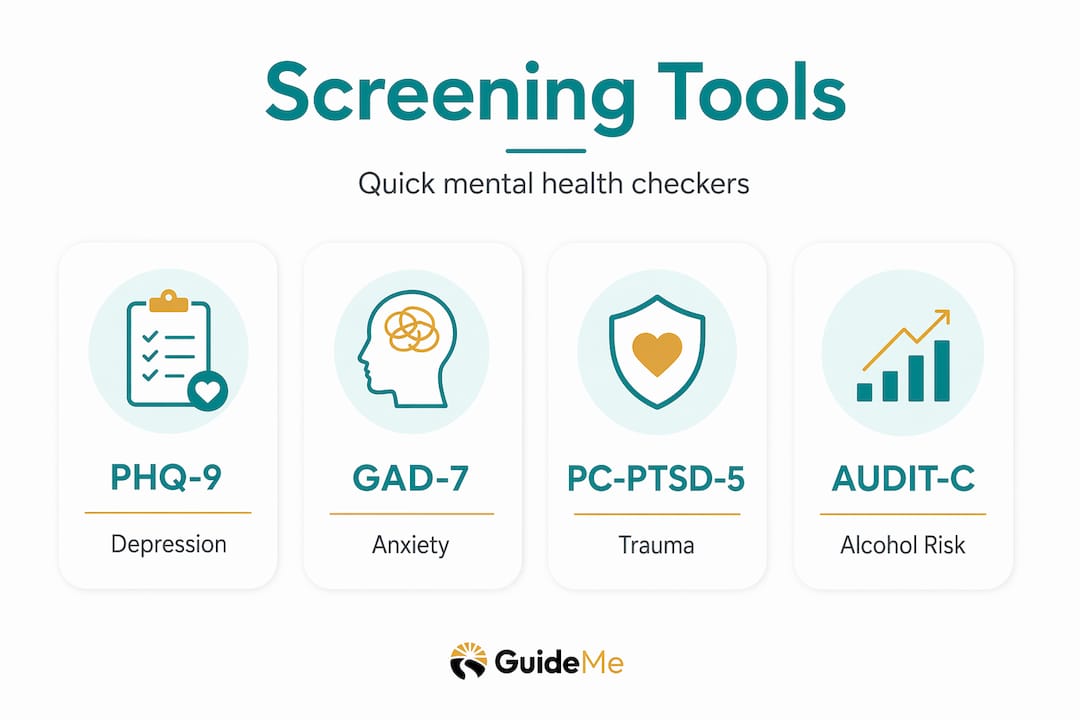
Tools such as the PHQ-9, GAD-7, PC-PTSD-5, AUDIT-C, and C-SSRS are among the most widely used instruments in clinical and counselling settings. Here is a breakdown of what each one screens for:
| Tool | Focus area | Approximate time |
|---|---|---|
| PHQ-9 | Depression severity | 3 to 5 minutes |
| GAD-7 | Generalised anxiety | 2 to 4 minutes |
| PC-PTSD-5 | Trauma and PTSD risk | 2 to 3 minutes |
| AUDIT-C | Alcohol use | 1 to 2 minutes |
| C-SSRS | Suicide risk | 5 to 10 minutes |
Each of these tools produces a score that helps your clinician understand the severity of what you may be experiencing. A higher score on the PHQ-9, for instance, does not mean you will be diagnosed with depression. It means your clinician will look more closely and consider whether further assessment is needed.
Screening results directly inform your next steps in therapy. They may indicate which type of specialist to refer you to, whether you need weekly or more intensive support, and whether any immediate safety measures should be discussed. In that sense, the impact of screening on therapy outcomes begins the moment your results are reviewed.
Screening also continues throughout treatment, not just at the beginning. Repeated use of these tools allows your therapist to track changes over time and adjust your treatment accordingly. This is one of the most underappreciated aspects of how screening aids therapy: it keeps your care responsive to where you actually are, not just where you started.
How screening shapes therapy decisions
Patient characteristics have a significant influence on how therapy unfolds. Social inhibition and interpersonal difficulties are among the traits that predict how a person will progress in therapy and how complex their treatment journey is likely to be. Screening provides clinicians with early visibility of these factors.
Here is how screening outcomes directly shape the therapy process:
- Matching therapy type to need. Someone whose screening reveals high anxiety alongside trauma indicators may benefit more from a trauma-focused approach than standard CBT. Without screening data, this distinction might only emerge after several unproductive sessions.
- Anticipating relationship dynamics. Patient expectations mediate therapy outcomes, and a skilled therapist who understands these from the outset can build a more productive working relationship from session one.
- Identifying treatment complexity early. The Difficult-to-Treat Depression Questionnaire, for example, predicts treatment resistance before failure occurs, allowing clinicians to plan appropriately rather than cycling through ineffective approaches.
- Reducing wasted time and emotional cost. When the right therapy is identified early, you spend less time in treatments that do not fit your needs. That matters practically and emotionally.
- Strengthening the therapeutic alliance. Positive therapeutic alliance predicts higher effectiveness, and screening data that informs how a clinician approaches you from the very beginning contributes directly to that alliance.
The honest message here is that your screening responses are not just data points. They are a signal of your readiness to engage and your trust in the process. The more openly you respond, the better equipped your clinician is to support you.
Pro Tip: If you find certain screening questions confusing or distressing, you are allowed to say so. A good clinician will walk you through the questions and explain why they are being asked.
How to prepare for a mental health screening
Knowing what to expect from a screening removes a great deal of the anxiety people feel about the process. Here is what you should know before you go in:
- Screenings are not pass or fail. There is no correct answer. The goal is an honest picture of how you are doing right now.
- You do not need to prepare extensively. Simply being honest and thoughtful in your answers is all that is required.
- Ask what happens with your results. You are entitled to understand how your screening information will be used and who will see it.
- Treat it as a starting point, not a verdict. A screening result does not define your mental health. It opens a conversation about where to go next.
- Use it as a self-reflection tool. Many people find that completing a structured screening helps them clarify what they have been feeling, sometimes for the first time.
If you are not sure whether you are at a point where screening or therapy feels right, recognising the signs you might benefit from support is a helpful first step.
Inconsistent or incomplete screening is associated with worse symptom trajectories over time. Skipping honest reporting does not protect you. It delays the care you need.
Pro Tip: Write down two or three things you have been struggling with before your screening appointment. You do not need to share the list, but having your thoughts organised beforehand often helps you answer screening questions more accurately.
My perspective: screening is undervalued, and that is costing people
In my experience working with people who are trying to access mental health support, one pattern comes up repeatedly. People treat screenings as a box-ticking exercise, and then feel frustrated when their therapy does not quite fit what they were hoping for. The two things are connected.
I have seen what happens when someone engages honestly and thoughtfully with a screening process. Their therapy pathway becomes clearer, their clinician feels like a better match, and they spend less time in sessions working out the basics. I have also seen the reverse. When people rush through screenings or downplay symptoms, they often end up in generic treatment programmes that do not reflect their actual needs.
What I find underappreciated is that screening is also an act of self-awareness. Sitting with those questions, even briefly, asks you to pay attention to your own experience in a structured way. That attention itself has value.
The discomfort some people feel during screenings is real and completely understandable. Being asked direct questions about your mood, sleep, substance use, or thoughts of self-harm can feel exposing. But that discomfort is worth tolerating. The data those questions generate is what makes personalised care possible. Knowing how to assess therapist fit starts much earlier than most people realise. It starts at screening.
— Yetty
How Guidemetherapy supports your screening journey
Taking the first step toward therapy is often the hardest part, and not knowing what to expect makes it harder. Guidemetherapy is built around the idea that getting matched with the right therapist should not feel like a guessing game.
When you use Guidemetherapy, you go through an in-depth, human-led process that incorporates the kind of structured understanding that good screening provides. The platform combines AI-powered matching with real clinical insight to help you understand your mental health and find a therapist who is genuinely suited to your needs. You are not filling in a form and hoping for the best. You are getting a therapy plan designed around who you actually are and what you are actually experiencing. If you are ready to move from uncertainty to clarity, Guidemetherapy is where that journey starts.
FAQ
What is the role of screening in therapy?
Screening in therapy identifies potential mental health concerns early using brief, structured tools, so that clinicians can direct individuals toward the most appropriate care before problems escalate.
How long does a mental health screening take?
Most mental health screenings take between 5 and 15 minutes, making them much shorter than a full psychiatric evaluation, which typically lasts 60 minutes or more.
What are common screening tools used in therapy?
Widely used tools include the PHQ-9 for depression, GAD-7 for anxiety, PC-PTSD-5 for trauma, AUDIT-C for alcohol use, and C-SSRS for suicide risk assessment.
Does a screening result in a diagnosis?
No. Screening is not a diagnostic process. It is a risk filter that indicates whether further assessment may be needed, not a conclusion about what condition you have.
Why do honest answers in a screening matter?
Incomplete or downplayed responses during screening can delay access to the right treatment. Honest answers give clinicians the clearest possible picture of your needs from the very beginning.