

Most therapists start clients on weekly sessions because that cadence builds momentum and gives the therapeutic relationship room to grow. But the right frequency depends on your diagnosis, your goals, and your life. Some people need twice a week to get through a crisis; others do well checking in monthly once things stabilise. A therapy navigation platform can help you build a personalised plan rather than guess.
TL;DR:
- Weekly sessions are most effective for building trust, maintaining momentum, and consolidating skills, especially during the initial stages of therapy.
- Frequency should be adjusted based on clinical severity, treatment goals, homework capacity, personal schedule, and access to services.
- Mismatched scheduling, such as starting with monthly visits or early gaps, can slow progress and create the illusion that therapy isn't working.
- Intensive protocols like CBT or ERP often require multiple weekly sessions or concentrated blocks, particularly during crises or for specific disorders.
- Regularly reviewing progress with your therapist and openly discussing schedule adjustments helps tailor therapy to your evolving needs.
Table of Contents
- What therapists usually recommend for therapy frequency
- Factors to consider when deciding your own therapy frequency
- Weekly, fortnightly and monthly therapy schedules compared
- When and how to change your therapy appointment schedule
- Special cases where therapy frequency is intensified or restructured
- What the research says about therapy frequency and recovery speed
- How to bring up frequency with your therapist
- How Guidemetherapy helps you find the right therapy frequency
- Sources
What therapists usually recommend for therapy frequency
The standard outpatient model is often called the "weekly hour": a 45 to 60 minute session, once a week, with the initial intake sometimes running longer. This isn't arbitrary. Weekly contact keeps recent events fresh enough to discuss meaningfully, and it gives you a consistent rhythm to practise new skills between visits.
The clinical reasoning behind this rests on a few pillars:
- Alliance building. Trust between you and your therapist develops faster with regular contact, and gaps longer than two weeks can make that trust harder to sustain.
- Memory and momentum. Weekly sessions mean you're discussing a stressor or a skill attempt while it's still recent, not reconstructing it from memory.
- Skill consolidation. For approaches like CBT, frequent early contact helps you actually retain and apply techniques rather than forgetting them between long gaps.
Clinicians sometimes recommend twice a week for acute presentations, such as active suicidal ideation, severe depression, or concentrated treatment protocols like exposure and response prevention (ERP) for obsessive compulsive disorder. A 2020 review of once-weekly psychotherapy as a clinical norm found that weekly scheduling is common more for administrative convenience than because it's proven superior to every other cadence. That's worth knowing before you assume weekly is non-negotiable.
Factors to consider when deciding your own therapy frequency
Deciding on a schedule isn't just a clinical question. It's a conversation that should weigh your diagnosis against your actual life. Work through these in roughly this order:
- Clinical severity and risk. Active crises, high risk, or intensive protocols like ERP or trauma processing usually call for more frequent contact than general talk therapy for stress.
- Treatment goals. Are you working through a specific issue with an endpoint, or building long-term coping skills? Time-limited goals often support a more intensive start.
- Homework capacity. If your therapy involves between-session exercises, ask yourself honestly whether you can complete that work between visits, weekly or otherwise.
- Schedule and life constraints. Work shifts, caring responsibilities, and travel time all affect what's sustainable, not just what's ideal.
- Cost and access. Whether you're paying privately, using NHS services, or claiming through insurance, budget and appointment availability often shape frequency as much as clinical need does.
- Telehealth options. Remote sessions remove travel time from the equation and can make a higher frequency more realistic for people with tight schedules.
None of these factors override the others automatically. A severe presentation with a packed work schedule might still land on weekly with homework simplified, rather than fortnightly with a full workbook.
Weekly, fortnightly and monthly therapy schedules compared
Each rhythm suits a different stage or situation, and mismatching them is a common reason people feel therapy "isn't working" when the real issue is pacing.
- Weekly. Best for starting therapy, managing acute symptoms, and learning new skills. This is the default for good reason: it keeps issues current and gives you enough repetition to build habits.
- Fortnightly. Works well once you've made partial progress, or when budget and time genuinely don't stretch to weekly visits. The risk is that gaps this early can dilute momentum if introduced too soon.
- Monthly. Suited to long-term maintenance once you're stable, functioning well, and mostly using the skills you've already built. Starting therapy at a monthly cadence, though, risks a weaker alliance and slower initial progress.
- Twice-weekly or short intensive blocks. Considered when symptoms are severe, when a protocol like ERP calls for concentrated exposure work, or during a crisis that needs closer monitoring for a defined period.
Think of these less as fixed categories and more as a ladder you move up and down depending on how you're doing. Nobody stays on one rung forever.
When and how to change your therapy appointment schedule
Frequency isn't a decision you make once. It should shift as your circumstances do, and there are fairly clear signals for which direction to move.
Signs you might need more frequent sessions:
- Symptoms are returning or intensifying after a period of stability.
- A new stressor (bereavement, job loss, relationship breakdown) has emerged.
- You're struggling to retain or apply skills between visits.
Signs you might be ready to reduce frequency:
- You're consistently using coping strategies without prompting.
- Symptom improvement has held steady across several sessions.
- Daily functioning at work and home feels stable rather than effortful.
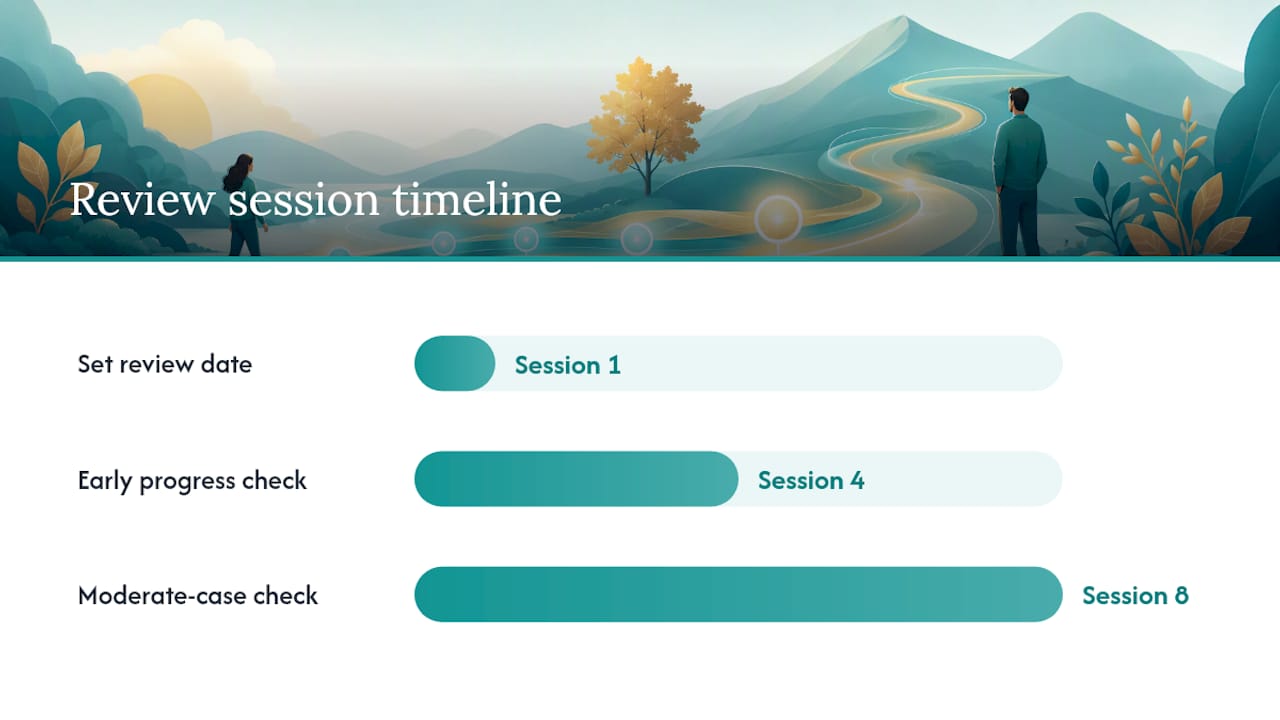
Formal review points help make this less guesswork. Many services check progress around session 4 for brief interventions and session 8 for moderate cases, partly because dose-response research shows a large share of treatment gains appear within that early window.
Pro Tip: Ask your therapist to set a specific review date at the very first session, not a vague "we'll see how it goes." A named session number gives you both a concrete point to reassess honestly.
Special cases where therapy frequency is intensified or restructured
Some situations call for schedules well outside the standard weekly hour, and knowing these exist helps you recognise when your own care might need to shift temporarily.
- Intensive CBT and ERP programmes. OCD treatment in particular sometimes uses multiple sessions per week, or concentrated multi-day blocks, to build exposure momentum faster than weekly visits allow.
- Medication-assisted protocols. Esketamine treatment typically starts with twice-weekly induction sessions before tapering to weekly or fortnightly maintenance based on how symptoms respond, according to post-hoc analysis of longer-term outcomes.
- Crisis and urgent care. Active risk situations may call for daily or near-daily contact for a short, defined period, quite separate from routine outpatient scheduling.
These aren't signs of "failing" at standard therapy. They're deliberate, time-limited adjustments matched to acute need.
What the research says about therapy frequency and recovery speed
Naturalistic studies tracking more than 21,000 clients found that weekly sessions produced steeper recovery curves than fortnightly ones, with weekly attendees reaching clinically significant improvement faster.
That doesn't settle the debate. The same body of evidence shows the total long-term magnitude of change between weekly and fortnightly groups is less clear-cut than the speed difference. Some trials cited in reviews of the once-weekly norm found twice-weekly schedules produced larger effect sizes for depression, though few randomised trials compare every frequency across every diagnosis directly. The honest takeaway: frequency clearly affects speed and alliance, but personalising it and reviewing progress regularly matters more than chasing a single "correct" number.
How to bring up frequency with your therapist
Try saying: "Could we try weekly for eight sessions and review how it's going?" Naming a number and a review point turns frequency into a shared experiment, not a fixed rule, and it's fine to mention budget constraints openly.
— Yetty
How Guidemetherapy helps you find the right therapy frequency
Some therapy platforms are built for exactly this decision: matching how often you see someone to what your situation actually needs, rather than defaulting to whatever slot happens to be free. In-depth screening can build a personalised therapy plan before you're matched with a therapist, so frequency gets discussed as part of your plan from day one, not left to chance in session one.

Platforms pairing AI-assisted matching with human oversight can help ensure your plan reflects your diagnosis, goals, and schedule, not a generic template. If you're weighing up whether weekly, fortnightly, or something more intensive fits your circumstances, a personalised therapy plan is the practical next step. You can also read Guidemetherapy's step-by-step scheduling guide to prepare questions before your first appointment.
This article is general information, not a substitute for advice from a qualified doctor. Consult a qualified healthcare professional about your own circumstances before acting on anything here.
Sources
- Scheduled healing: the relationship between session frequency and psychotherapy outcome in a naturalistic setting
- Retiring, rethinking, and reconstructing the norm of once-weekly psychotherapy
- The dose-response effect in routinely delivered psychological therapies: A systematic review