

TL;DR:
- Assessing therapy progress involves setting clear goals and using both standardized tools and personal reflections to monitor meaningful changes. Open collaboration with your therapist and understanding that progress may be non-linear enhances your active participation in recovery. Recognizing subtle behavioral shifts and internal growth is essential, as visible results often extend beyond numeric scores.
Many people in therapy reach a point where they wonder whether anything is actually changing. You turn up each week, talk, reflect, and go home — but the question "is this working?" lingers. Knowing how to assess therapy progress is not a passive exercise. It is a skill you can actively develop, and doing so makes you a more engaged participant in your own recovery. This guide walks you through the preparation, tools, self-reflection techniques, and collaborative conversations that turn vague uncertainty into clear, honest insight.
Table of Contents
- Key takeaways
- How to assess therapy progress: laying the groundwork
- Standardised tools for measuring therapy effectiveness
- Self-reflection techniques and signs of therapy improvement
- Discussing progress with your therapist
- Common challenges when tracking therapy progress
- My perspective on reading the signs of progress
- Start your therapy journey with Guidemetherapy
- FAQ
Key takeaways
| Point | Details |
|---|---|
| Set clear goals first | Defining personal therapy goals before assessment gives you a reliable baseline to measure change against. |
| Use standardised tools | Validated scales like the PHQ-9 and GAD-7 provide objective snapshots of symptom change over time. |
| Look beyond symptom scores | Qualitative shifts in behaviour, relationships, and self-perception are equally valid signs of improvement. |
| Talk openly with your therapist | Sharing your self-assessment with your therapist turns progress review into a collaborative, productive dialogue. |
| Accept non-linear progress | Setbacks and plateaus are normal; they do not mean therapy is failing. |
How to assess therapy progress: laying the groundwork
Before you can measure whether therapy is working, you need to be clear about what you are measuring it against. This sounds obvious, but many people begin therapy without ever pinning down specific, personal goals. Vague intentions like "feeling better" or "being less anxious" are understandable starting points, but they are too broad to evaluate meaningfully. Taking time to set clear therapy goals before you attempt any kind of progress review gives you an honest baseline.
Once your goals are defined, the next step is to make progress assessment part of the conversation with your therapist from the beginning. Many clients feel reluctant to raise this, worried it sounds like a complaint or a challenge to their therapist's expertise. It is neither. Asking how you will both know when things are improving is a sign of healthy engagement. Your therapist should welcome this kind of open discussion.
It also helps to understand the difference between two types of progress. Symptom tracking looks at measurable changes — reduced frequency of panic attacks, better sleep, lower scores on a standardised scale. Qualitative improvement is harder to quantify but just as real. It includes things like feeling less reactive in arguments, noticing you have more patience, or no longer dreading Mondays the way you once did. Both matter, and tracking both types produces the most meaningful picture of where you stand.
- Clarify at least two to three specific goals with your therapist in your early sessions
- Ask your therapist which indicators they will be paying attention to
- Keep a brief written note after each session about what felt different, useful, or difficult
- Revisit your goals every four to six weeks, not just at the end of treatment
Pro Tip: If you are unsure how to begin, ask your therapist: "What would progress look like for someone working on what I am working on?" Their answer will tell you a great deal about how they think about measuring therapy effectiveness.
Standardised tools for measuring therapy effectiveness
Many therapists use validated questionnaires as part of what is known as Measurement-Based Care (MBC). This is the practice of collecting standardised data at regular intervals to track how a client is responding to treatment. MBC implementation has led to a 23.5% relative improvement in anxiety and depression symptom outcomes, which makes it one of the more evidence-backed approaches in modern therapy.
Here is an overview of the most common tools you are likely to encounter:
| Tool | What it measures | How often used |
|---|---|---|
| PHQ-9 | Depression severity (9 items) | Weekly or fortnightly |
| GAD-7 | Generalised anxiety severity (7 items) | Weekly or fortnightly |
| Outcome Rating Scale (ORS) | Overall wellbeing across four life areas | Start of each session |
| Session Rating Scale (SRS) | Quality of the therapeutic relationship | End of each session |
The PHQ-9 and GAD-7 are straightforward questionnaires. You rate how often you have experienced specific symptoms over the past two weeks, producing a score that sits on a severity scale. These scores are useful because they are consistent and comparable across time. A meaningful drop in your PHQ-9 score over six weeks is objective evidence that something is shifting.
The Outcome Rating Scale and Session Rating Scale work differently. Session Rating Scales function as collaborative tools that open dialogue between you and your therapist about session quality and your experience of the therapeutic relationship. They are less about clinical diagnosis and more about real-time feedback. If your SRS score is low after a session, that is a signal worth discussing, not ignoring.
The limitation of relying solely on questionnaires is that they capture only part of the picture. Scores fluctuate based on life events, sleep, and circumstances that have nothing to do with therapy itself. Combining numeric scores with personal reflection gives you far more context for interpreting what those numbers actually mean for you.
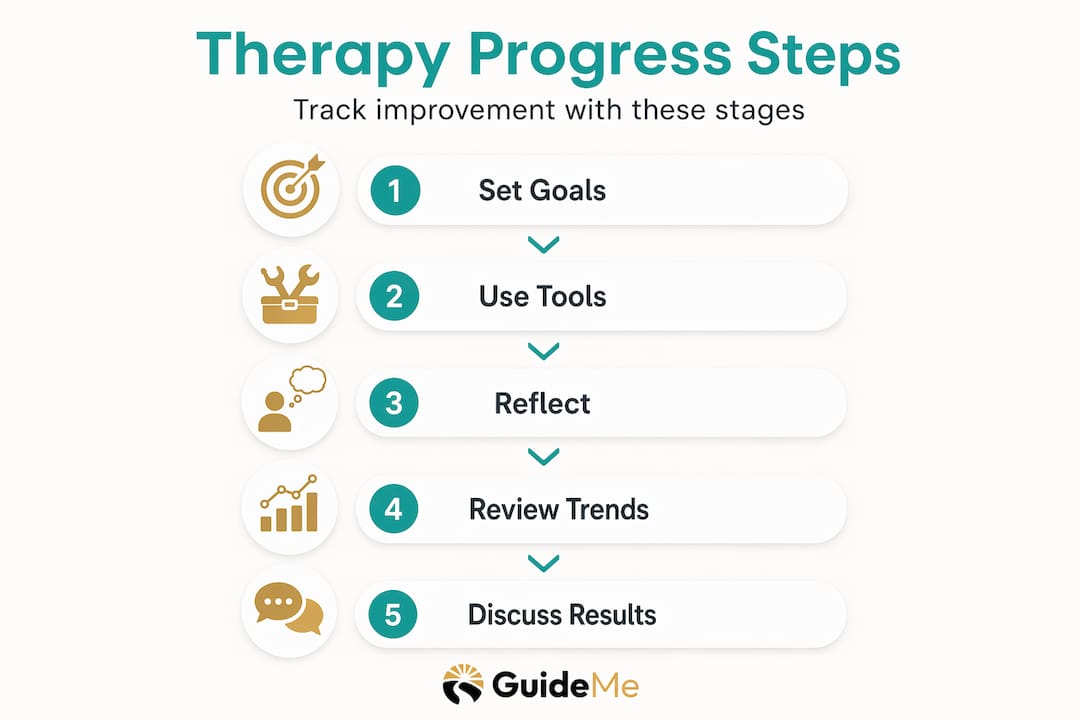
Pro Tip: Ask your therapist to share your score history in a graph or table format. Seeing a trend over eight to twelve weeks is far more informative than comparing just two data points.
Self-reflection techniques and signs of therapy improvement
Standardised scales tell you part of the story. The other part lives in your daily life, and you are the only one who can observe it. Developing a habit of self-reflection between sessions is one of the most underused tools available to therapy clients.

The most telling signs of therapy improvement are often quiet ones. You might notice that you handled a difficult conversation without shutting down. You might realise you did not replay an embarrassing moment for three days straight. You might catch yourself setting a boundary with a family member and feeling calm rather than guilty about it. These moments do not appear on any questionnaire, but they represent genuine, meaningful change.
Practical methods for capturing these observations include:
- Keeping a brief therapy journal where you write two to three sentences after each session about what resonated or felt challenging
- Using a mood tracking app to log emotional states at consistent points in the day, creating a data trail you can bring to sessions
- Reviewing your journal monthly to look for patterns, particularly in how you responded to stress, conflict, or low mood
- Noting behavioural changes, such as situations you avoided that you now approach, or coping strategies you actually used rather than just knowing about
- Paying attention to relationship dynamics, specifically whether communication feels more honest or less fraught over time
Emotional regulation is another key indicator. Therapy often improves your ability to notice an emotion before it takes over. If you are responding rather than reacting more often, that is real progress, even on a week when your mood scores look unremarkable.
Progress is often non-linear, with the most profound growth happening through internal shifts that are not immediately visible on symptom scales. Knowing this in advance means you are less likely to misread a difficult fortnight as evidence that therapy is failing. Early therapeutic success is actually linked to a willingness to engage with uncomfortable feelings, which means discomfort during this process is often a productive signal, not a warning sign.
Discussing progress with your therapist
Self-assessment matters most when it feeds into an open conversation with your therapist. This is where evaluating therapy outcomes stops being a solo exercise and becomes a true collaboration.
Here is a structured way to approach these conversations:
- Bring your observations to the session. Share what you have noticed in your daily life since your last appointment. Be specific. "I felt anxious before the meeting but I used the breathing technique and it helped" is more useful than "I had an okay week."
- Share your questionnaire scores and ask about trends. If your therapist uses standardised measures, ask them to walk you through your score history. Request their clinical interpretation alongside your own.
- Raise divergences honestly. If your therapist seems satisfied with your progress but you do not feel the same way, say so. Research shows that therapist and patient ratings of session quality often differ, and those differences are worth exploring, not avoiding.
- Discuss whether your goals still fit. Goals set in the first session may need updating as you grow. What felt urgent six months ago may have shifted, and new priorities may have emerged.
- Consider the quality of the therapeutic relationship itself. A strong therapist-client rapport is one of the most reliable predictors of good outcomes. If trust feels low, that is worth naming.
- Ask about adapting the approach. Integrating continuous quality improvement with standardised assessment has been shown to significantly improve therapy outcomes. This means therapy should evolve based on what the data and your experience tell you, not stay fixed.
Digital platforms for routine outcome monitoring can support this process by giving both you and your therapist access to graphical progress dashboards, making trend analysis easier and treatment planning more responsive.
Common challenges when tracking therapy progress
Assessing your own progress honestly is not always straightforward. Several common obstacles can cloud the picture.
- Expecting linear improvement. Progress in therapy moves in waves. A difficult week does not erase the growth of the previous three months. Holding a longer view helps you avoid misreading normal fluctuations as failure.
- Overreliance on symptom scores. A score that has not budged does not mean nothing has changed. Qualitative shifts in behaviour and relationships can precede measurable symptom reduction by weeks.
- Stopping therapy too soon. Feeling "good enough" after a period of improvement is common, but premature termination before addressing root patterns often leads to relapse. Discuss readiness to end therapy thoughtfully with your therapist.
- Harsh self-judgement during review. Assessing progress is not the same as grading yourself. Approach it with the same curiosity and self-compassion you are likely developing in sessions.
- Comparing your progress to others. Therapy timelines vary enormously depending on what you are working on, your history, and your circumstances. Comparison serves no one here.
Patience with the process is not passive. It is an active choice to stay present with what is genuinely happening rather than demanding a particular shape of change.
My perspective on reading the signs of progress
I have seen people leave therapy convinced it did not work, only to describe, in the same breath, choices they made, conflicts they navigated, and fears they no longer carried the way they once did. The disconnect between what they measured and what had actually changed was striking. And it pointed to something I think gets overlooked too often: progress in therapy is frequently invisible until you know what to look for.
In my experience, the clients who got the most from therapy were not necessarily the ones who felt better fastest. They were the ones who stayed curious about their own reactions, kept talking honestly with their therapist even when progress felt stalled, and resisted the urge to judge a month by a bad week. What I have learned is that measuring therapy effectiveness requires you to look across multiple dimensions at once — your symptoms, yes, but also your relationships, your sense of self, your capacity to tolerate discomfort, and the quiet moments where you catch yourself responding differently.
The most meaningful progress I have witnessed was almost never the dramatic kind. It was the person who stopped apologising for having opinions. The client who finally told their partner the truth about something they had been carrying for years. These things do not show up on a PHQ-9, but they are exactly what therapy is for.
— Yetty
Start your therapy journey with Guidemetherapy
If you have found this guide useful but still feel unsure about where you stand in your therapy, Guidemetherapy can help you take the next step with confidence.

Guidemetherapy is a therapy navigation platform that combines human insight with AI-powered matching to connect you with the right therapist from the start. Whether you are looking to better understand your therapy goals, access tools for tracking your progress, or find a therapist who fits your needs and circumstances, Guidemetherapy is built to support you at every stage. You should not have to feel lost in your own treatment. Explore Guidemetherapy and discover a more supported, clearer therapy experience.
FAQ
What are the signs that therapy is working?
Signs of therapy improvement include reduced symptom severity, better emotional regulation, healthier relationship patterns, and the ability to use coping skills you have learned in real situations. Quiet internal shifts such as setting boundaries or catching old thought patterns are equally valid indicators.
How often should I review my therapy progress?
Reviewing your progress every four to six weeks is a reasonable rhythm for most people in therapy. Using standardised tools like the PHQ-9 or GAD-7 fortnightly, combined with a monthly self-reflection review, gives you both short-term data and a longer-term perspective.
What is Measurement-Based Care and how does it help?
Measurement-Based Care involves collecting standardised symptom data at regular intervals throughout treatment. MBC has been linked to a 23.5% relative improvement in anxiety and depression outcomes, making it a well-supported method for assessing client progress in therapy.
What should I do if I feel therapy is not helping?
Raise it directly with your therapist before making any decisions. Share specific observations rather than a general sense of dissatisfaction. If the therapeutic relationship itself feels like part of the problem, that conversation is also worth having, as alliance quality is a strong predictor of outcomes.
Can I assess my own therapy progress without standardised tools?
Yes. Reflective journalling, mood tracking apps, and careful attention to behavioural changes in daily life are all valid ways of tracking therapy progress without formal scales. Combining both approaches gives you the most complete picture.