

TL;DR:
- A therapy plan is a personalized, collaborative document that outlines mental health issues, measurable goals, evidence-based interventions, and review schedules. Regular evaluation and client involvement ensure therapy remains focused, effective, and adaptable to changing needs. Accessing and updating this plan empowers clients to actively participate in achieving meaningful mental health progress.
A therapy plan is a personalised, structured roadmap that outlines your mental health goals, the methods your therapist will use to help you achieve them, and how your progress will be measured over time. In clinical settings, this document is formally known as a mental health treatment plan, and it forms the backbone of effective, accountable care. A well-constructed therapy plan identifies the specific problems you are facing, sets clear and measurable goals using the SMART framework, selects evidence-based interventions such as CBT or DBT, and schedules regular reviews to keep treatment on track. Tools like the PHQ-9 depression scale and GAD-7 anxiety measure are commonly used to give those goals real, trackable numbers. When you and your therapist build this plan together, therapy becomes a shared, purposeful process rather than a series of open-ended conversations.
What does a therapy plan actually include?
A comprehensive therapy plan must include four core elements: a problem list linked to your diagnosis, measurable SMART goals, evidence-based interventions, and a predefined review schedule. Each element serves a distinct purpose, and leaving any one out weakens the entire structure.

The problem list is where therapy begins. It connects your personal challenges to a clinical diagnosis, giving both you and your therapist a shared understanding of what you are working on. This is not a list of complaints. It is a precise record of the symptoms and behaviours that are affecting your daily life, such as persistent low mood, social avoidance, or disrupted sleep.
SMART goals translate those problems into targets you can actually measure. A goal like "feel better" tells you nothing. A goal like "reduce PHQ-9 score from 17 to below 10 by week 12" tells you exactly what success looks like. Measurable language protects you from spending months in therapy without knowing whether anything is changing.
Interventions are the specific techniques your therapist will use to help you reach each goal. These should be evidence-based methods such as Cognitive Behavioural Therapy, Dialectical Behaviour Therapy, or Acceptance and Commitment Therapy, each linked directly to the goal it is meant to address. A therapist who selects interventions without tying them to specific goals is working without a map.
The review schedule is what keeps the plan alive. Plans should be reviewed every 4 to 6 sessions to track progress and adapt treatment. This regularity means your therapy adjusts as you grow, rather than staying fixed to a version of you from your first session.
Pro Tip: Ask your therapist to share the written plan with you after your first or second session. You have a legal right to access and amend it, and reviewing it yourself helps you stay focused between sessions.
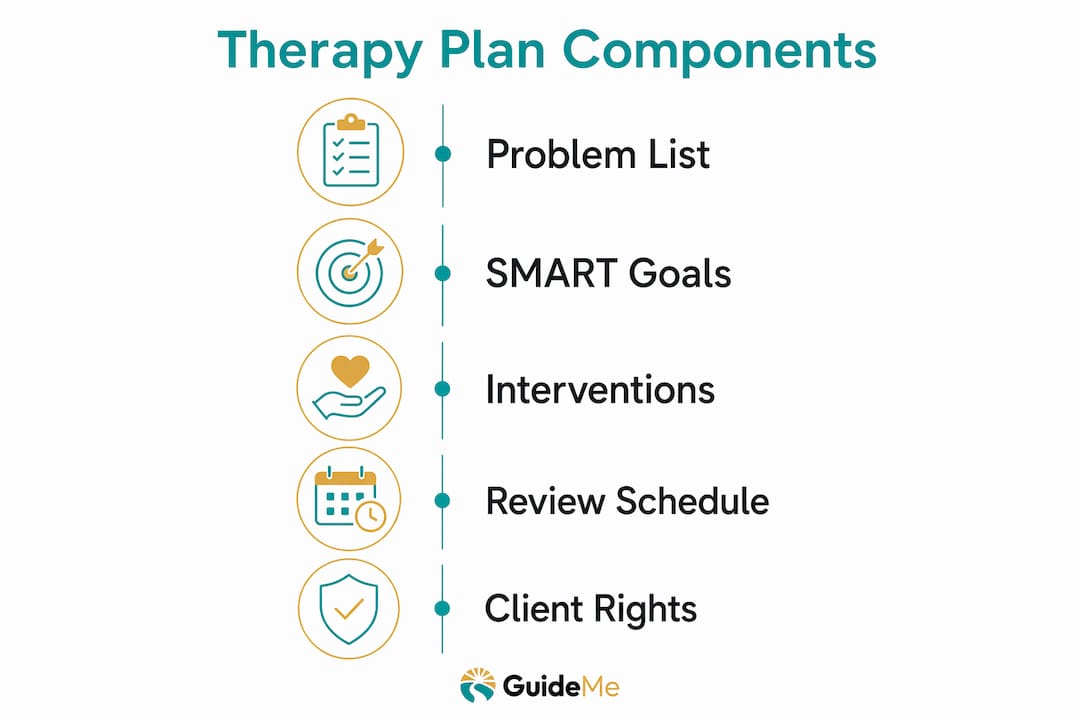
Here is a quick reference for the core components:
| Component | Purpose |
|---|---|
| Problem list | Links your personal challenges to a clinical diagnosis |
| SMART goals | Defines measurable targets with clear timelines |
| Interventions | Specifies evidence-based techniques tied to each goal |
| Review schedule | Sets regular check-ins to adapt the plan as you progress |
| Progress measures | Uses tools like PHQ-9 or GAD-7 to track symptom change |
How do you collaborate with your therapist on your plan?
Collaborative goal-setting improves therapy outcomes by increasing client engagement and providing clear progress markers. This means your active involvement is not optional. It is one of the strongest predictors of whether therapy will work for you.
Many people arrive at therapy expecting the therapist to take full control. The more effective approach is to treat your therapist as a skilled guide and yourself as the person who knows your life best. Personalised plans adjusted to your preferences consistently outperform rigid, one-size-fits-all models. Here is how to engage meaningfully in the planning process:
- Share your priorities clearly. Before your first session, write down the two or three things you most want to change. Bring this list. Your therapist cannot read your mind, and starting with your priorities ensures the plan reflects your actual life.
- Ask about the methods being proposed. If your therapist suggests CBT or mindfulness-based techniques, ask how they work and why they are appropriate for your situation. Understanding the rationale increases your confidence in the process.
- Request measurable goals. If a goal sounds vague, ask how you will both know when it has been achieved. Push for specific language and timelines.
- Discuss flexibility from the start. Life changes, and your plan should too. Ask your therapist how often the plan will be reviewed and what the process is for adjusting goals if your circumstances shift.
- Understand the documentation. If you are using insurance, your therapy plan also serves as a medical necessity document. Knowing this helps you understand why precise language matters and why your therapist may ask detailed questions early on.
The therapist-client relationship is the foundation on which all of this rests. A plan built in genuine dialogue, where you feel heard and your preferences are reflected, is far more likely to hold your commitment over time.
Pro Tip: If you feel your current plan does not reflect your needs, you are entitled to request a review at any time. Therapy is not a fixed contract. It is a working agreement.
Common pitfalls in therapy planning and how to avoid them
Proper treatment planning is often neglected due to administrative pressures, but this neglect is one of the most common reasons therapy stagnates. Knowing the pitfalls in advance puts you in a much stronger position.
The most frequent problems include:
- Vague goals. "Improve self-esteem" is not a goal. It is a wish. A measurable goal specifies what will be different, by how much, and by when. Without this precision, neither you nor your therapist can tell whether therapy is working.
- Goal drift. This is a clinical term for what happens when sessions become unstructured over time. Without scheduled reviews and clear metrics, therapy can drift from its original purpose into open-ended conversation that feels supportive but produces little measurable change.
- Interventions not linked to goals. If your therapist is using a technique without explaining which goal it addresses, ask. Every intervention should have a clear purpose tied to your plan.
- No standardised measurement. Tools like the PHQ-9 for depression and GAD-7 for anxiety are best practice for tracking progress. Without them, progress becomes a matter of opinion rather than evidence.
- Poor documentation. If progress notes do not reference treatment plan objectives, insurance coverage can be denied unexpectedly. Every session should document which goal was addressed and how you responded. This protects your access to continued care.
The good news is that all of these pitfalls are avoidable when you know what to look for. Asking your therapist direct questions about goals, methods, and measurement is not being difficult. It is being an informed participant in your own care.
What tools help you track therapy progress effectively?
Tracking your progress is not just your therapist's job. When you understand how your improvement is being measured, you become a more active and motivated participant in the process. The right tools make progress visible, which matters enormously when change feels slow.
The PHQ-9 and GAD-7 are the two most widely used self-report scales in mental health settings. The PHQ-9 measures depression severity across nine items, producing a score from 0 to 27. The GAD-7 does the same for generalised anxiety across seven items. Both are short, validated, and required for many insurance audits. A drop in your PHQ-9 score from 17 to 9 over eight weeks is not an opinion. It is a clinical finding.
| Tool | What it measures | How often to use |
|---|---|---|
| PHQ-9 | Depression severity (0 to 27 scale) | Every 4 to 6 sessions |
| GAD-7 | Anxiety severity (0 to 21 scale) | Every 4 to 6 sessions |
| Session feedback forms | Therapeutic alliance and session usefulness | After each session |
| Behavioural logs | Frequency of target behaviours between sessions | Weekly |
Beyond standardised scales, behavioural observation and session feedback give your therapist a richer picture. If your goal is to reduce social avoidance, a weekly log of social interactions you attempted provides concrete data. This kind of between-session tracking also helps you assess progress in real time, not just during appointments.
Digital tools and therapy apps are increasingly used to supplement in-session work. Many allow you to log mood, sleep, and anxiety levels daily, creating a data trail that your therapist can review. This is particularly useful when you find it hard to recall how you felt across the week during a single 50-minute session.
Pro Tip: Before each session, spend two minutes reviewing your tracking data from the previous week. Coming prepared with specific observations makes your sessions more focused and productive.
Key takeaways
A therapy plan works when it combines measurable goals, evidence-based interventions, and regular reviews built collaboratively between client and therapist.
| Point | Details |
|---|---|
| Four core components | Every plan needs a problem list, SMART goals, linked interventions, and a review schedule. |
| Collaborative planning | Active client involvement in goal-setting consistently improves therapy outcomes. |
| Avoid goal drift | Schedule reviews every 4 to 6 sessions and use standardised tools like PHQ-9 and GAD-7. |
| Documentation matters | Progress notes must reference plan objectives to protect insurance coverage and therapy continuity. |
| Plans are living documents | Therapy plans should evolve with your needs, not remain fixed from the first session. |
Why I think most people underestimate their role in therapy planning
Most people walk into their first therapy session expecting to be assessed and then told what to do. I understand why. When you are struggling, handing over control feels like relief. But in my experience, that passive approach is exactly what leads people to feel stuck after several months of sessions that seemed to go nowhere.
The research is clear: therapy plans as living documents that evolve with client input produce better outcomes than fixed prescriptions. What surprises most people is that this is not just a nice idea. It is a structural feature of effective treatment. When you co-create your goals, you are more likely to work towards them between sessions, not just during them.
The thing I find most underused is the client's legal right to access and amend their own therapy plan. Most people do not know this right exists. Exercising it is not confrontational. It is the most direct way to make sure your therapy reflects where you actually are, not where you were when you first walked in.
I also think the clinical concept of goal drift deserves far more attention outside professional circles. Sessions that feel warm and supportive can still be drifting away from your original goals. Warmth is not the same as progress. Asking your therapist "which goal are we working on today?" is one of the most productive questions you can bring to a session. It keeps both of you accountable.
Therapy is a partnership. The plan is the agreement that makes that partnership concrete. Own it.
— Yetty
Start your therapy journey with a plan that fits you
If you have read this far, you already understand that a well-structured mental health treatment plan is the difference between therapy that moves forward and therapy that circles. The next step is finding the right support to build one that genuinely fits your life.
Guidemetherapy is a therapy navigation platform that combines human expertise with AI-powered matching to help you start therapy the right way. Rather than leaving you to figure out your goals alone, Guidemetherapy creates an in-depth therapy plan tailored to your specific needs before matching you with a therapist who is the right fit for those goals. You get personalised therapy support from the very beginning, with structured goals, evidence-based methods, and a process designed to make your therapy experience clearer, more comfortable, and more effective.
FAQ
What is a therapy plan?
A therapy plan is a structured document created collaboratively by a client and therapist that outlines the client's mental health problems, measurable goals, chosen interventions, and a schedule for reviewing progress. It is also formally known as a mental health treatment plan.
How often should a therapy plan be reviewed?
Therapy plans should be reviewed every 4 to 6 sessions to assess progress and make adjustments based on how the client is responding to treatment.
What are SMART goals in a therapy plan?
SMART goals are Specific, Measurable, Achievable, Relevant, and Time-bound objectives. In therapy, an example would be "reduce PHQ-9 score from 17 to below 10 by week 12" rather than a vague aim like "feel less anxious."
Can I ask to see and change my therapy plan?
Yes. Clients have a legal right to access and amend their therapy plan. Requesting a copy and discussing any changes with your therapist is a straightforward way to keep your treatment aligned with your current needs.
Why does documentation in a therapy plan matter for insurance?
If progress notes do not reference the objectives in your treatment plan, insurance providers can deny coverage. Every session should document which goal was addressed and how you responded, protecting your access to continued care.