

TL;DR:
- Effective corporate counselling selection requires clearly defined objectives, verified credentials, structured evaluation, and precise contracts to ensure measurable employee wellbeing outcomes.
- HR should involve employee representatives during consultations to assess emotional resonance and cultural fit, prioritizing relationship quality over credentials alone.
Corporate counselling selection is a structured, strategic process that requires defined organisational objectives, verified provider credentials, and a clear evaluation framework before any engagement begins. HR professionals and corporate leaders who treat this as a procurement exercise rather than a strategic decision consistently report poor cultural fit and wasted spend. The corporate counselling selection steps outlined here follow a practical four-week framework, drawing on accreditation standards such as BACP and ICF certification levels, to help you secure a provider who genuinely serves your workforce. Getting this right from the outset protects both employee wellbeing and organisational liability.
What prerequisites should HR define before starting the counselling selection process?
The corporate counselling process begins well before you contact a single provider. HR must first establish measurable objectives tied directly to organisational priorities, whether that is reducing absenteeism, supporting managers through change, or addressing burnout in specific teams. Without this foundation, shortlisting becomes guesswork.
Employee needs must be assessed with equal rigour. Consider session format preferences (in-person, remote, or hybrid), cultural and linguistic requirements, and the level of confidentiality employees expect. A workforce with a high proportion of frontline staff has different needs from a leadership team navigating a merger. Both require different provider profiles.
Credential requirements must be defined at this stage, not later. In the UK, look for providers accredited by the British Association for Counselling and Psychotherapy (BACP) or the UK Council for Psychotherapy (UKCP). For coaching-adjacent roles, ICF PCC or MCC levels indicate advanced competence. Knowing which standards you require narrows the field considerably before research begins.
- Set measurable goals: reduced sick days, improved engagement scores, or specific team-level outcomes
- Define session format: individual, group, or a blended programme
- Confirm accreditation requirements: BACP, UKCP, or ICF certification levels
- Establish budget parameters and reporting expectations aligned with confidentiality obligations
- Clarify engagement length, noting that effective engagements typically last six to twelve months with biweekly or monthly sessions
Pro Tip: Document your prerequisites in a one-page brief before approaching any provider. This brief becomes your evaluation scorecard and prevents scope creep from the very first conversation.
How to conduct structured research and shortlisting for corporate counselling services
Research works best when it is time-bounded and criteria-driven. The structured selection timeline dedicates the second week entirely to identifying five to eight potential providers, using professional directories, peer referrals, and accreditation body listings as primary sources. Casting a wider net than this creates unnecessary noise; fewer than five limits meaningful comparison.

Credential verification is non-negotiable and faster than most HR teams assume. Active licence verification takes approximately three minutes per check using regulator-specific lookup tools, and must include a review of any disciplinary history. This step alone eliminates unqualified candidates without requiring a single conversation.
Use the table below to filter candidates against your defined criteria before progressing to consultation calls:
| Criterion | What to check | Why it matters |
|---|---|---|
| Accreditation | BACP, UKCP, or ICF PCC/MCC | Confirms professional and ethical standards |
| Corporate experience | Case studies with similar organisations | Reduces onboarding time and cultural mismatch |
| Session formats | In-person, remote, group options | Matches workforce logistics and preferences |
| Availability | Lead times and session frequency | Prevents delays in programme launch |
| Reporting approach | Behavioural metrics, not session content | Protects employee confidentiality |
| Fee structure | Per-session, retainer, or programme pricing | Allows accurate budget forecasting |
Providers with verified corporate credentials and demonstrable experience with organisations of your size should be prioritised at this stage. A provider who has worked exclusively with individuals in private practice is not automatically equipped for the dynamics of a corporate mental health programme. Shortlist three to five candidates who meet all core criteria before moving to consultation calls.
What should you expect during initial consultation calls with providers?
The consultation call is a mutual evaluation, not a sales pitch from either side. These 10 to 20 minute calls are designed to assess competence, communication style, and the foundation of a working relationship. HR leaders who treat them as informal chats miss critical signals.
Structure each call with a consistent set of questions so you can compare providers fairly. The following sequence works well:
- Ask the provider to describe their approach and the theoretical models they draw on. Vague answers here signal a lack of methodological clarity.
- Ask how they have supported employees with specific challenges relevant to your workforce, such as leadership transitions, redundancy, or chronic stress.
- Ask how they measure progress. Providers who cannot articulate a clear framework for observable behavioural milestones are unlikely to deliver measurable outcomes.
- Ask about their crisis protocol. Every credible provider should have a clear process for managing disclosures or acute mental health episodes.
- Ask what they need from your organisation to make the engagement successful. This question reveals whether they think in partnership terms or transactional ones.
Emotional resonance during evaluation is a major predictor of long-term counselling success. Providers who make employees feel heard and respected, rather than processed, produce better engagement and outcomes. HR leaders should involve a small group of employee representatives in at least one consultation call to assess this dimension directly.
Pro Tip: Record your impressions immediately after each call using a simple scoring sheet. Memory degrades quickly when evaluating multiple providers, and a consistent scoring approach prevents recency bias from distorting your final decision.
Red flags to note during calls include: guarantees of specific outcomes, pressure to commit before a trial period, reluctance to discuss methodology, and vague responses to questions about confidentiality boundaries.
How to finalise selection, set contracts, and manage engagement boundaries
Reference checks are the most skipped step in the corporate counselling process, and the most revealing. Contact at least two previous organisational clients, not individual references supplied by the provider. Ask specifically about responsiveness, adherence to confidentiality protocols, and whether the engagement delivered against agreed objectives.
Once a provider is selected, the contract must be precise. Contractual clarity prevents scope creep and limits liability exposure for both parties. The table below outlines the key terms every corporate counselling contract should address:
| Contract element | What to specify |
|---|---|
| Session number and frequency | Total sessions, biweekly or monthly schedule |
| Communication protocols | Between-session contact rules and response times |
| Confidentiality terms | What is reported, to whom, and in what format |
| Engagement duration | Start date, review points, and end date |
| Measurement milestones | Behavioural indicators agreed in advance |
| Termination clause | Notice period and conditions for early exit |
Progress reporting should centre on behavioural metrics and milestones, not session content. This approach allows your organisation to monitor programme impact while fully protecting employee privacy. Agree on these indicators before the engagement begins, not midway through.
If uncertainty remains after the consultation process, a pilot period of four to six weeks with a small cohort is a sound investment. It generates real evidence of fit before a full organisational commitment is made. Most credible providers welcome this approach because it demonstrates their confidence in their own methodology.
What common mistakes should HR avoid when selecting corporate counselling services?
The most costly mistake is overemphasising technical credentials at the expense of cultural fit and measurable impact. A provider with impressive qualifications who cannot articulate how their work connects to your organisational goals will deliver limited value regardless of their accreditation level.
A second common error is scope mismanagement. Corporate counselling is a defined engagement with agreed boundaries, not an open-ended support line. Without explicit session limits and communication protocols in the contract, providers and employees alike can develop expectations that the organisation cannot sustain.
HR professionals are typically not trained for confidential counselling roles. Assigning internal staff to deliver counselling without proper qualifications creates both liability exposure and a breach of the trust employees need to engage honestly. External, credentialled providers are not a luxury; they are a professional and legal safeguard.
"The right provider is not the most credentialled one in the room. It is the one whose approach, values, and communication style align with your workforce's specific needs and your organisation's culture."
Finally, commit to ongoing evaluation. If early sessions reveal a poor fit between provider and employees, act on that signal rather than waiting for the contract term to expire. Most contracts include a termination clause for this reason, and switching providers early is far less disruptive than sustaining a misaligned engagement for months.
Key takeaways
Effective corporate counselling selection requires defined objectives, verified credentials, structured consultation calls, and precise contractual terms to deliver measurable employee wellbeing outcomes.
| Point | Details |
|---|---|
| Define prerequisites first | Set measurable goals, accreditation requirements, and budget before approaching any provider. |
| Verify credentials quickly | Licence checks take roughly three minutes and must include disciplinary history review. |
| Treat consultations as evaluations | Use a consistent question set and involve employee representatives to assess emotional fit. |
| Specify contracts precisely | Define session limits, communication rules, confidentiality terms, and behavioural milestones. |
| Evaluate cultural fit alongside credentials | Providers who align with your organisation's values deliver stronger long-term outcomes. |
What I have learned about choosing corporate counselling providers
By Yetty
After working through dozens of corporate counselling selection processes, the pattern I see most often is this: HR teams spend weeks comparing accreditation levels and fee structures, then rush the consultation call stage because the shortlist took longer than expected. That is exactly the wrong trade-off.
The consultation call is where you find out whether a provider can actually hold space for your employees, not just whether they hold the right letters after their name. I have seen providers with BACP accreditation and ten years of corporate experience completely miss the emotional register of a workforce going through redundancy. And I have seen less decorated practitioners create genuine psychological safety in a first call. Credentials are the entry ticket, not the destination.
What I would encourage every HR leader to do is involve two or three employees from different levels of the organisation in at least one provider call. Their instinctive response to how the provider communicates tells you more than any scoring matrix. Therapy and counselling work because of the relationship, and that relationship starts in the first conversation. Prioritise that signal. It will serve your organisation far better than a checklist ever can.
— Yetty
How Guidemetherapy supports your counselling selection process
Selecting the right corporate counselling provider takes time, structure, and access to verified professionals. Guidemetherapy removes the most time-consuming parts of that process.
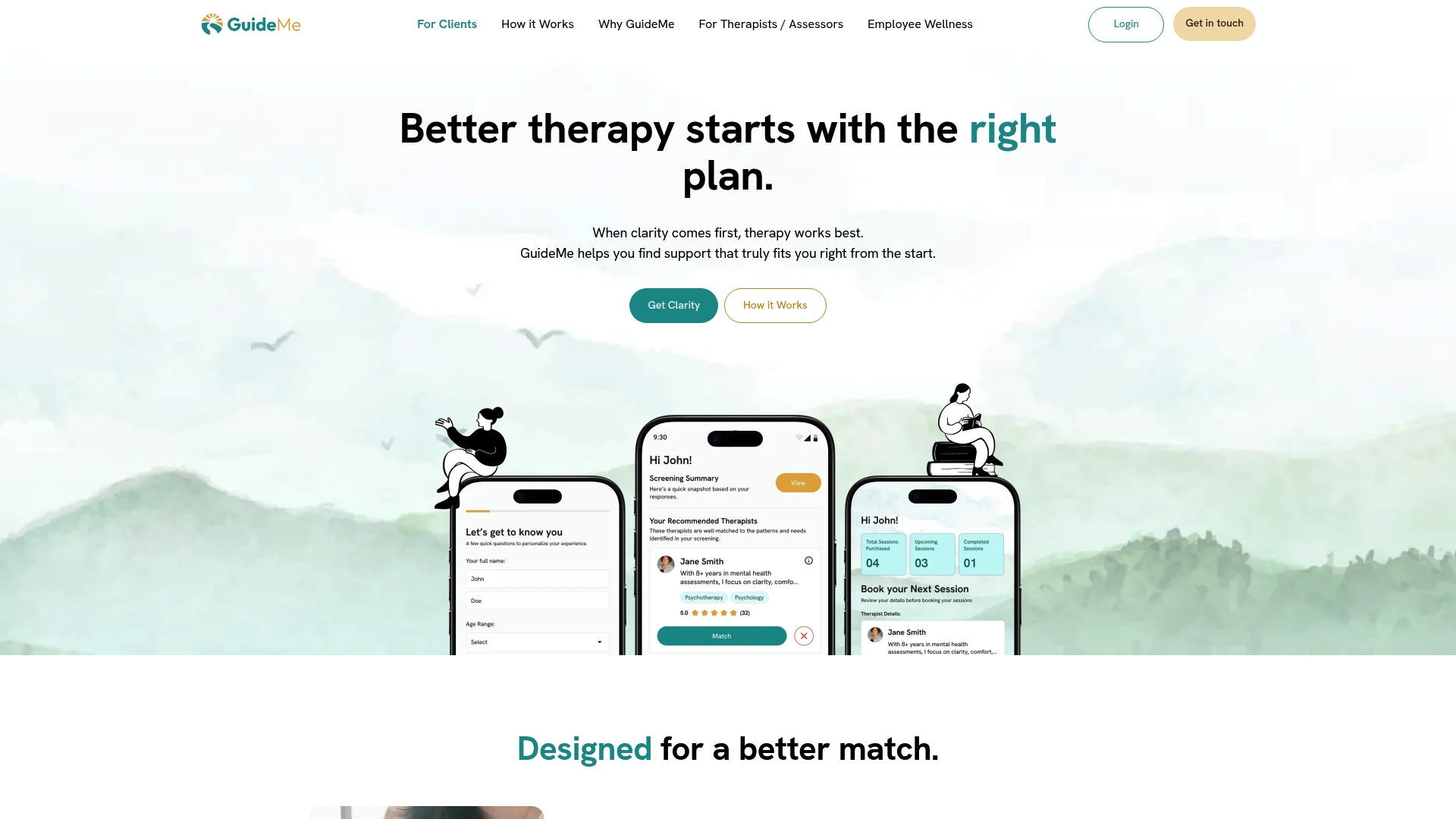
The Guidemetherapy platform connects HR teams and corporate leaders with a curated network of accredited counsellors whose credentials have already been verified. Rather than spending weeks researching directories and cross-checking licences, you receive a shortlist matched to your organisation's specific goals, workforce profile, and cultural requirements. The platform is human-led and AI-powered, which means the matching process is both efficient and genuinely personalised. For organisations building or upgrading their corporate mental health programme, Guidemetherapy provides a structured starting point that reduces HR workload without sacrificing the quality of fit.
FAQ
What are the main corporate counselling selection steps?
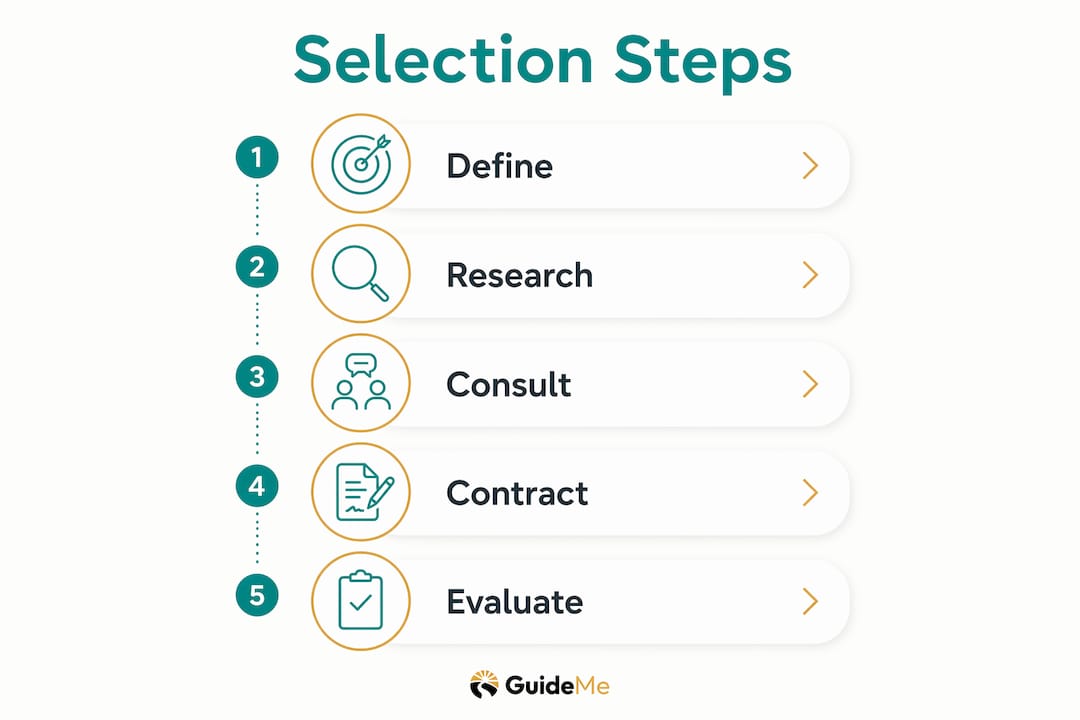
The core steps in counselling selection are: define organisational objectives and employee needs, research and shortlist five to eight providers, conduct structured consultation calls, complete reference checks, and finalise a precise contract. The full process typically spans four weeks.
How long should a corporate counselling engagement last?
Corporate counselling engagements typically run for six to twelve months, with biweekly or monthly sessions recommended as best practice. Shorter engagements rarely allow enough time to produce measurable behavioural change at an organisational level.
What credentials should a corporate counsellor hold?
In the UK, look for BACP or UKCP accreditation as a minimum standard. For coaching-adjacent roles, ICF PCC or MCC certification indicates advanced professional competence. Always verify active licence status and check for any disciplinary history before shortlisting.
Should HR conduct counselling internally or outsource it?
Outsourcing to qualified external providers is the safer and more effective approach. Internal HR staff typically lack the specialist training required for confidential counselling roles, and conducting counselling without proper qualifications creates both liability and confidentiality risks.
How should progress be measured without breaching confidentiality?
Progress reporting should focus on observable behavioural indicators and agreed milestones rather than session content. This approach allows organisations to track programme effectiveness while fully protecting the privacy of participating employees.