

Human therapist matching pairs you with a therapist through a real conversation with a clinician, not a form that spits out a name. It looks at how you communicate, what you need right now, and what's likely to help, rather than just ticking boxes on availability and specialism. That cuts down on the trial and error that puts people off therapy altogether. If you want to start today, write two or three sentences about what's bringing you to therapy and ask for a free assessment call.
TL;DR:
- Human therapist matching involves a clinician using judgment during a conversation to find a better fit, especially for complex or layered needs.
- The process includes an intake interview, clinician review, a free assessment call, and typically a wait of a few days to weeks before the first session.
- Sharing detailed goals, clinical history, cultural preferences, and budget constraints upfront improves match quality and reduces the need for multiple attempts.
- Give the initial therapist two to three sessions to assess compatibility, focusing on comfort, clarity, and pacing before deciding to continue or rematch.
- Human judgment enhances algorithmic screening by catching nuances such as hesitation or unspoken concerns that automated tools alone cannot detect.
Table of Contents
- What is human therapist matching, and how is it different from a directory?
- What happens during a human-led matching process?
- What should you tell your matcher to get a better match?
- How do you know if the match is right, and what if it isn't?
- Why human-led matching still matters
- Ready to get matched? Here's how to start
- Sources
- FAQ
What is human therapist matching, and how is it different from a directory?
Human therapist matching means a real person, usually a clinician or trained matcher, listens to your situation and chooses a therapist based on judgement, not just filters. A directory or self-service platform asks you to sort through profiles yourself, filtering by postcode, price, and specialism, and hoping the description on a bio page tells you enough about how someone actually works in the room with a client.
The difference matters because the strength of your relationship with your therapist, known as the therapeutic alliance, predicts outcomes about as strongly as the therapy method used. That's not a small detail. A clinician-run matching conversation can notice things a questionnaire never will: hesitation before answering a question, the way you describe a past experience, what you avoid saying entirely. Human matching at Therapsy works on exactly this principle, treating the conversation itself as diagnostic information.
Where human-led matching helps most:
- When your needs are layered (a specific diagnosis alongside a life event, for example) and no single filter captures that
- When you've tried therapy before and it didn't land, but you're not sure why
- When identity, language, or cultural background shape what "the right fit" means for you
The limitation is availability. A human matcher can only place you with therapists who have capacity, so if your criteria are very narrow, you may wait slightly longer than a directory search that returns a hundred results instantly, most of which won't actually be right.
What happens during a human-led matching process?
The sequence is fairly consistent across services that do this properly, and knowing it in advance takes the anxiety out of the first step.
- First contact. You'll have a short, conversational intake, either by phone, video, or a written form that a person reads and follows up on. Expect questions about what's bringing you to therapy now, what you've tried before, and what matters to you in a therapist.
- Clinician review. Someone with clinical training looks at what you've shared and matches it against therapist strengths, not just specialisms on paper. This is where judgement replaces algorithms.
- Free assessment call. You speak directly with the therapist you've been matched to, usually before any payment or commitment, so you can both check the fit works. Free initial assessments are standard practice precisely because a five-minute call reveals things a bio never will.
- Booking and first session. If the assessment goes well, you book your first proper session. If it doesn't, you go back to step two.
Timelines vary, but first contact typically happens within hours to a couple of days, while the wait for a first session ranges from a few days to a few weeks depending on therapist availability and how specific your needs are.
Pro Tip: If you're offered a choice between two matched therapists, take the assessment call with both before deciding. A five-minute conversation tells you more about fit than any written bio.
What should you tell your matcher to get a better match?
The quality of your match depends heavily on what you're willing to share upfront. Vague answers get vague matches.
Come prepared to talk about:
- Your goals and immediate priorities. What do you want to be different in three months? Naming a concrete goal, rather than "I want to feel better", gives a matcher something to work with.
- Clinical history. Past diagnoses, previous therapy (what worked, what didn't), and any medication you're taking all shape which therapist and which therapy approach suits you.
- Identity and practical preferences. Language fluency, gender preference, cultural background, and whether you want online or in-person sessions all affect comfort levels, and comfort affects whether you actually turn up to session three. Cultural competence and language fit genuinely change outcomes, so don't treat these as minor details.
- Access and affordability. Say upfront if you need a sliding scale, have insurance to use, or can only manage fortnightly sessions rather than weekly ones.
If cost is the main barrier, it's worth knowing that insurance portals and university clinics can offer lower-cost routes alongside matching services, so mention budget constraints early rather than after you've fallen for a therapist you can't afford.
How do you know if the match is right, and what if it isn't?
Give it three sessions before you judge anything properly. One awkward first meeting doesn't mean a bad match, it might just mean nerves on both sides.
- Check your comfort levels. Do you feel able to be honest, even about difficult things? Discomfort that fades by session two is normal; discomfort that doesn't shift is worth naming.
- Check clarity. Has your therapist offered some sense of a plan, even a loose one, or does every session feel like it's starting from scratch?
- Check pace. Are you moving too fast for comfort, or so slowly that nothing feels like it's happening?
- Ask for a rematch if needed. A good matching service will do this without asking you to justify yourself repeatedly, and treats it as routine rather than failure.
Trying more than one therapist before finding the right fit is genuinely common, not a sign you're doing therapy wrong. Your privacy throughout this process matters too: what you tell a matcher, and any feedback you give about why a match didn't work, should stay confidential and only inform future matching decisions, not follow you around as a permanent label.
Why human-led matching still matters
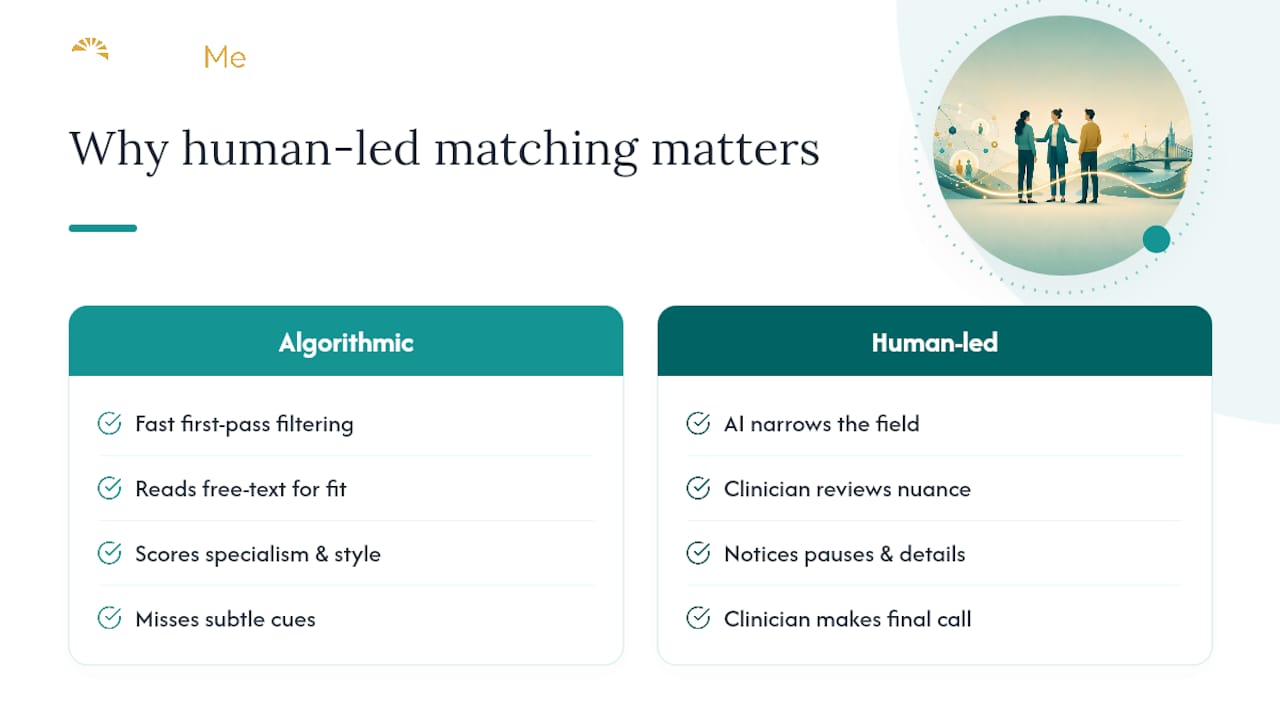
The industry has spent the last few years getting excited about algorithmic matching, and some of that excitement is fair. Tools that read free-text descriptions and score compatibility across dimensions like specialism and communication style genuinely speed up the first pass through hundreds of therapist profiles. What they can't do is notice the pause before someone answers a question about their family, or catch the detail that gets mentioned once and never again.
Some therapy matching services use a human-led, AI-assisted model for exactly this reason: the technology narrows the field quickly, but a clinician makes the final call on fit, weighing nuance no form can capture; see How Meddle Works: AI-Powered Healthcare Matching & Coordination for an example of this approach. That's not a claim that algorithms are useless. It's a claim that judgement should sit above them, not the other way round. Readers wanting more background on the author's clinical perspective can find further reading on Yetty's author pages.
— Yetty
Ready to get matched? Here's how to start
This therapy navigation service is an alternative to scrolling therapist directories for hours, hoping a profile photo and a two-line bio tell you enough. It works the other way round: you talk to a clinician-led matching process that combines AI-assisted screening with a real conversation, then you get a free assessment call with your matched therapist before committing to anything.
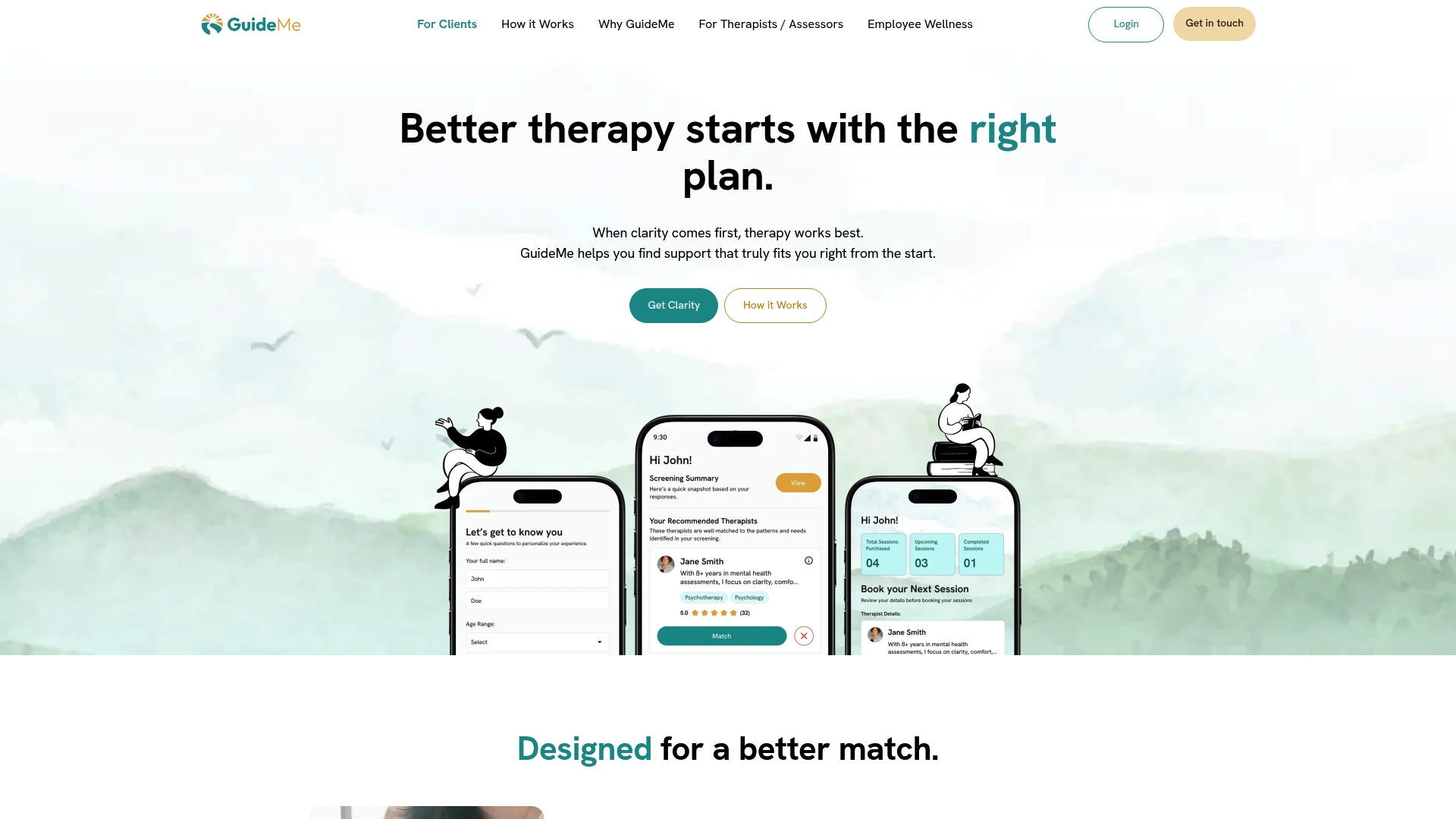
Getting started takes three steps. Visit the Guidemetherapy platform and complete the short intake screening. Prepare a brief summary of your goals and any practical needs (language, online versus in-person, budget) so the clinician reviewing your case has real detail to work with. Then book your free assessment call, typically arranged within a day or two of first contact, and if the match isn't right, ask for a rematch; it's built into the process, not an exception to it.
This article is general information, not a substitute for advice from a qualified doctor. Consult a qualified healthcare professional about your own circumstances before acting on anything here.
Sources
- How can I find a therapist who is a good fit for me? - NAMI HelpLine
- Therapist Matcher | Find Your Perfect Therapy Match
- How to Choose a Therapist - Open Path Psychotherapy Collective
- How to find a therapist: Simple ways to start your search - UChicago Medicine
FAQ
How long does human therapist matching take?
First contact usually happens within hours to a couple of days, while booking your first session can take anywhere from a few days to a few weeks depending on therapist availability.
Is the first assessment call free?
Most human-led matching services, including Therapsy's process, offer a free assessment call before you commit to paid sessions, and Guidemetherapy follows the same principle.
What if my first match doesn't feel right?
Ask for a rematch. It's a normal, expected part of the process, and NAMI's guidance confirms that trying a few therapists before finding the right one is common.
What should I prepare before my intake conversation?
Write down your main goal for therapy, any relevant clinical history, and your practical preferences around language, format, and budget so the matcher has enough detail to work with.
Is human-led matching better than an algorithm alone?
Human-led matching adds clinical judgement on top of algorithmic screening, catching nuances like hesitation or unspoken concerns that automated tools relying on text-based compatibility scoring alone can miss.