

Online therapy suits most people dealing with mild to moderate anxiety, depression, or stress, particularly when access, cost, or time are barriers to weekly appointments. In-person care remains the safer default for crisis situations, complex trauma, or conditions that need close clinical observation. Systematic reviews consistently find comparable outcomes between the two for common presentations, so the deciding factor is usually your specific situation, not the format itself.
TL;DR:
- Online therapy is most effective for mild to moderate anxiety, depression, or stress and is not recommended for high-risk cases like active suicidal thoughts or severe psychosis.
- Therapist-guided internet cognitive behavioral therapy produces outcomes nearly identical to face-to-face sessions for common mental health conditions, but its effectiveness diminishes with complex or long-term issues.
- Choosing between online and in-person therapy depends on symptom severity, clinical risk, personal comfort, and logistical factors such as travel, privacy, and scheduling flexibility.
- Proper screening and a personalized treatment plan from a qualified clinician are essential for matching the correct therapy format and avoiding mismatches that could harm progress.
- Switching between online and in-person therapy requires consultation with a therapist to update safety plans and ensure continuity, especially in higher-risk cases.
Table of Contents
- Online therapy vs in person therapy: the pros and cons
- Does the research say online therapy works as well as in person?
- Who does online therapy suit, and who needs in-person care?
- What are the practical differences: cost, privacy, and technology?
- How do you choose the right format? A short checklist
- Can you switch between online and in-person therapy?
- GuideMe's take on helping you pick the right format
- Why the "just pick one and see" approach fails most people
- How GuideMe can help you get started
- Sources
Online therapy vs in person therapy: the pros and cons
Choosing between formats comes down to matching what each does well against what you actually need — if you want, try this telehealth versus in-person advisor to help weigh your options.
Online therapy tends to offer:
- Wider choice of therapists, regardless of where you live
- Lower travel costs and no commuting time
- Easier scheduling around work or childcare
- Reduced stigma for people uncomfortable visiting a clinic in person
Online therapy's typical limitations:
- Dependent on stable internet and a private space at home
- Harder for therapists to pick up on subtle body language
- Less suited to acute crises requiring immediate physical support
In-person therapy tends to offer:
- Full access to non-verbal cues, tone, and body language
- A neutral, distraction-free environment away from home stresses
- Established emergency protocols if a session escalates
In-person therapy's typical limitations:
- Travel time and cost, especially outside cities
- Longer waiting lists in many areas
- Less flexible scheduling for shift workers or carers
Messaging-based therapy and telephone sessions sit apart from both. They're convenient for brief check-ins, but the evidence base for videoconferencing is stronger than for text-only formats, which haven't been studied to the same depth.
Does the research say online therapy works as well as in person?
The short answer: for most common mental health conditions, yes. A pooled analysis of 31 randomised trials found therapist-guided internet CBT produced almost identical symptom improvement to face-to-face CBT, with a pooled effect size of g≈0.02, close enough to zero that the two formats are considered clinically equivalent for that approach.
A broader 2026 multilevel meta-analysis comparing video-based and face-to-face psychotherapy reached a similar conclusion on post-treatment symptom severity but flagged substantial heterogeneity across studies and rated the overall certainty of evidence as low. That matters, because parity on average doesn't mean parity for every person or every condition.
The evidence is strongest for structured, therapist-guided approaches like CBT and some trauma-focused behavioural therapies. It's noticeably thinner for psychosis, complex personality disorders, and long-term outcomes beyond a year. So the honest takeaway is: online therapy holds up well for common presentations, but complexity changes the calculation.
Who does online therapy suit, and who needs in-person care?
Matching format to need starts with an honest look at symptoms and circumstances, not just preference.
Online therapy usually suits:
- Mild to moderate anxiety, depression, or stress
- People with mobility limitations or no local specialist access
- Parents and carers who need flexible, at-home scheduling
- Those who feel more comfortable opening up from a familiar space
In-person care is usually the safer choice for:
- Active suicidal risk or recent self-harm
- Acute psychosis or severe eating disorders
- Complex trauma needing close physical monitoring
- Young children, some neurodivergent people, or anyone with sensory needs that make screens difficult
Clinical guidance from bodies like the Royal College of Psychiatrists is clear that certain high-risk or medically complex cases need local clinical support that video simply can't replicate.
Pro Tip: If you're unsure which category you fall into, ask a GP or therapist for a brief risk assessment before committing to a format. It takes one conversation and avoids weeks of mismatch.
What are the practical differences: cost, privacy, and technology?
Beyond clinical fit, everyday logistics often decide the outcome. Pricing varies: platform subscriptions can undercut private practice hourly rates, though costs shift depending on session length and therapist experience.
- Check your setup first. A stable connection, a private room, and a working camera matter more than people expect.
- Weigh travel against convenience. In-person sessions cost time; online sessions cost none, but demand a quiet space at home.
- Think about disclosure. Some people open up more easily from their own sofa; others find home too full of distractions to focus.
- Factor in childcare or work hours. Online slots are easier to fit around a lunch break than a commute to a clinic.
How do you choose the right format? A short checklist
A few direct questions to a therapist or platform can save weeks of trial and error.
Ask before you commit:
- What are your qualifications, and do you have experience with my specific condition?
- What happens if I need urgent support outside a session?
- How is my data stored, and who can access session notes?
- Have you delivered this modality before, and for how long?
Red flags to walk away from:
- No clear plan for escalating to in-person care if things get worse
- Vague or unverifiable clinician credentials
- Pressure to sign up immediately without a proper screening call
- Privacy terms that are missing, vague, or buried in fine print
A sensible approach: trial online sessions for low-acuity concerns, but arrange an initial in-person assessment for anything higher-risk, and agree an escalation plan from day one. That single step, discussed in the therapeutic alliance between you and your therapist, does more to protect outcomes than the format itself.
Can you switch between online and in-person therapy?
Your goals and confidentiality protections stay the same regardless of format. What changes is logistics: emergency contacts, monitoring frequency, and how sessions are structured day to day.
- Raise the idea with your therapist directly rather than switching unannounced.
- Update your safety plan if you're moving from in-person to online, especially for higher-risk cases.
- Book a face-to-face assessment first if your case has grown more complex.
- Consider a hybrid pattern: video for weekly sessions, in-person for quarterly reviews or crisis points.
GuideMe's take on helping you pick the right format
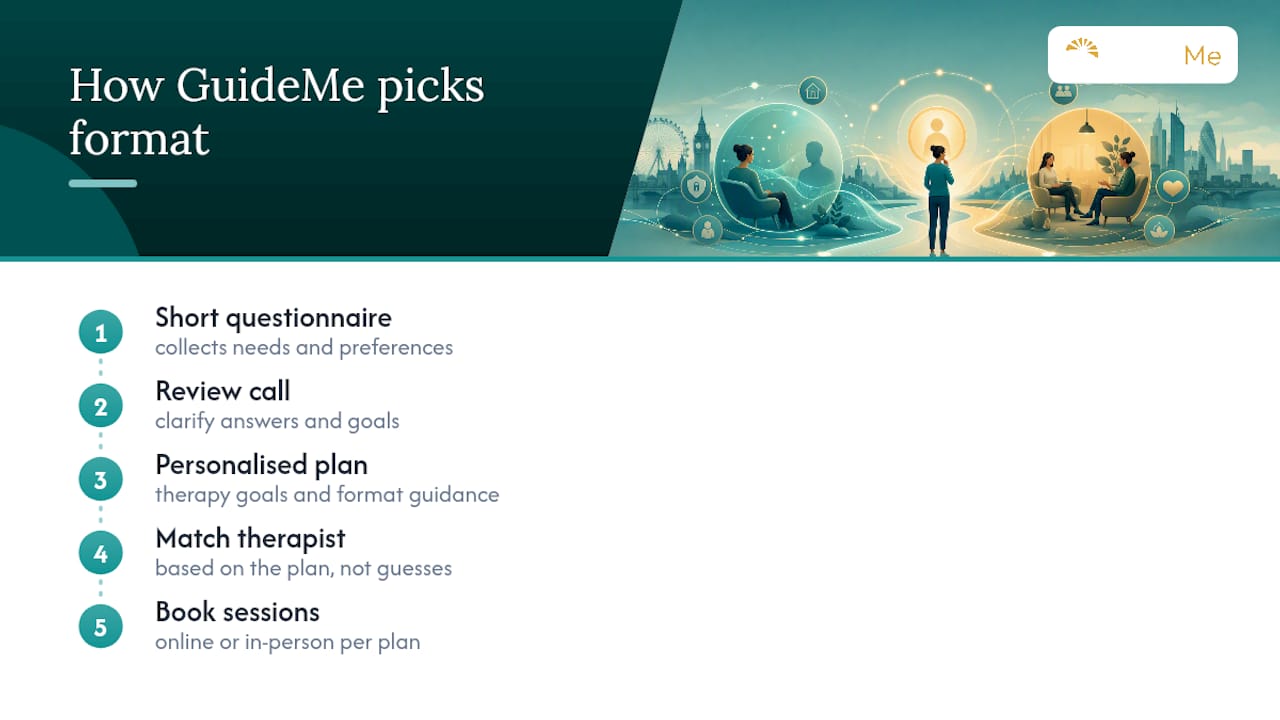
We built GuideMe around a simple observation: most people don't know which format they need until someone asks the right questions. Our screening process builds a personalised therapy plan first, then matches you to a therapist based on what your answers actually show, not a guess.
Setup takes a short questionnaire and a review call. The platform supports both online and in-person bookings, so the plan drives the format, not the other way round. If you're ready to see what fits, our online therapy setup guide is a useful starting point before you begin.
Why the "just pick one and see" approach fails most people
Most guides treat this as a lifestyle choice: pick whichever fits your calendar. That's backwards. The research is clear that outcomes hinge on matching modality to clinical complexity, not convenience alone, and the gap in evidence for high-acuity cases is exactly where casual "try it and see" advice becomes risky.
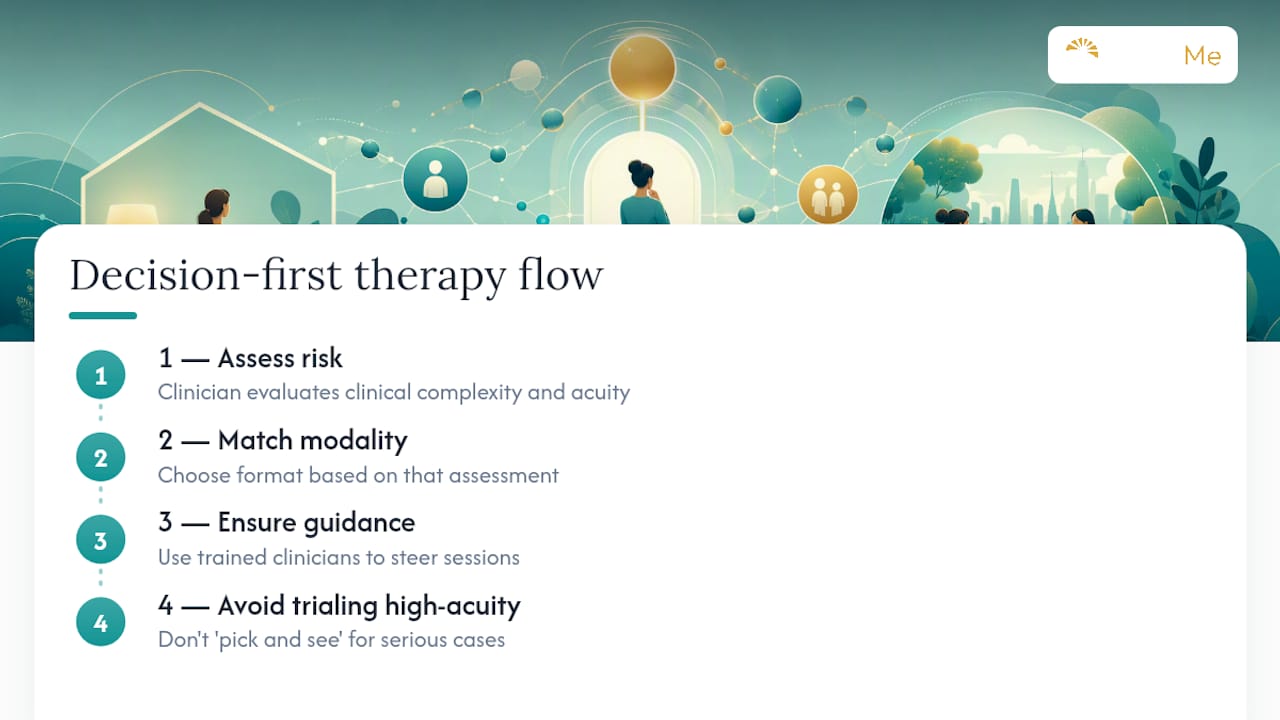
What's underestimated is how much therapist-guidance quality matters more than the screen itself. The trials showing near-identical outcomes for internet CBT all involved trained clinicians actively steering sessions, not self-guided apps left to run alone. Strip out that guidance and the comparison changes entirely.
The practical fix isn't picking a format and hoping. It's asking a clinician to assess risk first, then choosing based on that answer, not on which option feels less awkward this week.
— Yetty
How GuideMe can help you get started
Working out which format fits you doesn't need to involve weeks of guesswork or a string of mismatched introductory calls. This approach starts with proper screening, builds a personalised therapy plan around your actual symptoms and circumstances, and then matches you with a therapist through a process designed to consider your responses from the first step.
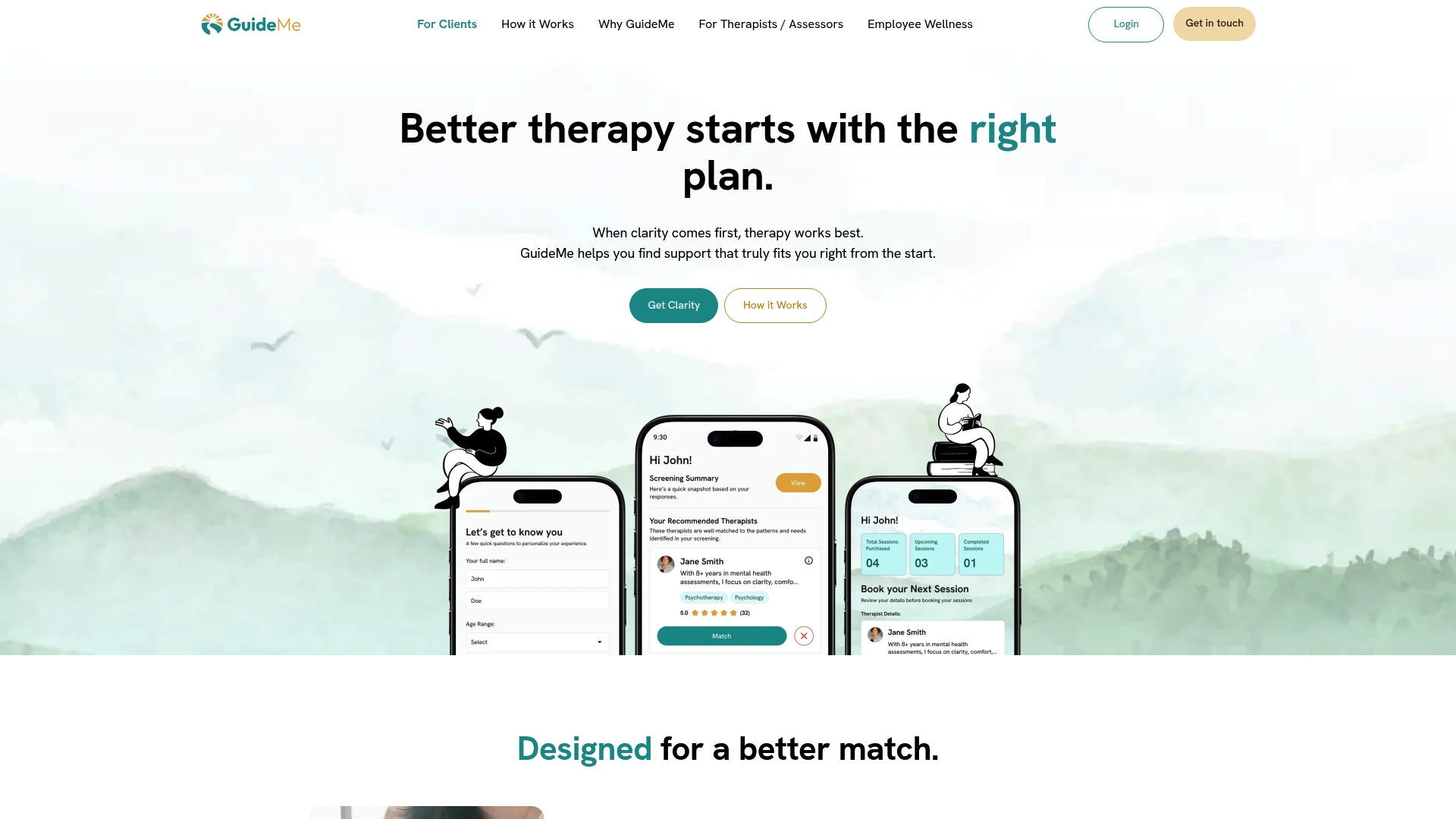
This suits you particularly well if you want guided matching rather than scrolling through directories, and if you're still weighing whether online or in-person sessions make more sense for your situation. The service supports both, so the decision follows your plan rather than limiting your options upfront. If you're ready to find out what fits, start your screening with GuideMe and see which therapists and formats match your needs.
This article is general information, not a substitute for advice from a qualified doctor. Consult a qualified healthcare professional about your own circumstances before acting on anything here.
Sources
- Review of the current empirical literature on using videoconferencing to deliver individual psychotherapies to adults with mental health problems
- Comparing video-based and face-to-face psychotherapy: systematic review and multilevel meta-analysis
- Acuity, diagnosis, and community factors in virtual and in-person treatment: qualitative study