

TL;DR:
- Self-referral to NHS Talking Therapies provides a quick route for adults in England with common mental health issues. Private therapy offers faster access and diverse approaches but involves higher costs and requires credential verification. Starting early treatment, even with guided self-help, can prevent difficulties from worsening and improve overall wellbeing.
If you're ready to book a therapy appointment in the UK, the fastest route for anxiety or depression is to self-refer directly to NHS Talking Therapies — no GP needed. For more complex conditions, or if you'd prefer not to wait, booking a private therapist is the other clear path.
Here's what to do right now:
- NHS self-referral (England): Visit the NHS Talking Therapies service finder and submit a self-referral online or by phone. You must be an adult and registered with a GP.
- GP referral: If you're dealing with a more complex condition such as bipolar disorder, a personality disorder, psychosis, or an eating disorder, speak to your GP first. They can refer you to specialist secondary care.
- Private therapy: Search the BACP therapist directory or use a matching platform like Guidemetherapy to find a verified therapist and book directly.
- Crisis or urgent support: Call NHS 111 (option 2 for mental health), contact your GP for an urgent appointment, or call Samaritans on 116 123 at any time.
Table of Contents
- NHS or private: which route fits you?
- How to self-refer to NHS Talking Therapies, step by step
- What happens at a therapy appointment: the first session explained
- What types of talking therapy might you be offered?
- Costs, waiting times, and what to do while you wait
- How do you check a therapist's credentials and spot red flags?
- Therapist fit and how to prepare for your first session
- Free and low-cost alternatives while you wait
- Key takeaways
- The thing most people get wrong about booking therapy
- Guidemetherapy: matched to the right therapist, faster
- Useful sources and further reading
NHS or private: which route fits you?
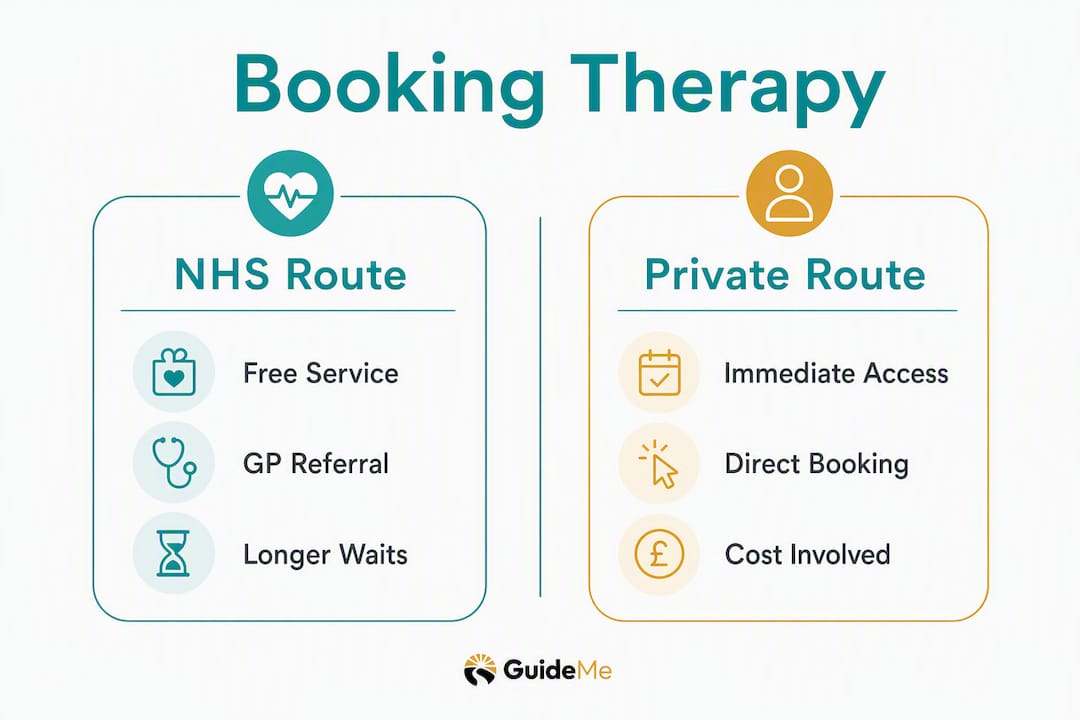
The right route depends on what you're dealing with and how quickly you need support.
NHS Talking Therapies is designed for adults in England with common mental health problems: anxiety, depression, phobias, OCD, PTSD, and similar conditions. It's free, and you can self-refer without seeing a GP first. The trade-off is waiting time. Demand is high, and some areas have longer queues than others.
For NHS self-referral, you'll need to:
- Be an adult.
- Be registered with a GP in England
- Have a condition suitable for talking therapies (anxiety, depression, and related problems)
GP referral is the right first step when your needs are more complex. Conditions such as bipolar disorder, personality disorders, psychosis, and eating disorders typically require specialist assessment that goes beyond what NHS Talking Therapies offers. Your GP can refer you to community mental health teams or secondary care services.
Private therapy suits people who want to start sooner, prefer a specific therapist or approach, or have needs that sit outside the NHS Talking Therapies remit. Session fees vary, but the process is straightforward: find a registered therapist, contact them directly, and agree a time. Guidemetherapy's matching service is worth considering here. It combines human-led screening with AI-assisted matching to connect you with a therapist suited to your specific situation, often faster than searching directories alone.
How to self-refer to NHS Talking Therapies, step by step
Self-referral is simpler than most people expect. Here's the process from start to first session:
- Find your local service — Go to the NHS Talking Therapies service finder and enter your postcode to locate the service covering your area.
Waiting times vary by area. NHS England data shows that most people referred to NHS Talking Therapies are seen for an initial assessment within a few weeks, though waits for ongoing therapy can be longer in high-demand areas. Digital therapy options — structured online programmes approved by the NHS — can sometimes reduce the wait, and research from the NHS confirms that remote and digital formats are as effective as in-person care for many common mental health problems.
Pro Tip: If you're unsure whether your symptoms qualify, refer anyway. The assessment will clarify this, and you won't be turned away for asking.
What happens at a therapy appointment: the first session explained
The first session is an assessment, not a treatment. That distinction matters practically: you won't leave with a diagnosis or a finished care plan, and that's entirely normal.
According to Mind, a good first session typically covers:
- Introductions — the therapist explains who they are, their training, and their approach
- Confidentiality — what is kept private and the specific limits (safeguarding, risk to self or others)
- Practicalities — session length, frequency, fees if private, cancellation policy
- What brought you here — a broad conversation about your current difficulties
- Background history — relevant life context, previous mental health support, and current medications
- Wellbeing and risk check — a brief assessment of how you're coping and any immediate safety concerns
- Agreed next steps — whether to continue, what format, and when
Practitioners use this intake to gather information and build rapport. A definitive diagnosis or extended treatment planning usually follows later sessions, not the first one.
Pro Tip: You don't need a polished account of your life. Therapists expect uncertainty — starting with "I'm not sure where to begin" is completely fine, and they'll use prompts to help you.

What types of talking therapy might you be offered?
The type of therapy you receive depends on your condition, your preferences, and what the service offers. Here's a clear breakdown.
On the NHS, the most common options are:
- Cognitive Behavioural Therapy (CBT): The most widely offered therapy on NHS Talking Therapies. Effective for anxiety, depression, OCD, PTSD, and phobias. Available individually, in groups, or as guided self-help.
- Counselling: A more open, exploratory conversation-based approach. Often offered for grief, relationship difficulties, and life adjustment issues.
- Guided self-help: Structured workbooks or online programmes supported by a practitioner. A common first step for mild to moderate symptoms.
- Interpersonal Therapy (IPT): Focuses on relationships and communication patterns; used for depression.
Private therapy adds further options:
- Psychodynamic psychotherapy: Explores how past experiences shape current patterns of thought and behaviour.
- EMDR (Eye Movement Desensitisation and Reprocessing): An evidence-based treatment for trauma and PTSD.
- Couples or relationship therapy: Addresses difficulties between partners; not typically available on NHS Talking Therapies.
- Humanistic therapies: Person-centred counselling and Gestalt therapy focus on self-awareness and personal growth.
Formats available include:
- In-person (clinic or therapy room)
- Video call (widely available and often shorter waiting times)
- Telephone
- Structured digital programmes (NHS-approved apps and online courses)
For remote sessions, use a genuinely private space — not a shared living room — and test your camera and microphone beforehand. Your therapist will ask for your exact location at the start of each remote session so they can contact local emergency services if needed.
Costs, waiting times, and what to do while you wait
Private therapy is a real cost, and NHS waits are a real constraint. Here's an honest picture of both.
| Route | Typical cost | Waiting time | Format |
|---|---|---|---|
| NHS Talking Therapies | Free | Weeks to several months (varies by area) | In-person, video, phone, digital |
| Private therapist (UK, outside London) | £50–£120 per session | Days to 1–2 weeks | In-person, video, phone |
| Private therapist (London) | £50–£120 per session | Days to 1–2 weeks | In-person, video, phone |
| Online/video private session | 20–40% lower than in-person rates | Days to 1–2 weeks | Video, phone |
| Charity or low-cost service | Free or reduced fee | Varies | In-person, video |
While you're waiting for an NHS appointment or deciding on a private therapist, there are practical steps you can take now:
- Access guided self-help resources — NHS-approved apps and online programmes are available through your local Talking Therapies service.
- Check your employer's Employee Assistance Programme (EAP). Many employers offer free, confidential counselling sessions. Some premium health plans include mental health benefits that cover therapy sessions.
How do you check a therapist's credentials and spot red flags?
Always verify registration before booking a private therapist. The three main registers in the UK are:
- BACP (British Association for Counselling and Psychotherapy): The largest professional body for counsellors and psychotherapists. Check the online directory at bacp.co.uk.
- UKCP (UK Council for Psychotherapy): Covers a broader range of psychotherapy modalities. Searchable register at psychotherapy.org.uk.
- HCPC (Health and Care Professions Council): The statutory regulator for certain professions including clinical psychologists and arts therapists. Registration here is a legal requirement for those titles.
Ask for the therapist's registration number and cross-check it on the relevant register before paying or committing to sessions. This takes two minutes and gives you meaningful assurance about their training, ethics, and professional conduct standards.
A practical checklist before booking:
- Confirmed registration on BACP, UKCP, or HCPC
- Professional indemnity insurance in place
- Clear cancellation and missed-session policy (typically 24–48 hours' notice required)
- Session length stated (usually 50 minutes)
- Fee structure explained upfront, including whether a sliding scale is available
- DBS check confirmed if working with vulnerable adults or children
Red flags to watch for:
- No clear registration or refusal to share a registration number
- Pressure to commit to a long block of sessions before you've had an assessment
- Vague or absent confidentiality policy
- No mention of supervision (all registered therapists should have regular supervision)
Pro Tip: Use the step-by-step guide to choosing the right therapist to work through speciality, approach, and availability before you contact anyone.
Therapist fit and how to prepare for your first session
Therapeutic fit is the strongest predictor of positive outcomes in therapy. The modality matters less than whether you feel heard, respected, and able to be honest with the person in front of you. The first session is a trial for both of you.
Prepare with this short checklist:
- Write down your two or three main concerns before the session
- Note any current medications and relevant medical history
- Prepare a handful of questions to ask your therapist (their approach, experience with your specific difficulty, what progress might look like)
- For remote sessions: find a private room, test your tech, and have your address to hand
- Know that you can say "I'm not sure this is the right fit" — a good therapist will not take this personally
You don't need to arrive with a polished narrative. Bringing a list of concerns and a few questions is enough. The therapist will guide the rest.
Pro Tip: Treat the first one or two sessions as a trial. If something feels consistently off — the therapist talks over you, dismisses your concerns, or you simply don't feel safe — it's reasonable to try someone else. Switching is not failure; it's good self-advocacy.
Free and low-cost alternatives while you wait
Formal therapy isn't the only option, and for some people it isn't the right first step. These resources are available now, without a referral:
- University counselling services: — If you're a student, your university almost certainly offers free or subsidised counselling. Waiting lists exist but are often shorter than NHS queues.
These options work well for short-term support, financial barriers, or as a bridge while waiting for a formal assessment.
Key takeaways
Getting a therapy appointment in the UK is straightforward once you know which route fits your situation: self-refer to NHS Talking Therapies for common anxiety and depression, or book a verified private therapist for faster access or specialist needs.
| Point | Details |
|---|---|
| NHS self-referral | Adults in England can self-refer to NHS Talking Therapies for anxiety and depression without seeing a GP first. |
| Private session costs | Private therapy in the UK typically costs £50–£120 per session for a 50–60 minute session. Online sessions are commonly 20–40% less expensive than in-person rates. |
| Check credentials first | Always verify a therapist's registration on BACP, UKCP, or HCPC before paying or committing to sessions. |
| Fit matters most | Therapeutic fit is the strongest predictor of positive outcomes; the first session is a trial, and switching therapists is acceptable. |
| Guidemetherapy | Guidemetherapy offers human-led and AI-assisted matching to connect you with a verified therapist suited to your needs, often faster than searching directories alone. |
The thing most people get wrong about booking therapy
The most common mistake isn't choosing the wrong therapist. It's waiting until things feel unbearable before reaching out at all.
There's a widespread assumption that therapy is for people in crisis, or that you need to have your thoughts in order before you pick up the phone. Neither is true. The NHS Talking Therapies self-referral process was designed precisely so that people can access support early, before difficulties become entrenched. And private therapists are accustomed to working with people who aren't sure what they need yet.
The other thing worth saying plainly: the first therapist you see may not be the right one. That's not a sign that therapy doesn't work. Therapeutic fit is genuinely important, and the research is clear that the relationship between therapist and client shapes outcomes more than any particular technique. Treating the first session as a trial rather than a commitment removes a lot of the pressure.
What actually moves the needle is taking the first step — whether that's filling in a self-referral form, checking the BACP directory, or using a matching platform to narrow the field before you even make contact. The process is more accessible than it looks from the outside.
Guidemetherapy: matched to the right therapist, faster
Searching directories, checking registers, and trying to work out which type of therapy fits your situation can take time you don't always have. Guidemetherapy removes that friction.
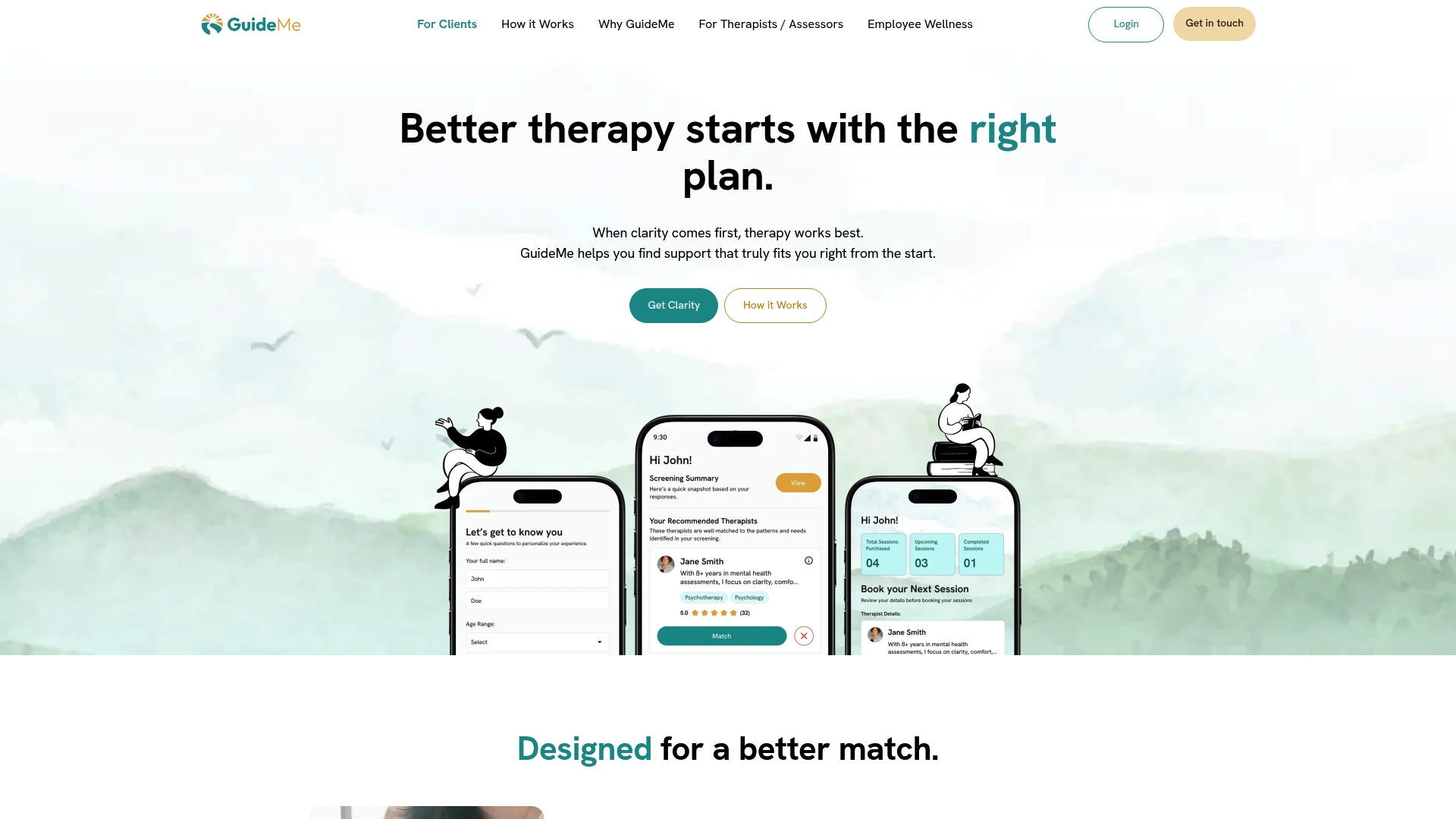
The platform combines human-led screening with AI-assisted matching to connect you with a verified, registered therapist suited to your specific needs. You start with an in-depth therapy plan that helps clarify what you're looking for, then get matched with therapists whose approach, experience, and availability align with your situation. There's no guesswork about credentials — every therapist on the platform is verified against professional registers.
For people who've already explored the NHS route and want private support, or who simply want to start sooner with someone who fits, Guidemetherapy offers a clearer, faster path to a first session. Start your therapy plan at Guidemetherapy and get matched with a therapist who's right for you.
Useful sources and further reading
- NHS Talking Therapies — service finder: Find and self-refer to your local NHS Talking Therapies service in England.
- NHS England: NHS Talking Therapies for anxiety and depression: Programme-level information on what NHS Talking Therapies services offer and how they're delivered
- UKCP therapist register: Find registered psychotherapists across a range of modalities.
- HCPC register: Statutory register for clinical psychologists, arts therapists, and other regulated health professions.
- Hub of Hope: National database of local mental health support; search by postcode for free and low-cost services.
- Guidemetherapy: Therapy navigation platform offering personalised therapy plans, verified therapist matching, and booking support.