

TL;DR:
- Using a professional directory or matching service speeds up finding a licensed therapist from weeks to days. Verifying credentials through official registers and contacting two therapists for brief calls ensures a confident, informed choice.
Start with a verified UK directory or a human-led matching service, then contact two shortlisted therapists for a brief initial call. That single approach cuts the search from weeks to days.
- Run a postcode or specialism search on a professional-body directory (BACP, UKCP) or a matching platform first.
- Contact two shortlisted therapists for a 10–15 minute initial call before committing to a paid session.
Table of Contents
- What therapist finder tools are and how they work
- Key UK directories and matching platforms worth knowing
- How to search these tools and which filters matter most
- How to verify a UK therapist's credentials
- Directory versus matching service: which should you use?
- What therapy costs and how long it takes to start
- How to contact and evaluate a therapist: a step-by-step guide
- How Guidemetherapy works and what sets it apart
- Key takeaways
- The part of the search nobody talks about
- A note on the search itself
- Guidemetherapy: a clearer path to the right therapist
- Useful UK sources for verifying therapists and continuing your search
What therapist finder tools are and how they work
The term "therapist finder tool" covers two distinct types of resource, and knowing the difference saves time.
A directory is a searchable database where you apply filters yourself. You might visit the BACP Therapist Directory and filter by postcode, specialism (anxiety, trauma, bereavement), and session format. The results are yours to browse, compare, and contact directly. Control sits entirely with you.
A matching service does more of the work. You answer a set of screening questions, and the platform uses an algorithm, a human adviser, or both to suggest a shortlist. Welldoing's MatchPlus service, for example, delivers personalised matches within three working days using a human-assisted process.
Both types share a core set of features:
- Filters for location, specialism, and therapy type (CBT, psychodynamic, EMDR, and others)
- Session format options: online, in-person, or telephone
- Fee range and sliding-scale indicators
- Language preferences
- Accreditation badges (BACP, UKCP, HCPC)
Key UK directories and matching platforms worth knowing
Each platform below serves a different type of search. Here is what each one actually offers:
- Guidemetherapy combines in-depth screening, AI-assisted shortlisting, and human review to match you with a licensed therapist. It offers ongoing support between sessions and covers both individual and organisational needs. The step-by-step matching process is designed to get you to the right person from the first session.
- Psychology Today (UK) lists thousands of therapists with detailed profiles, searchable by postcode, issue, and therapy type. Profiles vary in quality, so read them carefully.
- BACP Therapist Directory holds over 18,000 private therapists, all of whom must be registered or accredited BACP members. That requirement is built into the listing process, not something you have to verify separately.
- UKCP Find a Therapist draws from a national register accredited by the Professional Standards Authority, covering psychotherapists and psychotherapeutic counsellors who meet defined training standards.
- Counselling Directory is one of the highest-traffic therapy directories in the UK. Therapists pay a listing fee to appear on the platform, so credential verification still falls to you.
- Mental Health Match uses a short questionnaire to suggest therapists based on your preferences and needs, with a focus on matching by identity and lived experience as well as clinical specialism.
All six platforms offer UK-wide coverage, and most list therapists who work online, which effectively removes geography as a barrier.
Pro Tip: Filter by accreditation badge first, then by specialism. Directories like BACP and UKCP build credential checks into their listing requirements, so you can trust the registration signals before you read a single profile.
How to search these tools and which filters matter most
The order in which you apply filters determines how quickly you reach a usable shortlist.
Primary filters to apply first:
- Specialism or presenting issue (anxiety, depression, relationship difficulties, trauma)
- Therapy modality (CBT, person-centred, psychodynamic, EMDR)
- Accreditation or professional registration (BACP, UKCP, HCPC)
- Session format: online, in-person, or telephone
- Location or travel radius
- Fee range (include sliding scale if budget is a concern)
- Language (if English is not your first language)
- Current availability (some directories let you filter for therapists accepting new clients)
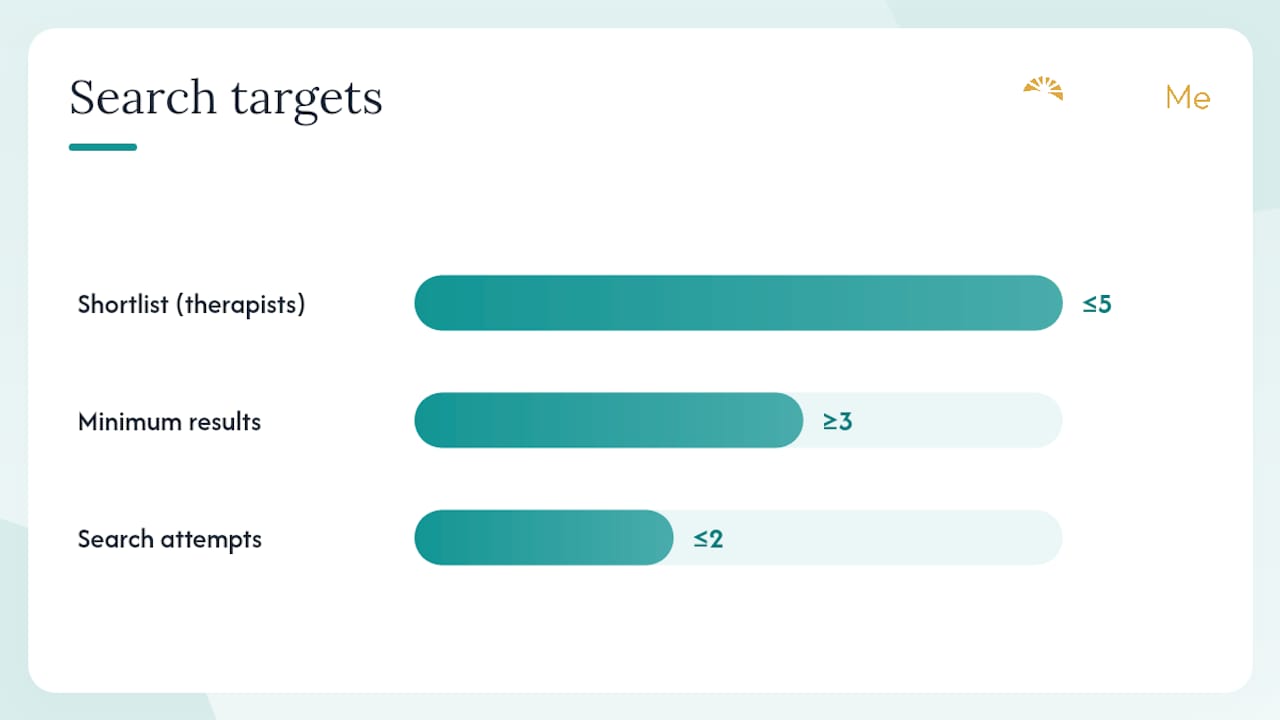
Once you have a shortlist of five or fewer, use secondary filters to separate similar profiles:
- Years of experience and any specialist training certificates
- Clarity and warmth of the therapist's written profile description
- Supervision status (active supervision is a professional standard, not optional)
- Accessibility notes (wheelchair access, neurodivergent-affirming practice)
Pro Tip: If your initial search returns fewer than three results, widen the radius or switch to online. Most therapists now offer remote sessions, and online therapy removes distance as a limiting factor entirely. If you still cannot find a confident match after two searches, switch to a human-led matching service.
How to verify a UK therapist's credentials
Checking registration takes less than five minutes and protects you from unlicensed practitioners.
- Identify the relevant register — BACP covers counsellors and psychotherapists. UKCP covers psychotherapists and psychotherapeutic counsellors. HCPC covers clinical psychologists and other regulated health professions. Each register has a public search tool on its website.
- Check the profile for accreditation details. A BACP-accredited therapist has met a higher standard than a registered member. UKCP's register is accredited by the Professional Standards Authority, which adds a further layer of public assurance.
Directory versus matching service: which should you use?
| Dimension | Self-search directory | Human-led matching service |
|---|---|---|
| Tool type | User-filtered listings | Algorithm or human-curated shortlist |
| UK coverage | UK-wide (most platforms) | UK-wide (most platforms) |
| Filters available | Location, specialism, modality, fees, format | Screening questionnaire covers same dimensions |
| Credential visibility | Varies; strongest on BACP and UKCP | Depends on platform; good services verify before listing |
| Human support level | None; you contact therapists directly | Human adviser reviews matches (on premium tiers) |
| Cost to user | Free to search; therapist sets fees | Free to match; therapist sets fees |
| Booking process | Direct contact with therapist | Platform facilitates introduction |
| Privacy / data handling | Minimal data collected | More personal data shared; check GDPR statement |
Pros of self-search directories: fast, free, full control, strongest on professional-body sites.
Cons: time-consuming if your needs are complex; credential checking is your responsibility on commercial directories.
Pros of matching services: saves time, better for complex or niche needs, human support reduces decision fatigue.
Cons: you share more personal data; quality varies between platforms.
A practical rule: try a directory first. If you cannot identify a confident match within two searches, switch to a human-led matching service. Professional-body directories convert well precisely because credential verification is already built in, so readers arrive ready to book rather than still vetting.
What therapy costs and how long it takes to start
Typical session logistics:
- Sessions usually run 50–60 minutes, whether online or in-person.
- Most therapists require 24–48 hours' notice for cancellations; some charge a full or partial fee for late cancellations.
- Many therapists offer a brief free initial call (10–15 minutes) before the first paid session.
Fee expectations:
Private therapy in the UK typically costs £50–£120 per session, though fees vary by location, therapist experience, and specialism. Some therapists offer sliding-scale fees based on income. Counselling Directory therapists set their own fees; the platform itself is free to search, though therapists pay about £24.50 per month or £245 per year to be listed as of 2026.
Timeline from search to first session:
- Human-led matching (e.g. Guidemetherapy, Welldoing MatchPlus): shortlist within days; first session often bookable within one to two weeks.
- Self-search directory: shortlist in hours if you are clear on your needs; first session depends on therapist availability, typically one to three weeks.
- Waitlists: some therapists have waiting lists of several weeks. Contact two or three simultaneously to avoid delays.
How to contact and evaluate a therapist: a step-by-step guide
A short, clear initial message gets a faster, more useful response.
- Write a concise initial message. Include: your presenting issue in one sentence, your preferred session format (online or in-person), your availability, and one direct question about their experience with your issue.
- Request a brief initial call. Most therapists offer 10–15 minutes free. Use it.
- Ask these questions during the call:
- Are you currently accepting new clients?
- What is your therapeutic approach, and how does it apply to my situation?
- What does a typical session look like?
- What outcomes can I reasonably expect, and over what timeframe?
- What are your fees, and do you offer a sliding scale?
- What is your cancellation policy?
- Are you currently in clinical supervision?
- What is your registration number and professional body?
- Interpret the responses. A good match feels clear, warm, and direct. Red flags include vague answers about approach, reluctance to share registration details, or pressure to commit before you feel ready.
- If a therapist is unavailable or waitlisted, ask whether they can recommend a colleague, or return to your shortlist and contact the next person. For a detailed guide to assessing fit, Guidemetherapy's blog covers the key signals to look for.
What to do if you want to change therapists mid-process: tell your current therapist directly. You are not obligated to continue. A professional will support the transition and may suggest referrals.
How Guidemetherapy works and what sets it apart
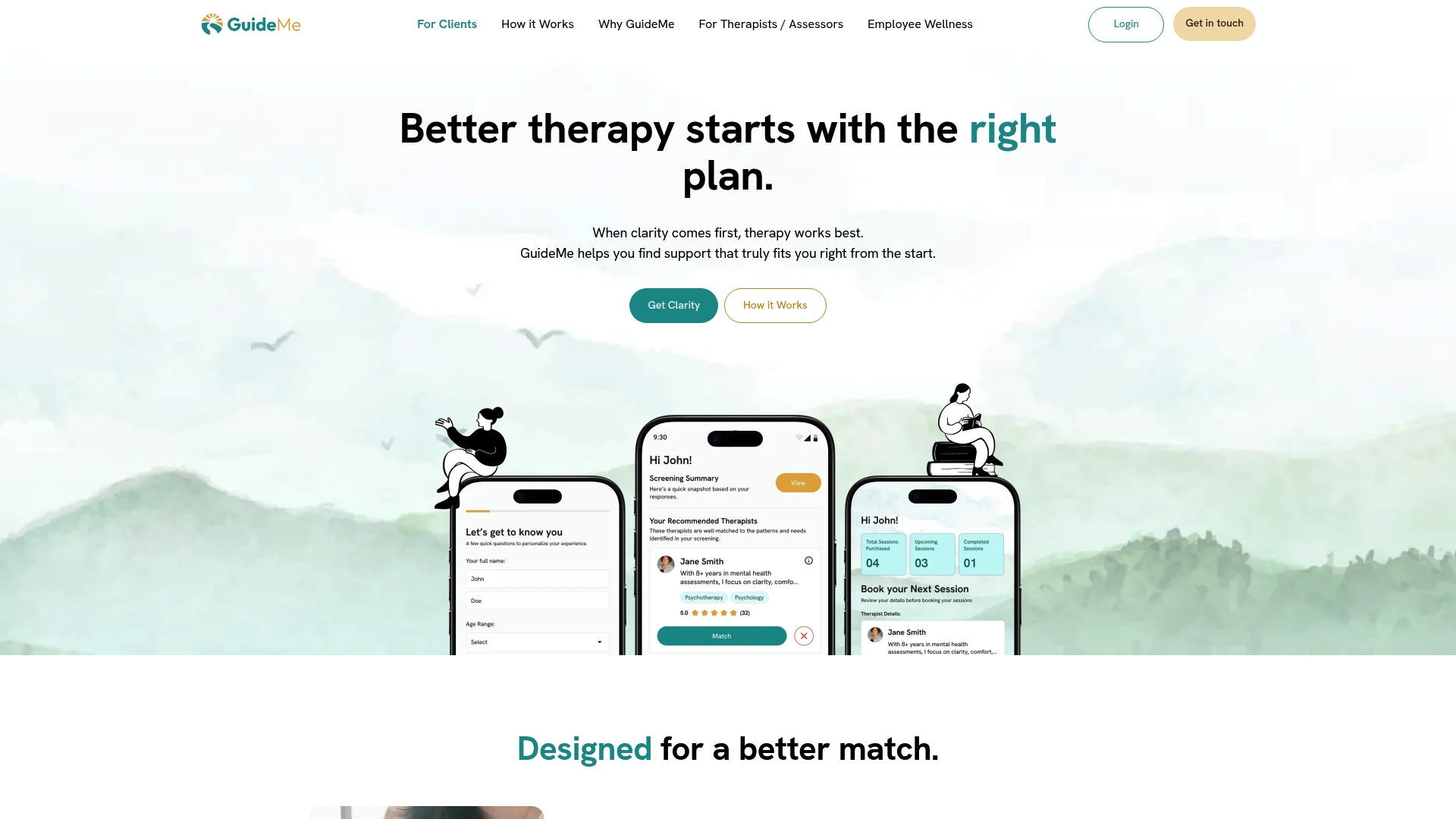
Guidemetherapy is not a standard directory. It is a therapy navigation platform that combines in-depth screening, AI-assisted shortlisting, and human review to match you with the right therapist from the start.
How the process works:
- Complete a detailed screening questionnaire covering your mental health history, preferences, and goals.
- AI-assisted shortlisting narrows the field based on your responses.
- A human adviser reviews the shortlist and confirms the match.
- You receive a personalised therapy plan alongside your matched therapist.
- Ongoing support between sessions is available throughout your time on the platform.
How Guidemetherapy maps to the evaluation criteria:
- Filters: specialism, therapy type, session format, fees, and availability are all covered in the screening process.
- Credential checks: therapists on the platform are vetted before listing.
- Human support: human review is built into every match, not an optional add-on.
- Privacy: personal data is handled under GDPR; the privacy policy is publicly available.
Guidemetherapy reports a 93% first-try match rate based on internal data, meaning the large majority of users are matched with the right therapist without needing to restart the process.
Key takeaways
The most reliable route to finding a licensed therapist in the UK is to start with a professional-body directory or a human-led matching service, verify credentials directly, and contact at least two therapists before committing.
| Point | Details |
|---|---|
| Start with accredited directories | BACP and UKCP directories build credential checks in, saving you verification time. |
| Use filters in order | Apply specialism and accreditation filters first; widen radius or switch to online if results are thin. |
| Verify registration independently | Search the professional body's register directly using the therapist's name or registration number. |
| Contact two therapists at once | Parallel outreach reduces wait time; use the 10–15 minute initial call to assess fit before booking. |
| Guidemetherapy for human-led matching | Guidemetherapy's hybrid screening and human review achieves a 93% first-try match rate for users who want a guided process. |
The part of the search nobody talks about
A note on the search itself
Searching for a therapist can feel oddly exposing, even before you have spoken to anyone. You are filling in filters about your most private difficulties, reading strangers' profiles, and trying to make a consequential decision with limited information. That discomfort is normal, and it does not mean the process is not working.

What I find most people underestimate is how much the quality of the search tool shapes their confidence in the outcome. A directory that shows you a registration badge and a warm, specific profile gives you something to hold onto. A generic listing with no photo and a one-line bio leaves you guessing. The tool is not neutral; it either builds your confidence or erodes it.
The other thing worth saying plainly: if the first therapist is not the right fit, changing is not a failure. It is the process working as it should. Guidemetherapy's ongoing support is specifically designed for that moment, helping you transition without losing momentum.
Guidemetherapy: a clearer path to the right therapist
Searching through directories and evaluating profiles takes time and energy that most people would rather spend on their actual wellbeing. Guidemetherapy offers a faster, more supported alternative: complete a detailed screening, receive a personalised therapy plan, and get matched with a vetted, licensed therapist by a human adviser backed by AI.
Your personal data is handled under GDPR throughout the process. Guidemetherapy does not share your information with third parties without your consent, and the full privacy policy is available on the website.
Ready to skip the guesswork and get matched with the right therapist? Start your therapy match on Guidemetherapy today.
Useful UK sources for verifying therapists and continuing your search
- NHS Talking Therapies: find NHS-funded talking therapy services in England by postcode; free at the point of use.
- BACP Therapist Directory: search over 18,000 registered and accredited therapists; use to verify BACP membership status.
- UKCP Find a Therapist: national register of psychotherapists accredited by the Professional Standards Authority; use to confirm UKCP registration.
- Counselling Directory: large commercial directory; useful for broad searches, but verify credentials independently.
- Welldoing: matching service with human-assisted MatchPlus tier; good for users who want a curated shortlist.
When using any directory, prioritise therapists listed on accredited professional registers (BACP, UKCP, HCPC) and confirm that fee information and cancellation policies are stated clearly before booking.
This article provides general information about finding a therapist and is not a substitute for professional mental health advice. Always verify a therapist's registration directly with the relevant professional body before booking.