

TL;DR:
- Therapy enhances change management by addressing psychological barriers, resistance, and emotional responses. Leaders who develop psychological safety and employ therapeutic techniques improve adaptation and sustainment of change initiatives. Embedding psychological practices into organizational culture builds resilience and long-term change success.
Therapy is defined as a structured psychological intervention that enables individuals and organisations to process, adapt to, and sustain meaningful change. The role of therapy in change management is to address the psychological and emotional readiness that determines whether a change initiative succeeds or fails. Traditional change management frameworks, such as those from McKinsey and Prosci, focus heavily on process, communication, and governance. Yet 70% of complex change programmes fail primarily because they neglect the psychological contract and unmanaged employee resistance. Approaches like cognitive-behavioural therapy (CBT), transactional analysis, and systemic coaching are now recognised as foundational tools for leaders who want change to stick.
How does therapy facilitate behavioural and emotional adaptation during change?
Organisational change triggers psychological threats that most change plans never account for. Employees face identity disruption, loss of status, and deep uncertainty, all of which activate threat responses that produce resistance, disengagement, and anxiety. These are not performance problems. They are predictable psychological reactions that require a psychological response.

Therapeutic interventions address this directly. CBT reduces anxiety and promotes adaptive behaviours by helping individuals identify unhelpful thought patterns and replace them with more constructive ones. In a change management context, this means helping employees reframe "this change threatens my role" into "this change requires me to develop new skills." That shift does not happen through a town hall meeting or a slide deck.
Behavioural design research shows that weakening existing comforts and anxieties is more effective than communication alone when enabling behaviour change during transitions. This is a critical distinction. Most change programmes rely on messaging to shift behaviour. Therapy-informed approaches redesign the conditions under which behaviour occurs.
Key therapy techniques that support adaptation during change include:
- Motivational interviewing: Helps leaders and employees resolve ambivalence about change by evoking internal motivation rather than applying external pressure
- Role-playing and psychodrama: Allow employees to rehearse new behaviours and process emotional responses in a safe group setting
- Cognitive restructuring: Identifies and challenges the distorted thinking that drives resistance
- Behavioural activation: Anchors new cognitive shifts through repeated, rewarded practice in real work contexts
Pro Tip: When introducing a new process or structure, pair the announcement with a facilitated group session using motivational interviewing techniques. This surfaces ambivalence early and prevents it from calcifying into active resistance.
What evidence supports therapy's effectiveness in change management?
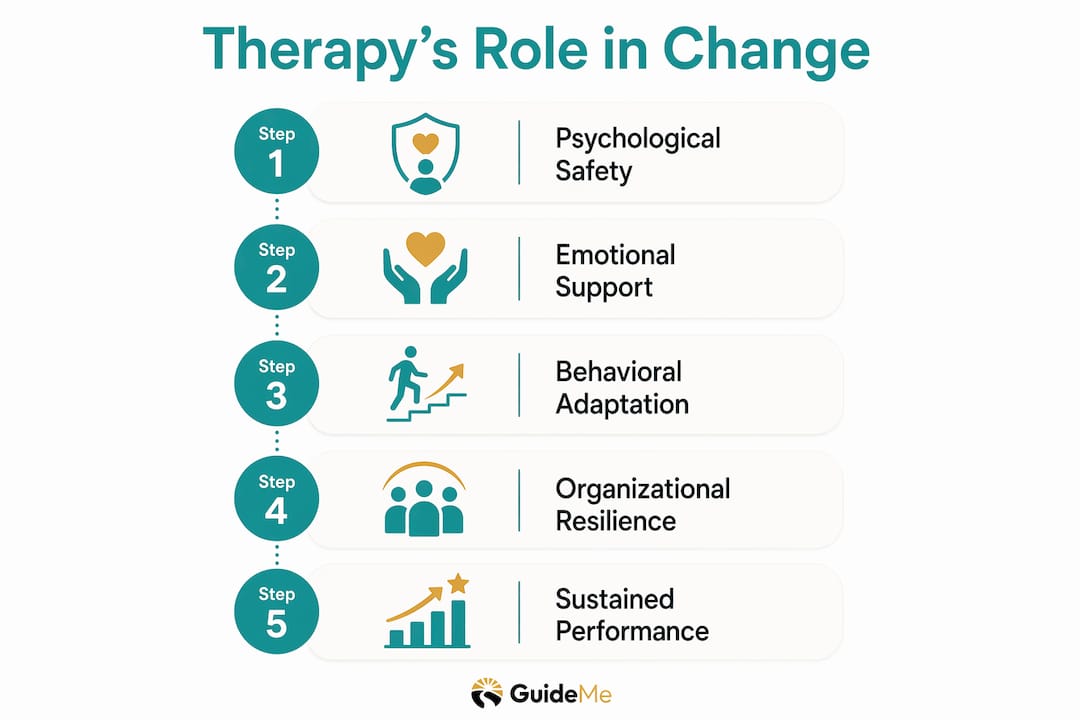
The empirical case for therapeutic intervention in organisational change is substantial and growing. Three bodies of research are particularly relevant for corporate leaders.
Amy Edmondson's work at Harvard Business School established that psychological safety drives 40% more effective team learning and new process implementation. This means that teams operating in psychologically safe environments are measurably better at adopting change. Psychological safety is not a cultural aspiration. It is a performance variable with a quantifiable effect on change outcomes.
"Leaders must create holding environments that allow systemic anxieties to be processed rather than ignored. Trying to minimise discomfort often increases resistance." — Intact Academy, systemic leadership research
A recent systematic review found that 73% of role-playing studies used group formats specifically to improve emotional regulation and interpersonal functioning. Group-based therapeutic formats are particularly well-suited to organisational settings because they address both individual psychology and team dynamics simultaneously.
Prosci's research confirms that active executive sponsorship focused on psychological readiness is the single top contributor to successful change. Sponsorship that addresses emotional safety, not just project milestones, produces fundamentally different outcomes.
| Evidence source | Key finding | Implication for leaders |
|---|---|---|
| McKinsey 2023 | 70% of change programmes fail due to human factors | Psychological readiness must be a design criterion |
| Amy Edmondson | Psychological safety improves team learning by 40% | Safety must be built before change is announced |
| Frontiers in Psychology 2026 | 73% of role-playing studies use group formats | Group therapy formats suit organisational change contexts |
| Prosci research | Executive sponsorship is the top change success factor | Leaders must model psychological openness, not just process compliance |
How do different therapeutic approaches complement change management?
Different therapy modalities address different dimensions of organisational change. Understanding which approach to apply, and when, is what separates effective change leadership from well-intentioned but ineffective intervention.
Cognitive-behavioural therapy (CBT) targets the thought patterns that generate resistance. In practice, this means structured conversations that help employees examine the assumptions driving their reluctance. Behavioural techniques in CBT bridge cognitive insight and real-world behaviour change, anchoring new habits through practice and reinforcement. CBT is particularly effective for individuals experiencing change-related anxiety or burnout.
Transactional analysis (TA) offers a framework for understanding how leaders and employees communicate under pressure. Leaders operating from a "Critical Parent" ego state, issuing directives and dismissing concerns, generate compliance at best and covert resistance at worst. Shifting to an "Adult" state, characterised by transparency, curiosity, and mutual respect, produces the collaborative dialogue that change requires.
Systemic coaching addresses the organisation as a whole rather than individual employees in isolation. It helps leaders understand how team dynamics, historical patterns, and unconscious loyalties shape responses to change. This is particularly useful when an organisation has experienced repeated failed change efforts and has developed a collective cynicism about new initiatives.
Motivational interviewing (MI) is one of the most transferable therapy techniques for change management. MI aids leaders in evoking intrinsic motivation for change, resolving ambivalence without coercion. Rather than telling employees why change is necessary, MI-trained leaders ask questions that help employees articulate their own reasons for engaging with it.
Key distinctions between these approaches:
- CBT works best at the individual level for anxiety and cognitive resistance
- TA works best at the relational level for improving leader-employee communication
- Systemic coaching works best at the team and organisational level for cultural patterns
- MI works best in one-to-one conversations where ambivalence is the primary barrier
Pro Tip: Train line managers in basic motivational interviewing before a major change announcement. Managers who can hold ambivalence without dismissing it will reduce escalation to HR and leadership far more effectively than any communications cascade.
What practical steps can leaders take to integrate therapy into change?
Integrating therapeutic principles into change management does not require every leader to become a therapist. It requires leaders to develop specific psychological capabilities alongside their operational skills. The following steps provide a structured approach.
-
Build your own capacity for ambiguity. Leaders who are visibly uncomfortable with uncertainty transmit that anxiety to their teams. Supervision, coaching, or personal therapy helps leaders develop the internal stability needed to hold space for others during transitions.
-
Create a holding environment before announcing change. A holding environment is a psychologically safe space where employees can express concerns, ask questions, and process reactions without fear of judgement. Employees feel 64% more secure when leaders clearly define what will remain constant during disruptive change. Establish those constants explicitly and early.
-
Use behavioural design to reduce friction. Identify the specific behaviours the change requires and remove the practical and psychological barriers to those behaviours. This is more effective than repeated communication about why the change matters.
-
Contract at three levels. Effective therapeutic contracting operates at the administrative level (roles and responsibilities), the professional level (goals and methods), and the psychological level (expectations, fears, and unspoken assumptions). Apply this framework to change communications to address what employees are actually worried about, not just what the project plan covers.
-
Train internal teams in systemic coaching and TA. Equipping HR business partners, team leads, and change champions with these tools creates a distributed psychological capability across the organisation. This produces systemic impact rather than isolated interventions.
-
Measure psychological health alongside operational metrics. Track trust levels, communication quality, and psychological safety scores throughout the change programme. These are leading indicators of whether the change will sustain.
How does therapy strengthen organisational resilience during change?
The benefits of therapeutic intervention extend well beyond the immediate change programme. Organisations that embed psychological practices into their change approach build adaptive capacity that compounds over time.
Clarity in the psychological contract, the unwritten expectations employees hold about their relationship with the organisation, directly reduces anxiety and resistance. When leaders address these expectations openly rather than assuming alignment, employees experience change as something happening with them rather than to them. This distinction determines whether people engage or withdraw.
Therapy-informed approaches also address what systemic practitioners call "organisational scripts." These are the unconscious patterns of behaviour, often rooted in past experiences of change, that pull teams back towards familiar ways of operating even after new processes have been introduced. Identifying and naming these scripts is one of the most powerful things a leader can do to prevent regression.
Sustained psychological safety must be built as an ongoing organisational capability, not deployed reactively when a change programme begins. Teams that already operate with high trust and open communication adapt to change faster, with less disruption and lower attrition. The return on investment is not just in the current initiative. It is in every future change the organisation will face.
The markers of systemic organisational health include:
- Quality of relationships across hierarchical levels
- Openness and frequency of honest communication
- Degree of trust between teams and leadership
- Capacity to tolerate and process uncertainty without blame
- Speed of recovery after setbacks or disruptions
Why therapy in change management is not optional
Most change programmes treat psychological support as a supplementary resource, something to offer employees who are struggling. That framing misses the point entirely. Therapy-informed practice is not a welfare provision. It is a performance strategy.
What I have seen consistently is that leaders underestimate the emotional labour involved in leading change. They prepare their project plans, their communications strategies, and their governance structures. What they do not prepare is themselves. The psychological demands of holding a team through sustained uncertainty, absorbing anxiety without transmitting it, and modelling openness when the instinct is to project confidence are significant. Leaders who receive therapeutic support for executives perform differently in those moments. Not because they have more information, but because they have more internal capacity.
The shift from "doing" change to "being" change is where the real transformation happens. Doing change means executing a plan. Being change means embodying the psychological qualities that make adaptation possible for everyone around you. That is a therapeutic capability, and it can be developed.
The organisations I have seen sustain change successfully are not the ones with the best project management. They are the ones where leaders have done their own psychological work and built cultures where honesty, vulnerability, and learning are genuinely safe. That does not happen by accident. It happens through deliberate, sustained investment in psychological capability, including the role of therapy in workplace culture as a structural, not supplementary, element.
— Yetty
How Guidemetherapy supports leaders through organisational change
Navigating organisational change is psychologically demanding for leaders and employees alike. Guidemetherapy is designed to make finding the right therapeutic support straightforward and effective.
Guidemetherapy matches corporate leaders, HR professionals, and change management teams with therapists who specialise in workplace transitions, CBT, systemic coaching, and organisational psychology. The platform combines human expertise with AI-powered matching to connect you with the right therapist from the start, reducing the time and uncertainty that often delays people from getting support. Whether you are leading a restructure, managing a merger, or supporting a team through sustained uncertainty, find your therapist through Guidemetherapy and build the psychological capability your change programme actually needs.
Key takeaways
Therapy is a performance strategy in change management, not a welfare provision. Organisations that embed psychological practices into change programmes achieve measurably better outcomes and build adaptive capacity for future transitions.
| Point | Details |
|---|---|
| Psychological readiness determines success | 70% of change programmes fail due to neglected human factors, making psychological preparation a design requirement. |
| CBT and MI are directly applicable | Cognitive-behavioural therapy and motivational interviewing translate directly into change management practice for individuals and teams. |
| Psychological safety must precede change | Teams with established psychological safety adapt faster and with lower attrition than those where safety is introduced reactively. |
| Leaders need their own psychological support | Leaders who receive therapeutic support carry more internal capacity to hold teams through uncertainty without transmitting anxiety. |
| Systemic approaches address cultural patterns | Transactional analysis and systemic coaching address the organisational scripts that cause regression after change is introduced. |
FAQ
What is the role of therapy in change management?
Therapy addresses the psychological and emotional factors that determine whether organisational change succeeds or fails. It provides structured support for managing resistance, anxiety, and behavioural adaptation at individual, team, and systemic levels.
Which therapy techniques are most useful for change management?
Cognitive-behavioural therapy, motivational interviewing, transactional analysis, and systemic coaching are the most directly applicable approaches. Each addresses a different dimension of change, from individual anxiety to team communication patterns and organisational culture.
How does psychological safety affect change outcomes?
Amy Edmondson's research shows that high psychological safety leads to 40% more effective team learning and new process implementation. Teams that feel safe to speak honestly adapt to change faster and with less disruption.
Can leaders use therapy techniques without being therapists?
Yes. Motivational interviewing and basic CBT principles can be learned by managers and HR professionals through structured training. The goal is not to provide therapy but to apply psychological principles to leadership and communication practices.
How early should therapeutic support be introduced in a change programme?
Psychological safety and therapeutic contracting should be established before a change is announced, not after resistance appears. Reactive psychological support is less effective than a culture of safety built in advance of any specific transition.