

TL;DR:
- Corporate therapy services provide ongoing, confidential mental health support tailored to the workplace environment. They offer continuity, deep relational trust, and targeted interventions that surpass the scope of standard employee assistance programs. Properly structured, these services qualify for UK tax exemption, support legal duty of care, and foster a healthier, more engaged workforce.
What are corporate therapy services?
Corporate therapy services are professional mental health support programmes embedded within the workplace, providing employees with confidential, ongoing psychological care tailored to their working environment. Unlike a general referral to an external helpline, these services sit inside the organisation, meaning therapists understand the culture, pressures, and systems employees actually face day to day.
The scope is broader than many HR leaders expect:
- One-to-one therapy sessions with qualified practitioners
- Organisational wellbeing consultancy for HR and leadership teams
- Group or team-based psychological support
- Pre- and post-clinical outcome tracking to measure progress
- Anonymised, aggregated data shared with employers to inform strategy
From a legal standpoint, employer-funded welfare counselling including medical treatments such as Cognitive Behavioural Therapy has been exempt from tax and National Insurance since April 2020, provided it forms part of a qualifying welfare programme. Structuring your service correctly matters: HMRC requires all components of a programme to fall within the exemption for the whole arrangement to qualify.
Acas guidance confirms that employers carry a legal duty of care to reasonably support employees' mental health, which includes signposting to professional services and maintaining clear mental health policies.
How does corporate therapy differ from a standard EAP?
Employee Assistance Programmes prioritise access, speed, and scale. They work well when immediate support is needed across a large workforce. Corporate therapy services are built around something different: continuity.

EAPs typically offer short-term, solution-focused support, often with a different therapist each time, while corporate therapy gives employees a consistent therapeutic relationship over time. That consistency allows patterns to surface and be addressed, rather than managed session by session.
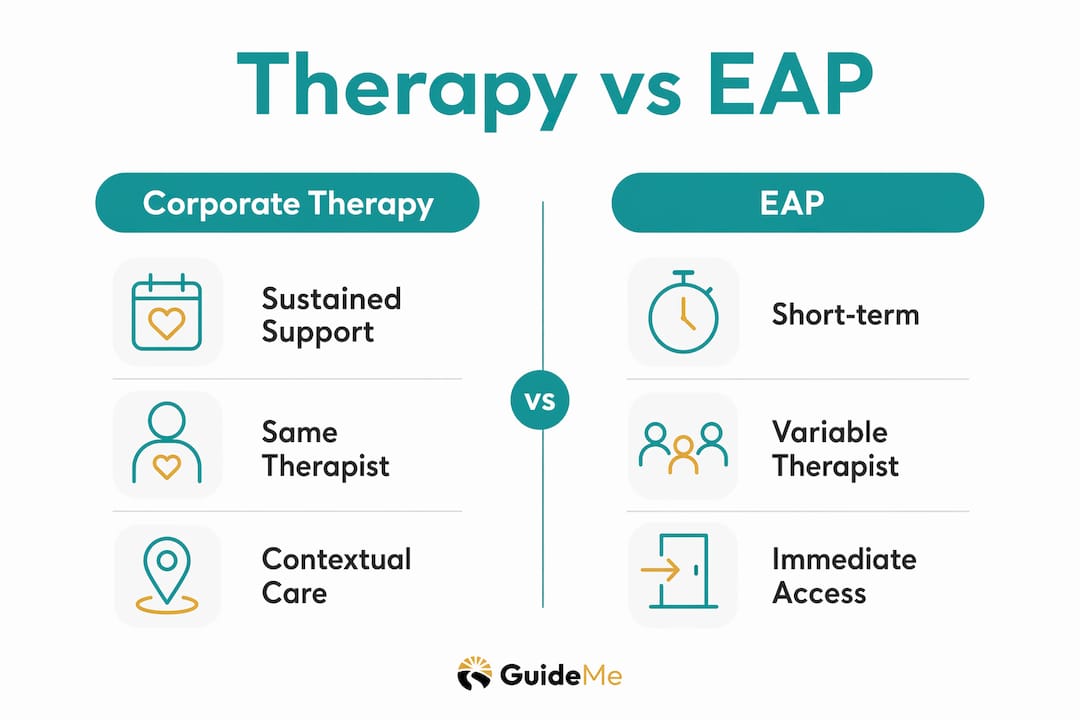
There is a practical risk HR leaders often overlook. Many EAP contracts include a cooling-off period that prevents employees from continuing with the same therapist privately once their allotted sessions end. Corporate therapy avoids this disruption entirely.
Embedded services delivered by HCPC-registered clinical psychologists who understand your organisation's culture produce more targeted interventions than generic programmes. HR and leadership teams receive anonymised outcome data, not individual case details, protecting employee trust while informing strategy.
- Continuity with the same therapist builds relational depth
- Contextual knowledge of company culture improves intervention quality
- Confidentiality assurances increase employee engagement with the programme
- Outcome data demonstrates improvements in wellbeing and work performance
Why corporate therapy matters for UK workplaces
Corporate therapy is a tax-efficient, legally sound investment in your workforce, not a discretionary benefit. When structured correctly under HMRC's welfare counselling exemption, it costs less than many employers assume.
- Supports your duty of care obligations under Acas guidance
- Reduces recurring absence and presenteeism linked to unresolved mental health difficulties
- Builds a psychologically safe culture that retains talent
- Provides leadership teams with anonymised wellbeing data to shape policy
- Delivers sustained improvement rather than one-off access
Organisations that tailor their offering to their own culture and communicate it clearly see higher uptake and greater impact. The role of therapy in workplace culture is increasingly central to how forward-thinking employers retain and support their people.
Finding the right therapist is where most corporate wellbeing programmes fall short. Guidemetherapy matches employees with the right practitioner from the start, using a human-led, AI-powered therapy navigation platform that creates a personalised plan before the first session. Start with Guidemetherapy and give your team support that actually fits.
Key takeaways
Corporate therapy services deliver sustained, confidential, and contextually informed mental health support that goes beyond what standard EAPs provide, while qualifying for UK tax exemption when correctly structured.
| Point | Details |
|---|---|
| Tax exemption applies | Employer-funded welfare counselling including CBT is exempt from tax and NI since April 2020 under HMRC rules. |
| Continuity is the key difference | Corporate therapy provides the same therapist over time, enabling deeper work than short-term EAP sessions allow. |
| Confidentiality drives uptake | Employees only engage when they trust that employers receive anonymised data, not individual case details. |
| Legal duty of care | Acas confirms employers must reasonably support employee mental health, including signposting to professional services. |
| Culture fit improves outcomes | Embedded therapists who understand organisational pressures produce more effective interventions than generic programmes. |