

TL;DR:
- Employee counselling offers short-term, confidential support for staff facing personal or work-related challenges.
- It helps reduce stress, improves mental health, and lowers long-term organizational costs through early intervention.
Employee counselling is a confidential, short-term support service that employers provide to help staff resolve personal and work-related challenges affecting their well-being and performance. Delivered through structured support programmes such as Employee Assistance Programmes (EAPs), it typically runs for 1 to 8 sessions and covers issues ranging from stress and burnout to anxiety, financial worries, and family concerns. Sessions take place by phone, video, or in person. For HR professionals and managers, understanding what employee counselling involves is the first step towards building a workplace where people genuinely feel supported.
What is employee counselling and how does it work?
Employee counselling is a structured, employer-funded service that gives staff access to a trained counsellor for short-term, confidential support. The industry term used across HR and occupational health settings is "workplace counselling," though employee counselling and EAP counselling are widely accepted equivalents. The service addresses both personal challenges, such as relationship difficulties or bereavement, and work-related issues, including conflict with colleagues, performance pressure, and work-related stress.

The process is straightforward. An employee contacts the EAP provider, usually through a free helpline or online portal, and is matched with a counsellor. Usage data is reported anonymously and in aggregate, meaning individual employees are never identified to their employer. This anonymity is central to the service's value. Without it, staff are far less likely to engage.
Counselling differs from therapy in scope and duration. Workplace counselling is short-term and solution-focused, not a clinical treatment for diagnosed conditions. When an employee's needs exceed what short-term support can address, the counsellor refers them to an appropriate external professional.
What are the different types of employee counselling?
Employee counselling approaches fall into three main styles: directive, non-directive, and cooperative. Each suits a different situation and employee need.
| Style | Who leads | Best used when |
|---|---|---|
| Directive | Counsellor | Employee needs clear guidance or a structured plan |
| Non-directive | Employee | Employee benefits from exploring their own solutions |
| Cooperative | Shared | Both parties contribute to problem-solving together |
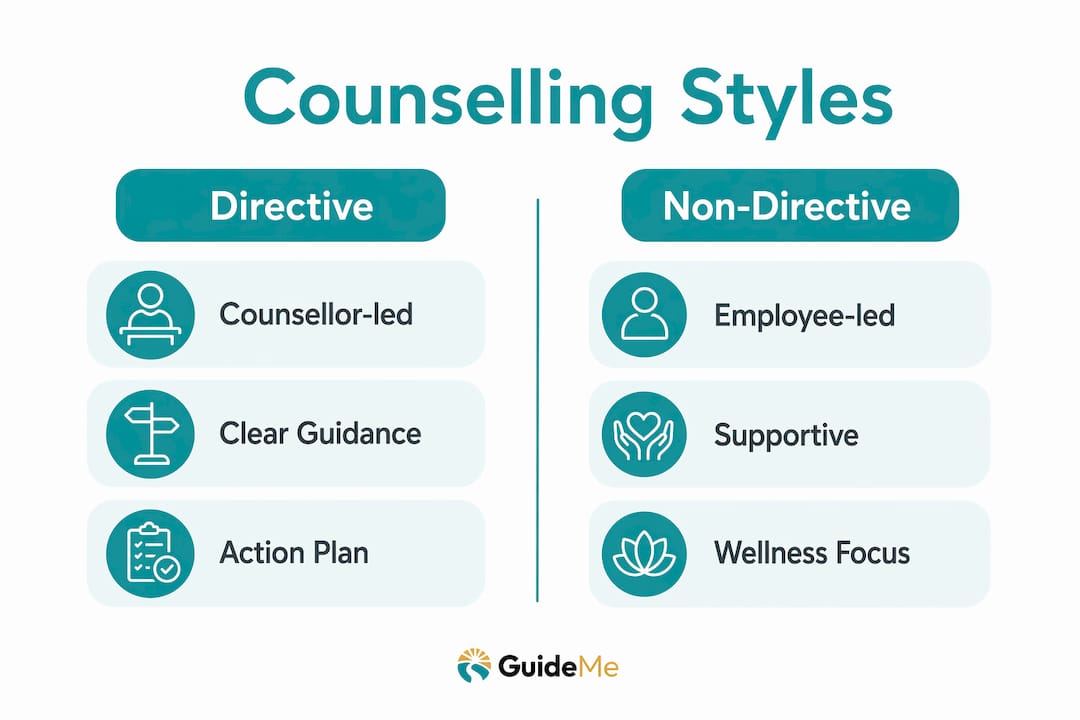
Directive counselling is counsellor-led. The counsellor listens, assesses, and offers specific advice or a plan of action. This works well in performance counselling, where clear goals and timelines are needed.
Non-directive counselling is the most widely recommended approach for wellness support. The most effective counselling empowers employees to find their own solutions through open-ended questions and active listening. The counsellor does not advise. Instead, they create space for the employee to think clearly and reach their own conclusions.
Cooperative counselling sits between the two. Both the counsellor and employee contribute ideas, making it useful for complex situations where neither party holds all the answers.
Beyond style, there is a critical distinction between performance counselling and wellness counselling. Performance counselling is corrective and goal-oriented, often using the GROW model to structure sessions around goal setting and improvement plans. Wellness counselling is supportive and psychological, focused on the employee's mental health rather than their output.
Pro Tip: Never blend performance and wellness counselling in the same session. Mixing the two signals to employees that disclosing personal struggles may affect their performance record, which destroys trust immediately.
What are the key benefits of employee counselling?
Employee counselling is a preventative strategy, not a reactive one. Addressing issues early reduces long-term leave and staff turnover and lowers indirect organisational costs. That distinction matters because most HR spending on mental health is reactive, responding to absences or resignations rather than preventing them.
The benefits for employees are direct and measurable:
- Reduced stress and improved daily functioning, particularly for staff managing anxiety, burnout, or heavy workloads
- Support for personal challenges including substance use, financial worries, and family concerns, all of which affect productivity and mental health
- Improved work-life balance, which raises engagement and reduces the risk of chronic burnout
- A safe, confidential outlet that employees can access without fear of career consequences
For organisations, the business case is equally clear. Employee counselling reduces indirect costs by addressing issues before they escalate into extended sick leave, disciplinary action, or resignation. Lower turnover alone produces significant savings, given the cost of recruiting and onboarding a replacement. Higher morale and engagement also translate into better team performance and lower rates of presenteeism, where staff are physically present but mentally disengaged.
The importance of employee counselling is not limited to crisis moments. Regular access to support normalises help-seeking behaviour across the workforce, which builds a more resilient culture over time.
How should HR professionals conduct effective counselling sessions?
Effective employee counselling sessions follow a clear process. Preparation, structure, and follow-up each carry equal weight.
-
Prepare the environment. Choose a private, neutral space. If the session is remote, confirm that both parties are in a location where they will not be overheard. State clearly at the outset that the conversation is confidential and explain any limits to that confidentiality.
-
Set the tone. Open with an open-ended question rather than a statement. "What would you like to focus on today?" signals that the employee leads the session. Avoid jumping to solutions in the first few minutes.
-
Use a structured framework. For performance counselling, the GROW model provides a reliable structure: Goal, Reality, Options, Will. Sessions typically last 30–60 minutes and should end with SMART goals and a documented plan.
-
Maintain boundaries. Managers should guide and support, not attempt to act as therapists. Attempting to fix employees during counselling creates ethical and legal risks. When an employee's needs exceed the scope of workplace support, refer them to an external professional promptly.
-
Document outcomes carefully. Proper documentation of goals, agreed actions, and follow-up dates protects both the employee and the organisation. Keep records factual and focused on outcomes, not personal disclosures.
-
Follow up. Schedule a check-in within two to four weeks. This signals genuine commitment and allows you to assess whether the agreed plan is working or needs adjusting.
Pro Tip: If a manager is conducting a performance counselling session, send the employee a written summary of agreed actions within 24 hours. This reduces misunderstanding and creates a clear record for both parties.
Managers who want to build these skills further can explore counselling selection steps designed specifically for HR leaders, which cover how to choose the right approach for different workplace scenarios.
What are common challenges and misconceptions about employee counselling?
Several persistent misconceptions reduce the effectiveness of employee counselling programmes, even in organisations that invest in them.
-
Confidentiality fears. Many employees believe their employer can access their counselling records. Effective communication about confidentiality significantly improves willingness to engage. HR teams should communicate clearly and repeatedly that usage data is anonymous and aggregated, never individual.
-
Stigma around mental health. Employees in high-performance cultures often avoid counselling because they fear being perceived as unable to cope. Normalising the service through visible leadership endorsement and regular internal communications reduces this barrier considerably.
-
Confusing counselling with disciplinary action. When managers refer employees to counselling in response to performance issues without clearly explaining the purpose, employees assume it is punitive. Separating performance counselling from wellness counselling in both language and process is critical to preserving trust.
-
Managers overstepping their role. HR professionals and line managers sometimes attempt to provide emotional support beyond their competence. Maintaining a non-judgmental space that separates empathy from agreement is a skill. Agreeing with an employee's grievances to seem supportive can create legal and relational problems.
-
Underestimating data privacy concerns. Employees want to know exactly what is recorded, who can access it, and how long it is retained. Clear data privacy communication is not optional. It is a prerequisite for genuine uptake.
Addressing these misconceptions requires consistent internal communication, manager training, and a clear written policy that employees can access at any time. The role of therapy in workplace culture is shifting, and organisations that get ahead of these barriers will see meaningfully higher engagement with their support services.
Key takeaways
Employee counselling works best when it is confidential, clearly separated from performance management, and supported by consistent communication from HR and leadership.
| Point | Details |
|---|---|
| Define the service clearly | Communicate to staff that counselling is confidential, short-term, and separate from disciplinary processes. |
| Match the approach to the need | Use directive counselling for performance goals and non-directive counselling for wellness and personal support. |
| Train managers on boundaries | Managers should guide and refer, not attempt to act as counsellors or therapists. |
| Document every session | Record agreed goals and follow-up dates to protect both employee and employer interests. |
| Address stigma proactively | Visible leadership endorsement and clear privacy communication increase uptake and trust. |
Why I think most organisations are still getting this wrong
I have seen a pattern repeat itself across organisations of every size. The EAP is in place, the leaflets are in the break room, and the HR team considers the job done. Uptake remains low, and nobody asks why.
The problem is rarely the counselling itself. The problem is that employees do not trust the system around it. They are not sure who sees what. They have watched a colleague get referred to counselling after a difficult performance review and drawn their own conclusions. The service exists, but the conditions for using it honestly do not.
What I have found is that psychological safety is not created by a policy document. It is created by consistent behaviour from managers and HR teams over time. When a line manager handles a difficult conversation with genuine curiosity rather than a fixed agenda, that builds more trust than any EAP communication campaign.
The other thing I would push back on is the tendency to treat all counselling as the same thing. Performance counselling and wellness counselling serve entirely different purposes. Conflating them, even unintentionally, sends a message that personal disclosure is risky. Organisations that separate these clearly, in their language, their processes, and their documentation, see meaningfully better outcomes.
Employee counselling is a genuine investment in workforce sustainability. But it only works when the culture around it is honest, and that starts with HR.
— Yetty
How Guidemetherapy supports workplace mental health
Organisations looking to strengthen their employee counselling provision need more than a helpline number. They need a way to match employees with the right support from the start.
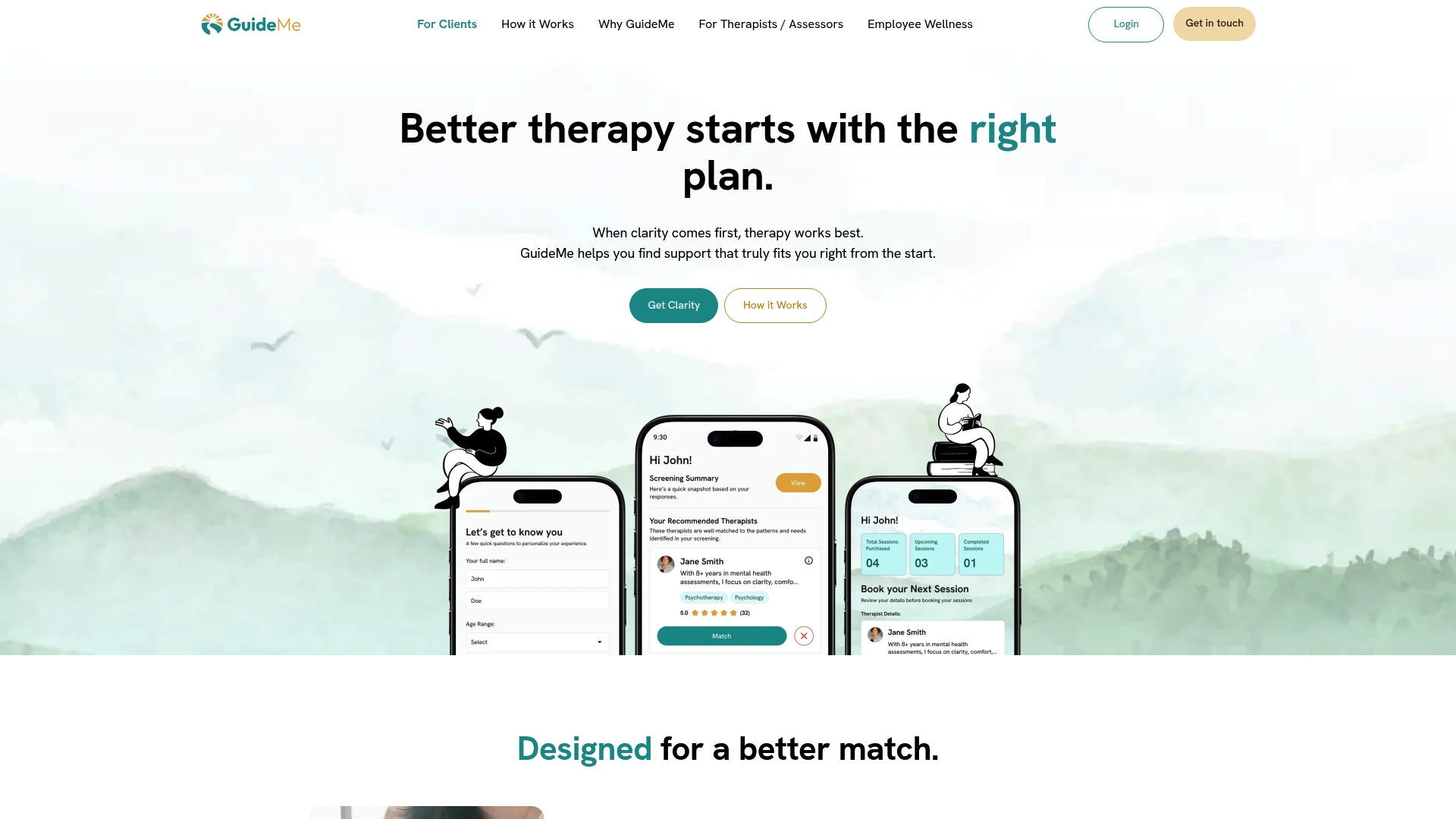
Guidemetherapy is a therapy navigation platform that combines human expertise with AI-powered matching to connect employees with therapists suited to their specific needs. For HR teams, this means staff are not left to navigate an overwhelming list of providers alone. Each person receives an in-depth therapy plan and a matched therapist, making the process clearer and more likely to result in genuine engagement. If your organisation is ready to build a more supportive counselling framework, visit Guidemetherapy to see how the platform works.
FAQ
What is the difference between employee counselling and therapy?
Employee counselling is short-term, solution-focused support typically lasting 1 to 8 sessions, addressing work and personal challenges. Therapy is longer-term clinical treatment for diagnosed mental health conditions, delivered by a licensed practitioner.
Is employee counselling confidential?
Usage data from EAP counselling is reported anonymously and in aggregate. Individual employees are not identified to their employer, though counsellors are required to break confidentiality in specific circumstances, such as risk of harm.
What types of issues does employee counselling cover?
Employee counselling addresses stress, burnout, anxiety, relationship difficulties, bereavement, financial worries, substance use, and family concerns, as well as work-related issues such as conflict and performance pressure.
How does the GROW model apply to employee counselling?
The GROW model structures performance counselling sessions around Goal, Reality, Options, and Will. It helps managers and employees set clear, measurable improvement plans within a 30–60 minute session.
How can HR teams increase employee counselling uptake?
Clear, repeated communication about confidentiality, visible leadership endorsement, and separating counselling from disciplinary processes are the three most effective ways to increase staff engagement with counselling services.