

TL;DR:
- Family therapy focuses on improving communication and relationships within the family unit by addressing interaction patterns. It employs various models, such as systemic, structural, narrative, and solution-focused approaches, tailored to each family's needs. Most brief programs last 6 to 8 sessions and promote lasting bonds, conflict resolution, and healthier dynamics.
Family therapy is a form of talk therapy designed to improve communication and relationships within a family system by addressing the interaction patterns that keep families stuck. Unlike individual therapy, it treats the family unit as the focus of care, working with two or more members together to resolve conflict, rebuild trust, and strengthen emotional bonds. Licensed professionals, including marriage and family therapists (MFTs) and clinical psychologists, lead these sessions using evidence-based approaches tailored to each family's specific needs. If your family is struggling to communicate, facing a major life change, or supporting a member with a mental health condition, family counselling sessions offer a structured and supported path forward.
What is family therapy and which approaches are used?
Family therapy is defined as a talk therapy that improves communication and relationships by addressing mental health concerns for individuals and their families. It does not follow a single fixed method. Instead, therapists draw on a range of models depending on the family's presenting issues, goals, and dynamics.
The five most widely used approaches are:
- Systemic family therapy: Focuses on understanding problems through the lens of family interaction patterns rather than individual symptoms alone. The systemic approach treats the family as an interconnected system where one person's behaviour affects everyone else.
- Structural family therapy: Examines the organisation of the family, including roles, hierarchies, and boundaries, to identify where the structure is contributing to conflict or dysfunction.
- Strategic family therapy: The therapist takes an active, directive role in designing specific tasks and interventions to shift unhelpful communication cycles.
- Narrative therapy: Helps family members separate their identities from their problems by rewriting the stories they tell about themselves and each other.
- Solution-focused brief therapy: Concentrates on what is already working and builds on existing strengths rather than analysing the root causes of problems.
| Approach | Core goal | Typical duration |
|---|---|---|
| Systemic | Change interaction patterns across the family system | 8–16 sessions |
| Structural | Reorganise family roles and boundaries | 8–12 sessions |
| Strategic | Resolve specific presenting problems through directed tasks | 6–10 sessions |
| Narrative | Reframe family stories and identities | 8–12 sessions |
| Solution-focused | Build on strengths and set achievable goals | 6–8 sessions |
Therapists trained in the Gottman Method or Emotionally Focused Therapy (EFT) may integrate these frameworks into couples and family work, particularly where attachment and emotional regulation are central concerns. The choice of approach is not arbitrary. MFTs with an average of 13 years of clinical experience assess the family's needs before selecting or combining methods, which is why the same presenting problem can lead to different therapeutic routes for different families.

Pro Tip: Ask your therapist at the first session which approach they plan to use and why. Understanding the rationale helps you engage more fully and sets realistic expectations from the start.
What benefits can families expect from family therapy?
Family therapy promotes behaviour modification, psychoeducation, and healthy boundary setting alongside strengthened family bonds and communication. Research confirms improved family functioning and coping skills after completing a course of therapy. These are not vague outcomes. They translate into measurable changes in daily life.
The most commonly reported benefits include:
- Clearer communication: Families learn to express needs and feelings without blame or withdrawal, reducing the frequency and intensity of arguments.
- Conflict resolution skills: Therapists teach specific techniques for de-escalating disagreements and reaching workable compromises.
- Stronger emotional bonds: Addressing unspoken resentments and misunderstandings rebuilds trust and closeness between family members.
- Mental health support: Family therapy addresses anxiety, mood disorders, behavioural issues, attachment problems, substance abuse, and recovery from abuse or neglect. Systematic reviews confirm its broad applicability across diverse mental health and relational challenges.
- Healthier boundaries: Members learn to distinguish between supportive involvement and unhelpful enmeshment or disengagement.
- Shared coping strategies: Families develop a collective toolkit for managing stress, grief, illness, or transition.
One finding that surprises many families is how quickly change can occur. Because therapy targets the interaction patterns between people rather than waiting for one individual to change, shifts in communication can produce noticeable results within a small number of sessions. This is one reason why understanding therapy's benefits early in the process helps families commit to the work rather than dropping out before progress consolidates.
How does family therapy work in practice?
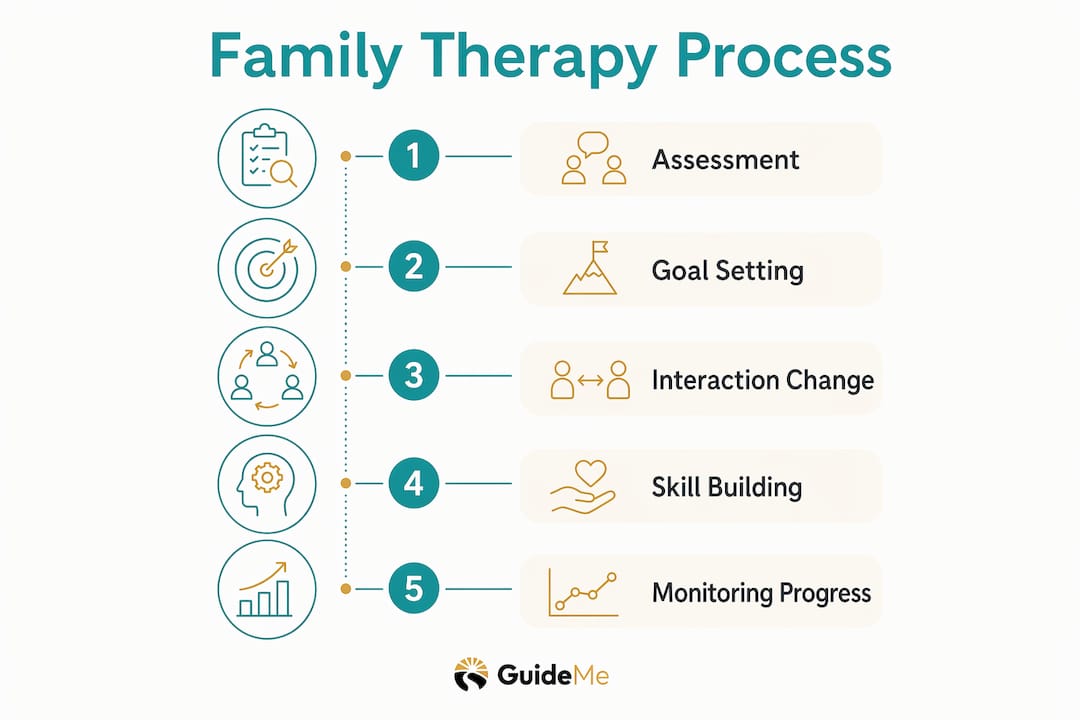
Brief couples and family therapy commonly spans about 6 to 8 sessions and may include combined couple, family, and individual meetings. This is shorter than many people expect, and it reflects the solution-focused orientation of most contemporary family therapy models.
Here is what a typical course of family therapy looks like from start to finish:
- Initial assessment: The therapist meets with the family, sometimes together and sometimes in subgroups, to understand the presenting concerns, family history, and goals. This session establishes the working relationship and sets the tone for what follows.
- Goal setting: Therapist and family agree on specific, measurable goals. Vague aims like "communicate better" are translated into concrete targets such as "reduce the frequency of shouting during disagreements" or "re-establish weekly family time."
- Observation of interaction patterns: Therapists observe interaction patterns directly, including whole-family and subgroup meetings, to understand communication and roles. Watching how a family actually talks to each other in the room reveals far more than any individual account.
- Active intervention: The therapist introduces techniques to interrupt unhelpful cycles. This might involve role-play, reframing statements, or assigning tasks to practise between sessions.
- Consolidation and review: Progress is reviewed regularly. Sessions may shift in format as the family's needs evolve, moving from whole-family meetings to individual check-ins and back again.
- Closure: The final sessions focus on reinforcing the changes made and preparing the family to maintain progress independently.
The practical goal in family therapy is changing repeatable interaction patterns such as escalation, turn-taking, and response styles for lasting relational improvement. Therapists help families practise healthier communication behaviours during sessions so they can apply them in real-world situations at home.
Pro Tip: Arrive at each session with a specific example of a recent interaction that felt difficult. Concrete examples give the therapist something tangible to work with and make brief therapy formats significantly more effective.
Who needs family therapy and when should you consider it?
Family therapy suits a wide range of situations, not only those involving severe conflict or crisis. MFTs use a holistic, long-term wellbeing perspective rather than treating individuals in isolation, which means family therapy is appropriate whenever a relational dynamic is affecting one or more members' quality of life.
Consider family therapy if your family is experiencing any of the following:
- Persistent communication breakdowns or recurring arguments with no resolution
- A family member diagnosed with anxiety, depression, an eating disorder, or another mental health condition
- Behavioural problems in children or adolescents that are not responding to individual intervention
- Substance misuse by one or more family members
- A major life transition such as divorce, bereavement, relocation, or a new blended family
- Recovery from trauma, abuse, or neglect within the family
- Difficulties adjusting to a family member's chronic illness or disability
- Estrangement or breakdown of trust between parents and adult children
Family therapy works well alongside individual therapy rather than as a replacement for it. A teenager receiving individual counselling for depression, for example, may benefit significantly from concurrent family sessions that address the home environment contributing to their distress. The two modalities reinforce each other. Exploring counselling approaches that integrate both individual and family work gives you a clearer picture of what a combined treatment plan might look like for your situation.
The importance of family therapy lies not only in resolving existing problems but in building the relational skills that prevent future ones. Families who complete a course of therapy typically report that they are better equipped to handle future stressors together, which represents a lasting return on a relatively short investment of time.
Key takeaways
Family therapy produces lasting change by targeting the interaction patterns between family members rather than focusing on any single individual's symptoms or behaviour.
| Point | Details |
|---|---|
| Definition and focus | Family therapy is talk therapy that treats the family unit, addressing communication and relational patterns collectively. |
| Range of approaches | Models include systemic, structural, narrative, and solution-focused therapy, chosen based on the family's specific needs. |
| Typical duration | Most brief family therapy formats run for 6 to 8 sessions, making meaningful change achievable in a short timeframe. |
| Who benefits | Families facing communication breakdown, mental health conditions, behavioural issues, or major life transitions all stand to gain. |
| Preparation matters | Arriving with specific examples and clear goals makes each session more targeted and the overall course more effective. |
Why I believe family therapy is underused and misunderstood
Most families I speak with assume family therapy is a last resort. They picture a room full of raised voices and a therapist playing referee. That assumption keeps a lot of families from seeking help until the situation has deteriorated far beyond what it needed to reach.
What actually happens in well-run family therapy is quieter and more precise than that. The therapist is not there to adjudicate who is right. They are there to slow the interaction down enough for everyone to see what is actually happening between them. That shift in perspective, from "my family member is the problem" to "we have a pattern that is not working," is where the real change begins.
I have also noticed that families tend to underestimate how quickly progress can occur when the focus is on interaction rather than individual change. You do not need everyone in the family to be fully committed from session one. You need enough people willing to show up and try. The system responds to even small changes in how one person communicates, and that momentum builds.
My honest advice: do not wait for a crisis. If communication in your family feels consistently difficult or one member's struggles are affecting the whole household, that is already enough reason to explore family counselling sessions. The earlier you start, the less ground you have to recover.
— Yetty
Finding the right family therapist with Guidemetherapy
Starting family therapy is a positive step, but finding the right therapist for your family's specific situation can feel overwhelming without guidance.

Guidemetherapy is a therapy navigation platform that takes the uncertainty out of that search. It combines human expertise with AI-powered matching to help you understand your family's mental health needs and connect with a qualified therapist who is the right fit from the start. Rather than working through a long list of names and hoping for the best, you receive a personalised therapy plan and a matched therapist suited to your goals. Visit Guidemetherapy to start your family's therapy journey with clarity and confidence.
FAQ
What is the difference between family therapy and individual therapy?
Individual therapy focuses on one person's thoughts, feelings, and behaviours, while family therapy treats the family unit as a whole. Family therapy addresses the interaction patterns between members rather than any single person's internal experience.
How many sessions does family therapy typically take?
Most brief family therapy formats run for 6 to 8 sessions, though the total number depends on the complexity of the issues and the goals set at the outset. Some families continue beyond this if ongoing support is beneficial.
Can family therapy help with a child's behavioural problems?
Family therapy effectively addresses behavioural issues in children and adolescents by examining the family dynamics that may be contributing to the behaviour. It is often used alongside individual support for the child to produce the best outcomes.
Do all family members have to attend every session?
Not necessarily. Therapists strategically use combined sessions, including whole-family meetings and smaller subgroup meetings, depending on what each stage of therapy requires. Attendance is flexible and guided by the therapist's clinical judgement.
Is family therapy suitable for blended or non-traditional families?
Family therapy is appropriate for any group of people who consider themselves a family unit, regardless of structure. Therapists adapt their approach to the specific composition and dynamics of each family they work with.