

Yes. A well-designed workplace therapy programme, whether that is a traditional Employee Assistance Programme or a therapy-navigation service, gives employees timely, confidential mental health support and gives employers a measurable way to reduce absence and improve retention. Start with a needs audit or a small pilot rather than a full rollout, and treat GuideMe as one option worth evaluating alongside your current providers.
TL;DR:
- Starting with a needs audit and a small pilot helps ensure the therapy program aligns with organizational needs and encourages employee trust and engagement.
- Clinical triage and accreditation are crucial for quality, with clear response time expectations and strict confidentiality protecting employee privacy.
- Delivery models vary from helpline-only to blended and navigation-based, with higher-cost add-ons like virtual GPs and extended therapy sessions.
- Internal communication, manager training, and ongoing promotion are essential to improve program utilization beyond initial launch efforts.
- Cost models mainly include per-employee or pay-per-case pricing, with realistic ROI relying on internal metrics such as absence rates and staff retention rather than vendor benchmarks.
Table of Contents
- What is a workplace therapy programme, and what's the employer's role?
- What services do workplace therapy programmes actually include?
- What benefits do employees and employers actually see?
- How do you commission and implement a programme, step by step?
- How should HR evaluate and choose a provider?
- What do these programmes cost, and what ROI is realistic?
- What KPIs, governance and confidentiality standards should HR demand?
- How does therapy fit alongside your other wellbeing initiatives?
- How do you get employees to actually use the programme?
- What legal and compliance issues apply to workplace therapy services?
- How does GuideMe's approach compare with traditional EAPs?
- Ready to evaluate GuideMe for your organisation?
- Sources
What is a workplace therapy programme, and what's the employer's role?
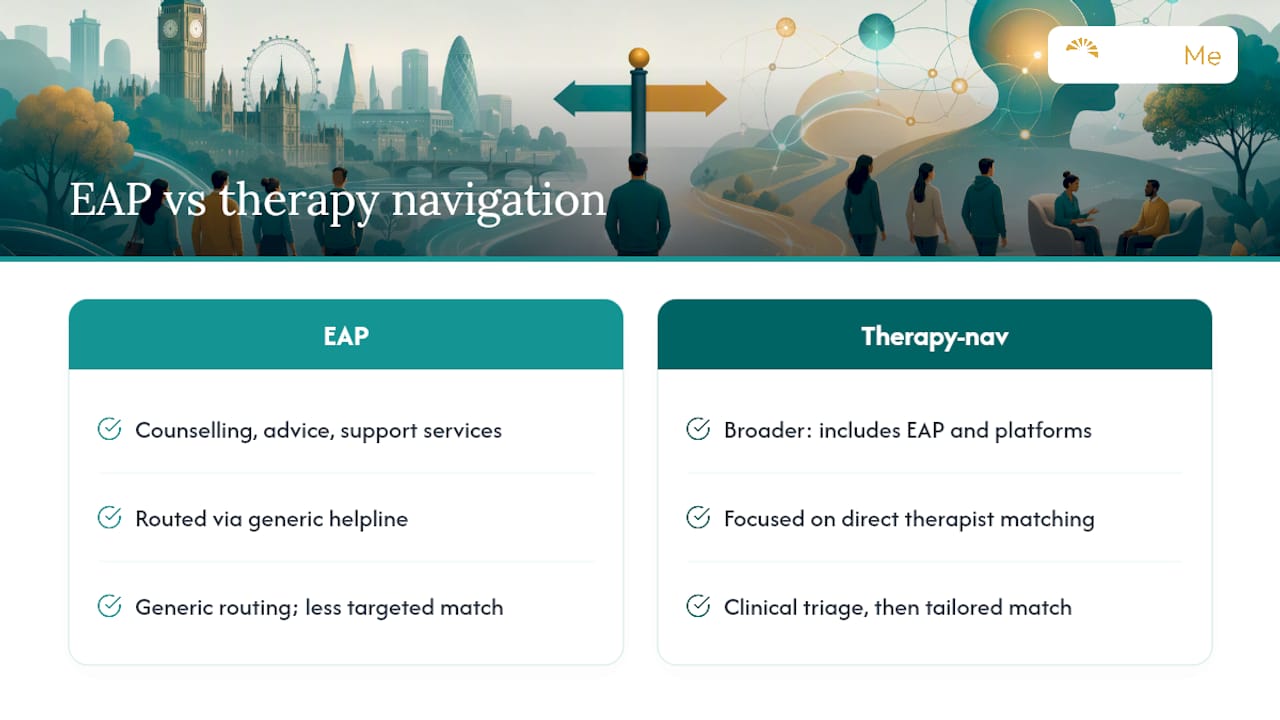
An Employee Assistance Programme, or EAP, is a benefit that gives employees confidential access to counselling, advice and support services, usually funded entirely by the employer at no cost to staff. A workplace therapy programme is the broader category. It includes EAPs but also covers newer models like therapy-navigation platforms, which focus on matching employees with the right therapist rather than routing everyone through a generic helpline.
Coverage typically extends beyond the employee to include their household or dependants, and most contracts allow line managers to access support too. This matters because managers often carry the emotional weight of supporting a struggling team member without anywhere to process that themselves.
Confidentiality is the foundation the whole system rests on. Reputable providers keep session content strictly between the employee and their therapist. Employers receive only aggregated, anonymised usage data, never details of who used the service or why. Clinical delivery should sit with practitioners accredited by bodies such as the BACP, with a clinical triage process that assesses urgency and risk before matching someone to a therapist. The HSE's guidance on work-related stress sets out the employer's underlying duty of care, which is the legal backdrop every programme design decision should sit against.
What services do workplace therapy programmes actually include?
Vendor offers vary more than most HR teams expect, and the labels aren't standardised, so a like-for-like comparison takes some digging. Most programmes are built from a mix of the following components:
- 24/7 helpline: immediate phone or chat support for urgent concerns, usually the entry point into the wider service.
- Short-term counselling: a set number of structured sessions, commonly between six and eight, delivered face-to-face, by phone or online.
- Care navigation: a triage step that matches the employee to the right type of support rather than defaulting everyone into generic counselling.
- Legal and financial advice: practical guidance on debt, family law or housing issues that often sit behind stress-related absence.
- Virtual GP access: on-demand GP appointments, increasingly bundled in as a differentiator.
- Critical-incident support: rapid-response counselling after a workplace death, redundancy round or traumatic event.
- Digital tools: apps offering self-guided CBT exercises, mood tracking or sleep support between sessions.
- Team or manager-facing therapy: group sessions or manager coaching, less common but growing.
Delivery models fall broadly into three types: helpline-only (cheapest, weakest continuity of care), blended models combining a helpline with structured counselling, and clinical navigation or stepped-care models that assess severity first and route people to the appropriate intensity of support. Virtual GP access and higher-intensity therapy (beyond the standard session allowance) are the items most often sold as paid add-ons rather than included as standard.
What benefits do employees and employers actually see?
Employees get faster access to support than they'd typically find through an NHS waiting list, along with privacy protections that make disclosure feel safer, and the chance for early intervention before a problem escalates into a crisis or long-term absence.
The context employers underestimate: workplace absence in the UK has reached its highest level in over a decade, according to CIPD analysis, with poor mental health cited as a significant driver. That alone makes a credible case for intervention, even before ROI modelling comes into it.
Here's where employers need to temper expectations rather than take vendor sales decks at face value. A rigorous evidence review from MIT Sloan found that corporate wellness programme outcomes and financial returns vary enormously between organisations, and that design and employee engagement predict success far better than any single vendor's marketing claims. Separately, RAND's research for the US Department of Labor cautions that lifestyle-only programmes rarely produce clear cost savings on their own.
The honest way to frame a business case internally is to lead with duty of care and retention risk, treat cost savings as a secondary and uncertain benefit, and commit to measuring your own utilisation and absence data rather than importing a vendor's headline ROI figure.
How do you commission and implement a programme, step by step?
Getting from "we should look into this" to a live programme usually takes eight to twelve weeks if you follow a structured process rather than signing the first proposal that lands on your desk.
- Run a needs assessment. Survey staff (anonymously) on current stress levels, existing support gaps and preferred access channels. Define what success looks like before you speak to a single supplier.
- Draft procurement requirements. Specify scope, service-level agreements for response times, clinical governance standards, and data protection compliance under UK GDPR.
- Shortlist and evaluate suppliers. Request demonstrations, ask for anonymised outcome data from existing clients, and check accreditation credentials directly rather than taking a claim at face value.
- Design a pilot. Choose one department or site, run it for three to six months, and set clear success criteria in advance, such as utilisation rate or manager-reported confidence in signposting support.
- Plan the rollout. Build a communications calendar, train managers on how to signpost the service without overstepping into informal counselling themselves, and set a review date at three and twelve months.
Pro Tip: Involve your occupational health team and a staff representative in the pilot design from day one. Programmes designed solely by HR without frontline input tend to see lower uptake, because employees don't trust a service they had no say in shaping.
The most common pitfall isn't a bad provider. It's poor internal communication, where staff simply don't know the service exists or don't trust that it's genuinely confidential. A close second is treating launch as a one-off announcement rather than a sustained effort, which is precisely why manager training and repeated, varied communication deserve their own line item in the implementation plan, not an afterthought bolted onto week one.
How should HR evaluate and choose a provider?
Build an evaluation matrix before you take a single sales call, and score every supplier against the same criteria rather than being swayed by whoever presents best. The categories that matter most:
- Clinical model: is there a genuine triage step, or does everyone get routed into the same standard counselling regardless of need?
- Access speed: what's the actual time from first contact to a booked appointment, not the marketed target?
- Therapist qualifications: are practitioners accredited by BACP, UKCP or an equivalent body, and how is that verified?
- Data protection and confidentiality: where is data stored, who can access it, and what does the anonymisation process actually look like in practice?
- Reporting: what does a quarterly dashboard contain, and is utilisation broken down by department without identifying individuals?
- Integration with occupational health: does the provider coordinate with existing OH referral pathways, or operate as a separate silo?
- Inclusivity: can the service match employees to therapists with relevant cultural, language or specialist experience?
Put these questions directly to suppliers: What's your average triage-to-first-appointment time? What happens if a case escalates to a safeguarding concern? Can you show anonymised outcome measures from a comparable client? How is reporting anonymised below team level? A stepped-care model with a single continuous care plan tends to reduce the handoffs between different practitioners that frustrate employees and dilute continuity.
Red flags that should end a conversation quickly: vague answers on triage timing, no clinical accreditation for therapists, refusal to share a sample anonymised report, or a contract that locks you in with no exit clause before you've even seen usage data.
What do these programmes cost, and what ROI is realistic?
Pricing usually follows one of three models: per-employee-per-year (PEPY), a flat annual fee based on total headcount regardless of usage; fee-per-case, charged only when an employee actually engages with the service; or blended bundles, combining a base helpline fee with paid add-ons for extras like virtual GP access or extended counselling sessions.
Virtual GP access and higher-intensity or longer-term therapy are the two items most likely to sit outside the base package and carry an additional charge. Ask for this itemised before signing, not folded into a single headline number.
Building a conservative ROI case means resisting the temptation to import a vendor's benchmark multiplier. Instead, track your own absence rate, staff turnover and utilisation figures before and after launch, over a full year rather than a single quarter. Both the MIT Sloan review and RAND's research are consistent on one point: financial returns from workplace wellness initiatives are genuinely variable, and a business case built on realistic internal data holds up far better under scrutiny than one built on an imported industry average.
What KPIs, governance and confidentiality standards should HR demand?
Ask providers to report on five things at minimum: utilisation rate, referral-to-treatment time, anonymised outcome measures (session-by-session symptom tracking, aggregated), absence and retention trends, and periodic employee experience surveys. Quarterly reporting is standard; anything less frequent makes it hard to spot problems early.
Clinical governance should include a named clinical lead, a defined safeguarding escalation pathway for risk-of-harm cases, and regular audits of therapist accreditation. On data handling, insist that any reporting below a certain team size (commonly five to ten employees) is suppressed or aggregated further, since small teams make anonymisation promises meaningless in practice.
How does therapy fit alongside your other wellbeing initiatives?
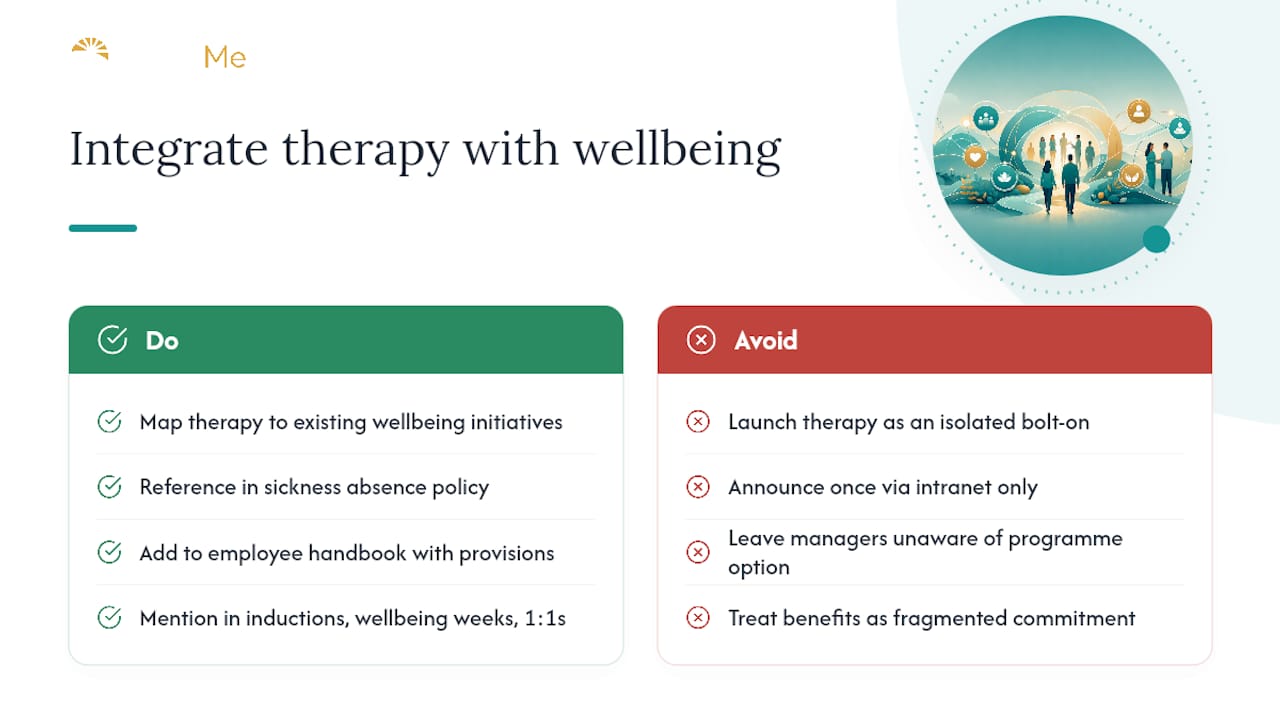
A therapy programme launched in isolation from your existing wellbeing strategy tends to underperform, because employees read fragmented benefits as fragmented commitment. If you already run a wellbeing platform, health cash plan or flexible working policy, map how the therapy programme sits alongside them rather than treating it as a bolt-on.
Policy alignment matters more than most HR teams initially assume. Your sickness absence policy, your reasonable adjustments process and your bullying and harassment procedures should all reference the therapy programme explicitly, so managers know it's a genuine option to signpost rather than a separate scheme nobody quite understands. The strongest integration tends to happen when the programme is written into the employee handbook alongside sick pay and flexible working provisions, not announced once via an intranet post.
There's a cultural dimension too. Guidance on embedding therapy into workplace culture consistently points to the same pattern: programmes framed as part of how the organisation operates, rather than a discrete HR benefit, see meaningfully higher engagement. That means referencing the service in wellbeing weeks, new starter inductions, and manager one-to-ones, not just in the benefits handbook.
How do you get employees to actually use the programme?
Utilisation is the metric most programmes quietly underperform on, often sitting well below what the contract cost would suggest is reasonable. Low uptake is rarely a sign employees don't need support. It's usually a sign they don't know the service exists, don't trust its confidentiality, or feel it doesn't apply to their specific situation.
Manager training is the single highest-leverage engagement lever available. Managers who feel confident signposting the service, without trying to counsel the employee themselves, are consistently linked to higher usage than a purely top-down comms campaign. A manager-focused support and training approach works because it puts the message in the hands of the person an employee already trusts, rather than an email from an unfamiliar HR inbox.
Repetition and variety in communication matter more than a single well-produced launch campaign. Mention the service in onboarding, in payslip messaging, on posters near break rooms, and in one-to-ones, spaced out across the year rather than front-loaded into launch week. Anonymised case studies or examples of emotionally supportive workplaces can normalise usage without breaching anyone's confidentiality, since they describe patterns rather than identifiable individuals.
What legal and compliance issues apply to workplace therapy services?
Data protection sits at the centre of the legal picture. Any programme handling employee mental health data must comply with UK GDPR, which classifies health information as special category data requiring a higher standard of protection and a lawful basis for processing, typically explicit consent or a legitimate employer interest carefully documented.
Your duty of care under health and safety law, set out in HSE guidance on work-related stress, requires you to carry out a risk assessment for psychological hazards, not just physical ones, and to make reasonable adjustments where an employee discloses a mental health condition covered by the Equality Act 2010. Contracts with providers should specify data processing agreements, breach notification timelines, and exactly where clinical records are stored and for how long.
Get your legal team to review the vendor contract for indemnity clauses covering clinical negligence, since the provider's therapists, not your HR team, carry direct clinical responsibility. Confirm the contract sets out what happens to employee data if you switch provider, and whether historic session data is deleted or retained under the outgoing supplier's own retention schedule.
How does GuideMe's approach compare with traditional EAPs?
Traditional EAPs often route everyone through the same helpline-first funnel, regardless of what the employee actually needs. Therapy navigation works differently: it starts with a proper screening step, builds a personalised plan, then matches the employee to a specific therapist suited to their situation, using AI to speed up the matching process while keeping a human involved in the judgement calls that matter.
Mapped against the evaluation criteria HR teams should already be using, that model addresses two recurring complaints about legacy EAPs directly: slow, generic matching and weak continuity when someone gets bounced between practitioners. GuideMe's structure, in-depth screening followed by tailored matching, is built to shorten that path and keep the same therapist involved throughout, rather than reassigning the employee at each stage of a stepped-care funnel.
— Yetty
Ready to evaluate GuideMe for your organisation?
If you're weighing up a helpline-only EAP against something with more clinical precision, the trade-off usually comes down to speed of matching versus depth of match. GuideMe is built to give employees a properly screened, personalised path to the right therapist from the first contact, rather than a generic helpline queue followed by a second referral once someone realises the first match wasn't right.
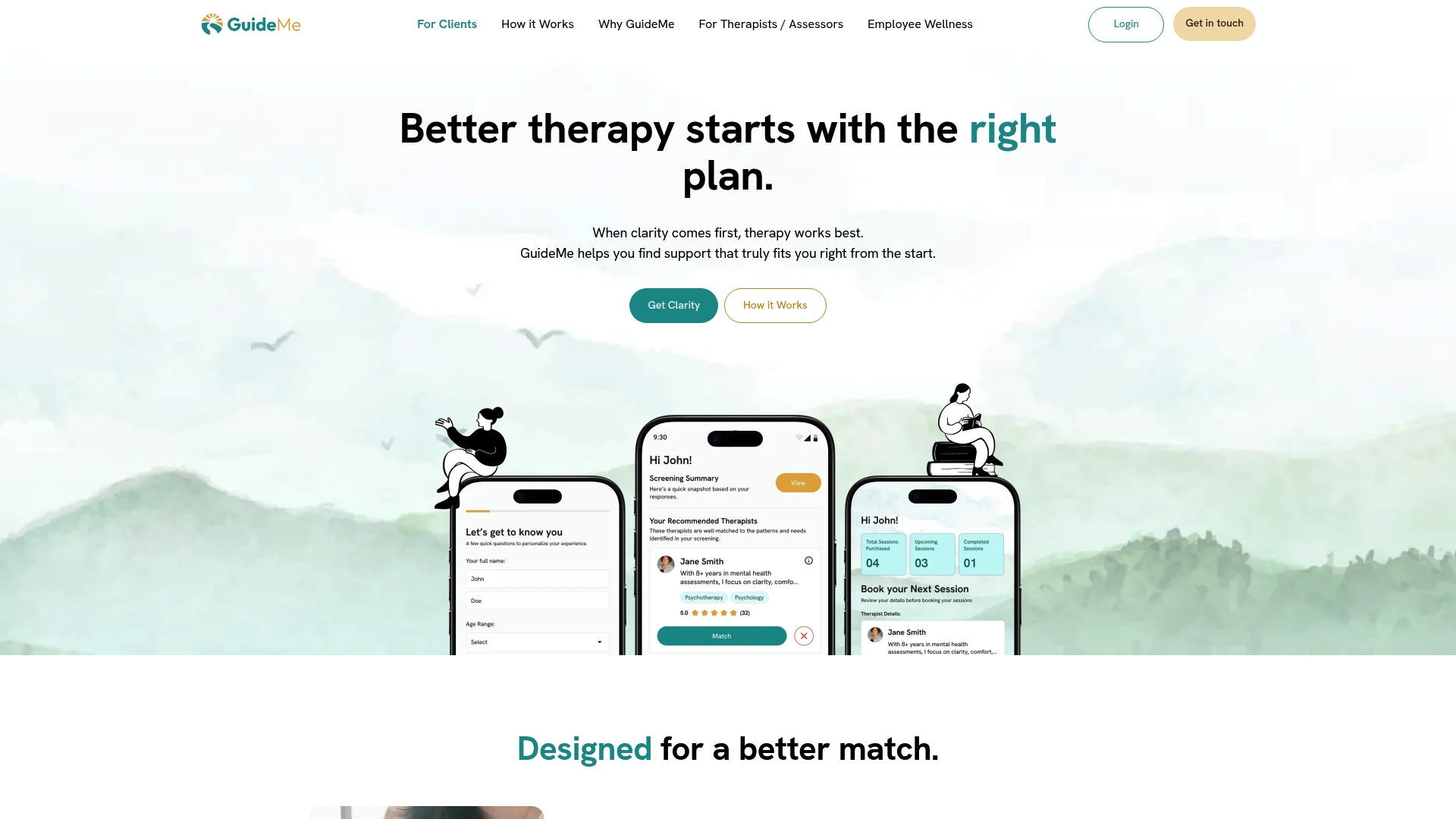
For HR teams comparing this against a traditional provider, the practical next step is the same one outlined earlier in this guide: request a demo, ask GuideMe directly about triage timing and anonymised reporting, and consider running it as a pilot alongside your existing programme rather than a full switchover on day one. You can find more detail on the platform, and start that conversation, at GuideMe's corporate solutions page. If you want to compare procurement questions first, this selection checklist for HR leaders is a useful companion.
Sources
- MIT Sloan Corporate Wellness evidence review
- HSE – work-related stress guidance
- CIPD press release on workplace absences
- RAND / DOL workplace wellness research report
This article is general information, not a substitute for advice from a qualified doctor. Consult a qualified healthcare professional about your own circumstances before acting on anything here.