

EAP counselling gives employees confidential, rapid access to professional mental-health support and practical advice, arranged and paid for by their employer. It typically includes a 24/7 helpline, several short-term counselling sessions, and guidance on legal or financial worries. Two useful reference points for quality are the UK Employee Assistance Professionals Association, which accredits providers, and platforms like GuideMe, which help match people to the right clinician.
TL;DR:
- Most EAP providers offer quick triage within 48 hours, with therapy starting inside a week in many cases, which is faster than NHS waiting times.
- Confidentiality is maintained through separate clinical records from HR, with only anonymized workforce trend data shared with employers.
- Costs typically depend on factors like face-to-face clinic inclusion, session guarantees, and additional services such as legal guidance or virtual GPs.
- Procurement should involve accredited providers, clear SLAs, and verification of clinician registration bodies, avoiding vague governance or non-clinical support routes.
- AI-assisted matching and screening improve clinician fit and confidentiality, making EAP most effective immediately after critical incidents or during rapid absence spikes.
Table of Contents
- What does EAP counselling actually include?
- How does the referral and triage process work?
- Is EAP counselling really confidential from my employer?
- What does an EAP typically cost UK employers?
- How should you choose an EAP counselling provider?
- How does GuideMe support corporate EAP counselling?
- When is commissioning an EAP the right call right now?
- Ready to see how GuideMe fits your workforce?
- Sources
What does EAP counselling actually include?
An employee assistance programme is built around a handful of core services, though exactly what your employer has bought varies by contract. Most UK schemes start with a 24-hour telephone helpline, staffed so someone can call at 3am after a bad night, not just during office hours.
From there, the structured support usually looks like this:
- A 24/7 phone line, often supplemented by video sessions and, in some contracts, face-to-face appointments
- A short course of structured counselling, commonly between four and eight sessions, though this depends entirely on the plan your employer has purchased
- Online CBT modules for people who prefer to work through material at their own pace
- Legal and financial guidance, covering everything from debt worries to family law questions
- Access to a virtual GP in many packages, useful when someone cannot get a same day NHS appointment
- Critical incident support, deployed after workplace accidents, bereavements, or traumatic events affecting a team
Eligibility almost always covers the employee and their immediate family, though the exact definition of "family" differs between providers, so it is worth checking the small print. Session limits exist for a reason: they keep the service sustainable and encourage onward referral when someone needs longer-term therapy rather than crisis support.
How does the referral and triage process work?
Getting from "I need help" to "I'm in a session" should be quick, and the best providers treat speed as a competitive feature, not a nice extra. The pathway generally runs like this:
- Initial contact. The employee calls the helpline directly, no manager sign-off required for standard counselling access.
- Triage. A clinician assesses urgency and need, with many providers promising an initial response within 48 hours; some, like PAM Group, describe triage within days and therapy starting inside a week, a stark contrast to NHS talking therapy waits that frequently run into months.
- Matching to the right support. Based on the triage outcome, the person is booked into structured counselling, signposted to online CBT, or, for more serious presentations, escalated.
- Escalation where needed. Complex cases move to occupational health or specialist therapy, and some providers run on-site clinics for larger employers.
There is also a manager referral route, separate from self-referral, which HR teams use when a manager is worried about someone's wellbeing, but the employee has not reached out themselves. Face-to-face availability varies significantly by region, so always confirm local clinic coverage before assuming in-person sessions are included.
Is EAP counselling really confidential from my employer?
Yes, and this is the single most important thing to understand before you or your team use the service. Reputable providers keep clinical records entirely separate from HR systems. Your manager never learns that you called, what you discussed, or what the clinician recommended.
What employers do receive is anonymised, aggregated management information, showing trends like call volumes or common presenting issues across the whole workforce, never anything traceable to an individual. This separation is precisely what the EAPA's provider standards are designed to protect, and it is worth reading Guidemetherapy's guide to confidentiality in employee counselling if you want the fuller picture.
Mental health difficulties account for a significant portion of UK workplace absences, according to CIPD data on workplace absence, which is exactly why governance and trust matter so much here. When employees do not believe the service is genuinely private, uptake collapses, regardless of how good the clinical offer is.
Before signing with any provider, check for:
- EAPA accreditation or registered membership status
- Clinicians registered with BACP, NCPS, UKCP, BPS, or HCPC as appropriate to their discipline
- A clear, plain-English explanation of how data flows between the provider, HR, and any third parties
- Reference to recognised security standards such as ISO 27001 for handling sensitive personal data
- Evidence of clinical audit, defined escalation pathways, and explicit consent processes
What does an EAP typically cost UK employers?
Pricing usually follows one of two models: a per employee, per annum fee for an ongoing subscription, or a pay-as-you-go clinic-based arrangement where you pay per session used. The subscription model suits larger, predictable workforces; pay-as-you-go can work better for smaller businesses testing the waters.
What drives the price up or down includes:
- Whether face-to-face clinics are included or charged separately
- Guaranteed minimum session numbers per employee
- 24/7 helpline access versus office-hours only
- The depth of management information reporting on offer
- Add-ons like virtual GP access or legal and financial advice lines
When budgeting, ask providers for a demo, a written SLA covering triage and waiting-time commitments, and whether a short pilot is available before you commit to an annual contract. The ROI case is straightforward once you have the absence figures in front of you: faster access to support tends to mean shorter absences and smoother returns to work, which is the core argument the CIPD's own absence research keeps reinforcing.
How should you choose an EAP counselling provider?
Procurement for an EAP should never be a five-minute tick-box exercise. It shapes how supported your entire workforce feels for the length of the contract.
Work through this sequence:
- Shortlist providers holding current EAPA accreditation or registered status.
- Request a demo and ask direct questions: "How is staff anonymity preserved in your MI reporting?" and "Show me your actual triage times and therapy start times, not marketing averages."
- Run a short pilot with one department or site before rolling out company-wide.
- Sign a contract with a clear SLA, covering triage windows, escalation routes to occupational health, and reporting cadence.
Pro Tip: Ask every shortlisted provider to name their clinician registration bodies out loud on the call. Hesitation here is the clearest red flag you will get during procurement.
Watch for warning signs: vague answers about governance, no verifiable clinician registration, MI reports that could plausibly identify individuals, or a primary support route built around a non-clinical chatbot rather than qualified counsellors. Guidemetherapy's own corporate counselling selection guide walks HR leads through this exact sequence in more depth.
How does GuideMe support corporate EAP counselling?
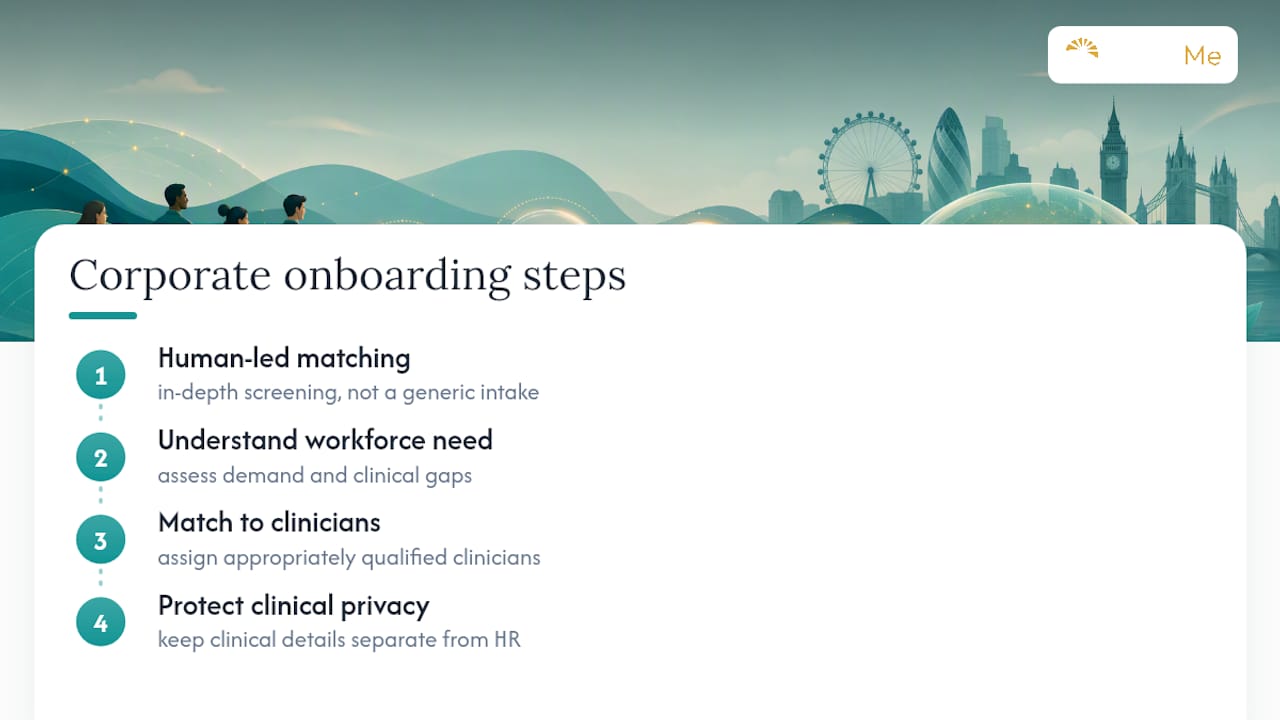
Guidemetherapy takes a human-led, AI-assisted approach to matching, starting with in-depth screening rather than a generic intake form. For HR teams, that means employees are matched to a clinician suited to their actual presenting issue, not just whoever has a free slot that week.
Corporate onboarding follows a similar logic to the selection steps above: understand the workforce need, match to appropriately qualified clinicians, and keep clinical detail entirely separate from anything HR sees. Guidemetherapy's guide to corporate therapy services sets out how this integrates alongside an existing EAP or as a standalone option for organisations still building out their support offer.
When is commissioning an EAP the right call right now?
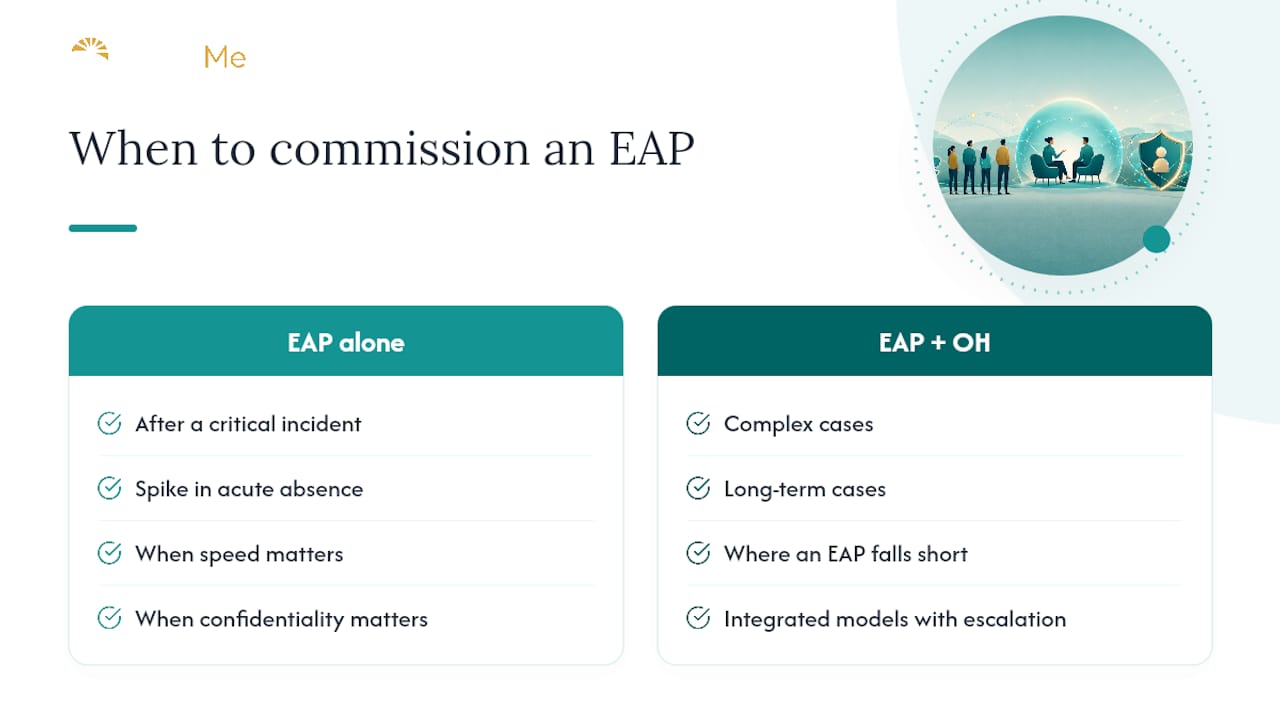
An EAP earns its cost fastest after a critical incident, during a spike in acute absence, or whenever speed and confidentiality matter more than depth of intervention. NHS talking therapies remain valuable, but their waiting times rarely match an acute workplace need.
Where an EAP falls short, on complex or long-term cases, pairing it with occupational health closes the gap. The strongest UK models now do this by design, escalating cleanly rather than running two disconnected services side by side, similar to the integrated pathway MCL Medics describes. Speed and targeted access, not raw session volume, are what make the cost genuinely justifiable.
— Yetty
Ready to see how GuideMe fits your workforce?
Guidemetherapy gives HR teams a faster route to the right clinician than a standard EAP directory search, because matching starts with genuine screening rather than a static list of names and specialisms. Instead of employees guessing which counsellor suits their situation, GuideMe's human-led, AI-assisted process narrows that down before the first session is even booked, while keeping every clinical detail well away from management view.
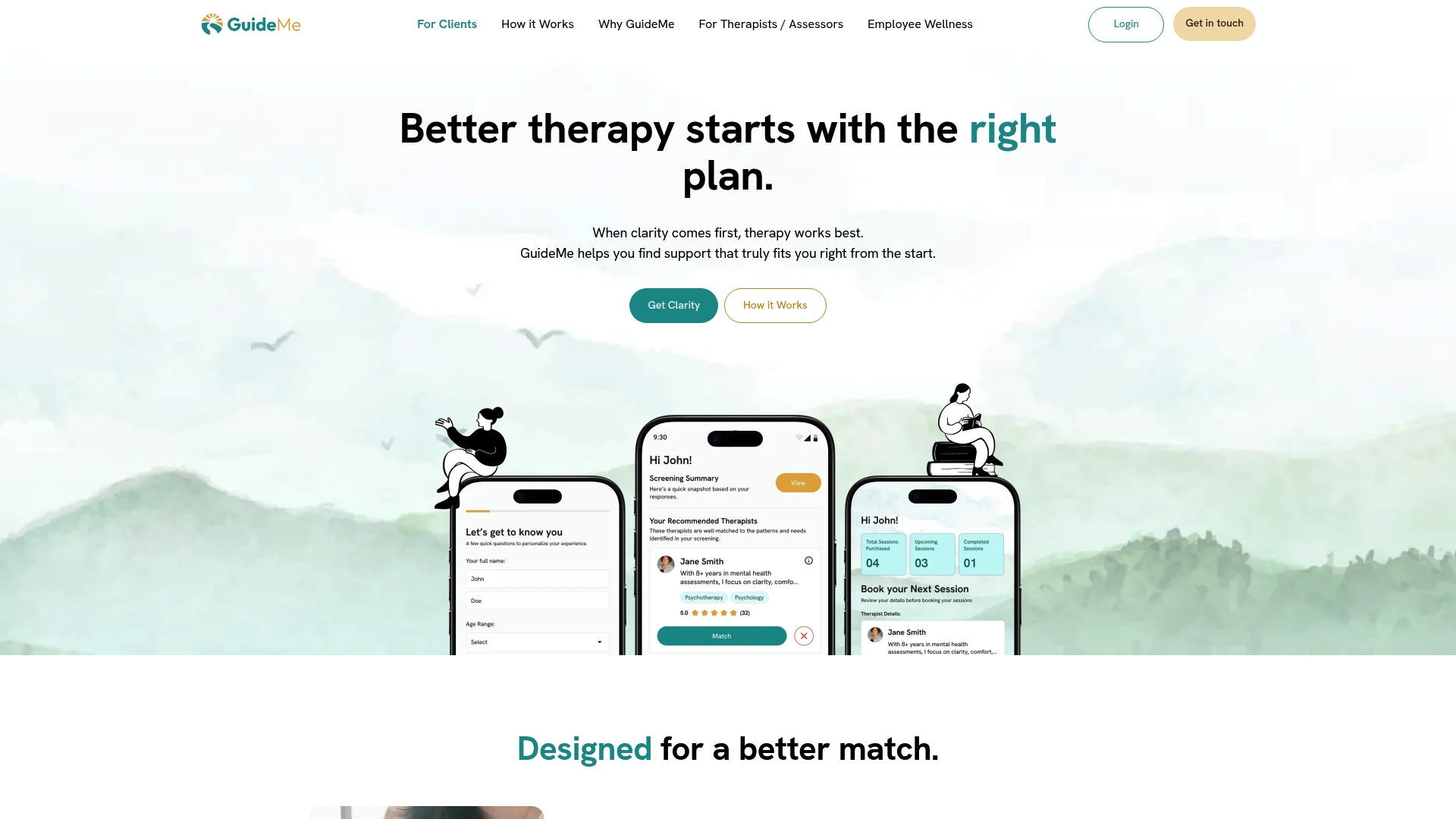
If you are weighing up a new EAP contract, or want to strengthen one you already have, request a demo through Guidemetherapy to see how corporate onboarding and clinician matching work in practice. A short pilot with one team or site is a sensible first step before any wider rollout.
Sources
For provider standards, see the EAPA's accredited provider registry. On data handling, ISO 27001 sets the benchmark providers should reference. For employee-facing detail, read Guidemetherapy's guide to confidential consultations.
This article is general information, not a substitute for advice from a qualified doctor. Consult a qualified healthcare professional about your own circumstances before acting on anything here.
- The UK Employee Assistance Professionals Association Find an EAP provider
- CIPD – workplace absences highest over decade (press release)
- ISO 27001 — Information security management
- Employee Assistance Programme (EAP) - PAM Group
- Employee Assistance Programme | EAP UK | MCL Medics