

TL;DR:
- Workplace counselling helps employees and managers address mental health, improve functioning, and resolve conflicts. Its benefits include reduced anxiety and depression, lower absenteeism, and better emotional regulation, but only a small percentage of eligible employees utilize the service. Embedding counselling within ongoing organizational support and fostering a culture of openness increases engagement and long-term effectiveness.
Workplace counselling is a confidential, professional support service that helps employees and managers address mental health challenges, resolve conflicts, and improve day-to-day functioning at work. The reasons to seek workplace counselling range from managing stress and anxiety to navigating difficult team relationships and performance pressures. Despite its clear value, annual utilisation sits at just 3–8% of eligible employees. That figure shows how many people are missing support that is already available to them. Understanding the full scope of workplace counselling, often delivered through Employee Assistance Programmes (EAPs), is the first step to changing that.
Why seek workplace counselling: the core benefits for employees
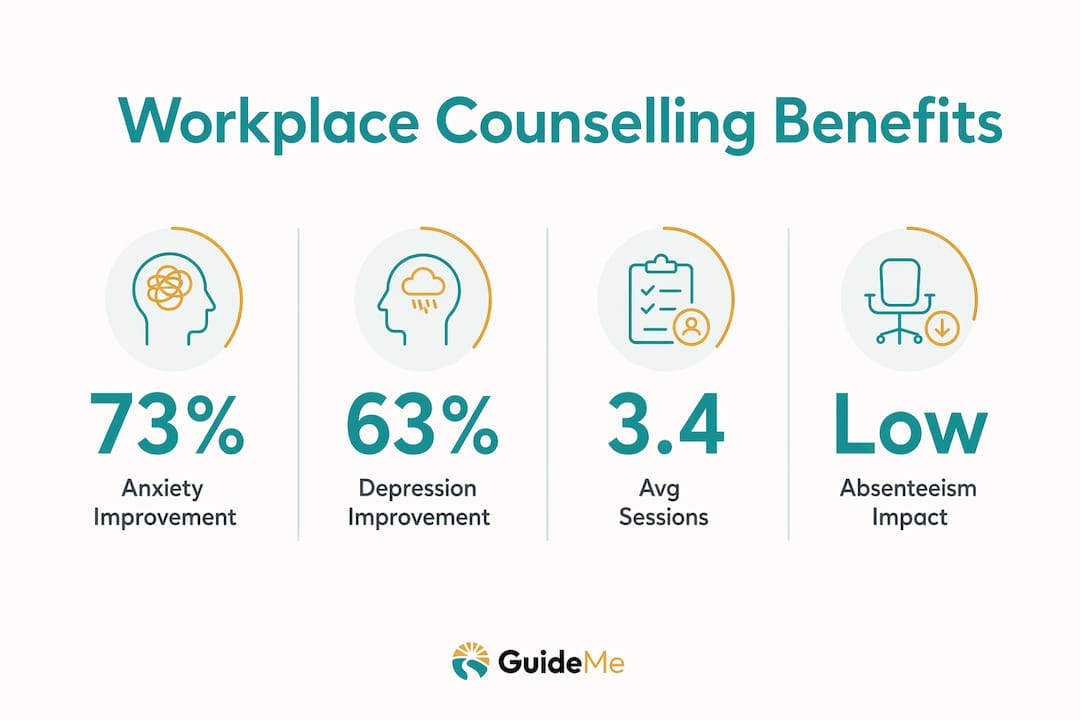
Workplace counselling produces measurable clinical improvements. A 2026 analysis of ComPsych behavioural health services found 63% improvement in depression and 73% improvement in anxiety among participants. Those are not marginal gains. They represent a meaningful shift in how people feel and function at work each day.
The importance of employee counselling extends beyond clinical outcomes. Participants in the same ComPsych study showed 76% reduced absenteeism and a 90% therapeutic alliance rating, meaning the vast majority felt genuinely supported by their counsellor. That level of trust matters because people who feel safe with their counsellor engage more fully with the process.
The advantages of counselling in the workplace also include practical accessibility. EAP counselling typically resolves issues within about a month, with an average of 3.4 sessions delivered across video, telephone, and in-person formats. That brevity removes one of the most common objections: that therapy takes too long or disrupts a busy schedule.
Key benefits employees gain from workplace counselling include:
- Reduced symptoms of depression and anxiety
- Lower levels of workplace impairment and presenteeism
- Improved ability to manage stress before it becomes burnout
- Access to remote therapy options that fit around working hours
- A confidential space to process personal and professional difficulties
Pro Tip: If you are unsure whether your employer offers an EAP, ask your HR department directly. Many employees are unaware the service exists, and it is almost always free to access.
Stigma remains the most significant barrier to uptake. Employees worry about confidentiality, fear being judged, or doubt whether their problems are serious enough to warrant support. Addressing those concerns openly, and knowing that sessions are strictly confidential, removes the most common reason people hold back.
Why do managers and organisations seek workplace counselling?
Managers seek workplace counselling for reasons that go beyond personal wellbeing. AllOne Health data shows that 52% of organisational consulting cases are manager-initiated, covering employee performance issues, mental health concerns, and HR risk management. That figure confirms that EAPs have shifted from a purely personal resource to a core management tool.
The reasons managers and organisations initiate counselling support typically fall into four categories:
- Employee performance and conduct. Managers use counselling to address declining performance, behavioural changes, or interpersonal difficulties before they escalate into formal HR processes.
- Mental health and substance misuse. Organisations refer employees to counselling when signs of burnout, depression, or substance-related issues affect attendance or output.
- Organisational development and change. Counselling supports teams through restructures, redundancies, and leadership transitions, reducing the psychological impact of uncertainty.
- Crisis preparedness. Organisations embed counselling into their response plans for critical incidents, ensuring employees have immediate access to professional support when needed.
The role of therapy in workplace culture has expanded significantly. Counselling is no longer a last resort. It is part of how forward-thinking organisations manage risk, retain talent, and build psychologically safe environments.
Pro Tip: Managers who refer employees to counselling should clarify upfront that sessions are confidential. Employees are far more likely to engage when they know their manager will not receive session details.

Leadership endorsement is critical. When senior leaders visibly support mental health resources, uptake increases across the organisation. Counselling works best when it is positioned as a normal part of working life, not a response to failure.
How does counselling help with conflict resolution at work?
Counselling reduces workplace conflict by targeting the root cause: emotional reactivity. A 2026 mindfulness study published in Springer found that counselling lowers emotional reactivity and enhances empathy, leading to better psychological safety and reduced dysfunctional conflict. The mechanism is straightforward. When people can regulate their own responses, they stop escalating disagreements.
Conflict resolution counselling builds specific skills rather than simply managing symptoms. Those skills include:
- Self-regulation under pressure
- Empathy and perspective-taking
- Non-violent communication techniques
- Active listening in high-tension conversations
"Managers often expect counselling to 'fix the employee.' The real goal is building the self-regulation skills that prevent conflict from escalating in the first place." — Springer 2026 mindfulness research
This distinction matters for how organisations frame counselling to their teams. Counselling is not corrective. It builds capacity. Employees who develop stronger interpersonal skills contribute to better team dynamics across the whole organisation, not just within their immediate relationships.
Psychological safety, the belief that one can speak up without fear of punishment, improves when individuals feel emotionally regulated and heard. Counselling creates the conditions for that safety to develop. Teams with higher psychological safety report better collaboration, fewer errors, and lower turnover.
What stops employees from using workplace counselling?
Annual utilisation of workplace mental-support services sits at just 3–8% of eligible employees. The gap between availability and use is not accidental. It reflects a specific set of barriers that organisations need to understand and address.
| Barrier | Type | Impact on uptake |
|---|---|---|
| Stigma around mental health | Individual | Prevents employees from self-referring |
| Confidentiality concerns | Individual/Organisational | Creates distrust in the process |
| Limited privacy at work | Practical | Makes booking or attending sessions difficult |
| Workload and time pressure | Practical | Reduces perceived permission to seek help |
| Unclear awareness of services | Organisational | Employees do not know what is available |
Each barrier requires a different response. Stigma needs cultural change and visible leadership support. Confidentiality concerns need clear, repeated communication about what is and is not shared. Practical barriers, such as limited privacy or time, need structural solutions like flexible booking and remote session options.
Reducing timing friction and clarifying confidentiality are the two most effective design changes organisations can make to increase uptake. Neither requires significant investment. Both require intentional communication.
Pro Tip: Organisations that co-design their counselling communications with employees, rather than simply announcing services, see higher engagement. Asking staff what would make them more likely to use support is itself a form of psychological safety.
How can organisations make workplace counselling last?
Workplace counselling produces the strongest results when it is embedded in ongoing organisational support rather than delivered as a one-off event. A 2026 systematic review in the International Archives of Occupational and Environmental Health found that mental health intervention effects wane without sustained organisational follow-up. That finding has direct implications for how programmes are designed.
The table below compares a minimal counselling offer with a sustained programme model.
| Feature | Minimal offer | Sustained programme |
|---|---|---|
| Session structure | Single referral pathway | Screening, matched support, structured follow-up |
| Manager involvement | Referral only | Regular check-ins and booster sessions |
| Outcome measurement | Absenteeism reduction | Presenteeism, functioning, and clinical outcomes |
| Leadership role | Passive endorsement | Active, visible championing |
| Programme review | Annual or ad hoc | Continuous with employee feedback loops |
Evaluating counselling via presenteeism and work functioning gives a more accurate picture of impact than absenteeism alone. A 2026 meta-analysis found no significant absenteeism reduction from occupational health interventions but did find positive ROI and presenteeism improvements. That means organisations measuring only sick days will underestimate the value of their counselling investment.
Effective counselling programmes function as structured pathways involving screening, matched support, and follow-up, not isolated sessions. Booster sessions and managerial check-ins sustain the gains made in initial counselling. Organisations that treat counselling as a pathway rather than a product see better long-term outcomes for their people.
Key takeaways
Workplace counselling delivers its greatest value when it is accessible, confidential, and embedded within sustained organisational support rather than offered as a standalone service.
| Point | Details |
|---|---|
| Clinical outcomes are significant | Workplace counselling improves depression and anxiety in the majority of participants who engage. |
| Managers are active users | Over half of EAP organisational consulting cases are manager-initiated, covering performance and mental health. |
| Conflict resolution is a core function | Counselling builds self-regulation and empathy skills that reduce dysfunctional workplace conflict. |
| Utilisation remains low | Only 3–8% of eligible employees use available services, largely due to stigma and practical barriers. |
| Sustained programmes outperform one-off sessions | Booster sessions, follow-up, and leadership support are required to maintain counselling benefits over time. |
What I have learned from watching organisations get this wrong
I have seen organisations invest in counselling services and then wonder why nobody uses them. The answer is almost always the same: the service exists, but the culture does not support it. Employees read the room. If their manager has never mentioned mental health, if no senior leader has ever said "I used the EAP," the service sits unused regardless of how good it is.
The other mistake I see repeatedly is measuring success by absenteeism. Absenteeism is a lagging indicator. By the time someone is off sick, the problem has already compounded. The real gains from counselling show up in presenteeism, in the quality of someone's thinking, their patience in a difficult meeting, their willingness to raise a concern early. Those things do not appear on a spreadsheet, but they are the difference between a team that functions well and one that quietly deteriorates.
Confidentiality is not just a legal requirement. It is the foundation of the entire service. Organisations that blur the line between counselling and performance management destroy trust in both. Managers need to know what they can and cannot ask, and that boundary needs to be communicated clearly and consistently.
The organisations that get this right treat counselling as a normal part of working life. They talk about it in onboarding. They mention it in team meetings. They make it easy to access and easy to understand. That is not a large investment. It is a decision about what kind of workplace you want to be.
— Yetty
Workplace wellbeing support, matched to you
Finding the right counsellor is often the hardest part of seeking help. Guidemetherapy is a therapy navigation platform that matches employees and managers with the right therapist from the start, using an in-depth therapy plan built around your specific needs.
Whether you are dealing with work-related stress, a difficult team situation, or simply want to understand your mental health better, Guidemetherapy offers a confidential, accessible first step. The platform is human-led and AI-powered, so you get a thoughtful match rather than a random referral. Visit Guidemetherapy to build your therapy plan and find the support that fits your situation.
FAQ
What is workplace counselling?
Workplace counselling is a confidential professional support service that helps employees and managers address mental health issues, stress, and interpersonal difficulties at work. It is most commonly delivered through Employee Assistance Programmes (EAPs).
How many sessions does workplace counselling typically take?
EAP counselling resolves most issues within about a month, with an average of 3.4 sessions delivered across video, telephone, and in-person formats.
Does workplace counselling actually reduce anxiety and depression?
A 2026 ComPsych analysis found 73% improvement in anxiety and 63% improvement in depression among participants, alongside a 90% therapeutic alliance rating.
Why do so few employees use workplace counselling?
Annual utilisation sits at just 3–8% of eligible employees. The main barriers are stigma, confidentiality concerns, limited privacy, and a lack of awareness about what services are available.
How should organisations measure the success of counselling programmes?
Absenteeism alone is not a reliable measure. A 2026 meta-analysis found that presenteeism improvements and work functioning are more accurate indicators of counselling's impact and return on investment.