

TL;DR:
- Therapy boundaries are professional limits that ensure safety, structure, and ethical treatment for both client and therapist. They include time, confidentiality, communication, and physical contact rules, all designed to foster trust and prevent role confusion. Respecting and understanding these boundaries enhances therapy effectiveness and protects against harm or burnout.
Many people starting therapy wonder why certain rules exist in the room. The explanation of therapy boundaries is not about creating distance or making sessions feel clinical and cold. Boundaries in therapy are agreements that protect you and your therapist, making it possible to do genuinely meaningful work together. Without them, the therapeutic relationship loses its structure, and real progress becomes much harder. This guide covers what therapy boundaries are, the different types you will encounter, why they matter, and how you can play your part in maintaining them.
Table of Contents
- Key takeaways
- What are therapy boundaries?
- Types of therapy boundaries and examples
- Why therapy boundaries matter
- Nuanced boundary challenges in therapy
- How clients can respect therapy boundaries
- My perspective on therapy boundaries
- Finding the right therapist starts here
- FAQ
Key takeaways
| Point | Details |
|---|---|
| Boundaries are protective, not restrictive | They create psychological safety for both the client and therapist from the very first session. |
| Multiple types of boundaries exist | Time, confidentiality, communication, and dual relationship boundaries all shape the therapy experience. |
| Violations carry real risks | Unclear or broken boundaries can harm client wellbeing and lead to therapist burnout and exhaustion. |
| Flexibility is not the same as drift | Intentional boundary adaptations serve clinical goals; unplanned drift erodes the relationship over time. |
| Clients have an active role | Understanding and respecting boundaries helps you get the most from therapy and builds lasting trust. |
What are therapy boundaries?
The therapy boundary definition, at its core, is straightforward. Boundaries are the agreed limits and rules that structure the professional relationship between you and your therapist. They are invisible protective limits that define what is appropriate behaviour on both sides, setting clear expectations from the very first contact.
These limits are not arbitrary. They exist to create a safe, structured space where honest conversation can happen without confusion about roles, responsibilities, or intentions. According to BACP guidance, boundaries help create psychological safety and protect both parties, providing the therapy relationship with a clear purpose and professional standard.
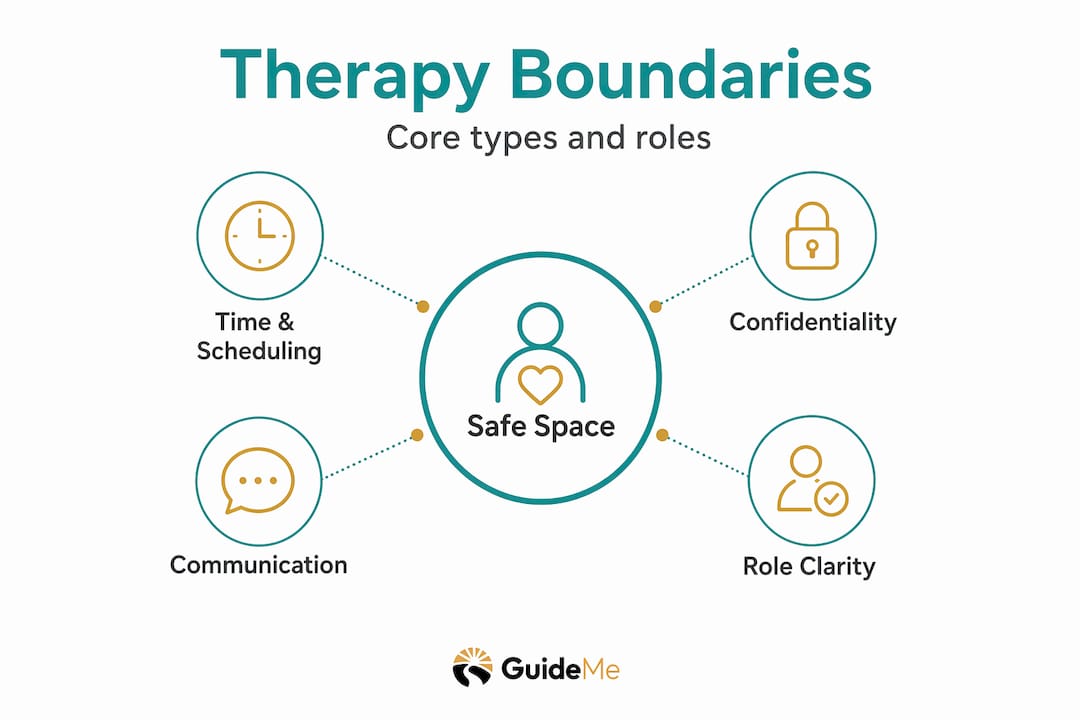
Therapy boundaries connect directly to professional ethics. Therapists have a fiduciary duty, meaning their professional and ethical obligations require them to put your interests above their own. This includes avoiding conflicts of interest and maintaining objectivity throughout your work together. Understanding what these boundaries mean helps you see them not as walls but as the foundation of a trustworthy working relationship.
It also helps to know that boundaries begin before you even sit down for your first proper session. The therapy intake process is where many boundaries are first explained and agreed upon, covering everything from session length to contact outside appointments.
Key principles underlying all therapy boundaries include:
- Professional role clarity. Your therapist is not a friend, mentor, or advisor in the social sense. Their role is defined and purposeful.
- Consistency. Boundaries apply equally across all clients, removing the risk of favouritism or differential treatment.
- Client-centred focus. Every limit exists to serve your wellbeing and therapeutic progress, not to make the therapist's work easier.
- Ethical accountability. Therapists are professionally accountable for maintaining these limits, even when they feel awkward to enforce.
Types of therapy boundaries and examples
When people ask about explaining therapy boundaries in practical terms, it helps to break them into categories. Each type addresses a different aspect of the therapeutic relationship.
| Type of boundary | What it covers | Practical example |
|---|---|---|
| Time and scheduling | Session length, punctuality, and cancellation policies | A 50-minute session ends on time, regardless of where the conversation is |
| Confidentiality | Privacy of disclosures and information sharing | What you say stays in the room, with defined legal exceptions |
| Communication | Contact outside sessions, messaging, and social media | No responding to late-night texts; auto-replies for after-hours contact |
| Dual relationships | Avoiding social or personal roles alongside the therapy role | A therapist will not become your friend, employer, or business partner |
| Physical contact | Touch policies within the session | Handshakes may be appropriate; other physical contact is typically avoided |
| Gift-giving | Receiving personal gifts or gestures | Most therapists decline gifts to avoid role confusion and obligation |
Pro Tip: Ask your therapist about their boundaries during your first session. A good therapist will welcome the question and explain their policies clearly. Knowing what to expect from the start reduces anxiety and helps you feel more settled in the room.
Time boundaries are among the most misunderstood. When a therapist ends a session at a set time, it can feel abrupt or uncaring. In reality, discussing session structure at intake and maintaining consistent time limits actually protects the quality of your treatment. Consistent endings mean consistent structure, and structure is what allows deeper work to happen.

Communication boundaries have become increasingly complex in the digital age. Therapists are advised to set clear expectations early about social media, after-hours contact, and digital messaging. These are not personal rejections. They are professional policies designed to maintain the integrity of the therapeutic space.
Why therapy boundaries matter
The importance of boundaries in therapy goes well beyond following professional rules. They directly affect whether therapy can work at all.
When boundaries are clear, you know what to expect. That predictability builds trust. Clients notice a therapist's punctuality, consistency, and communication style. Clear therapist behaviour reinforces respect, models healthy relationship patterns, and keeps you engaged with the process.
Without boundaries, the therapy relationship becomes vulnerable to role confusion. A therapist who becomes too personally involved, shares too much of their own life, or blurs professional lines is no longer functioning as a therapist. They have shifted into a role that is not therapeutic and can be actively harmful.
The risks of boundary violations extend to therapists as well. Working without proper limits exposes therapists to burnout, vicarious trauma, and compassion fatigue. When a therapist absorbs too much of a client's emotional distress without protective boundaries, their effectiveness declines. That decline directly affects the quality of care you receive.
Consider what violations can look like in practice:
- A therapist sharing personal problems with a client, reversing the caregiver role
- Extending sessions repeatedly beyond the agreed time without clinical reason
- Engaging with a client on social media outside of the therapy context
- Accepting expensive gifts that create a sense of obligation or indebtedness
- Forming a personal friendship with a current client
"Boundaries in therapy protect the client's right to receive competent, ethical care. Without them, the therapeutic relationship loses the structure that makes healing possible."
These violations undermine outcomes because they shift the focus away from your needs and onto the relationship dynamic itself. When you are spending mental energy worrying about the nature of your relationship with your therapist, you are not doing the work that brought you to therapy in the first place. Understanding how trust and boundaries interconnect can help you identify whether your current therapy feels safe and effective.
Nuanced boundary challenges in therapy
Not every boundary situation is straightforward. Experienced therapists regularly face moments where rigid rule-following and genuine clinical care appear to pull in different directions. Understanding how they navigate these situations helps you understand what healthy boundary management actually looks like.
-
Recognise the difference between flexibility and drift. Intentional boundary adaptations are planned, clinically justified, and documented. A therapist who accompanies an agoraphobic client on a brief outdoor walk as part of treatment is making a deliberate clinical choice. Drift, by contrast, happens gradually and without clear justification. It tends to serve the therapist's comfort rather than the client's needs.
-
Understand digital communication policies. Therapists are encouraged to document their digital communication policies and share them during intake. This includes expectations about social media, messaging apps, and response times. If your therapist has an auto-reply for out-of-hours messages, that is a deliberate boundary in place to protect the therapeutic frame.
-
Acknowledge the role of cultural context. Some clients come from backgrounds where gift-giving is a meaningful expression of gratitude, or where formality feels cold and disrespectful. Skilled therapists adapt their communication style while keeping the core ethical boundaries intact. Flexibility in manner does not mean flexibility in limits.
-
Talk openly about discomfort. If a boundary feels confusing or even upsetting, you are allowed to raise it. Therapists welcome this kind of dialogue because addressing relationship dynamics directly is often some of the most productive work in therapy.
-
Appreciate supervision as a boundary tool. Most registered therapists in the UK attend regular clinical supervision. This process exists partly to help them identify when boundaries are drifting and to maintain clear professional standards across their caseload.
Pro Tip: If something in your therapy sessions feels off, such as a shift in tone, unexpected personal disclosures from your therapist, or pressure to extend the relationship outside of sessions, trust that instinct. You can raise it directly in session, and if you feel unable to, speaking to another professional for a second opinion is always appropriate.
How clients can respect therapy boundaries
Therapy boundaries are not solely the therapist's responsibility. You play a meaningful part in maintaining the relationship boundaries in counselling that make your sessions productive.
Here is what a healthy, boundaried therapy relationship looks like from your side:
- Arrive and leave on time. Respecting session structure shows you value the boundaries the therapist has set and helps maintain the professional frame.
- Keep contact to agreed channels. If your therapist has specified that contact between sessions should go through a particular method, use it. Contacting them via personal social media or searching for their personal details crosses a professional line.
- Respect confidentiality in both directions. Your therapist holds your disclosures in confidence. In turn, keeping session content private outside therapy helps maintain the safety of the space for you.
- Understand when information may be shared. Confidentiality has legal and ethical limits. Your therapist will share information if there is a serious risk of harm to you or someone else. Knowing this in advance helps you make informed choices about what to disclose.
A real example from 2026 illustrates how confidentiality boundaries can create tension beyond the therapy room. A teenager exercised her right to keep her therapy content private from her parents, which led to family conflict about what confidentiality actually means. The situation highlights how well-intentioned boundary-setting can be misunderstood by people outside the room, and why it matters to explain these boundaries clearly to everyone involved.
If you are unsure what questions to raise with your therapist about how they work, this guide on questions to ask your therapist is a useful starting point for your first few sessions.
My perspective on therapy boundaries
I have spent a significant amount of time observing how therapy boundaries play out in practice, and one thing I have come to believe firmly is this: boundaries are not what makes therapy feel formal. They are what makes therapy feel safe.
What I have seen is that the clients who struggle most with boundaries early on often benefit from them the most over time. There is something reassuring about a therapist who holds the line consistently. It communicates, without words, that they are trustworthy and that the relationship is not going to shift or become confusing.
What I have also noticed is that clients often mistake emotional warmth for a lack of boundaries. A therapist can be deeply empathic, genuinely caring, and still maintain every professional limit. Those two things are not in conflict. The warmth is real. The structure is also real. Both serve you.
My honest view is that when clients feel a boundary is "cold" or "unfair," it is almost always worth exploring that reaction in the session itself. That discomfort is often therapeutic material. It tells you something about how you relate to limits in your life more broadly.
Boundary clarity does not reduce the humanity of therapy. It protects it.
— Yetty
Finding the right therapist starts here
Starting therapy with a clear understanding of boundaries sets you up for a far better experience. But finding a therapist you trust to hold those boundaries well is its own challenge.

Guidemetherapy is designed to take the guesswork out of that process. The platform combines human expertise with AI-powered matching to connect you with a therapist who fits your needs from the very beginning. Rather than sifting through profiles and hoping for the best, you get an in-depth therapy plan and guidance built around you. If you are ready to take that step, visit Guidemetherapy to get matched with the right therapist and start therapy with confidence.
FAQ
What is the therapy boundary definition?
Therapy boundaries are agreed limits and professional rules that structure the relationship between client and therapist. They protect both parties, create psychological safety, and uphold ethical standards throughout treatment.
What are the main types of therapy boundaries?
The main types include time and scheduling boundaries, confidentiality limits, communication policies, dual relationship restrictions, and physical contact guidelines. Each type addresses a different part of the therapeutic relationship.
Why are boundaries important in therapy?
Boundaries protect your wellbeing by maintaining clear roles, preventing exploitation, and building trust. Without them, therapists risk burnout and clients risk harm through role confusion or inappropriate relationship dynamics.
Can therapy boundaries ever be adjusted?
Yes, but only intentionally and with clinical justification. There is an important distinction between intentional flexibility and gradual drift. Planned adaptations that serve the client's therapeutic needs are appropriate; unplanned changes that blur professional roles are not.
What should I do if I feel a boundary has been crossed?
Raise it directly in your session if you feel comfortable doing so. Addressing relationship dynamics openly is part of the therapeutic process. If you feel unable to raise it with your therapist, consulting another mental health professional for guidance is a reasonable next step.